
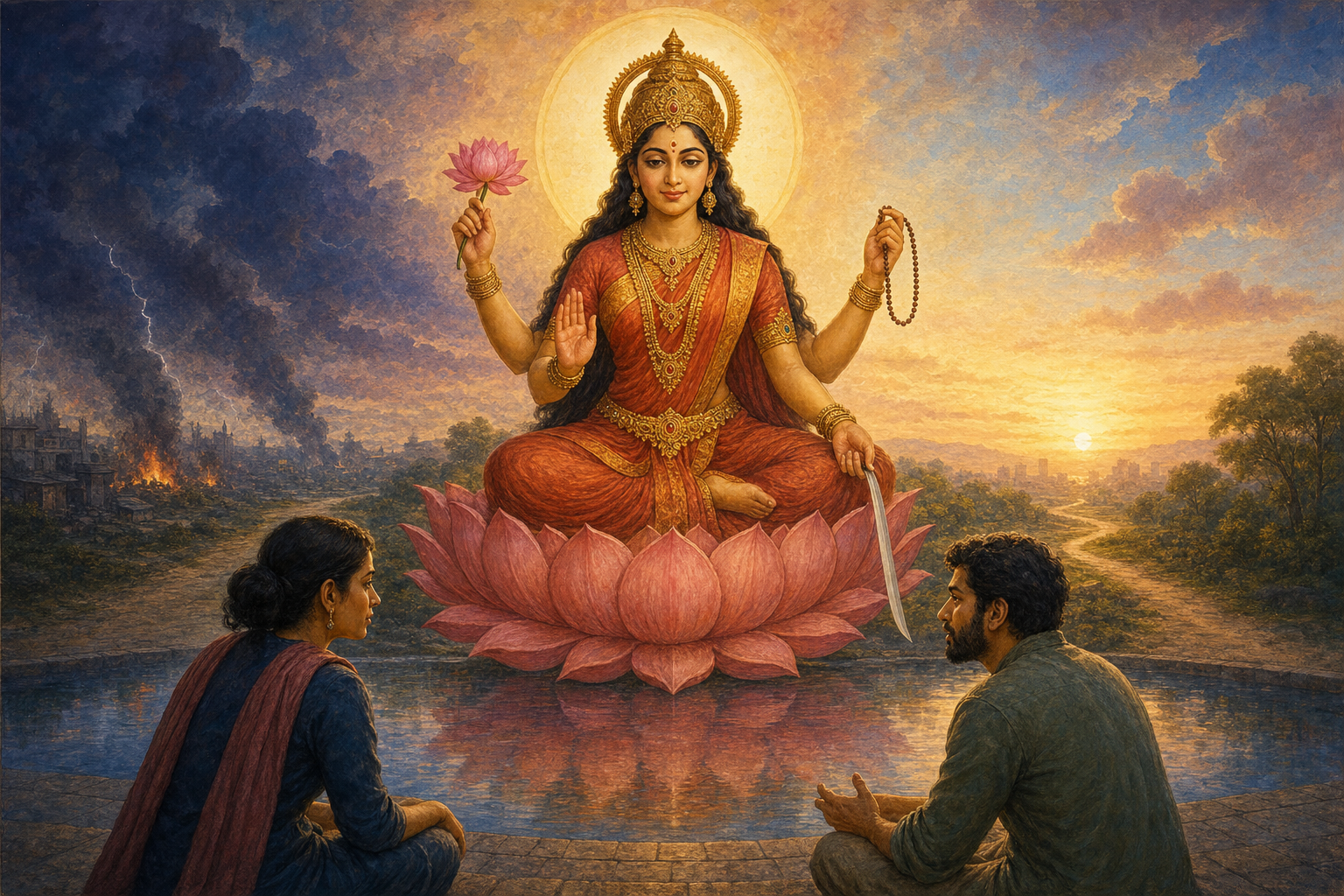
You may recognize the Goddess’s lotus, weapons, serene gaze and graceful speech, yet still wonder what any of them asks you to do. It is easy to memorize that the lotus means purity or that a weapon represents power. The harder and more useful task is to let the image govern a decision, a disagreement or a response to injustice.
Goddess symbolism becomes ethical wisdom when you read each attribute in relation to the whole form. Durga’s lotus belongs beside her weapons. Madhurabhashini’s sweetness belongs with clarity and disciplined listening. In both cases, Shakti is not power released from restraint; it is power given a rightful aim.
Key takeaways
- Read the deity, attribute and situation together. A lotus held during battle does not teach withdrawal; it teaches lucid action without inner corruption.
- Durga’s weapons answer what must be confronted. Her lotus asks whether the confrontation is guided by discernment, proportion and a desire to restore dharma.
- Sweet speech is not timid speech. Madhurabhashini represents truth expressed clearly, compassionately and without the heat of ego.
- Detachment does not mean indifference. It means remaining involved without allowing anger, pride or attachment to dictate your conduct.
- Test your interpretation by its fruit. Sound contemplation should produce clearer judgment, less self-deception, more responsible speech and action that can stop when its dharmic purpose has been fulfilled.
Read the whole image before interpreting one symbol
A sacred attribute is not a dictionary entry with one fixed definition. Begin with the tension inside the image. Who holds the object? What is happening around the deity? Which other qualities are present? What human disorder is being corrected?
In the Devi Mahatmya’s encounter between Durga and Mahishasura, the lotus appears amid an armed struggle against adharma. Its serenity does not cancel the weapons, and the weapons do not cancel its serenity. The composition holds together two capacities that human beings often separate: the courage to confront disorder and the consciousness required to avoid becoming disordered while confronting it.
You can apply a simple sequence whenever you contemplate Goddess iconography:
- Name the pressure. Identify the conflict, temptation, fear or responsibility represented by the scene.
- Name the divine capacity. Ask whether the attribute contributes courage, clarity, compassion, restraint, learning, abundance or another quality.
- Name the distortion. Consider what happens when that quality is separated from the rest of the form. Courage without discernment becomes recklessness; sweetness without truth becomes flattery; detachment without care becomes indifference.
- Name the required conduct. Convert the symbolism into one action and one restraint. Decide what you will do, and what impulse you will refuse to obey while doing it.
This method prevents two common mistakes. The first is reducing sacred art to decoration. The second is treating one appealing symbol as permission to neglect the deity’s other attributes. Durga cannot be divided into force without wisdom or compassion without the willingness to defend dharma.
Iconographic details can refine the reading. An open lotus may indicate awakened readiness, while a bud can indicate unrealized potential. White can emphasize purity and pink a compassionate presence. Yet these cues should support the total composition, not replace it. The central question remains practical: what kind of consciousness must accompany the power shown here?
Durga’s lotus makes power answerable to dharma

The lotus rises from mud without taking on the mud’s character. That does not make it an emblem of escape. In Durga’s hand, it represents engaged clarity: entering a necessary struggle without letting confusion, vanity or hatred occupy the mind.
This distinction matters whenever you believe you are defending something righteous. A worthy cause does not automatically purify every method used in its name. Anger can reveal that a boundary has been violated, but it cannot by itself determine a proportionate response. Strength can stop harm, but strength unexamined by viveka can continue striking after its purpose has been achieved.
Before a difficult confrontation, use the lotus as an ethical audit:
- What is actually under threat? Separate injury to dharma, duty or another person from injury to your status and self-image.
- What outcome would restore order? Define the correction you seek before entering the conflict. If you cannot describe an end point, resentment may be directing you.
- Is the response proportionate? Choose the action required to address the wrong, not the action that offers the greatest emotional release.
- What must remain unstained? Identify the principle you will not sacrifice, even if violating it would make victory easier.
- When will you stop? A dharmic response has a purpose and therefore a limit. Domination keeps going because the opponent’s humiliation has become the reward.
The lotus also corrects several misleading readings of Durga. Serenity is not delay when immediate action is necessary. Compassion does not require leaving wrongdoing unopposed. Detachment does not mean abandoning the people affected by injustice. These qualities discipline the intention, means and aftermath of action; they do not remove the duty to act.
Mahishasura can also be contemplated as uncontrolled impulse, pride and adharma clouding discernment. Begin that contemplation inwardly. Ask where your own mind changes shape to protect a craving, grievance or convenient story. Using a demon’s name merely to dehumanize a human opponent reverses the lesson: it protects your ego from scrutiny while granting it permission to behave without restraint.
The ethical meaning of victory is therefore larger than defeating resistance. A complete victory protects what needed protection, restores the possibility of right relationship and leaves the victor capable of self-command. The weapons supply decisive energy. The lotus ensures that the energy remains Shakti in the service of dharma rather than force in the service of ahankara.
Madhurabhashini turns inner wisdom into right speech

Wisdom that never reaches your words remains incomplete. At Vilamal’s Thiruvarur Pathanjali Manoharar Temple, Parvati is worshipped as Madhurabhashini, the embodiment of sweet speech and clear thought. Her moon-like gaze evokes cool luminosity: expression governed by insight rather than by the heat of reaction.
“Sweet” can be misunderstood here. It does not mean decorating every statement with praise, avoiding disagreement or withholding an unwelcome truth. Speech becomes ethically sweet when it is free of needless cruelty and ordered toward understanding. If you conceal what another person needs to know, sweetness has become evasion. If you use a true fact mainly to wound, truth has become a weapon for anger.
Before an important conversation, move through this discipline:
- State your purpose privately. Complete the sentence, “This conversation should help us…” If the honest ending is “make the other person feel small,” do not speak yet.
- Separate observation from accusation. Describe the action you can identify and its effect. Avoid pretending that you can see the other person’s entire motive or character.
- Say the necessary truth plainly. Do not bury the point beneath so much politeness that the listener has to guess what matters.
- Remove the extra injury. Delete ridicule, sweeping labels and old grievances that do not help resolve the present issue.
- Make a clear request or boundary. Give the listener something definite to answer rather than ending with blame.
- Listen before preparing the rebuttal. Restate what you understood and allow correction. Humility in listening is part of truthful speech because it protects you from arguing against a position the other person did not hold.
Suppose an agreement was changed without consulting you. “You never respect anyone” turns one act into a total judgment of character. A Madhurabhashini-shaped response would be more exact: “We had agreed on this plan, and it was changed without speaking to me. I need us to consult each other before changing it again.” The second form is not weaker. It identifies the breach, explains its consequence and establishes a boundary without adding an unverifiable accusation.
The same principle applies in public debate. You can correct a false claim, defend a tradition and refuse a hostile premise without imitating contempt. Calm language should sharpen your argument, not soften it into surrender. The test is whether removing the insult also removes the substance. If the substance survives, the insult was never doing dharmic work.
Devotion to Madhurabhashini therefore extends beyond asking for eloquence, academic success or reconciliation. It places an obligation on the devotee: thought must be clarified before speech, truth must be joined to compassion, and listening must remain possible even during disagreement. The blessing is expressed ethically when your words make reality clearer while preserving the other person’s human dignity.
Shared lotus imagery invites kinship without erasing difference

The lotus carries a broad Dharmic resonance. In Hindu traditions it can signify purity, learning, prosperity and the blossoming of sattva, appearing with forms such as Durga, Lakshmi and Saraswati. In Buddhism it is closely associated with awakening above the waters of samsara. Jain imagery connects it with Padmaprabha and meditative stillness. Sikh teaching uses the lotus as a metaphor for remembrance and for remaining unstained while living within the world.
These affinities reveal a shared moral direction, not an interchangeable theology. The traditions do not become identical because each recognizes detachment, awakening or disciplined consciousness. Hindu Goddess symbolism should be understood within its own theology of Shakti even when it opens a fruitful conversation with Buddhist, Jain and Sikh uses of the lotus.
You can preserve both kinship and integrity by following a few rules in Dharmic dialogue:
- Describe what the symbol does in its particular setting before proposing a universal meaning.
- Use phrases such as “shared aspiration” or “related ethical discipline” when the traditions point toward comparable conduct through distinct teachings.
- Do not recruit another tradition merely to validate your own. Let its vocabulary and devotional world remain visible.
- Look for the practical meeting point: disciplined awareness, detachment without withdrawal, compassion, remembrance or freedom from ego-driven conduct.
- Allow genuine differences to remain. Mutual respect is stronger when it does not require pretending that every doctrine is the same.
This approach gives Dharmic unity ethical substance. Unity is not achieved by collapsing inherited paths into a vague spiritual sameness. It appears when communities recognize related aspirations, speak accurately about one another and cooperate without demanding erasure.
Carry one attribute into the next real decision

Do not wait for a perfectly calm period to practise these meanings. Choose a symbol when a concrete difficulty is already in front of you. If you are entering conflict, contemplate Durga’s lotus alongside her weapons. If a hard truth must be spoken, invoke Madhurabhashini’s cool gaze and disciplined sweetness.
Before acting, name your “mud”: pride, confusion, agitation, fear or attachment to being seen as right. Then name the “lotus” the moment requires: discernment, courage, compassion, restraint or clarity. Decide on one necessary action and one ego-driven action you will refuse. This makes contemplation answerable to conduct.
Japa, visual contemplation and steady breathing can support this discipline, including during Navaratri and Durga Puja. Yet calm feeling is not the final measure. Examine what followed. Did you see the problem more accurately? Did you speak without distortion? Did your action protect what mattered? Could you stop once the dharmic purpose was met?
For your next difficult conversation, write the necessary truth in one plain sentence. Remove the insult without removing the truth. Add the boundary or request that would improve the situation. Then listen closely enough to discover whether your first understanding was incomplete. That is where Goddess symbolism leaves the shrine without leaving the sacred: wisdom becomes speech, power accepts moral direction, and devotion takes responsibility for its effect on the world.
References
- DharmaRenaissance Blog — Lotus of Wisdom in Durga’s Hand: Padma, Shakti, and the Defeat of Mahishasura
- DharmaRenaissance Blog — Madhurabhashini of Vilamal: Moon-Eyed Parvati’s Blessings at Thiruvarur Patanjali Manoharar
