
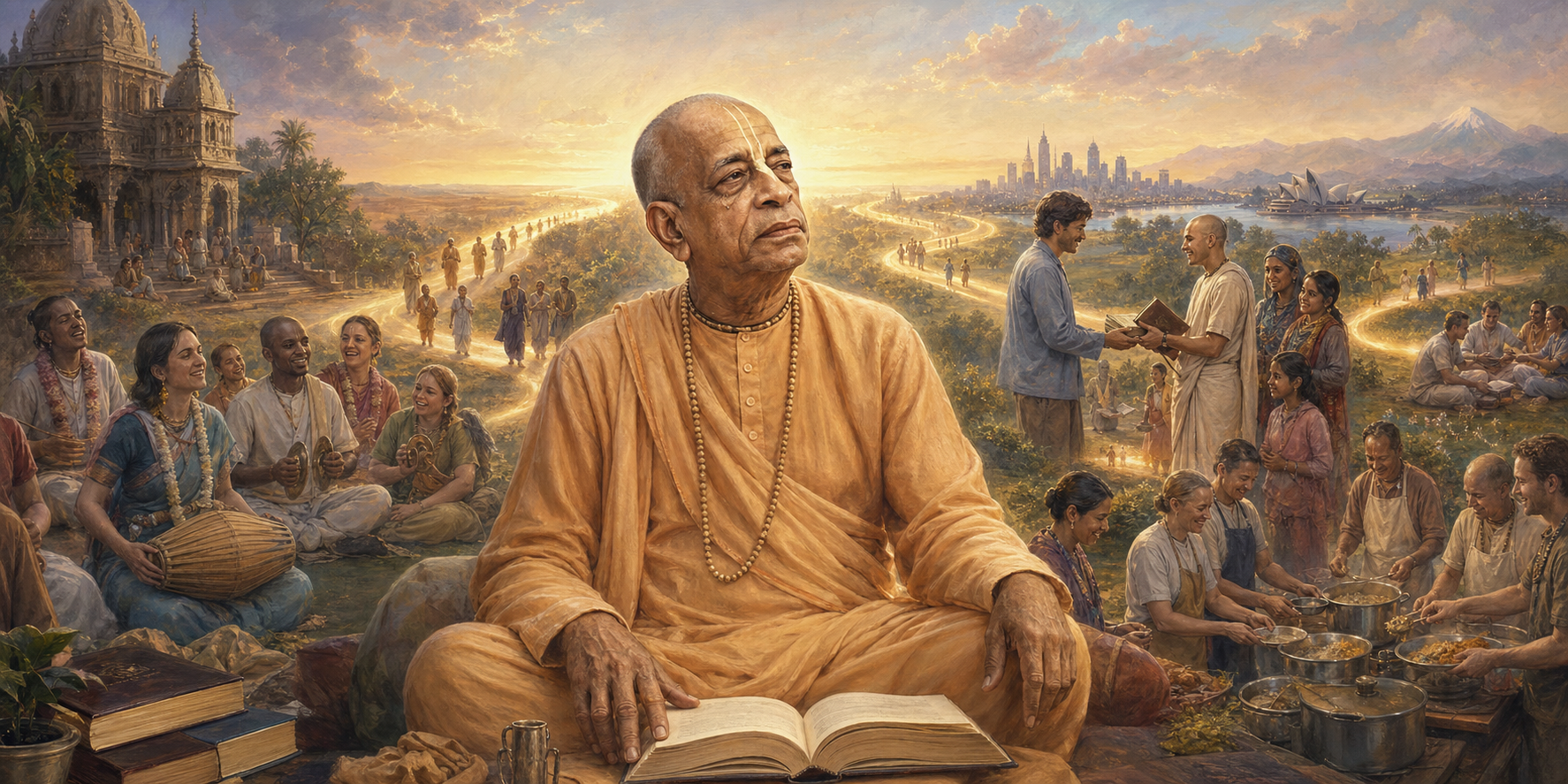
If you revere Srila Prabhupada but wonder what fidelity to his legacy asks of you, the answer is more demanding than preserving a memory and more practical than recreating a past era. His mission became global because teaching, publication, personal practice, community and service reinforced one another.
You can use that pattern to evaluate any work undertaken in his name. Whether you distribute books, welcome people at a temple, lead kirtan, teach online or support a local community, the central question is the same: does your service help another person move from a first encounter with dharma toward informed and freely chosen devotional practice?
His legacy is a working architecture, not a memorial
As ISKCON’s founder, Srila Prabhupada carried the teachings of the Bhagavad Gita and bhakti-yoga from India to people across the world. He did not accomplish this merely by making an Indian spiritual tradition visible abroad. He joined a clear body of teaching to forms of participation that people could enter: books, study, kirtan, temples, education, community and seva.
That combination matters. A teaching without an accessible doorway remains confined to people who already know it. An inviting doorway without a clear teaching becomes generic spirituality. Practice without community is difficult to sustain, while community without service can turn inward. Prabhupada’s achievement was to connect these elements so that each supported the others.
Disciplined scholarship, practical leadership and culturally sensitive communication worked together in his mission. Cultural adaptation was therefore not an afterthought. It was a way of making a rooted teaching intelligible without concealing its identity or emptying it of substance.
When you assess a program inspired by Prabhupada, ask four concrete questions:
- Can a newcomer identify the teaching being offered, or only describe the atmosphere?
- Is the next practice clear, such as reading, kirtan, discussion or seva?
- Can local volunteers explain the purpose in the language and social setting of the people they hope to reach?
- Can the work continue when its most visible organizer is absent?
A weak answer does not condemn the whole effort. It identifies the next service that needs attention. A welcoming gathering may need a clearer path into study. A strong study group may need more community care. A productive distribution campaign may need better follow-up.
Books give the global mission a durable centre

Book distribution occupies a central place in Prabhupada’s mission because a book can extend an encounter beyond the person who offered it. The recipient can return to an argument, test an interpretation, read privately and share the text with others. Bhagavad Gita As It Is also gives geographically separated communities a common point of reference.
Yet a distributed book and a read book are not the same result. Nor does reading by itself establish understanding, practice or belonging. Distribution is the beginning of a possible relationship. Treating the handover as the endpoint mistakes an output for the purpose behind it.
The scale made possible by organized seva is still significant. During the 2025-2026 Live to Give campaign, teams across 10 African countries collectively distributed 15,189 Bhagavad Gitas. That figure demonstrates coordination across borders and communities. It does not, by itself, tell us how recipients responded or how many entered sustained study. Reach and formation are different questions, and responsible organizers should examine both.
A useful local workflow looks like this:
- Prepare the volunteer. Anyone offering the book should be able to describe its identity, devotional orientation and relevance without disguising it as something else.
- Prepare for the audience. Choose language and examples that people actually understand, while keeping the name and origin of the teaching explicit.
- Offer a voluntary next step. A reading circle, kirtan, question session or seva opportunity gives an interested reader somewhere to go.
- Listen after distribution. Record recurring questions, points of confusion and reasons people return. Those observations reveal whether the doorway is working.
This approach protects both sides of the encounter. The recipient receives an honest invitation rather than pressure, and the volunteer remembers that the person matters more than the count.
Adapt the doorway without making the teaching vague

A global mission faces two opposite risks. One is to reproduce a form of presentation that worked in one place even when local language and social expectations differ. The other is to remove so much particularity that bhakti becomes an indistinct message about being positive or spiritual. Neither serves the reader well.
Multilingual engagement, youth participation and locally sensitive distribution strategies show where adaptation is most useful. Language, venue, format, illustrations and the style of invitation can change. The identity of Bhagavad Gita As It Is, the devotional purpose of the mission and the freedom of the person receiving the invitation should remain clear.
You can separate the work into three layers. First, state what is being presented and from which tradition. Second, adapt the means of access to the local audience. Third, invite feedback so that unfamiliar wording, avoidable offence or unintended pressure can be corrected. This is cultural intelligence in the service of clarity, not dilution presented as openness.
The same discipline is needed when speaking about unity among Hinduism, Buddhism, Jainism and Sikhism. Compassion, ethical action, service and the pursuit of wisdom provide meaningful ground for cooperation across dharmic traditions. Common ground, however, is not sameness. These traditions retain distinctive teachings, authorities, practices and understandings of liberation.
In a mixed dharmic setting, say both things plainly. You can identify the value being shared while also explaining that a session presents the Bhagavad Gita through Prabhupada’s bhakti-centred teaching. Respect grows from accurate representation, not from blurring every distinction.
Institutions turn a founder’s example into continuity
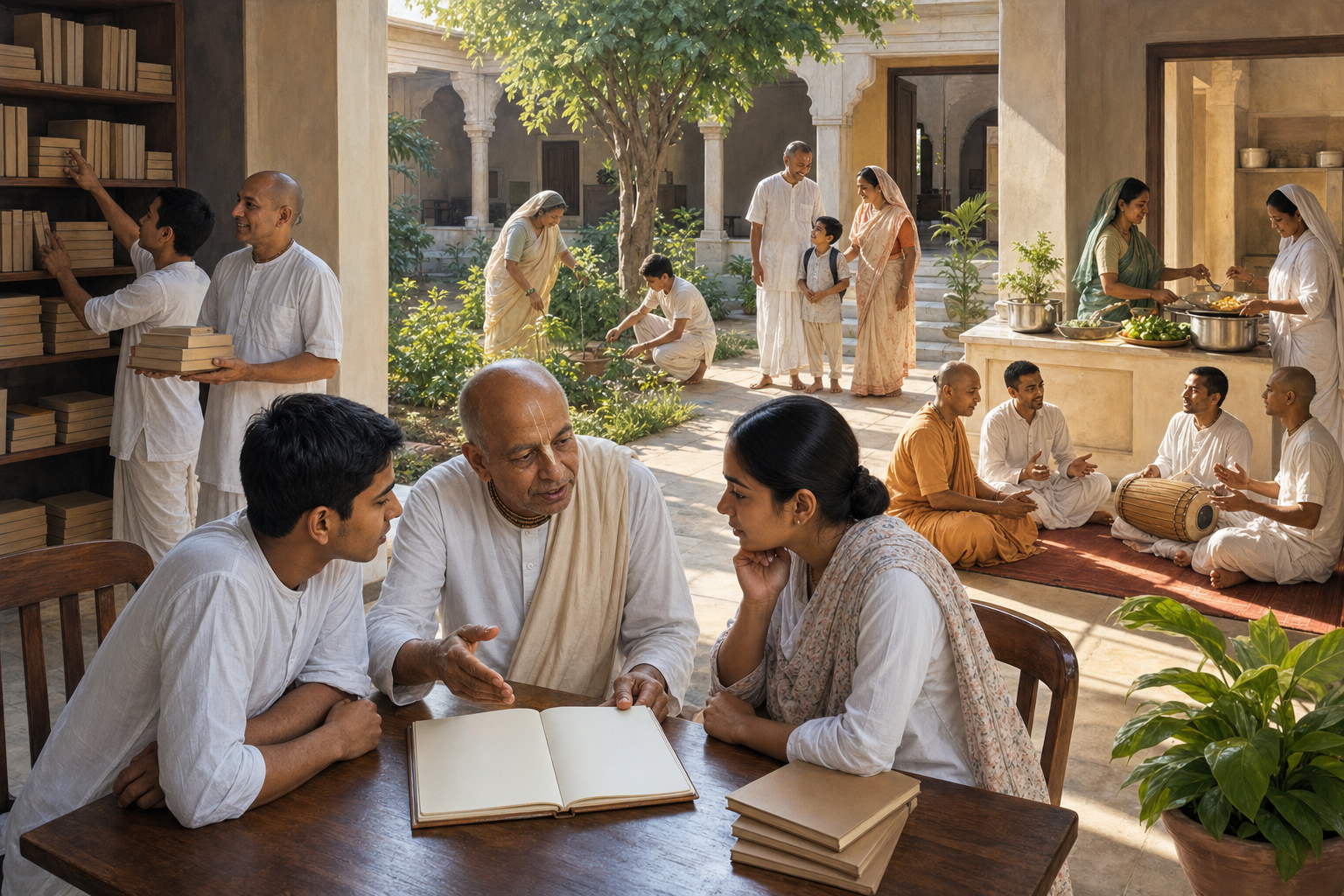
A charismatic teacher can open a path, but a global mission needs structures that remain useful beyond a single personality or generation. Publications, temple projects, kirtan, educational initiatives and community building gave Prabhupada’s work several ways to transmit knowledge and sustain practice.
These structures should operate as a connected path rather than as isolated departments. A publication introduces the teaching. Study develops understanding. Kirtan and personal practice make devotion lived rather than merely discussed. Community supports continuity. Seva turns inner formation outward. If one connection breaks, visible activity can continue while the deeper purpose weakens.
Four common gaps deserve attention:
- Books without study create reach but leave readers to navigate difficult questions alone. Pair distribution with an accessible way to learn.
- Gatherings without deliberate welcome can remain closed social circles. Give someone clear responsibility for receiving newcomers and answering basic questions.
- Education without service can become abstract. Connect what is taught about seva to useful work that participants can actually join.
- Leadership without succession creates dependency. Make responsibilities teachable, share practical knowledge and prepare others to carry the work.
Prabhupada’s interior disciplines are as relevant here as his visible achievements. Patience, courage, humility and responsibility accompanied the expansion of his mission. These qualities are not decorative tributes to a saintly life. They are operating requirements for anyone entrusted with people, teachings or institutions.
Reverence therefore cannot replace accountability. A community honours its acharya when its teaching is faithful, its dealings are truthful, its service is responsible and its knowledge can be passed on. The right measure is not whether an activity resembles the past on the surface. It is whether people are being helped toward serious understanding, sustained practice, mutual care and selfless service.
Key takeaways for carrying the mission forward

- Prabhupada’s legacy is the union of faithful teaching, accessible communication, lived practice, durable community and outward service.
- Book-distribution totals measure reach, not the full spiritual result. Provide a voluntary path into reading, questions, kirtan and seva.
- Adapt language and delivery to local people, but identify the text, tradition and devotional purpose honestly.
- Build dharmic cooperation around real shared values without claiming that Hinduism, Buddhism, Jainism and Sikhism are interchangeable.
- Strengthen continuity by making leadership responsible, practical knowledge transferable and newcomers genuinely welcome.
If you are deciding where to contribute, look for the broken connection. Where books move but remain unopened, support study. Where programs run but newcomers disappear, improve welcome and follow-up. Where a community is strong but inward-looking, develop seva. Where the message is sound but culturally distant, work with trusted local speakers. That is how you carry Prabhupada’s legacy forward: preserve the integrity of the teaching, then put it back into motion.
References
- Dandavats – Srila Prabhupada-lilamrita with HG Kusha Mataji: A Powerful Portrait of Compassion and Dharma
- Dandavats – Be Brave, Live to Give: Global ISKCON 2025 Celebration Powering the Prabhupada Marathon
