

If the Moon occupies your first house, you may already know the central tension: you can read a room quickly, yet the room can also change how you feel about yourself. Other people’s moods, unfamiliar surroundings and disruptions to your routine may register before you have consciously decided what they mean.
This placement does not condemn you to instability, nor does it guarantee unusual intuition. It describes a close relationship between mind, emotion and identity. Your task is to determine when that responsiveness is giving you useful information, when it is merely reflecting the moment, and which disciplines help you remain receptive without becoming ungrounded.
Key takeaways
- Moon in the first house brings the condition of the mind close to the surface of the personality. Feelings may become visible through expression, tone, energy and decision-making.
- Sensitivity is the mechanism behind both the gifts and the difficulties. It can produce empathy, adaptability and social intuition, but it can also encourage reactivity, people-pleasing and emotional exhaustion.
- The placement cannot be judged from house position alone. Sign, Nakshatra, lunar phase, aspects, conjunctions, house lordships and the condition of the Lagna ruler can substantially change the result.
- Work involving care, education, hospitality, counseling, public interaction or cultural expression may suit this placement, but occupation must still be judged from the whole horoscope and the person’s actual capacities.
- The practical aim is not emotional suppression. It is a steadier rhythm built through observation, boundaries, ethical action and regular contemplative practice.
What Moon in Lagna actually changes
The first house, or Lagna, concerns embodied identity: how you enter situations, how others initially encounter you, and how vitality and temperament are expressed. The Moon is associated with manas, the responsive mind that receives impressions, forms preferences and reacts to changing conditions. With the Moon in Lagna, the distance between an inner response and its outward expression can be unusually short.
This is why the placement is often visible rather than merely private. A change of mood may alter your face, voice, posture or pace. A welcoming environment may bring out warmth and confidence; a tense one may make you guarded or fatigued. Even when you say little, other people may sense that you are responding to them.
Calling this person simply "emotional" misses the point. The more useful description is emotionally receptive and environmentally responsive. Receptivity can become perceptiveness when you observe carefully. Without discernment, the same receptivity can make a passing atmosphere feel like a permanent truth about you.
Suppose you leave a difficult gathering convinced that you have made a poor impression. Before treating that conclusion as fact, ask three questions: What did anyone actually say or do? What changed in your body and mood after you entered the room? Did the conclusion remain convincing after you returned to your normal rhythm? These questions separate perception from emotional contagion without dismissing either.
The same distinction applies to intuition. Intuition may arrive as a quiet recognition of a pattern. Reactivity usually carries pressure: answer now, withdraw now, please this person now, or protect yourself before anything has happened. When urgency is high and evidence is thin, pause. For an important or irreversible decision, write down the feeling, the observable facts and what could verify your interpretation before you act.
At its best, this placement makes identity humane rather than rigid. You can adapt, listen and let encounters teach you. The work is to retain a centre while remaining responsive. Otherwise adaptability turns into self-erasure, and empathy becomes the habit of carrying emotions that were never yours to resolve.
Read the Moon in the correct chart order
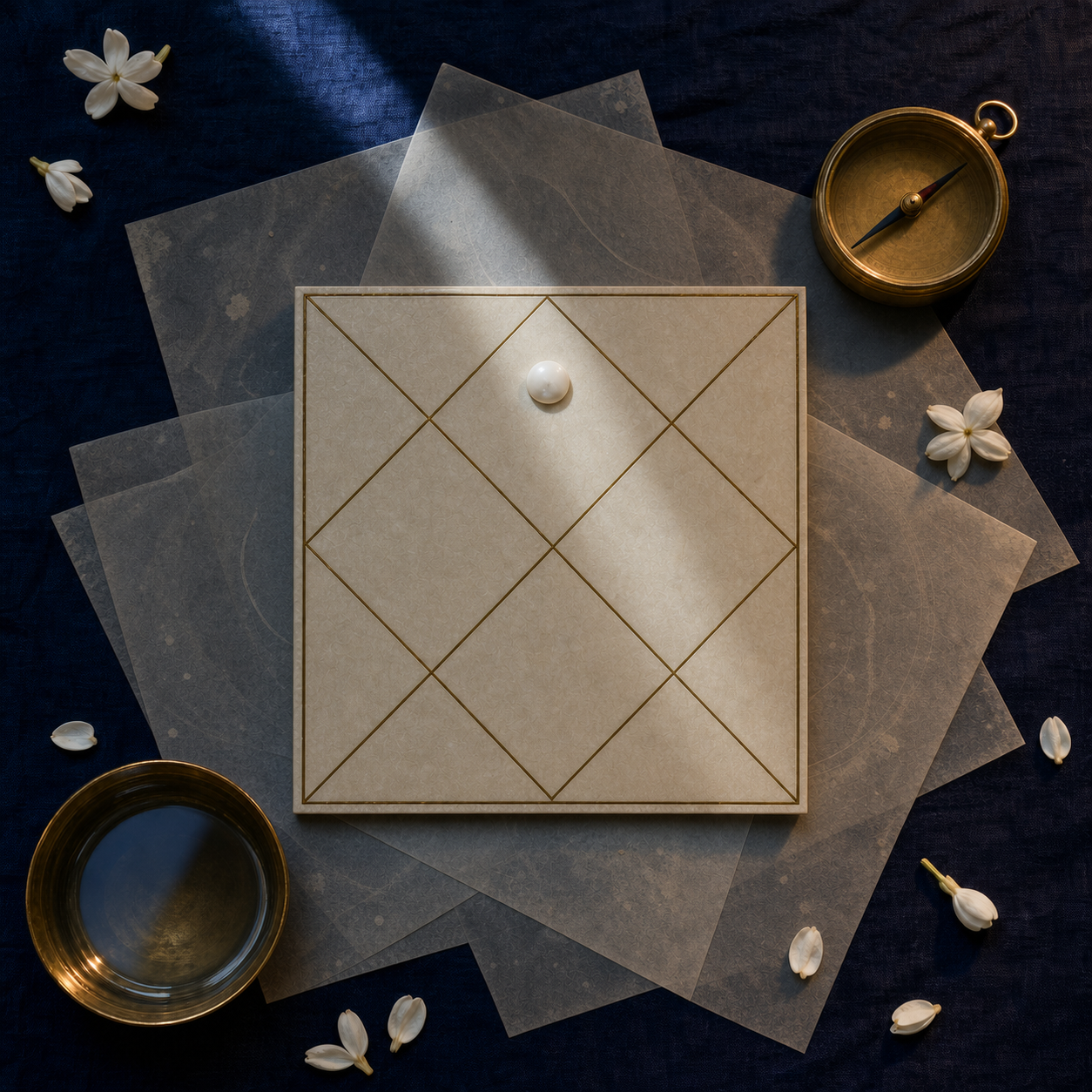
A house placement is the beginning of interpretation, not its conclusion. Two people with Moon in the first house can express it very differently because the Moon does not operate in isolation. Before accepting a prediction about personality, marriage, health or career, check whether the interpretation has considered the following layers.
- The sign occupied by the Moon. The sign describes the manner in which lunar responsiveness is expressed. It helps answer whether the mind tends to meet experience through restraint, intensity, practicality, sociability or another sign-based mode.
- The Moon’s dignity and overall strength. A supported Moon is generally better able to use sensitivity constructively. A strained Moon may show the same sensitivity through insecurity, rapid fluctuation or difficulty recovering after stimulation.
- The waxing or waning condition. Lunar phase is part of traditional strength assessment. It should refine the reading rather than become a slogan about whether the Moon is simply "good" or "bad."
- The Nakshatra. The lunar mansion gives a more particular backdrop for motives, instincts and recurring emotional patterns. A generic first-house description cannot replace this layer.
- Aspects and conjunctions. Supportive contacts can steady the mind and increase resilience. Difficult contacts may intensify defensiveness, agitation or emotional pressure. A conjunction also changes what becomes entangled with identity.
- Lordships, yogas and the Lagna ruler. The houses governed by the Moon, the strength of the ascendant lord and relevant yogas show where lunar themes are likely to operate. Life circumstances and maturity determine how those potentials are used.
This sequence protects you from two common errors. The first is fatalism: assuming that one placement dictates your character. The second is selective optimism: choosing the most flattering description and ignoring conditions that require discipline. A responsible reading holds both capacities at once and then asks which one your habits are reinforcing.
Specialized combinations need the same restraint. Some traditional readings examine the presence of the Sun, Mars or Jupiter in the fourth or tenth house alongside a first-house Moon and associate the configuration with gains involving long journeys or sea-related activity. Treat such a rule as a condition to investigate, not a promised event. Confirm the relevant houses, lordships and planetary strength, and seek blessings before a major undertaking rather than using the combination as a substitute for practical judgment.
Notice how the placement operates in daily life

Work, service and public presence
A visible Moon can make warmth and responsiveness part of your public identity. People may find it easier to speak with you, and you may notice needs before they are stated directly. That can support work in care, education, hospitality, counseling, community-facing roles and the cultural arts. It can also help wherever listening and public trust matter.
Suitability is not the same as destiny. Ask what the work does to your nervous and emotional rhythm. Do you finish public-facing days fulfilled or depleted? Can you distinguish another person’s distress from your responsibility? Does the role permit recovery and clear limits? If the work depends on your sensitivity but punishes you for needing quiet, the problem may be the arrangement rather than the field itself.
Use a simple three-column check before a consequential professional decision: write what you directly observed, what you felt, and what still needs confirmation. This allows social intuition to contribute without letting mood make the whole decision. It is particularly useful after criticism, praise or a charged meeting, when the Moon in Lagna may temporarily identify with the strongest response in the room.
Relationships, security and boundaries
Moon in the first house often seeks emotional safety and a sense of home within close relationships. Consistent routines, a trustworthy tone and empathetic communication can matter as much as declarations of affection. Sudden coldness or ambiguity may feel especially destabilizing because relationship weather quickly becomes inner weather.
The danger is not caring too much. It is treating another person’s state as an instruction about who you must become. People-pleasing begins when you change your view, availability or boundaries to end discomfort before anyone has asked you to do so. When you sense tension, replace inference with a direct question: "Would you like listening, advice or practical help?" That one distinction prevents compassion from turning into uninvited emotional labour.
Keep at least one sentence ready for moments when empathy outruns capacity: "I care about this, and I need time before I respond." A boundary stated calmly is not a rejection of relationship. For this placement, it can be the structure that makes genuine closeness possible.
Bodily rhythms and emotional interpretation
Traditional interpretation sometimes connects this placement with bodily responsiveness, including changes involving digestion or fluids. The useful lesson is to notice patterns, not to assign every symptom to the horoscope. Record what occurred, how long it persisted, what else changed and whether ordinary factors such as food, sleep, stress or illness offer a clearer explanation.
Persistent, severe or unfamiliar symptoms belong with an appropriate health professional. Astrology cannot diagnose a medical condition, and a lunar remedy should never delay examination or replace treatment. The chart may prompt attentiveness; it does not establish a clinical cause.
The same rule applies to emotional distress. A changing mood is not automatically a disorder, and significant distress is not something you must solve through willpower or ritual alone. Use proportion: observe ordinary fluctuations, but seek qualified support when distress is persistent, disabling or creates danger.
Stabilize the Moon without suppressing it

The aim of a lunar discipline is not to become emotionally flat. It is to create enough steadiness that sensitivity serves discernment. A calm person can still feel deeply; the difference is that a feeling becomes information to examine rather than a command to obey.
Begin with a repeatable rhythm. Meditate or practise gentle pranayama before entering the most stimulating part of your day. After a demanding social encounter, journal before sending messages or making promises. Keep the evening quieter when possible, and spend time in nature or near water if that setting helps you settle. Consistency matters more than making the routine elaborate.
- Observe the trigger. Record the event without interpretation: who was present, what happened and what changed.
- Name the response. Note the emotion, bodily sensation and immediate impulse. Do not decide yet whether the impulse is correct.
- Test ownership. Ask whether the feeling was present beforehand, arose from direct evidence, or appeared only after contact with another person’s mood.
- Regulate before acting. Use meditation, breathwork, quiet walking or reflective writing until you can describe both the feeling and the facts.
- Choose a dharmic response. Decide whether the moment calls for truthful speech, a boundary, patience, ahimsa, service or no action at all.
This process turns reactivity into abhyasa, disciplined practice. Across the Dharmic traditions, mindfulness, ahimsa, introspection and seva offer complementary ways to train a responsive mind. Their theological settings are not identical, and they need not be flattened into one system. Their practical convergence is still valuable: awareness becomes trustworthy when it is joined to self-restraint and ethical conduct.
Traditional lunar upaya may include gentle recitation of Om Somaya Namah, prayer, a restrained Monday observance and deliberate care around the evening routine. If fasting is unsafe or conflicts with health needs, medication or professional guidance, choose a non-fasting form of restraint instead. Simpler food, reduced stimulation, less needless speech or dedicated time for prayer can preserve the intention without creating avoidable harm.
Do not measure a remedy by whether it forces an external event to occur. Measure whether the practice helps you pause, perceive accurately, keep your commitments and respond with greater compassion. These are the changes through which a strong lunar imprint can become intuitive leadership rather than emotional drift.
Start with the next situation that reliably unsettles you. Record the trigger, separate observation from interpretation, regulate before responding, and choose one clear boundary or act of seva. Moon in the first house becomes useful when you stop asking it to predict a fixed identity and begin using it to cultivate a steadier one.
References
