

You may be working toward a larger home, a more influential position, a successful institution, or enough wealth to give your family security. Then a spiritual doubt appears: does wanting material excellence weaken your commitment to dharma?
The better question is not whether you possess something splendid. It is whether that possession helps you perform your duties or quietly becomes the measure of your worth. Divine cities and golden palaces sharpen this distinction. They show you how to enjoy beauty, build ambitiously, and accept prosperity without asking any of them to manufacture peace.
A perfect city cannot repair a disordered heart
Purāṇic imagination presents Vishwakarma as the divine architect whose work expresses proportion, harmony, and cosmic order. The cities attributed to him across the Four Yugas belong to very different moral climates: the clarity of Satya Yuga, the growing desire of Treta Yuga, the conflict and complexity of Dvapara Yuga, and the fragmentation associated with Kali Yuga.
That difference matters more than the radiance of the buildings. A city may embody sacred measure, but it cannot make its residents truthful. A palace may remove physical discomfort, but it cannot create gratitude. An institution may have abundant resources, but it cannot force its leaders to use them justly. Outer order supports human flourishing; it does not perform the inner work on our behalf.
This is not an argument against architecture, technology, wealth, or urban ambition. Conditions matter. A well-ordered home can support study and worship. A thoughtfully built temple can gather a community. A prosperous city can care for people more effectively than one trapped in disorder. Yet every structure remains dependent on the character of those who inhabit and govern it.
You can apply that distinction before any major upgrade. Write down three different promises you are making about it:
- The functional promise: What concrete problem will this home, promotion, purchase, or project solve?
- The dharmic promise: Which duty will it help you perform, and whose welfare will it support?
- The emotional promise: What do you expect it to prove about your importance, success, security, or belonging?
The first two promises can justify an acquisition. The third deserves suspicion. A home can provide shelter and stability, but it cannot permanently end comparison. A title can grant authority, but it cannot settle your identity. When you ask an outer object to complete an inner task, even a good possession begins carrying a burden it cannot bear.
Shiva’s golden palace reveals what freedom looks like

The traditions surrounding Shiva, Ravana, and golden Lanka are not preserved as one uniform account, so they should not be forced into a single chronology. In one widely told version, Vishwakarma constructs a magnificent palace for Shiva and Pārvatī. Ravana renders exceptional service at its consecration and asks for the palace as his dakshina. Shiva grants it. In a related strand, Lanka’s splendor is first associated with Kubera and later taken by Ravana.
The shared moral contrast is more important than harmonizing every narrative detail. Shiva can relinquish gold without losing sovereignty. Ravana acquires grandeur but becomes increasingly governed by the identity, appetite, and power attached to it. The palace does not make one divine or the other adharmic. It reveals the relationship each already has with possession.
Shiva’s detachment should not be confused with contempt. Giving away the palace does not require pretending that craftsmanship is ugly or useless. Detachment means that the object’s value is recognized without allowing it to define the Self. Shiva remains Shiva when the palace is present, when it is requested, and when it is gone.
Ravana’s failure is correspondingly more precise than simply “having too much.” Wealth and power magnify agency. They widen the field in which wisdom or ahankara can operate. A boon therefore does not predetermine a person’s fall; it increases the responsibility attached to choice. A gift becomes dangerous when its recipient treats capacity as permission, admiration as legitimacy, or desire as dharma.
Use three tests whenever success places a new resource in your hands:
- Reception: Can you accept it gratefully without treating it as proof that you are superior?
- Custody: Can you administer it so that family, colleagues, dependants, or the wider community are not sacrificed to your prestige?
- Release: Can you surrender, reduce, or redirect it if keeping it would require adharma?
The release test is usually the clearest. You do not have to abandon a rightful possession merely to demonstrate purity. You do need to know the conditions under which duty would require you to let it go. If no such condition can even be imagined, ownership may already have become bondage.
Stewardship keeps splendor from becoming captivity
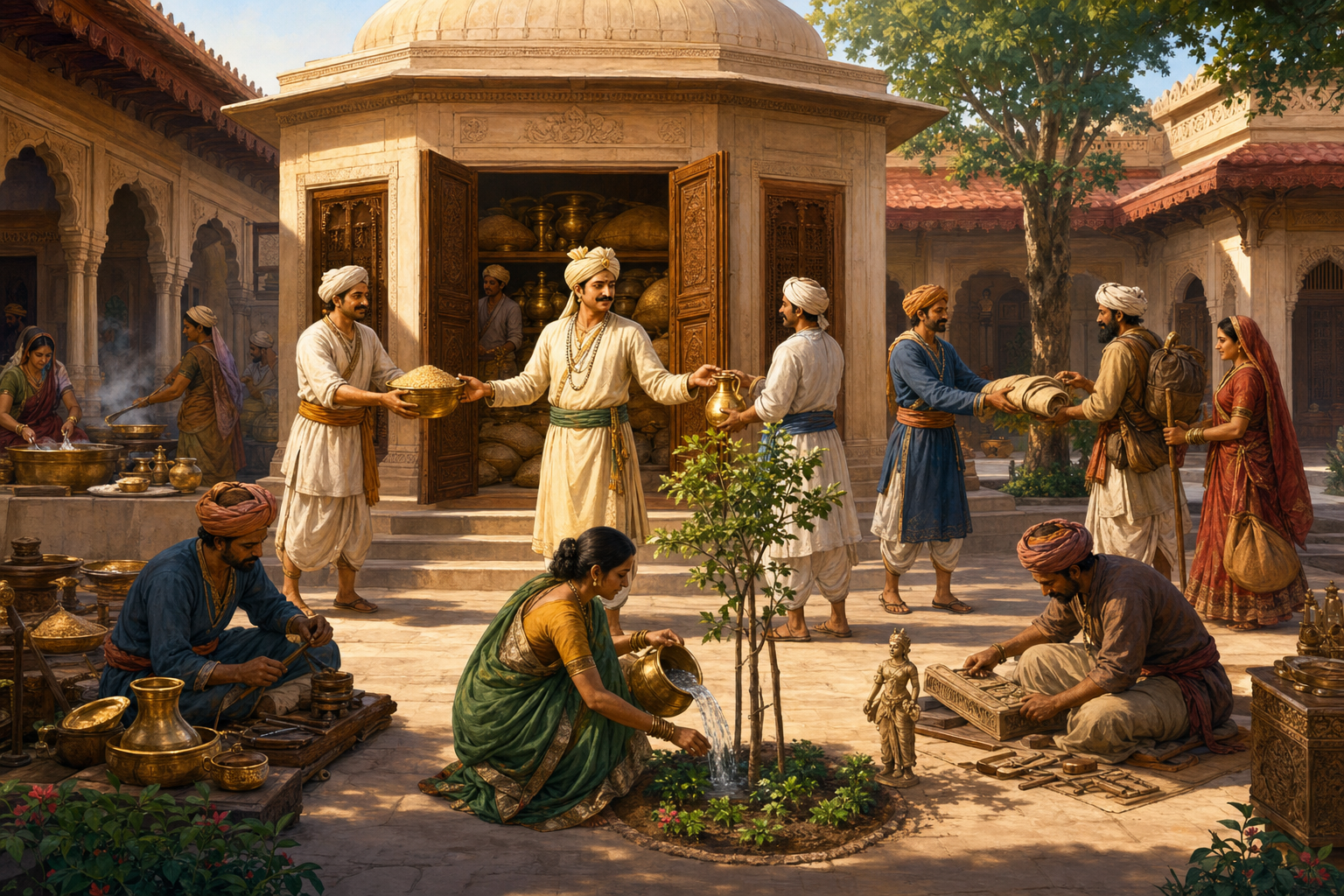
Calling wealth “entrusted” instead of “mine” is not a decorative change in language. It changes the questions you ask. An owner concerned mainly with status asks how much control an asset gives him. A steward asks what purpose the asset serves, who bears its costs, and what accountability comes with it.
| Decision test | Stewardship | Captivity |
|---|---|---|
| Why do I want it? | It serves a defined duty or legitimate need. | It must prove my importance or defeat comparison. |
| How may I obtain it? | The means must remain consistent with dharma. | The desired result is used to excuse harmful means. |
| Who benefits? | Its benefits extend beyond personal display. | Other people become instruments of prestige. |
| How do I respond to criticism? | I can examine whether the asset is being used well. | Any question about the asset feels like an attack on me. |
| Can I release it? | I can change course if duty requires it. | Loss of the possession feels like loss of the self. |
If your answers lean toward captivity, the answer is not necessarily to destroy or refuse the possession. First change its governance. Give it a written purpose. Separate family or institutional welfare from your personal image. Invite counsel from someone who is not impressed by the display. Name the ethical line you will not cross to retain it. Direct some of its benefit toward seva before comfort expands to consume everything available.
This is why the movement from Ravana’s rule toward Vibhīṣaṇa’s stewardship carries philosophical weight. Legitimacy does not arise from possessing the most magnificent city. It arises from caring for what has been entrusted in accordance with dharma. A golden city under adharma is disordered, however symmetrical its streets may be. Rightful stewardship can begin restoring order even before the gold changes.
The same distinction applies outside royal narratives. A family inheritance can preserve continuity or intensify rivalry. A leadership position can protect an institution or feed a need for obedience. A successful temple project can support worship or become a competition in spectacle. The material object does not decide between those outcomes. Repeated choices about purpose, means, accountability, and release do.
Four Dharmic disciplines address four forms of attachment
Hindu, Buddhist, Jain, and Sikh traditions are not interchangeable systems. Their metaphysics, disciplines, and religious aims retain important differences. Yet each gives you a way to notice when material means have crossed the line from useful support into inner domination.
Hindu practice brings karma yoga, satya, bhakti, and viveka to the problem. Karma yoga asks whether action is being performed as duty rather than as a project of self-glorification. Satya prevents you from disguising vanity as necessity. Bhakti relocates the center of devotion away from the possession. Viveka distinguishes what is changing from what should ground your identity. If success is making you more anxious, secretive, or dependent on praise, apply viveka before acquiring anything else.
Buddhism identifies dukkha in the attempt to secure lasting satisfaction through what is impermanent. The problem is not merely contact with pleasant things; it is upādāna, the clinging that demands they remain, obey, and protect the identity constructed around them. Mindfulness lets you notice that demand as it arises. The Middle Way then prevents the correction from becoming another extreme. You can use a comfortable home without demanding that it make change impossible.
Jainism’s aparigraha gives the problem a disciplined boundary. Non-possessiveness asks not only whether an object is technically yours, but how accumulation binds attention and affects other beings. Ahiṃsā widens the accounting: a possession cannot be evaluated only by the pleasure of its owner when its acquisition, protection, or display imposes harm. When accumulation has become automatic, establish a limit before desire supplies another justification.
Sikh teachings bring sahaj, seva, simran, hukam, and vigilance toward maya into social life. Equipoise prevents success from producing intoxication. Service redirects capacity toward others. Remembrance keeps the Divine, rather than status, at the center of consciousness. Acceptance of hukam challenges the fantasy that enough control can make life answer entirely to the ego. If recognition is becoming the reward you seek, perform a form of service that offers no stage for self-display.
You do not need to flatten these disciplines into a generic spirituality. Choose the correction that addresses your actual failure. Use viveka or contemplation of impermanence when identity has fused with an object. Use aparigraha when accumulation has lost its limit. Use seva when prestige is narrowing your concern for others. Use simran, bhakti, or mindfulness when attention cannot leave what you own, want, or fear losing.
Build an inner vastu before the next outer upgrade

Vastu Shastra concerns the ordering of external space, but the image of an “inner vastu” offers a useful personal discipline. This is not a substitute for the technical tradition of Vastu. It is a way to arrange desire, duty, identity, and use before a new possession enters your life.
Run the following process before a major purchase, promotion, inheritance decision, construction project, or expansion of authority:
- Name the object plainly. Write “larger house,” “leadership role,” or “new building,” not the emotion you hope it will produce.
- Give it one functional purpose. If you cannot state what it enables, you may be purchasing a symbol rather than solving a problem.
- List the duties attached to it. Include maintenance, time, attention, accountability, effects on relationships, and responsibility for anyone who will depend on your decision.
- Set the dharmic conditions. Decide which means of acquisition, use, and protection are unacceptable even if abandoning them would cost you the opportunity.
- Assign part of the benefit to service. Make that commitment before comfort and display expand around the entire resource.
- Write the release condition. State what change in duty, conduct, or consequence would make you reduce, transfer, or relinquish it.
If the decision survives this process, you need not enjoy it apologetically. Detachment does not require calling beauty ugly, neglecting what you own, or refusing every opportunity. It means enjoying a thing without confusing enjoyment with refuge. Care for it well, use it fully, and keep your identity larger than it.
If the decision fails, identify where it fails. An unclear function calls for delay. An unethical means calls for refusal. Duties you cannot carry call for a smaller option. An absent release condition calls for inner work before expansion. This is how restraint becomes intelligent rather than theatrical.
Key takeaways
- Material excellence can support dharma, but it cannot supply character, contentment, or spiritual identity.
- Detachment is the freedom to receive, use, and release a possession without making it the measure of the self.
- Wealth becomes legitimate through right purpose, ethical means, accountable stewardship, and concern for those affected by it.
- The clearest warning sign is not enjoyment but dependence: you cannot imagine being truthful, peaceful, or whole without the thing.
- Before expanding outer splendor, define its function, its duties, its ethical limits, its service, and its release condition.
Choose one possession or ambition that occupies your mind this week. Write down its function, the duty it creates, and the condition under which you would release it. If you can answer all three honestly, you are preparing to hold it as a steward. If you cannot, change the relationship before you increase the splendor.
References
- DharmaRenaissance Blog – Four Yugas, Four Marvelous Cities: Vishwakarma’s Vision and the Elusive Quest for Peace
- DharmaRenaissance Blog – Why Shiva Gave His Golden Palace to Ravana: Timeless Lessons on Detachment and Karma
