
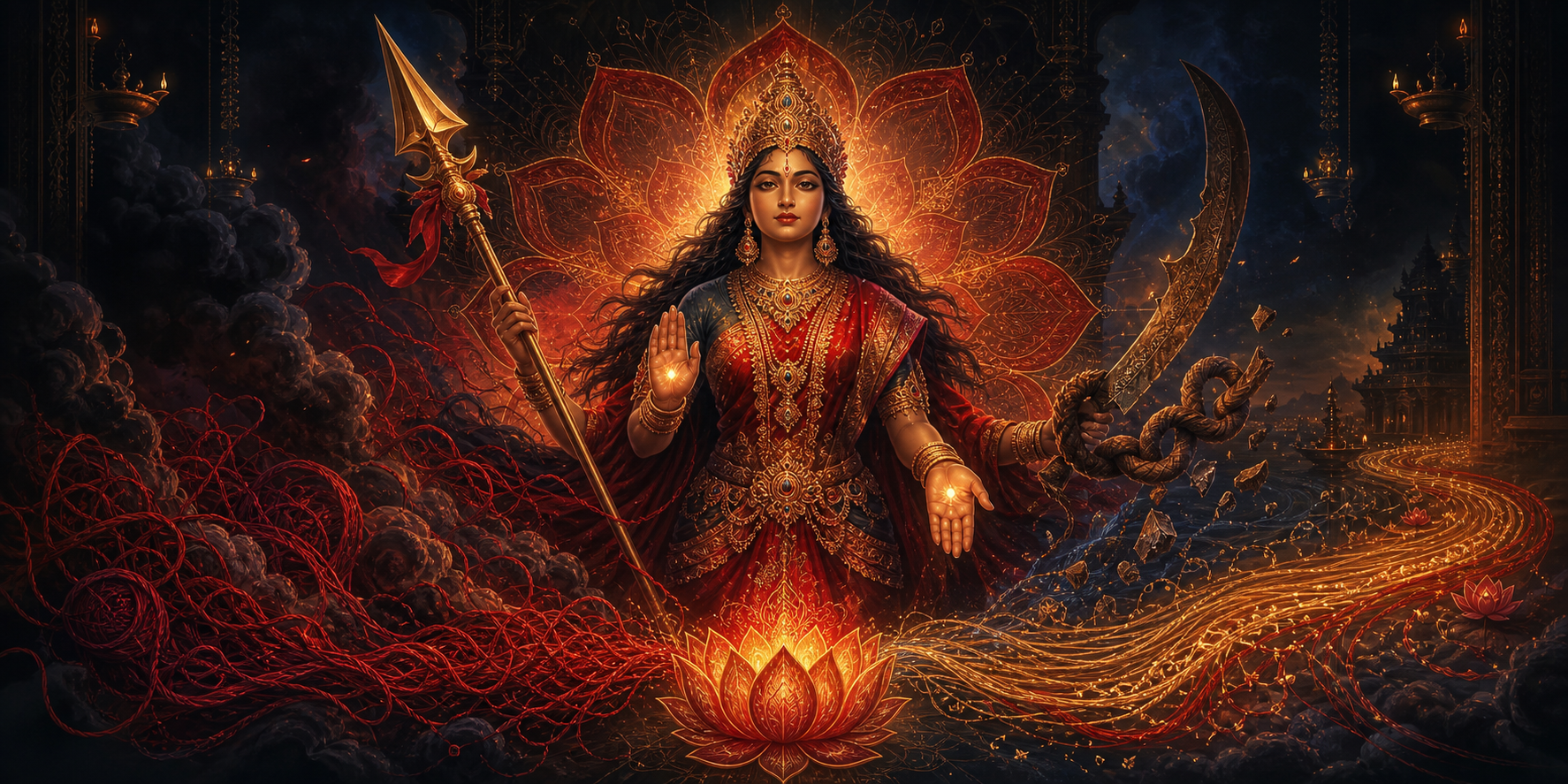
You may feel drawn to Durga’s spear or Kali’s fearsome imagery and still wonder what either symbol asks you to do in an ordinary life. The useful question is not simply what a weapon, severed form, or subdued figure means. It is what must change within you, and how your conduct should change with it.
Shakta imagery becomes practical when you read it as a sequence: a disorder is exposed, raw energy is brought under the Goddess, and that energy is redirected toward dharma. This approach preserves the symbols’ force without turning them into excuses for aggression or reducing them to decorative metaphors.
Transformative power is not the same as domination

The first distinction is between destroying something and transforming the energy bound up in it. Shakta images may show piercing, burning, severing, subduing, or standing upon an apparently defeated form. Yet their inner movement is often conversion. Ignorance gives way to clarity. Reactive force becomes disciplined protection. Hunger becomes purpose. Grasping becomes offering.
Durga’s spear unites focused wisdom with the duty to protect. It does not glorify force for its own sake. In a more esoteric register, Kali enthroned upon headless Kabandha turns an obstructive body of appetite and grasping into a vehicle. The former pierces confusion; the latter harnesses what confusion once controlled.
When you encounter a fierce Shakta image, apply three immediate tests:
- Locate the first target within. With these symbols, avidyā, ahankāra, inertia, compulsive hunger, and grasping are more reliable starting points than a person you dislike.
- Notice who governs the force. The spear rests in Durga’s hand; Kabandha rests beneath Kali. Power is legitimate because it has been placed under divine and ethical sovereignty.
- Inspect the result. A sound reading should lead toward clarity, steadiness, protection, compassion, or service. If it produces vanity, cruelty, or fascination with overpowering others, the reading has failed its own test.
This measure has echoes across the Dharmic family without making its traditions interchangeable. Buddhist disciplines join wisdom to diligence; Jain practice subjects passions to tapas and ahimsa; Sikh teaching confronts haumai and binds the kirpan to protective duty. These parallels establish an ethical boundary: intensity alone does not make power sacred. Power must be disciplined by truth, restraint, and care for beings.
Durga’s spear turns clear perception into protective action

Within the Devi Mahatmya, part of the Markandeya Purana, the gods equip Durga to restore cosmic balance. Agni gives her the spear, carrying the radiance of fire refined through tapas. This origin matters because the weapon’s authority does not come merely from its ability to wound. Its authority comes from purified energy directed by the Goddess toward the restoration of dharma.
The spear, or Borsha, can be read through its structure rather than treated as a generic sign of strength:
| Visible element | Discipline it evokes | Question for your practice |
|---|---|---|
| The unwavering shaft | Ekāgratā, or one-pointed steadiness | What single principle must remain steady while circumstances change? |
| The piercing tip | Viveka, or discriminative wisdom cutting through avidyā | Which false assumption or convenient confusion must be pierced? |
| Agni’s fire | Purification through tejas and tapas | Which part of your motive is anger, vanity, fear, or attachment in sacred disguise? |
| Durga’s hand | Courage governed by compassion and dharma | Who or what will your action protect, and how will you limit unnecessary harm? |
This reading is especially useful when you face a difficult conversation, a boundary that must be enforced, a duty you would rather avoid, or a public stand that carries consequences. Work through the spear’s logic before you act:
- Define the object of protection. Complete the sentence: This action must protect a person, a principle, a responsibility, or a vulnerable community.
- Name the confusion. Identify the assumption, evasion, or self-deception that prevents a clear response.
- Purify the motive. Remove any part of the planned action whose real purpose is humiliation, revenge, or the display of your own righteousness.
- Aim at one effective act. Choose a response precise enough to address the actual wrong rather than discharging emotion in every direction.
- Review the result. Ask whether you remained firm without abandoning compassion, truthfulness, or proportion.
The āratī flame can reinforce this discipline. Instead of allowing the flame to remain only an atmosphere of devotion, use it as a pause in which your motive is exposed to Agni. During Navaratri, you can pair worship with one recurring act of steadiness: keeping a necessary boundary, correcting one habitual falsehood, fulfilling a neglected duty, or serving someone who needs protection. Ritual then trains conduct.
The spear is not permission for indiscriminate militancy. If you cannot name what your action protects, what confusion it pierces, and how its harm will be constrained, you are not yet ready to invoke its symbolism. The ego is remarkably capable of borrowing sacred language for an undisciplined impulse.
Kali and Kabandha transform ego, hunger, and grasping

Here doctrinal precision is essential. Kali enthroned upon a headless Kabandha belongs to certain esoteric Shakta interpretations rather than mainstream, pan-Indian iconography. It should be approached as a lineage-sensitive contemplative motif, not announced as though every Kali tradition accepts Kabandha as her standard vāhana.
The Ramayana remembers Kabandha as a terrifying being who is eventually redeemed through an encounter with dharma. The esoteric image turns that pattern inward. What once obstructed the sacred path is not simply discarded; it becomes the ground upon which awakened power operates.
Headlessness here does not mean contempt for reason, learning, or discernment. It means the interruption of compulsive self-reference. Ahankāra no longer gets to make every perception, wound, success, and disagreement part of a story about me and mine. Kali’s sovereignty begins where that demand for centrality ends.
Kabandha’s belly-mouth can be contemplated as unexamined hunger, while his long arms evoke compulsive grasping. Under Kali, these drives are neither indulged nor merely repressed; they are harnessed. The body, prāṇa, and mind become a disciplined substrate through which Shakti can move.
You can use this symbol when an impulse feels stronger than your stated values. Reduce the impulse to its bare verb: consume, grasp, or prove. Do not begin by decorating it with a story about why you deserve satisfaction or why another person must validate you. Steady the body, breath, senses, and attention. Then assign the energy a Dharmic function. Hunger can become disciplined purpose. Grasping can become offering. The need for display can become quiet service.
The practical test is behavioural. You have not transcended ego merely because you experienced an intense meditation, adopted fierce imagery, or spoke fluently about non-attachment. Look for less reactivity, less compulsive self-justification, clearer attention, and a greater capacity to perform necessary work without making yourself its centre.
Nor should the headless image be literalised. It is not an invitation to self-harm, anti-intellectualism, or contempt for the body. Its purpose is the opposite: the human instrument becomes integrated enough to carry wisdom. Kali does not require a useless devotee. She requires a vehicle no longer commandeered by appetite and ego.
Use the symbol in the decision in front of you

A Shakta symbol becomes useful when it changes the next decision, not merely your vocabulary. For these and similar images, move through the following questions in order:
- What action is the Goddess performing? Identify the operative movement: piercing, burning, dissolving, subduing, carrying, or converting.
- What is the actual obstruction? Name avidyā, ahankāra, inertia, hunger, grasping, fear, or another inner disorder before projecting the symbol onto an external opponent.
- What energy is being reclaimed? Determine whether the image converts intensity into concentration, appetite into purpose, fear into courage, or power into protection.
- What governs the reclaimed energy? Locate the deity, dharma, compassion, ahimsa, truthful conduct, or protective duty that prevents force from becoming self-serving.
- What changed conduct would verify the interpretation? Choose an observable act: speak truth without humiliation, keep a boundary without hatred, complete a duty without self-display, or protect another person without seeking domination.
Keep lineage and context in view as you apply this method. Durga’s spear stands within a widely recognised narrative of cosmic protection. Kabandha as Kali’s vehicle is more restricted and esoteric. Respecting that difference is part of the practice. Plurality gives Shakta traditions depth, but plurality does not authorize us to present every regional or contemplative image as a universal doctrine.
Your interpretation is ethically usable only if it survives a final check:
- Can you name the harmful behaviour or inner disorder without reducing a human being to a demon?
- Does the practice reduce your ego’s centrality rather than furnishing it with grander religious language?
- Is the proposed response firm enough to protect, yet proportionate enough to avoid needless harm?
- Will someone vulnerable, neglected, or dependent on your duty actually benefit?
- Does the result make your attention steadier, your speech truer, and your service more reliable?
If the answer is no, pause. More intensity will not repair a confused aim. Return to the shaft’s steadiness, the spearpoint’s discrimination, Agni’s purification, or Kali’s dethroning of self-importance before acting.
Key takeaways
- When your attention is scattered, contemplate the spear’s straight shaft and commit to one governing principle.
- When judgment is clouded, use the spearpoint to identify the exact assumption that must be pierced.
- When a worthy cause is mixed with vanity, anger, or revenge, bring the motive under Agni before taking action.
- When hunger, grasping, or self-display controls your behaviour, use the Kabandha image to turn that energy into purpose, offering, and service.
- When an interpretation increases hostility, superiority, or fascination with domination, reject it. Shakta power is verified by disciplined transformation and Dharmic conduct.
The next time a Shakta image holds your attention, choose one visible detail and carry its question into one real decision. If your action becomes clearer, steadier, more protective, and less centred on you, the symbol has begun to do its work.
References
- DharmaRenaissance Blog — Agni’s Gift to Durga: The Sacred Spear of Shakti and the Transformative Fire of Wisdom
- DharmaRenaissance Blog — Kabandha as Kali’s Vahana: Tantric Symbolism of Ego-Transcendence and Inner Liberation
