
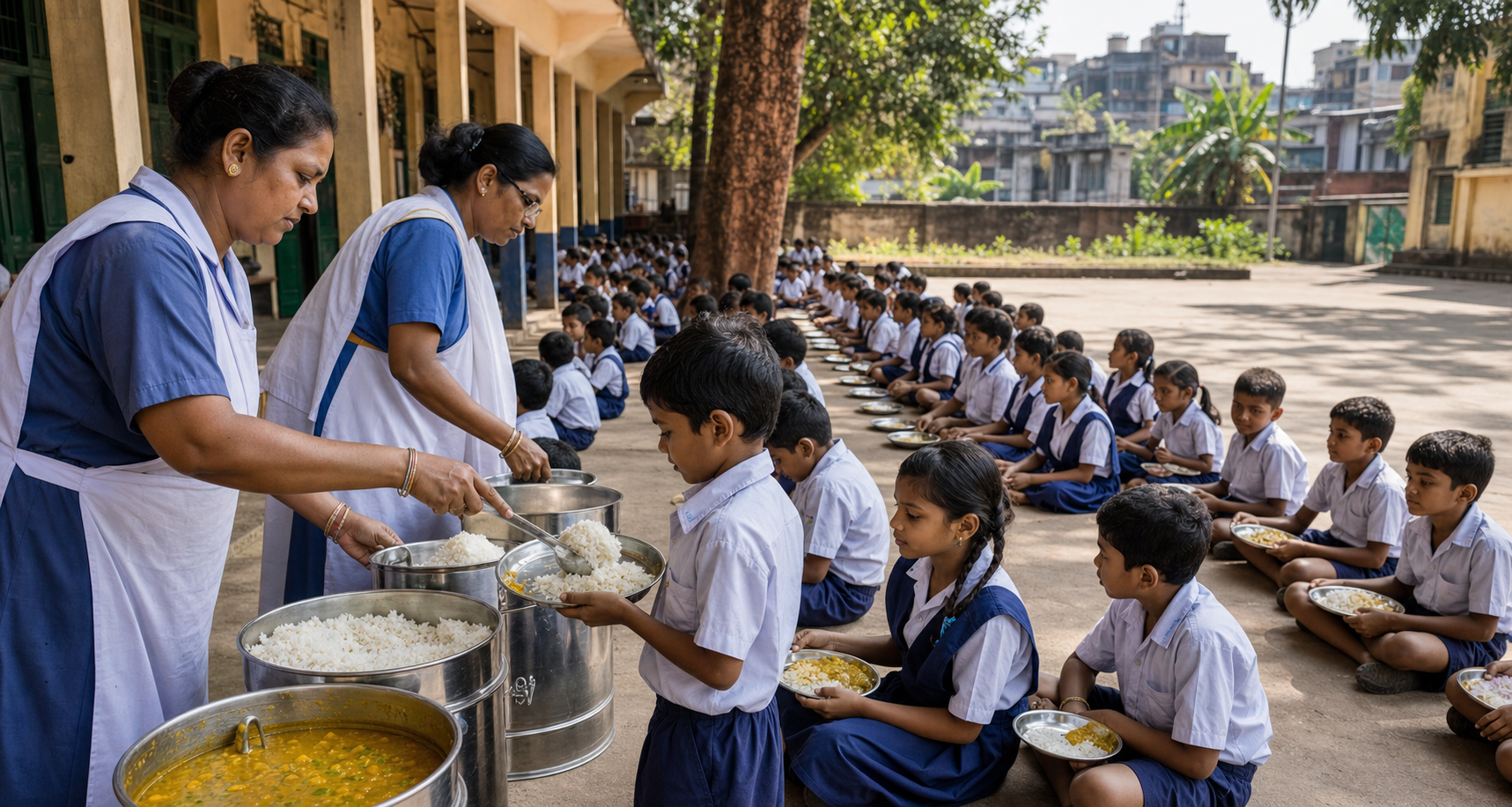
If your child studies in a Kolkata school covered by the new ISKCON meal programme, the most useful question is not whether a giant kitchen can produce an impressive number of meals. It is whether the right meal reaches every school on time, in good condition, every school day.
The expansion gives Kolkata a serious piece of food-service infrastructure and ISKCON a demanding test of Dharmic public service. You can welcome the seva while asking for clear evidence on delivery, nutrition, inclusion and accountability. In fact, that scrutiny is how a promising inauguration becomes a dependable institution.
What Kolkata’s schools have actually been promised
The first phase was announced for 44,000 students across 500 schools in the Kolkata Municipal Corporation area. The stated plan is to extend coverage to 2.5 lakh students within three months, as part of a broader aim to serve more than two lakh children each day.
Those figures describe intended coverage, not yet proven daily performance. That distinction matters. A scheme can have thousands of children on its list while still delivering late, sending the wrong quantity or failing to serve everyone present. Parents and school committees should therefore ask for both numbers: how many children are assigned to the programme, and how many meals are actually received and served each day.
The Taratala mega-kitchen can reportedly cook around 1.5 lakh meals at a time. That does not by itself conflict with a daily target of 2.5 lakh; more than one production or dispatch cycle may be possible. But the available account does not specify those cycles. As coverage grows, administrators should disclose how many batches are required, when each batch leaves and which schools belong to each route.
The announced menu framework includes rice, pulao or khichdi; paneer or chhana; soybean, seasonal vegetables or almonds; and sweets or seasonal fruit. Read that as a range of possible components, not a promise that every listed item will appear in every meal. A weekly school-level menu is the practical document families need.
Key takeaways
- The rollout begins with 44,000 students in 500 KMC-area schools and has an announced three-month target of 2.5 lakh students.
- The central kitchen can cook around 1.5 lakh meals at one time, so batching and dispatch performance will become increasingly important.
- ISKCON will provide the vegetarian meal, while boiled eggs are supposed to be supplied separately twice a week.
- GPS-tracked vehicles, sealed containers and an AI-enabled dashboard are useful controls, but they do not replace records kept at the receiving school.
- No cook-cum-helper is supposed to lose employment under the new arrangement; that promise should be verified during implementation.
The vegetarian meal and egg question has a workable answer
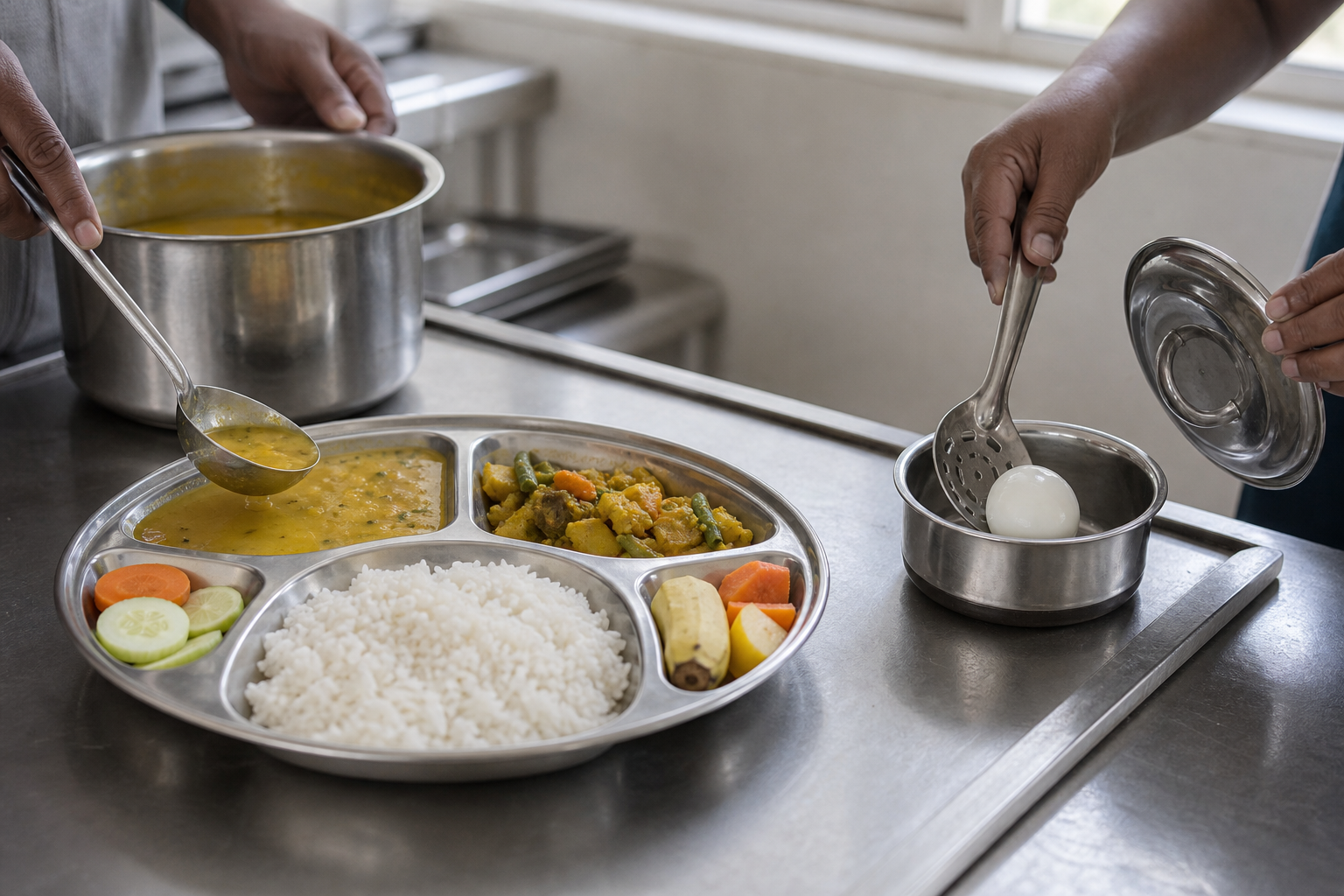
Much of the political argument has centred on eggs. The announced arrangement is straightforward: ISKCON retains its vegetarian food practice, while the government provides boiled eggs separately twice a week to students at schools receiving the meals.
This is a reasonable model for a plural public setting. It does not require a Dharmic institution to discard its food discipline in its own kitchen, and it does not make that discipline the only component of the state’s school-meal arrangement. Religious integrity and civic accommodation need not be treated as enemies.
The compromise will work only if responsibilities remain visible. Each participating school should display the two scheduled egg days, record the number delivered and report a missed delivery separately from any problem with ISKCON’s vegetarian meal. Otherwise, two supply chains can become an excuse for neither party to own a failure.
The vegetarian menu must also be judged on what is served, not on a label. Schools should record whether the declared paneer, chhana, soybean, vegetables, nuts or fruit actually arrived on the days shown in the menu. This is not an argument for imposing one food ideology. It is basic verification that children received what was promised.
Families managing a known food allergy or another medically required restriction should ask the school how ingredients and substitutions will be communicated before the child eats the meal. Almonds appear in the announced menu range, so a generic description such as “vegetarian” is not enough to establish that a meal is suitable for every child.
The last mile will decide whether the mega-kitchen succeeds
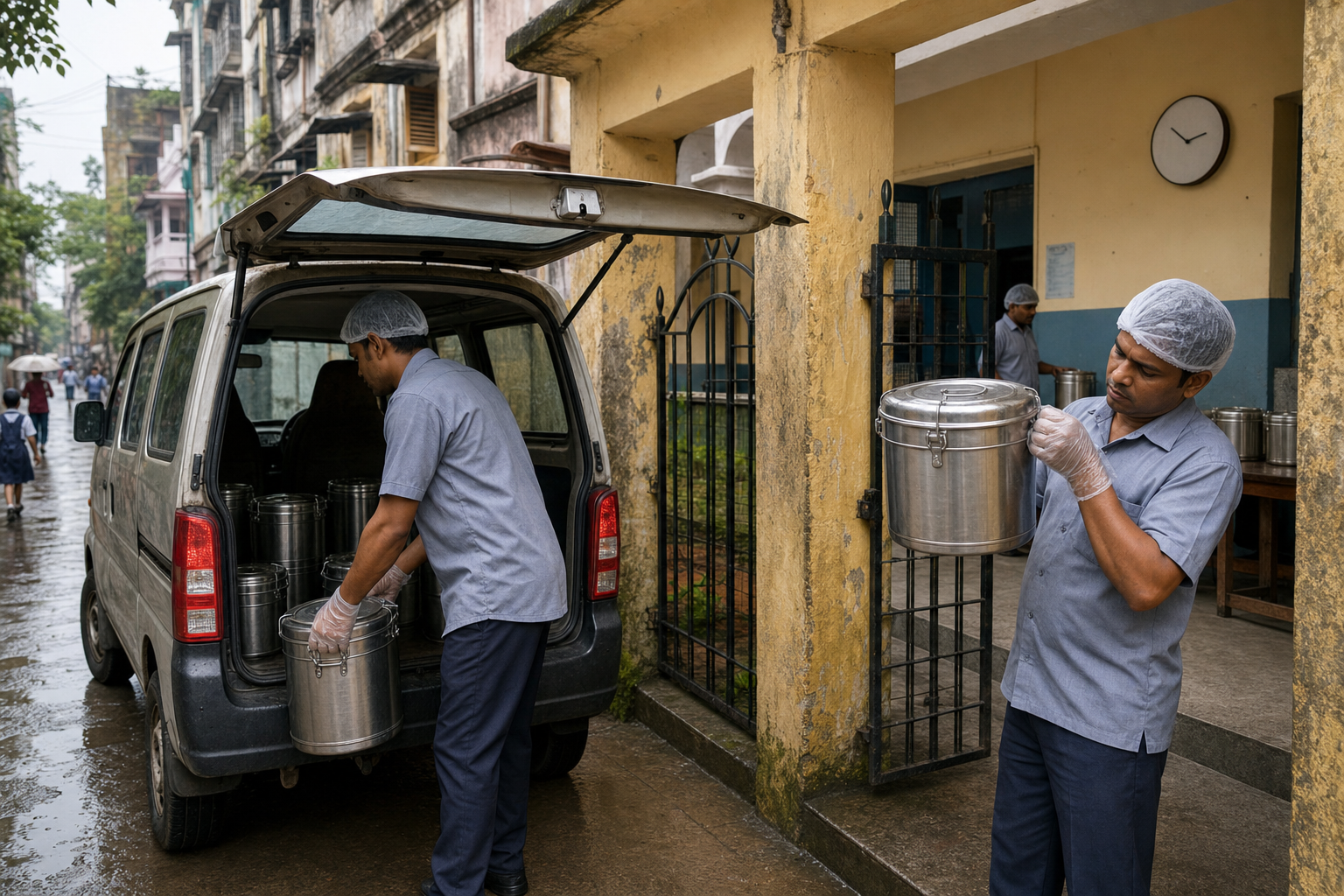
The new system includes electric delivery vehicles with GPS tracking, sealed food containers and an AI-enabled kitchen dashboard. These are sensible controls. They can improve visibility over dispatches, reduce casual handling and help managers notice exceptions.
The launch also revealed the weak point. Some north Kolkata schools did not receive their meals on time because VIP security constraints delayed vehicle dispatch. Officials said schedules would be streamlined from the following Monday. That may prove to have been a one-day disruption, but it demonstrates why kitchen capacity is not the same as reliable service. A meal completed in Taratala has not fulfilled its purpose until a child can eat it at school.
| Control | What it can establish | What the school must still check |
|---|---|---|
| GPS-tracked vehicle | Where a delivery vehicle travelled and when | When the school received the food and whether the timing disrupted serving |
| Sealed container | Whether a container remained closed before reaching the school | Whether the seal was intact, the quantity was correct and the food was acceptable when opened |
| AI-enabled dashboard | Whether selected kitchen and delivery parameters are being collected | Which parameters are measured, what triggers an alert and who resolves an exception |
| Large cooking capacity | How much food can be produced at one time | Whether batching, loading and routes deliver every school’s allocation consistently |
The important lesson is that technology records only what the system has been designed to record. A GPS point cannot tell you whether every child was served. An intact seal cannot tell you whether the school received enough portions. An AI label cannot tell you whether a repeated complaint was investigated. For each tool, administrators should name the metric, the person responsible for reviewing it and the corrective action expected when something goes wrong.
A short monthly exception report would be more useful to families than a display of technical sophistication. It could show delayed routes, quantity shortfalls, damaged or broken seals, menu deviations, missed egg deliveries, complaints received and the date each recurring problem was closed. Individual children’s names or medical information should not appear in a public report.
How parents and school committees can test the first month
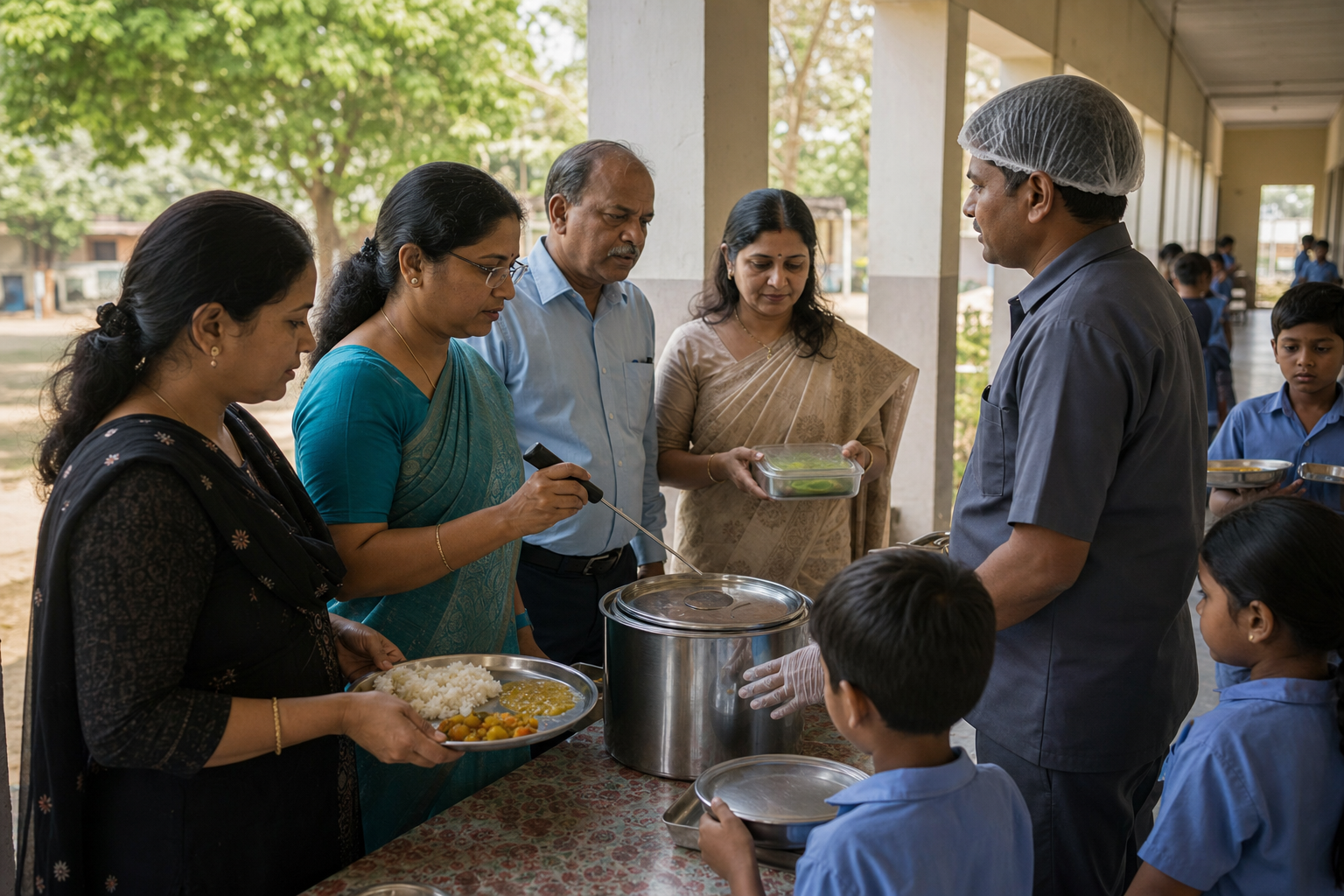
Do not judge the programme solely by an inauguration meal, and do not condemn it solely because of one disrupted launch day. Use the first four school weeks to establish a simple baseline. You do not need a complex audit system.
- Display the weekly promise. Put the menu, expected serving time and two designated egg days where students and families can see them. Without a visible promise, a deviation cannot be identified clearly.
- Keep one daily receiving log. Record scheduled arrival, actual arrival, number of portions, seal condition, menu received and whether the separate egg delivery arrived on its promised day. The receiving staff member should initial the entry.
- Record service, not just delivery. Note approximately how many children were present, how many meals were served and whether a substantial quantity remained. A delivery count alone cannot reveal a portion shortage or a meal children repeatedly decline to eat.
- Ask children three plain questions. At class level, ask whether the meal was available, whether the portion was sufficient and whether they would willingly eat that menu item again. Aggregate the responses rather than publishing children’s names.
- Escalate patterns in writing. When the same route, shortage or menu problem repeats, send a dated note that identifies the school, delivery date, problem and requested correction. Keep the response with the monthly record.
- Verify the employment promise. The announcement said that no cook-cum-helper would lose a job. School committees should record whether existing workers remain employed, what duties they now perform and whether any unresolved displacement has occurred.
This process separates three different questions that public debate often mixes together: Can the central kitchen cook at scale? Can the delivery network reach schools reliably? Do children actually receive and eat the promised meal? A programme succeeds only when all three answers remain yes.
Student feedback deserves particular attention. One Class 7 pupil at the launch described the pulao, rice, paneer and mixed vegetables served there as tasty, while another expressed hope that ISKCON’s reputation would translate into good school meals. Those reactions are encouraging, but routine feedback from ordinary school days is the evidence that should guide menu adjustments.
Support the seva, and insist that it keeps its promises
For a Dharmic institution, feeding children is more than a demonstration of organisational scale. Annadana becomes dependable public service when devotion is joined to punctuality, honesty about failures, respect for different family practices and disciplined correction.
If you are a parent, teacher or school committee member in the first group of 500 schools, ask for the four-week log now, before expansion makes weak routines harder to repair. If the system works well, the record will give it earned public confidence. If it does not, the same record will show administrators exactly which route, handoff or responsibility needs to be fixed.
References
- Dandavats – Iskcon mid-day meal kicks off for 44k students across 500 schools
- The Times of India – ISKCON mid-day meal kicks off for 44k students across 500 schools
