
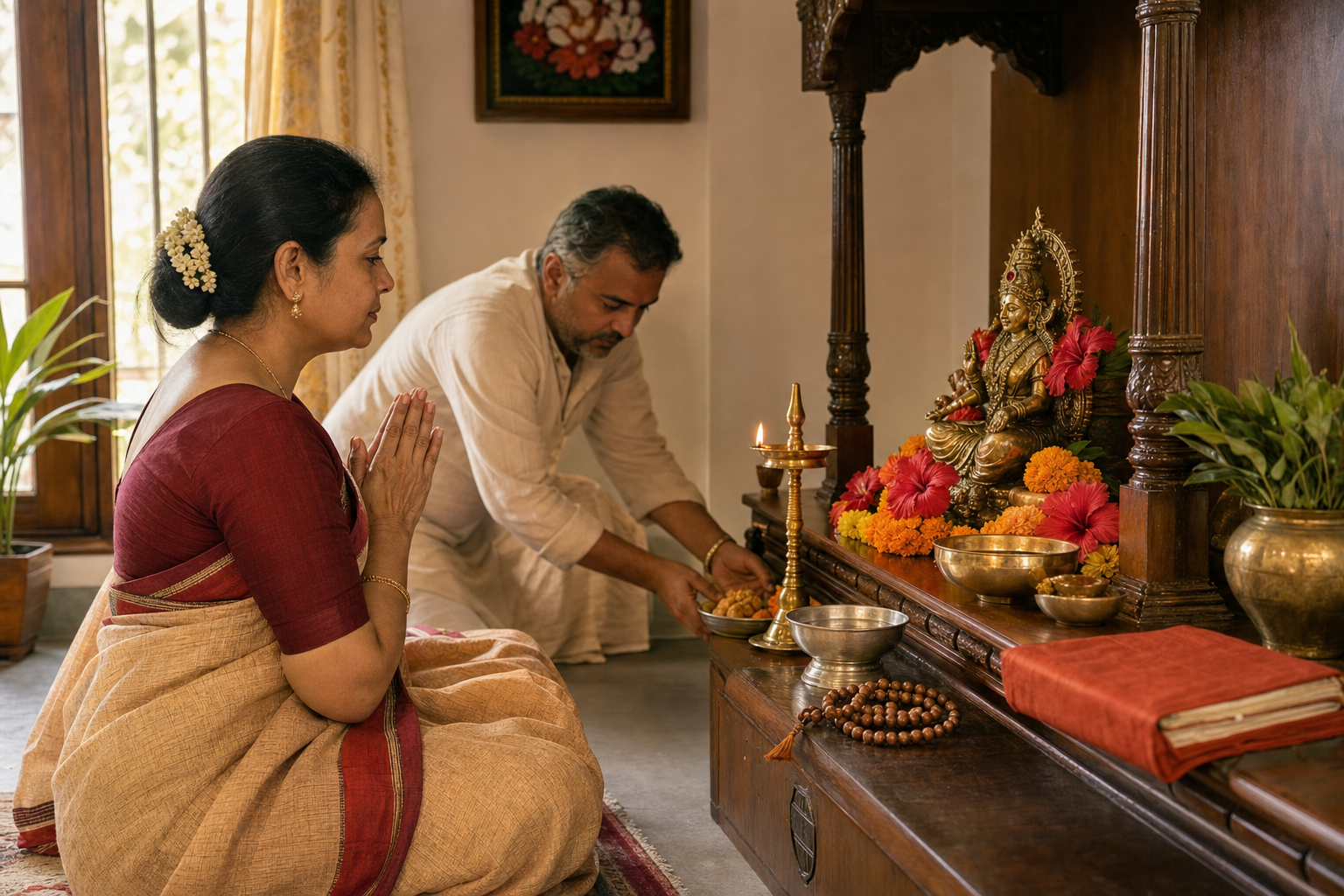
You may feel drawn to a form of the Divine Mother and still be unsure what to do next. Is the image offering a precise teaching or merely devotional beauty? May you recite any hymn you find? If your family names a goddess as its Kula Devi, what makes that relationship different from personal preference?
A grounded approach keeps three dimensions together: the symbol trains your vision, the hymn disciplines your speech, and the living tradition places both within a relationship. When these are separated, Shakti can be reduced to an abstract idea of power. When they remain connected, goddess worship becomes a practical way to cultivate attention, courage, compassion, and responsibility.
Read a Shakti image from the ground upward
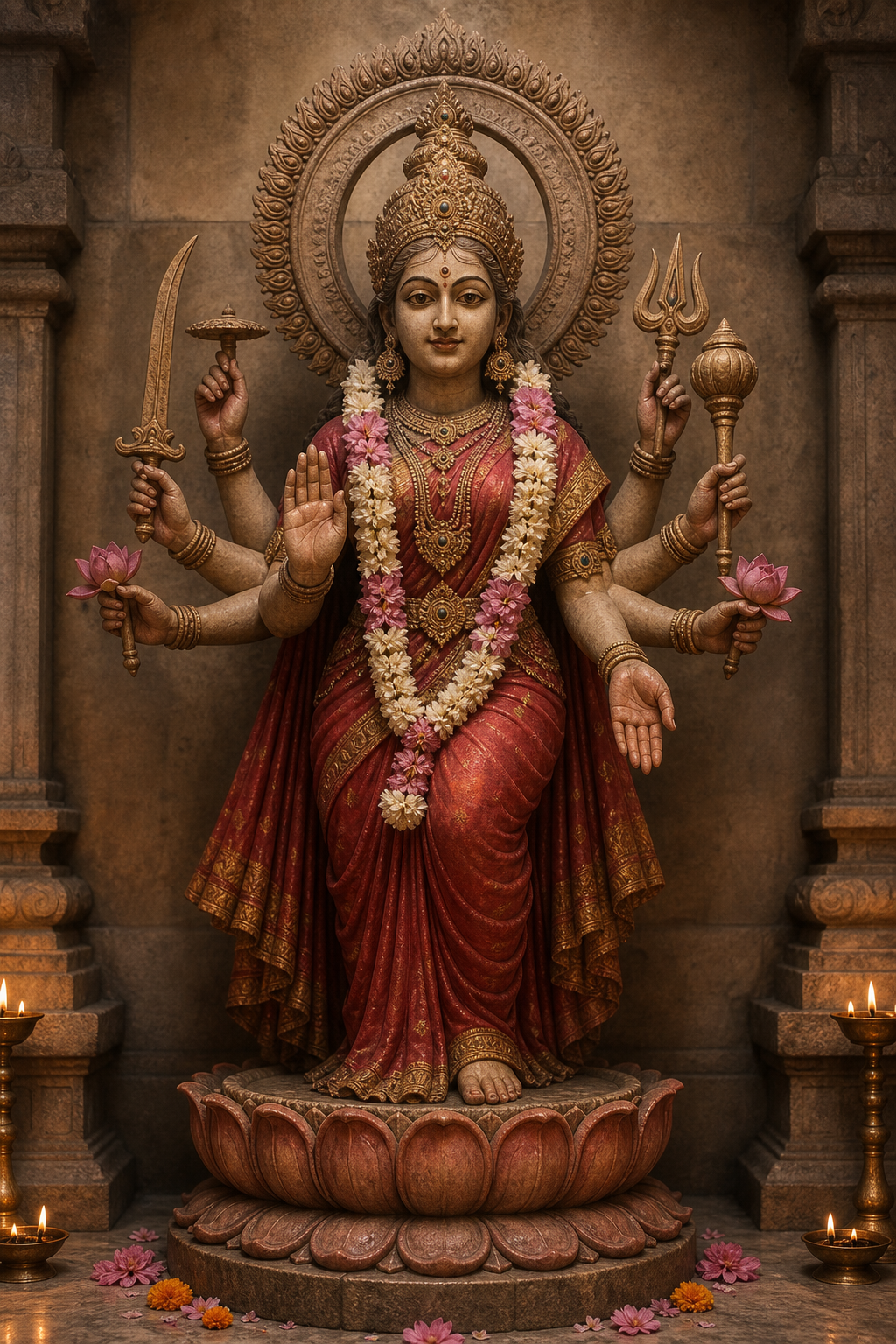
Begin by asking what each element is doing in relation to the others. A sacred image is not a collection of interchangeable decorations. Posture, seat, direction, gesture, colour, weapon, flower, and accompanying deity form a visual grammar. The meaning lies as much in their relationship as in any single object.
The image of Shodashi, also known as Tripura Sundari or Lalita, seated upon a lotus arising above Shiva’s navel gives you a clear example. Read it from the ground upward: Shiva represents still, unconditioned consciousness; the navel marks origin, equilibrium, prana, and the organising fire of life; the lotus expresses pure emergence; and Shodashi manifests as conscious, compassionate power.
This is not a picture of one deity defeating or replacing another. Shiva and Shakti supply complementary terms in a single metaphysical statement. Consciousness is not inert nothingness, and power is not blind force. Shiva is the silent ground; Shakti is the intelligence by which that ground becomes creation, perception, beauty, knowledge, and action.
Shodashi means the Sixteen. Her eternal youth should not be read as an ordinary biological age. It signifies fullness: completeness of kala, beauty, wisdom, and compassionate sovereignty. As a Mahavidya and the central Goddess of Sri Vidya devotion, Tripura Sundari governs the three realms of experience while remaining their still centre. Her beauty is therefore not ornamental. It reveals an order in which wisdom and beauty illuminate one another.
The lotus contributes another layer. Hindu, Buddhist, Jain, and Sikh traditions all use lotus imagery to evoke purity, awakening, and an inward flowering that remains unstained by difficult surroundings. That shared vocabulary does not make the traditions doctrinally identical. In this particular image, the lotus belongs to a specifically Shiva-Shakti teaching: manifestation unfolds from consciousness without becoming separate from it.
You can use a simple four-pass method whenever you encounter unfamiliar goddess iconography:
- Describe before interpreting. Name the visible elements without immediately deciding what they mean.
- Identify each element separately. Ask what the lotus, navel, posture, gesture, or accompanying deity ordinarily signifies.
- Read the relationship. Notice what supports what, what emerges from what, and where stillness and activity appear.
- Bring the teaching inward. Ask where awareness, energy, discernment, and compassionate action meet in your own conduct.
For a modest dhyana, sit steadily and attend to your natural breath. Visualise a radiant lotus at the navel and recollect Shodashi as wise, serene sovereignty. Do not force the breath, manufacture an altered state, or add a mantra whose wording and use you have not received. The image itself is already sufficient material for contemplation.
Sri Vidya carries this relationship into the inward pilgrimage of the Sri Chakra, moving from outward worship toward interior realisation. If you have not been trained in that tradition, recognise the broad teaching without assuming that recognition confers ritual instruction. Reverence includes knowing the difference between contemplating a symbol and claiming mastery of its complete discipline.
Choose a hymn by relationship, not by size or reputation
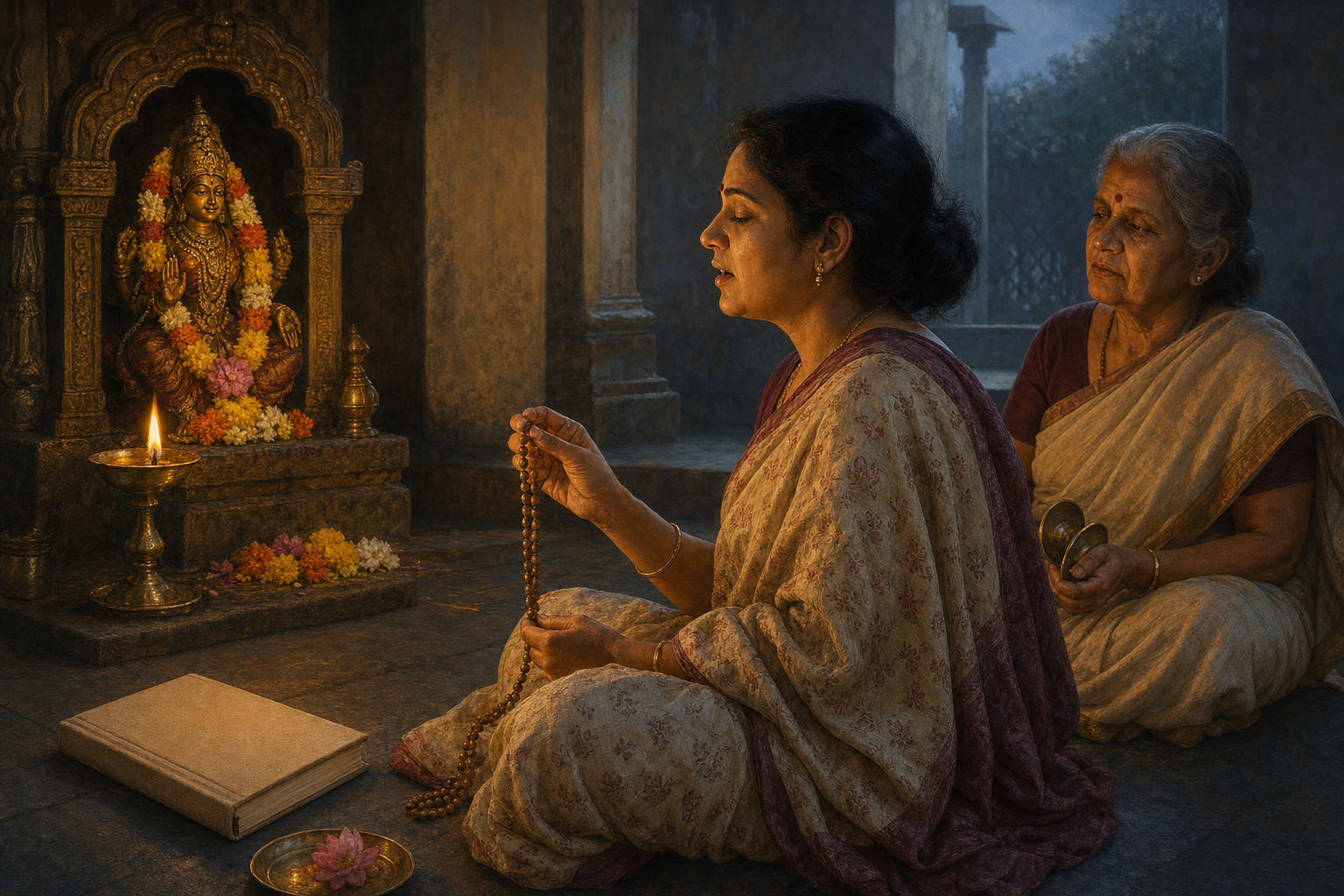
A stotra gives devotion a stable form. Its names, images, rhythms, and theological claims teach you how a particular community has learned to address the Goddess. That makes a hymn more than inspiring language, but it also means that one hymn should not be treated as a generic substitute for every goddess tradition.
The Mooka Panchashati is a 500-verse Sanskrit hymn to Kamakshi of Kanchipuram. Tradition remembers Mooka Kavi as a poet who could not speak and whose voice flowered through the Goddess’s grace. The memory makes spiritual sense as an image of inner silence ripening into sacred speech. It should be received as devotional testimony, not converted into a clinical promise about speech conditions.
You do not need to begin by attempting all 500 verses. A few verified verses recited regularly, with attention to their meaning, can establish a more honest relationship than a long recitation performed only to finish it. Kamakshi’s form, compassion, and sovereignty give the practice its centre. When temple darshan at Kanchipuram is possible, shrine and hymn can deepen one another; when it is not, thoughtful home recitation still offers an interior pilgrimage.
Dakshineshwari devotion has a different emphasis. Within the tradition of the Dakshineshwari Stuthi, the Goddess is approached as Shakti, Sanyasini, compassionate protector, and the consort of Dakshinamurthy, Shiva’s silent Guru form. This makes the hymn especially suited to a sankalpa centred on discernment, renunciation, inward stillness, or the unity of devotion and knowledge.
The distinction between stotra and mantra matters here. A hymn of praise may be publicly preserved, while the exact form and use of a mantra can depend on a parampara. When a text is available only as a fragment beginning with Om Ma, do not fill the gap from memory, combine phrases from unrelated websites, or assume that every reading is equivalent. Seek the complete wording from the lineage or a trustworthy teacher who actually preserves it.
Before adopting a hymn, apply three tests:
- Textual test: Do you have the complete and verified wording, or only an excerpt with missing syllables?
- Practice test: Is this a public praise hymn, or a lineage-specific mantra with instructions attached to it?
- Meaning test: Can you explain whom you are addressing and what at least the portion you recite is asking you to recognise?
If you need a simple public invocation, the widely used praise Ya Devi Sarva Bhuteshu Shakti Rupena Samsthita addresses Devi as the power present in all beings. It is short enough to recite attentively and broad enough to turn your attention from an external image toward the sacred presence within life.
Some Dakshineshwari observances use 11, 27, or 108 repetitions, preceded by breath awareness and a clear sankalpa. Use one of those counts when it belongs to the practice you have received; do not treat a larger count as automatically more potent. Counting should protect attention from drift, not turn worship into a transaction.
Panchopachara worship can accompany recitation where appropriate: gandha, pushpa, dhupa, deepa, and naivedya, or fragrance, flower, incense, lamp, and food offering. The sequence aligns body, speech, and mind around one act of hospitality toward the deity. If you cannot offer the complete set, a clean space, a lamp or flower, and attentive recitation preserve the essential dignity of the act.
A living goddess is known through relationship and place
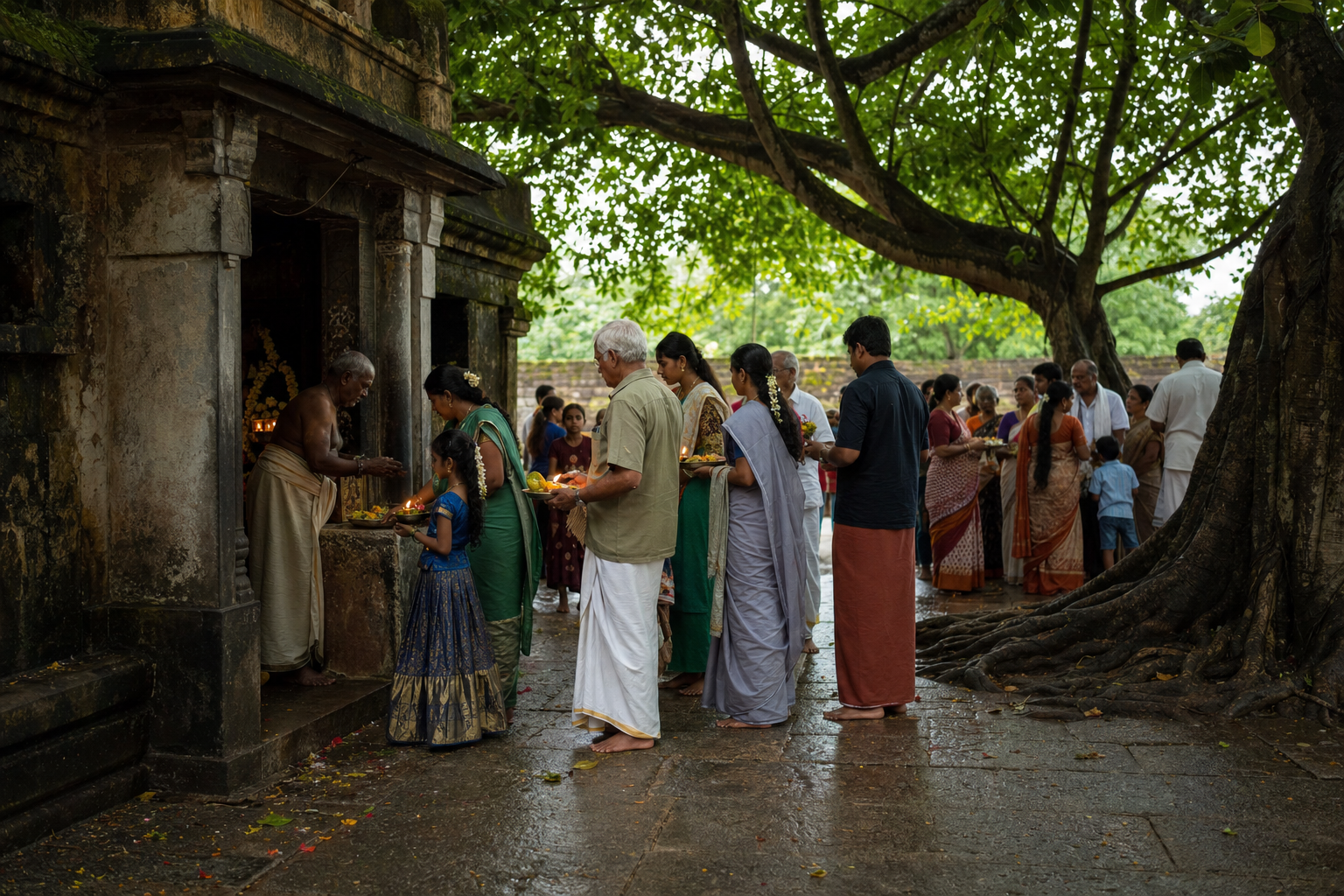
Shakti is cosmic, but goddess traditions are rarely placeless. A named Devi may be remembered through a particular temple, landscape, household, profession, festival, and ancestral relationship. These are not secondary details. They are how theology enters ordinary life.
Harsiddhi Mata is venerated across Gujarat, Madhya Pradesh, and Maharashtra as a protective and compassionate manifestation of Parvati. Her worship is anchored by the celebrated shrine at Ujjain and longstanding traditions in coastal Saurashtra. In this geography, the Goddess is not merely an abstract symbol of strength. Families approach her for moral courage, auspiciousness, clarity in uncertainty, and the safe continuation of communal life.
Her role as Kula Devi is especially important. Brahmin, Jain, and other community households maintain bonds with Harsiddhi Mata through family rites and life-cycle observances. A Kula Devata is therefore not simply the deity you currently find most attractive. The relationship carries inherited memory, obligations, customary offerings, and continuity between generations.
If you suspect that your family has a Kula Devi but do not know the tradition clearly, resist the urge to settle the matter through guesswork. Do this instead:
- Ask older relatives for the deity’s exact name, local pronunciation, associated village or temple, and the occasions on which the family remembered her.
- Write down differing memories without forcing them into immediate agreement. A regional name and a formal Sanskrit name may coexist, but similarity alone does not prove identity.
- Ask what the family actually did: lighting a diya, offering flowers or coconut, making a pilgrimage, joining an aarti, or observing a particular life-cycle rite.
- When a shrine is known, consult a responsible person connected with that temple or community before reviving an elaborate observance.
- Begin with the simplest practice the family can genuinely verify. Continuity is restored through fidelity, not through invented complexity.
Coastal devotion to Harsiddhi Mata makes the practical character of living Shakti especially visible. Fishing communities pray before departure for safety, favourable winds, and a peaceful return. A small lamp and a quiet prayer bind spiritual trust to the concrete risks of work and homecoming. The Goddess is present at the threshold where livelihood, uncertainty, courage, and family responsibility meet.
Navaratri expands that household bond into a communal rhythm of aarti, bhajan, dance, and gathering. Yet public celebration should not obscure the quieter structure beneath it: daily remembrance, inherited duty, and conduct shaped by the conviction that the Mother sees how her devotees live.
The presence of Hindu and Jain households within Harsiddhi devotion also teaches an important form of Dharmic plurality. Shared reverence need not erase doctrinal boundaries. Hindus, Buddhists, Jains, and Sikhs can recognise common values such as compassion, disciplined attention, truthfulness, and respect for life while retaining their distinct understandings of deity, liberation, scripture, and practice. Unity becomes stronger when it is accurate.
Build a home practice that joins image, sound, and conduct
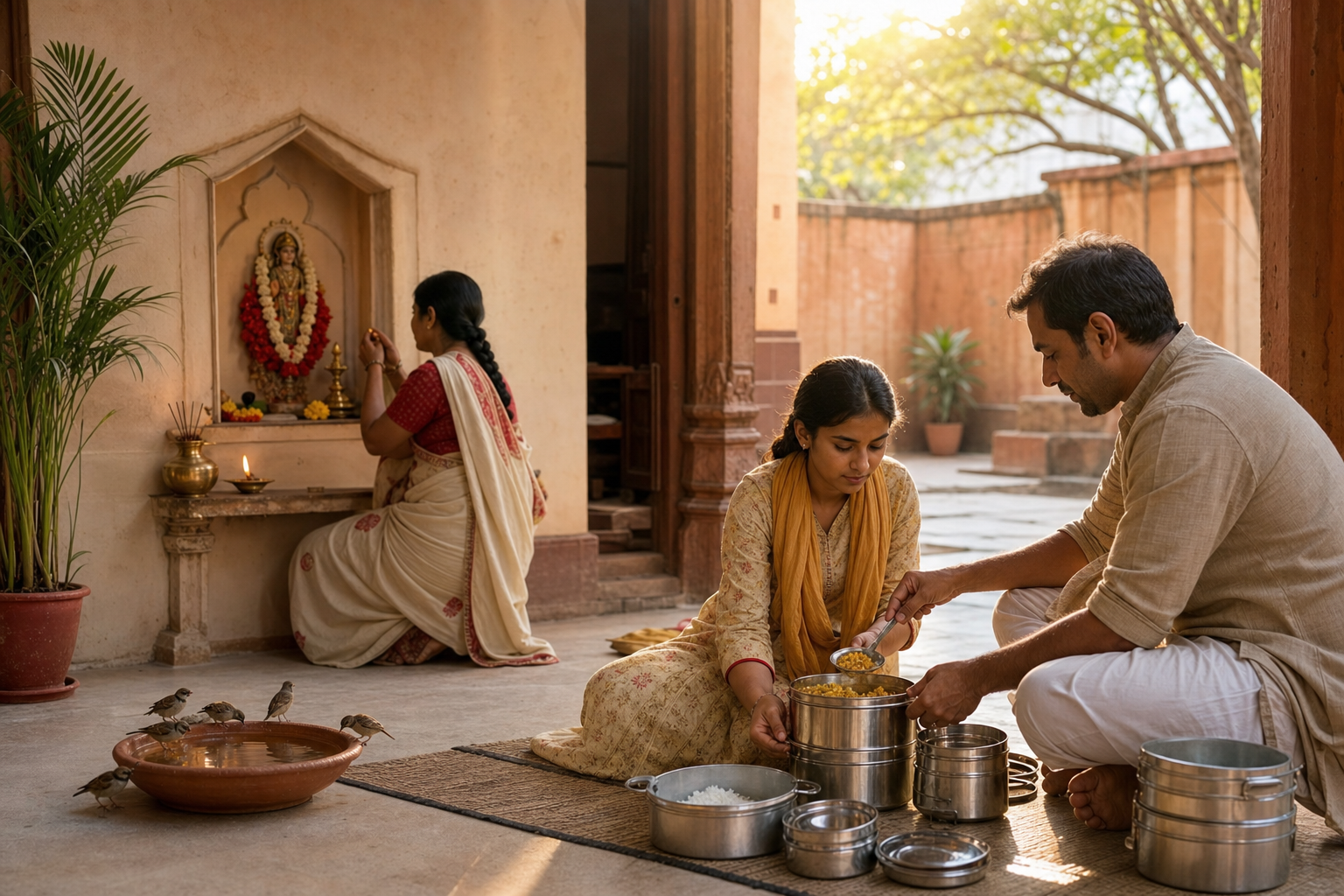
A sustainable Shakti practice does not require collecting many images, hymns, and ritual objects. Begin with one form you can identify, one verified praise you understand, and one ethical intention you are prepared to carry into the day. This keeps bhakti from becoming either consumption or performance.
- Prepare the place. Use a clean surface and, where practical, a diya or flower. Let the act of preparation mark a transition from distraction to attention.
- State a narrow sankalpa. Choose something you can embody, such as truthful speech, steadiness in a difficult duty, or compassion without loss of discernment.
- Look before reciting. Identify the deity, seat, posture, and central symbols. Recall the relationship they express rather than treating the image as a decorative backdrop.
- Recite a verified portion. Use a few verses, a complete public invocation, or the count given by your tradition. Pronounce carefully, but do not allow anxiety about perfection to replace devotion and meaning.
- Keep a period of silence. Let the sound settle. In Dakshineshwari worship, this silence naturally recalls the Guru principle; in Shodashi contemplation, it returns dynamic Shakti to the still awareness from which she flowers.
- Complete the sankalpa through action. If you invoked compassion, change how you address someone. If you invoked protection, fulfil a neglected responsibility. If you invoked wisdom, pause before repeating something unverified.
Daily recitation can provide a dependable rhythm, while Mondays, Navaratri, or Guru Purnima may carry special relevance in Dakshineshwari-oriented worship. Choose an observance because its meaning supports your practice, not because an auspicious date is expected to compensate for inattention during the rest of the year.
Devotees often describe clarity, emotional steadiness, protection, or deeper meditation in connection with goddess worship. Receive such accounts with respect, but do not impose a timetable on grace. The most immediate test is available in your conduct: whether abhyasa is making your attention steadier, your speech less careless, and your strength more compassionate.
There are also clear boundaries worth keeping. Do not invent missing mantra syllables. Do not declare a personally chosen deity to be your family’s Kula Devi without family memory or community grounding. Do not collapse every goddess into a vague feminine energy. And do not use the language of unity to erase the distinctive theology of Sri Vidya, Kamakshi worship, Dakshineshwari devotion, or Harsiddhi Mata’s regional traditions.
Key takeaways for your next act of worship
- Read Shakti iconography relationally: ask how consciousness, energy, purity, wisdom, and action are arranged.
- In the Shodashi image, Shiva is the still ground, the navel-lotus is the point of emergence, and the Goddess is conscious creative power.
- Treat a public stotra and a lineage mantra differently. If wording is incomplete or readings vary, seek instruction rather than improvising.
- Start a long hymn such as the Mooka Panchashati with a small, verified portion whose meaning you can contemplate.
- Recognise a Kula Devi through inherited family and community ties, not personal preference alone.
- Let worship culminate in conduct. The lamp, image, and recitation should make your next act more truthful, responsible, discerning, or compassionate.
At your next worship, do less but know what you are doing. Study one image from the ground upward, recite one complete and verified line, and carry one quality of the Goddess into a real obligation. If a mantra or family tradition remains uncertain, let your next act be an honest question to an elder, teacher, or temple community. That discipline is already a form of reverence.
References
- DharmaRenaissance Blog — Unveiling Tripura Sundari: Profound Symbolism of Shodashi on Shiva’s Navel Lotus
- DharmaRenaissance Blog — Harsiddhi Mata, Sacred Shakti: Kula Devata Uniting Gujarat, Madhya Pradesh and Maharashtra
- DharmaRenaissance Blog — Dakshineshwari Stuthi: Timeless Praise of Shakti, Consort of Lord Dakshinamurthy
- DharmaRenaissance Blog — Mooka Panchashati: Miraculous Hymn to Kamakshi and the Living Grace of Kanchipuram
