

You have seen a temple insulted, a Hindu student targeted, a festival obstructed, or a hostile claim spreading online. You know something is wrong. The difficult part is deciding what happened, what you can prove, and where to take it without exposing the victim to more harm.
The most effective response is neither silence nor instant outrage. It is a disciplined record: name the conduct accurately, preserve the original evidence, protect the people involved, and ask the right institution for a specific remedy. That approach makes anti-Hindu hatred harder to deny and harder to exploit.
Name the harm accurately before you name an offender
Anti-Hindu hostility appears in several forms, but they are not interchangeable. Calling everything a hate crime weakens serious cases because an official can dismiss the entire complaint after finding one inaccurate label. Start with the conduct you can establish.
- A crime is an act such as assault, a credible threat, stalking, vandalism, sexual violence, theft, or unlawful coercion. Whether it is formally treated as a hate crime depends on local law and evidence that bias influenced the act.
- Discrimination is adverse treatment connected to Hindu identity or practice. It may involve employment, education, housing, access to a facility, or permission to observe a festival. The strongest complaint identifies the decision, the decision-maker, the stated reason, and a relevant comparison.
- Harassment is repeated or severe conduct that creates a hostile environment. A slur can be evidence, but the surrounding pattern, the speaker’s authority, and the consequences often determine what an institution can do.
- Religious hostility includes contemptuous stereotypes, desecration, exclusion, and attempts to intimidate people out of visible Hindu practice. It may be morally serious even where the law does not prohibit it.
- Disinformation is fabricated or manipulated material designed to deceive. It becomes especially dangerous when it incites violence, identifies a target, impersonates an authority, or coordinates harassment.
These distinctions matter in live controversies. Between 26 July and 1 August 2026, for example, police in Uttar Pradesh arrested seven people over an alleged organised conversion network, while Delhi Police said they had identified and blocked more than 400 accounts allegedly operated from Pakistan and distributing deepfakes, manipulated visuals, and edited statements connected to student protests. Those are police claims at a particular stage of investigation. An arrest is not a conviction, and an account being blocked does not prove every allegation made about its operator.
The same care applies to speech. A reported complaint describing a Guru Purnima celebration as anti-national and the use of a derogatory cow-urine jibe against the IIT Madras director can reasonably prompt scrutiny of anti-Hindu stereotyping in political and institutional life. Yet offence alone is not automatically a crime. Record the exact words, identify the setting and speaker, and show any threat, exclusion, penalty, or repeated pattern that followed.
Do not move from an accused person’s name to a verdict against Muslims, Christians, journalists, students, or any other population. Individual responsibility and institutional patterns can both be investigated without collective blame. A Dharmic defence loses moral and evidentiary force when it reproduces the indiscriminate hatred it is trying to expose.
Build an evidence packet that can survive scrutiny
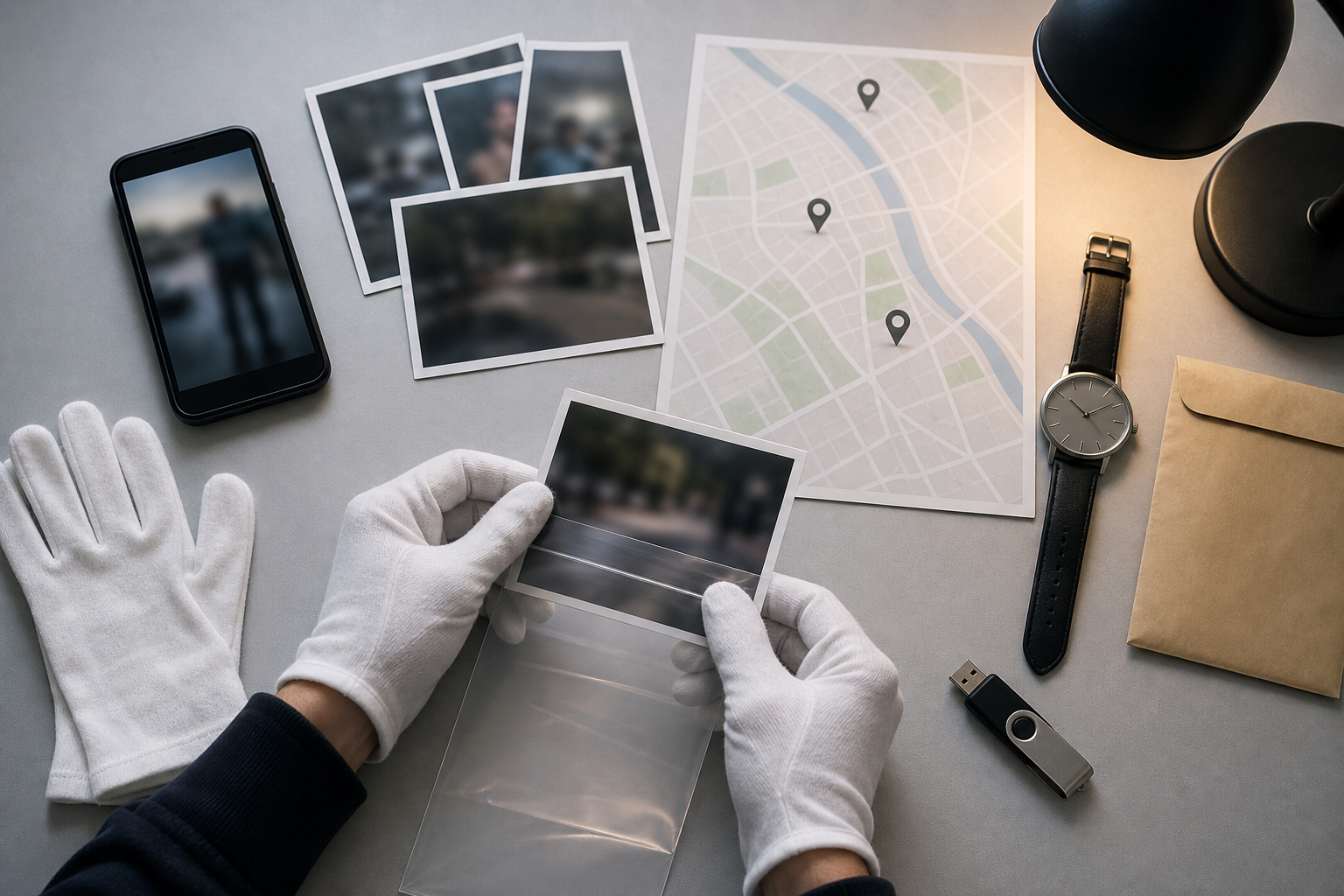
Your first record should be factual enough for a police officer, school administrator, employer, platform moderator, lawyer, or journalist to understand without reading your social-media commentary. Build it while memories and digital traces are fresh.
- Secure the person at risk. If violence, a credible threat, stalking, sexual abuse, or danger to a minor is occurring, contact local emergency services or an appropriate safeguarding authority. Do not delay urgent help to collect better footage.
- Open an incident record. Put the date, local time, time zone, location or platform, people present, and a one-sentence description at the top. Give the record a neutral name, such as Incident 2026-08-02 Temple Gate, rather than a conclusion about guilt.
- Preserve originals. Save the original image, video, audio, email, message, URL, account handle, and visible timestamp. Keep an untouched copy and work only from duplicates. A cropped screenshot may be useful for communication, but retain the full screen showing context.
- Write what each witness directly perceived. Separate words heard, acts seen, and files received from assumptions about motive. Ask witnesses to prepare their own notes before discussing details as a group.
- Capture context that bears on bias. Record anti-Hindu slurs, references to deities or practices, prior incidents, selected targets, symbols damaged, and any statement explaining why the victim was chosen. Quote only the words necessary to establish what occurred.
- Protect vulnerable people. Remove the names, faces, school details, addresses, and contact information of minors and survivors of sexual violence from public copies. Give unredacted material only to appropriate authorities or professional advisers.
- Keep a contact log. Record when you reported the matter, the channel used, the person or department that received it, the reference number, promised next step, and follow-up date.
A discrimination complaint needs an additional layer: the comparator. Suppose a restriction affects Diwali on environmental or safety grounds. The restriction is not proven anti-Hindu merely because Diwali is affected. Collect the written rule, criteria, data cited by the authority, dates of enforcement, treatment of genuinely comparable events, reasons given for any exception, and results of appeals. A double standard becomes demonstrable when equivalent cases receive materially different treatment under the same authority and conditions.
For a school, workplace, or venue dispute, preserve the policy version in effect when the decision was made. Save applications, approvals, denials, emails, meeting notes, and the practical consequence: cancelled access, lost pay, disciplinary action, additional cost, or denial of an accommodation. Avoid secret recording unless you have confirmed that it is lawful where you are; recording and privacy rules vary.
Label the status of every important claim. Use observed for what a witness directly saw, alleged for an accusation, verified for material authenticated through a reliable original, disputed where accounts conflict, and unknown where evidence is missing. That vocabulary prevents a preliminary report from hardening into an unsupported certainty.
Choose the reporting route by the remedy you need

Before sending the packet everywhere, decide what outcome is needed: immediate protection, a criminal investigation, removal of threatening content, preservation of evidence, a religious accommodation, reversal of a discriminatory decision, discipline under an institutional policy, or a public correction. Different remedies belong to different channels.
- Use police or emergency channels for violence, credible threats, vandalism, stalking, sexual offences, coercion, or immediate danger. Ask how to obtain an incident or complaint number and how to submit additional evidence. Laws, procedures, and legal deadlines differ by jurisdiction; serious cases warrant advice from a qualified local lawyer or victim-support service.
- Use the institution’s written process for a workplace, school, university, landlord, professional body, or venue. Cite the relevant policy language, attach the timeline, and request a defined action. Ask who owns the case and when a written response is due.
- Use platform reporting for impersonation, threats, doxxing, coordinated harassment, or manipulated media. Include URLs and account identifiers, not screenshots alone, because content and usernames can change.
- Use a trusted Hindu or civil-rights organisation when a victim needs accompaniment, translation, community safeguarding, or help escalating repeated institutional inaction. Confirm how the organisation protects personal data before sharing unredacted files.
- Use public communication only after considering consent, safety, defamation risk, and the possibility of contaminating an investigation. Publicity can mobilise support, but it can also expose a survivor, trigger retaliation, or spread a false identification that cannot be fully undone.
A useful submission is short at the front and complete behind it. Begin with one paragraph stating who was harmed, what observable act occurred, when and where it happened, why Hindu bias is suspected, whether anyone remains at risk, and what action you want. Follow it with a chronological timeline and an indexed set of attachments. Keep argument and historical background out of the opening page unless they directly establish the institution’s duty or a repeated pattern.
Do not publish an accused person’s home address, relatives, private contact details, or an unverified identity. Do not encourage followers to confront anyone. If the evidence is incomplete, say what remains unknown. Due process is not softness toward anti-Hindu hatred; it is what separates a defensible case from a rumour-driven campaign.
Stop digital propaganda without becoming its distributor

Manipulated media is built to convert your alarm into free distribution. The claim that hundreds of Pakistan-operated accounts circulated AI-generated or edited material during the Jantar Mantar protests illustrates the scale that authorities may confront, but it also requires precision: Delhi Police attributed more than 400 accounts; that attribution should not be silently expanded to every critic, student, or protest participant.
When a provocative clip reaches you, pause before reposting it. Save the link and a private evidentiary copy. Look for the earliest available upload rather than the most viral repost. Compare the clip with the complete speech, official statement, or longer recording when one is available. Check whether the audio continues naturally across cuts, whether captions match the spoken words, and whether the claimed date and location are supported. Visual oddities alone do not reliably prove an AI fabrication, so label the material unverified until its origin and context are established.
If you correct a falsehood, publish three things: the false claim in concise terms, the verified correction, and the best available original evidence. Avoid embedding the inflammatory file when a text description or blurred still will establish the issue. Repeating a slogan, slur, or fabricated image in every rebuttal can give it a larger audience than the original network achieved.
Apply the same standard to material that appears to favour Hindus. A false story does not become harmless because it confirms an existing concern. Archive it, report it, and correct it. Consistency protects genuine victims from the predictable claim that every anti-Hindu incident is manufactured.
Key takeaways
- Describe the observable conduct first; apply criminal or legal labels only when the facts and local law support them.
- Treat police claims, arrests, account blocks, and complaints as procedural developments rather than final proof.
- Preserve original files, URLs, timestamps, context, independent witness notes, and a complete reporting log.
- For discrimination, document the rule, decision, decision-maker, relevant comparator, stated reason, and concrete harm.
- Choose a reporting channel according to the remedy required, and state that remedy explicitly.
- Protect minors and survivors, reject doxxing and collective blame, and do not amplify unverified material in the name of opposing it.
Before the next festival, campus programme, temple event, or public campaign, create a blank incident form containing these fields and place the relevant emergency, institutional, legal, and platform contacts beside it. Name two trusted people who can preserve evidence and handle communications while organisers attend to safety.
That small preparation changes what happens after an incident. Instead of leaving a frightened victim to reconstruct events under pressure, your community can place a careful record before the authority capable of acting. Anti-Hindu hatred should be confronted firmly, but the firmness that lasts is disciplined, truthful, and protective of the innocent.
References
