

You may recognize Kali’s victory, repeat Krishna’s name, and still face the harder question when anger rises or devotion feels dry: what should remembrance change in your next choice?
Two complementary disciplines offer a practical answer. Fierce Shakti shows you what must be stopped. Krishna’s constant presence shows you what must continue. Used together, they help you set boundaries without hatred, sustain practice without depending on mood, and distinguish dharmic courage from wounded pride.
Key takeaways
- Kali’s fierce power protects the good through discernment; it does not give anger a sacred disguise.
- Shumbha and Nishumbha can expose ego and possessiveness, while Chanda and Munda can help you notice rage and cruelty before they direct your conduct.
- Krishna’s appearance and disappearance are compared to the apparent rising and setting of the sun. A change in perception does not prove a change in divine presence.
- Under pressure, ask two questions: What must stop now, and what must continue regardless of how you feel?
- A sound application should produce firmer boundaries, less impulsive speech, steadier sadhana, and greater humility in service.
Read divine power on theological, psychological, and ethical levels

Sacred imagery loses its force when it is pushed into only one category. If Kali is treated only as a battlefield figure, you may miss the inner struggle she illuminates. If she is reduced to a mental metaphor, you lose the sacred claim that Shakti is real, protective, and greater than the ego. The same caution applies to Krishna: His divine appearance carries a theological meaning that cannot be reduced to a motivational lesson.
At the theological level, divine power exceeds ordinary material causality. At the psychological level, the asuras reveal recognizable distortions of mind. At the ethical level, you must decide whether your action protects Dharma or merely satisfies an impulse. These levels belong together. Theology prevents you from making the ego supreme; psychology helps you notice how adharma gains a foothold; ethics tests whether remembrance has entered your conduct.
When Shumbha commands Chanda and Munda to seize Ambika, also known as Kausiki, Kali emerges from the Goddess’s furrowed brow, destroys the attacking forces, and lays the severed heads of the two generals before Ambika. Ambika then gives her the enduring name Chamunda. The movement is precise: luminous awareness does not negotiate with forces determined to possess and violate; it manifests the power required to end their advance.
The symbolic reading makes that movement personal. Shumbha and Nishumbha represent inflated ego and possessiveness. Chanda and Munda represent ungoverned rage and blind cruelty. Kali’s emergence from Ambika’s brow signifies uncompromising discernment arising from awareness. Her sword signifies knowledge that cuts through confusion, while the noose signifies restraint. Knowledge without restraint can become arrogance; restraint without knowledge can become frightened passivity.
Test whether your fierceness is actually dharmic
First, name the force moving through you. Do not begin by naming another person as the demon. Begin closer to home: anger is present, pride has been touched, possessiveness is speaking, or cruelty is asking for an excuse. Naming the tendency creates a small but decisive separation between awareness and impulse.
Second, name the good that needs protection. It may be truth, a vulnerable person, a legitimate boundary, a responsibility, or the dignity of everyone involved. If you cannot describe the protected good without referring to your status, victory, or desire to dominate, wounded pride may be wearing the language of Dharma.
Third, choose a form of action proportionate to the duty. In ordinary life, fierceness will usually mean a clear refusal, a firm sentence, withdrawal from a harmful exchange, an appeal for appropriate help, or practical protection for someone at risk. It does not mean imitating the violence of a sacred battlefield. Firm speech without hostility and protection without cruelty are better tests of strength than volume or aggression.
Finally, inspect what remains after you act. Protective force can stop when protection has been secured. Rage seeks an extra blow, another humiliating remark, or the pleasure of watching an opponent suffer. If the urge continues after the duty is complete, the inner Chanda and Munda have probably joined the fight.
Let Krishna’s constant presence steady your practice

In Srimad Bhagavatam 1.10.26-27, Krishna does not take birth like an ordinary conditioned being; He appears and disappears through His own internal potency. The sun provides the practical analogy. From the observer’s position, it seems to rise, set, arrive, and depart. Its apparent absence does not mean that the sun has ceased to exist.
This distinction matters whenever your spiritual life becomes dependent on immediate sensation. A distracted recitation, a dry period of meditation, or the absence of emotional consolation does not establish divine absence. Your perception has changed; that change should be acknowledged honestly, but it should not be promoted into a final statement about reality.
janma karma ca me divyam evam yo vetti tattvatah; tyaktva deham punar janma naiti mam eti so ‘rjuna.
Bhagavad-gita
Krishna’s words connect true understanding of His divine birth and actions with liberation from repeated birth and attainment of Him. Knowing in tattva is therefore more than collecting information about a sacred event. It should mature into humility, gratitude, and steadiness. If supposed knowledge makes you careless about duty or superior to other seekers, it has not yet become lived understanding.
When practice feels unrewarding, continue with the next honest act available to you. Attentive hearing, considered reflection, congregational chanting, and compassionate service give remembrance practical forms. Do not wait for a spiritual mood to grant permission. Hear attentively even when attention requires effort. Reflect rather than rushing past a difficult teaching. Chant without demanding an emotional spectacle. Serve without turning service into a claim for recognition.
Constancy is not passivity. The sun analogy does not promise that every circumstance will improve without your participation. It corrects the assumption that shifting perception is the whole of reality. Stable remembrance should make you more capable of meeting responsibilities, not less willing to meet them.
Use the right scriptural lens for the problem before you

Fierceness and constancy answer different forms of confusion. One interrupts a destructive movement; the other prevents you from abandoning a worthy path. The following distinctions can help you choose the appropriate response.
| Situation you notice | Scriptural lens | What to do next | Misuse to avoid |
|---|---|---|---|
| Anger is rising and you want to wound with words | Chanda and Munda | Pause, let your breathing settle, name the impulse, and speak only when you can identify the good you are protecting. | Calling reactivity courage |
| A person is being dominated or placed at risk | Chamunda’s protective fierceness | Set a clear boundary, seek appropriate support, and protect without adding humiliation or revenge. | Confusing compassion with passivity |
| Your sadhana feels empty or mechanical | Krishna and the sun analogy | Complete the next chosen act of hearing, reflection, kirtana, or seva without making mood the judge of truth. | Abandoning practice because consolation is absent |
| You want to possess, control, or win at any cost | Shumbha and Nishumbha | Ask which duty would remain if status and recognition were removed from the situation. | Dressing ahankara as Dharma |
| You know what is right but keep escalating | The sword and the noose | Use discernment to state the truth, then use restraint to stop once the necessary boundary is clear. | Using knowledge without self-control |
Related disciplines appear across the wider Dharmic family without making every doctrine identical. Buddhist practice confronts Mara’s armies through awareness, Jain discipline seeks victory over anger, pride, deceit, and greed, and the Sikh saint-soldier ideal joins righteous defense with humility. The useful common ground is self-mastery, compassion, courage, and responsibility. It should deepen mutual respect, not erase the distinct language and theology of each path.
Build a daily rhythm of remembrance, discernment, and repair
Before the day’s demands take over
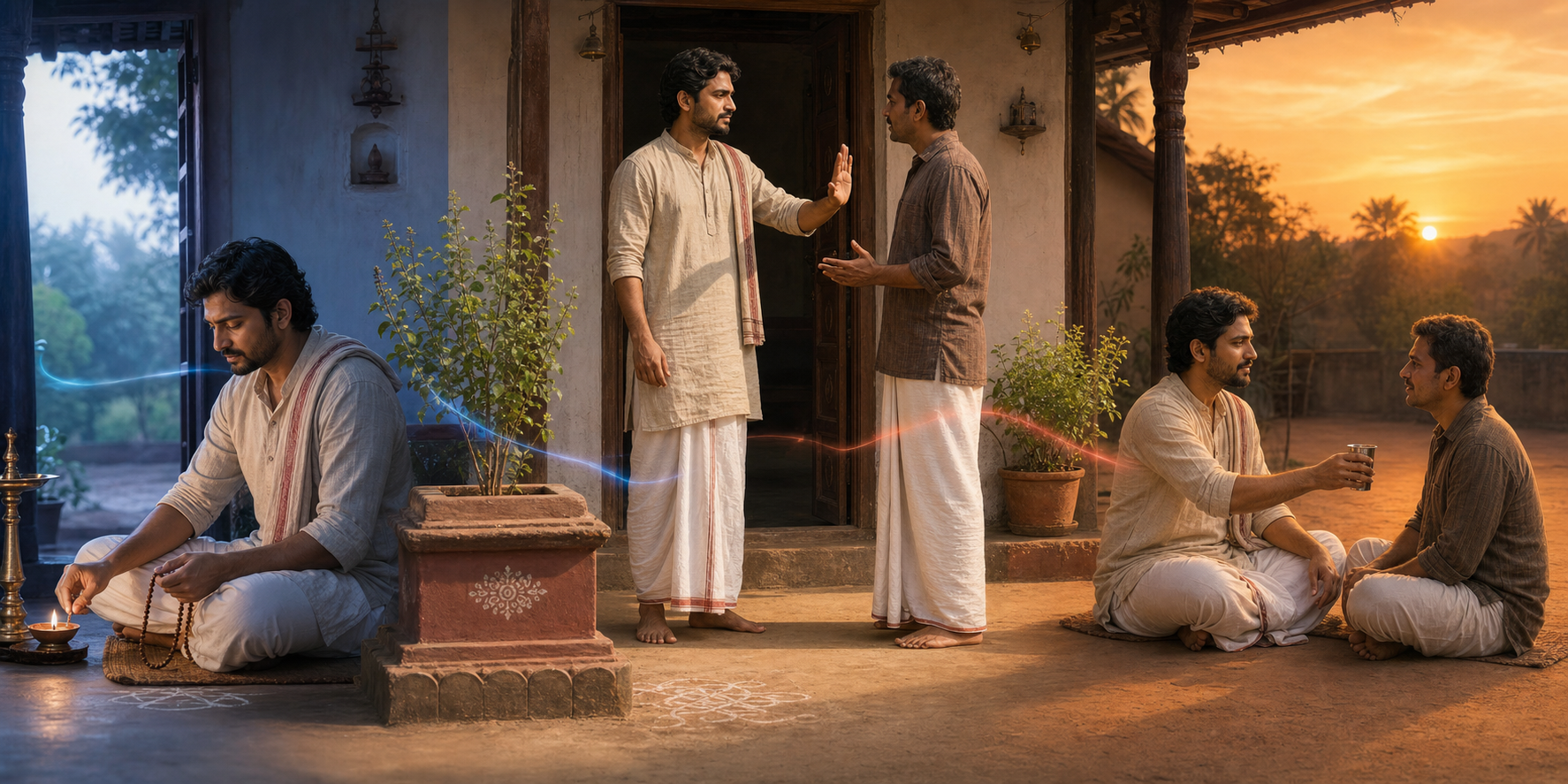
Choose one main form of sadhana instead of stacking practices you cannot sustain. You might hear or read a short passage attentively, reflect on one teaching, chant, or prepare one act of service. Then identify the duty most likely to test you that day. A specific intention such as protecting a boundary without contempt is more useful than a vague wish to be spiritual.
If Devi remembrance belongs to your path, the following invocation can orient power toward reverence rather than self-assertion:
Ya Devi sarva bhuteshu shakti rupena samsthita, namas tasyai, namas tasyai, namas tasyai, namo namah.
Devi Mahatmya
Do not use the mantra to intensify an argument already running in your mind. Use it to remember that Shakti is not your private anger. Divine power carries responsibility toward truth and the good.
When pressure arrives
Take a brief pause and allow your breathing to settle when circumstances permit. Then ask: What must stop, and what must continue? An insult may need to stop; your own dignity and truthful speech must continue. A harmful behavior may require a boundary; hatred does not need to accompany it. Spiritual dryness may need patient examination; sadhana should continue.
Do not turn the pause into avoidance when someone needs immediate protection. Its purpose is to remove needless reactivity so that necessary action becomes clearer. When no urgent intervention is required, waiting until you can state the duty without abuse is often a sign of control, not weakness.
Before the day closes
Review one difficult moment rather than judging the whole day. Ask what tendency arose, what value needed protection, whether your response was proportionate, and what remained afterward. If pride or cruelty entered the response, make the repair concrete: correct the false statement, apologize for the unnecessary wound, restore the boundary in calmer language, or seek help you avoided earlier.
This review is not an invitation to rehearse shame. Its purpose is viveka. Exposed habits lose some of their ability to operate unnoticed, and tomorrow’s choice becomes less automatic.
Let community support what solitude cannot
Private reflection can become self-confirming, especially when ego has already decided that its anger is righteous. Regular kirtana, attentive hearing, and compassionate seva place practice within relationships where patience and humility can be tested. Choose a recurring commitment you can honor, and let reliability matter more than intensity.
Start with one recurring situation in which you either react too quickly or give up too soon. Write the two questions where you will see them: What must stop? What must continue? At the next test, use fierce clarity for the first answer and steady devotion for the second. That is where sacred remembrance begins to become conduct.
References
- DharmaRenaissance Blog – Chanda and Munda’s Defeat: Devi Mahatmya’s Fierce Symbolism and Practical Lessons for Life
- Dandavats – Srimad Bhagavatam 1.10.26-27: Unveiling Krishna’s Divine Appearance and Timeless Grace
