
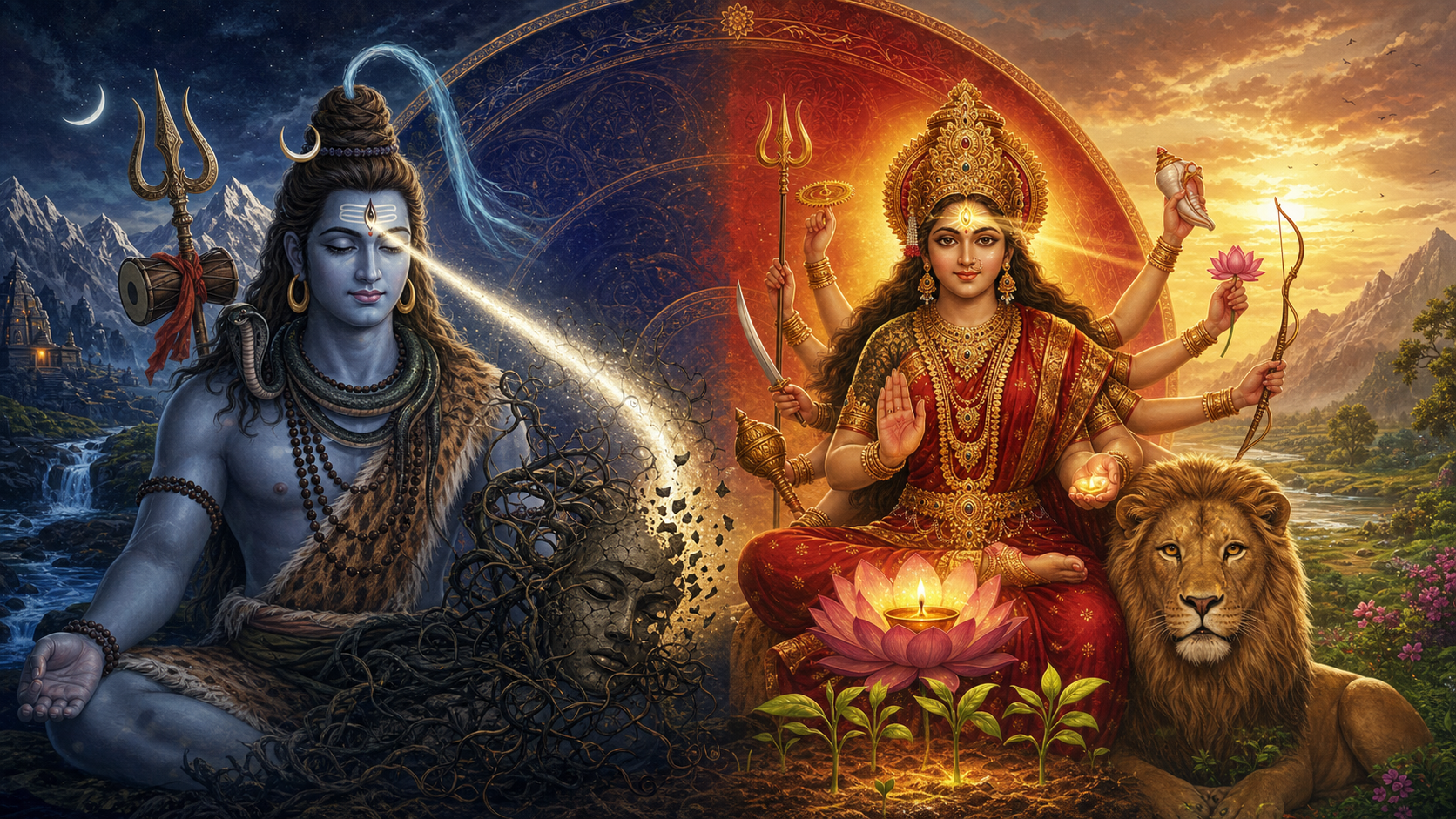
When you see the eye on Shiva’s forehead and Durga’s three-eyed gaze, it is tempting to file both under the vague idea of divine sight. That answer is not wrong, but it does not tell you what to do when desire, anger, duty, and protection pull you in different directions.
The practical reading is sharper. Shiva’s eye asks what within you must lose its power to command. Durga’s gaze asks what around you must not be abandoned. One purifies attention; the other carries clear attention into protection and action. Together they help you judge not only what to reject, but what to preserve.
Key takeaways
- The third eye represents awakened consciousness and decisive discernment, not merely an additional power of sight.
- Shiva’s third eye burns the compulsive force of desire, ignorance, and ego. It does not condemn love, family life, or creative energy.
- Durga’s three eyes express vigilant wisdom. They bring knowledge, will, and action together so that life, courage, duty, and dharmic order can be protected.
- Shiva and Durga do not present rival attitudes. Their symbolism forms a sequence: expose the distortion, release its grip, identify what remains worthy, and act to safeguard it.
- In a charged moment, ask two questions: What is controlling me? What am I responsible for protecting?
Shiva’s third eye burns the grip of desire, not love itself
The encounter between Shiva and Kamadeva gives the third eye its most memorable symbolism. The gods need Shiva and Parvati’s son, Skanda, to overcome Tarakasura. Kamadeva therefore approaches Shiva during deep meditation, draws his sugarcane bow, and releases his flower arrows. Shiva’s third eye opens, and Kamadeva is reduced to ashes.
A superficial reading makes this look like a war between spirituality and desire. The rest of the narrative rules out that conclusion. Shiva eventually unites with Parvati, and Skanda is born for the welfare of the world. The ascetic does not reject the householder’s sphere; he enters it after desire has been separated from compulsion. The target of the fire is not affection but the loss of freedom that occurs when an urge takes command of attention.
That is why the third eye is associated with jnana-agni, the fire of insight. Ordinary sight registers the attractive object and the feeling it produces. Insight sees the entire movement: the stimulus, the craving, the story the mind builds around it, and the action that may follow. Once that movement is fully seen, you have a chance to choose instead of merely react.
The fate of Kamadeva sharpens the distinction. Narratives vary: he may return as Ananga, the bodiless one, while another telling connects his return with Pradyumna in the Krishna tradition. Rati’s grief is also answered with compassion. Across these variations, the power of desire is refined rather than erased from existence. Love and generative energy remain, but they are no longer entitled to rule simply because they are intense.
Use the ashes as a three-part test
- Name what has arrived. Is it attraction, anger, fear, envy, vanity, or the wish to be recognized? Naming the movement prevents it from disguising itself as unquestionable necessity.
- Find the compulsion. Notice the demand for immediate relief: reply now, possess this, win the argument, punish the other person, or prove your importance. That urgency is often the part that needs Shiva’s fire.
- See what remains after the urgency is removed. Affection may remain. A legitimate boundary may remain. A promise, creative aim, or family duty may remain. That remainder deserves deliberate expression rather than suppression.
Vibhuti, the sacred ash associated with Shiva, can therefore be read as a reminder of what false urgency becomes when awareness has finished its work. Ash has no glamour and makes no demand. When you see or apply it, let it prompt a precise question: if ego and craving were no longer giving the orders, what would dharma still require from me?
Durga’s three eyes turn clear seeing into guardianship
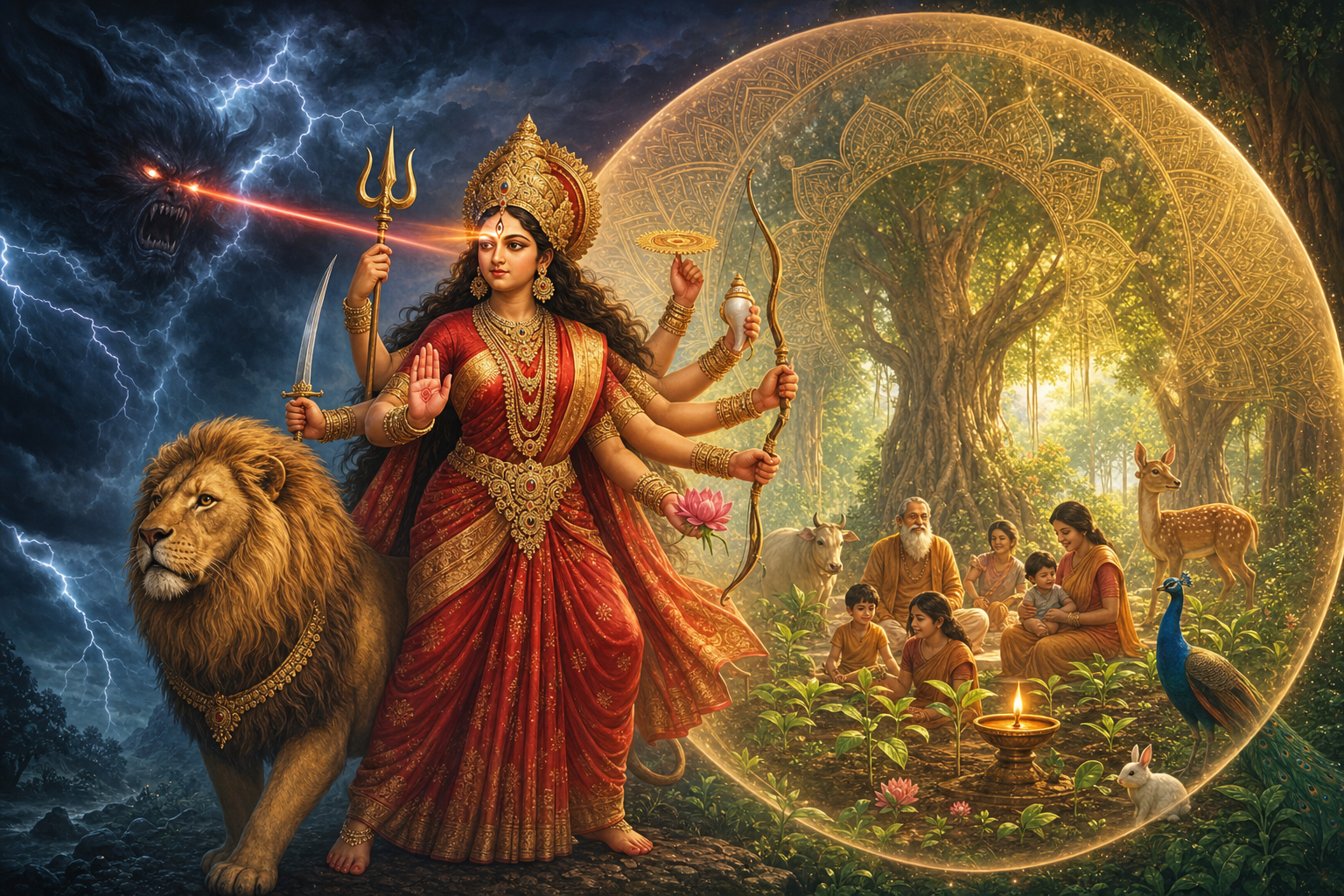
Durga’s third eye is not merely Shiva’s fire placed on another form. Her three-eyed gaze belongs to the iconography of a guardian: alert, armed, composed, and fully present to danger without being mastered by it. Shiva’s fire exposes the inner force that must be relinquished. Durga’s vision identifies the life-affirming reality that must be defended.
Several symbolic readings illuminate her three eyes. One associates them with iccha shakti, kriya shakti, and jnana shakti: the powers of will, action, and knowledge. Another connects them with sun, moon, and fire, as well as an awareness embracing past, present, and future. These need not be treated as competing passwords to one fixed image. Each warns against partial vision.
Knowledge without will can recognize a wrong and leave it untouched. Will without knowledge can become stubborn appetite. Action without either can become restless force. Durga’s three-eyed symbolism holds these capacities together: see accurately, choose the good, and bring power into its service.
Turn the three eyes into three checks
- Knowledge: What is actually happening, apart from what fear, loyalty, or anger wants you to believe?
- Will: What worthy reality are you choosing to sustain: truth, a person in your care, a just boundary, a family responsibility, or the integrity of a community?
- Action: What concrete intervention will protect that good without turning your own ego into the new threat?
Durga’s lion, weapons, and serene expression make the same point in visual form. Strength is present, but it is governed. Serenity does not mean passivity, and force does not mean fury without measure. The gaze comes first because power becomes protective only when it knows what it serves.
Do not force a choice between destruction and care
The most useful way to hold Shiva and Durga together is as two tests within one act of discernment. Before you can protect something well, you often have to remove the fear, possessiveness, vanity, or resentment distorting your view of it. After you have exposed that distortion, you still have to act. Purification without responsibility becomes withdrawal; protection without self-mastery can become domination.
| Situation | Shiva’s test | Durga’s test |
|---|---|---|
| Desire | What craving is taking away my freedom to choose? | What affectionate, creative, or generative purpose remains worthy of care? |
| Conflict | What anger, fear, or pride must lose its grip before I speak? | What truth, person, or boundary genuinely needs protection? |
| Spiritual practice | What distraction repeatedly breaks attention and discipline? | What habit, relationship, or form of service will sustain the practice? |
| Family life | Where has attachment become control or expectation? | What form of belonging, responsibility, or patient care must be preserved? |
| Leadership | What greed, vanity, or fear is clouding judgment? | Which people, institutions, and future obligations depend on a principled decision? |
This pairing prevents three common mistakes.
- All desire must be destroyed. Shiva’s later union with Parvati shows why that reading fails. Desire must be freed from compulsion so that it can mature into devotion, responsibility, and creative participation in the world.
- Any intense anger can be called third-eye fire. Shiva’s fire emerges from profound tapas and insight, not from wounded pride seeking sacred language. If your proposed action needs humiliation, haste, or revenge, it is more likely feeding the disturbance than seeing through it.
- Protection means preserving whatever already exists. Durga safeguards dharma, not mere familiarity. Some habits, arrangements, and loyalties protect life; others protect stagnation or adharma. Ask what the preservation is ultimately serving.
The symbolism should not be reduced to a crude opposition between masculine destruction and feminine softness. Shiva enters marriage and fatherhood; Durga carries weapons and confronts forces that threaten order. Shiva and Shakti are inseparable in this moral grammar. The fire makes room for responsible love, and protective power ensures that transformation serves life rather than consuming it.
Comparable pairings appear elsewhere in the dharmic family without making the traditions identical. Buddhist wisdom is joined to compassion; Jain tapas is disciplined by ahimsa; Sikh practice brings remembrance and service together, while miri-piri refuses to separate spiritual orientation from temporal responsibility. The shared lesson is practical: never cultivate inner mastery without asking whom it serves, and never exercise power without examining the ego that wields it.
A practical third-eye discipline for charged moments
You do not have to manufacture a mystical experience to live the symbol. Use it when you are about to send an angry message, make a promise under pressure, enforce a boundary, abandon a duty, or take a community decision. The practice is a movement from reaction to vision and from vision to responsible action.
- Interrupt the first reaction. Do not send, speak, promise, or punish at the first surge. The pause is not surrender; it creates the space in which discernment becomes possible.
- Gather your attention. Take a conscious breath, repeat a brief mantra, or sit in silence long enough to notice what the mind is demanding. Simple acts of dhyana and japa can train this capacity outside the moment of conflict.
- Name the force seeking command. Use an ordinary word: craving, fear, anger, envy, vanity, possessiveness, or avoidance. Do not make it grander than it is.
- Apply Shiva’s question. What part of this movement must be allowed to turn to ash? It may be the need to win, the fantasy of total control, or the demand for immediate satisfaction.
- Apply Durga’s question. Once that distortion is removed, what remains under your protection? Name the person, truth, obligation, relationship, boundary, or future good clearly.
- Choose an action that passes both tests. A clear action may be an apology, a firm refusal, a delayed reply, a fulfilled promise, a request for accountability, or an act of seva. If it feeds the impulse while damaging the good you named, it has failed the test.
This discipline also gives worship a direct ethical consequence. During meditation, pair inward attention with one outward duty. When vibhuti reminds you of impermanence and purification, identify one compulsion you will stop obeying. During the inward austerity associated with Mahashivaratri, choose a restraint that clarifies attention. During Navaratri’s celebration of Shakti, pair that restraint with an act that protects, nourishes, or restores something beyond yourself.
The measure of third-eye vision is not emotional intensity. It is whether you become less governable by impulse and more capable of serving truth, life, and duty. An outburst can feel fiery while remaining blind. A quiet boundary, a restrained word, or a timely act of protection may reveal far clearer sight.
The next time you encounter Shiva’s third eye or Durga’s three-eyed gaze, ask what you have been refusing to see. Name one compulsion that should lose its authority and one good that now requires your protection. Then take the smallest honest action that serves both.


References
- DharmaRenaissance Blog – Shiva’s Third Eye and the Ashes of Desire: Profound Symbolism Behind Kamadeva’s Fall
- DharmaRenaissance Blog – Why Durga’s Third Eye Saves What Shiva’s Burns: The Sacred Balance of Fury and Nurture
