
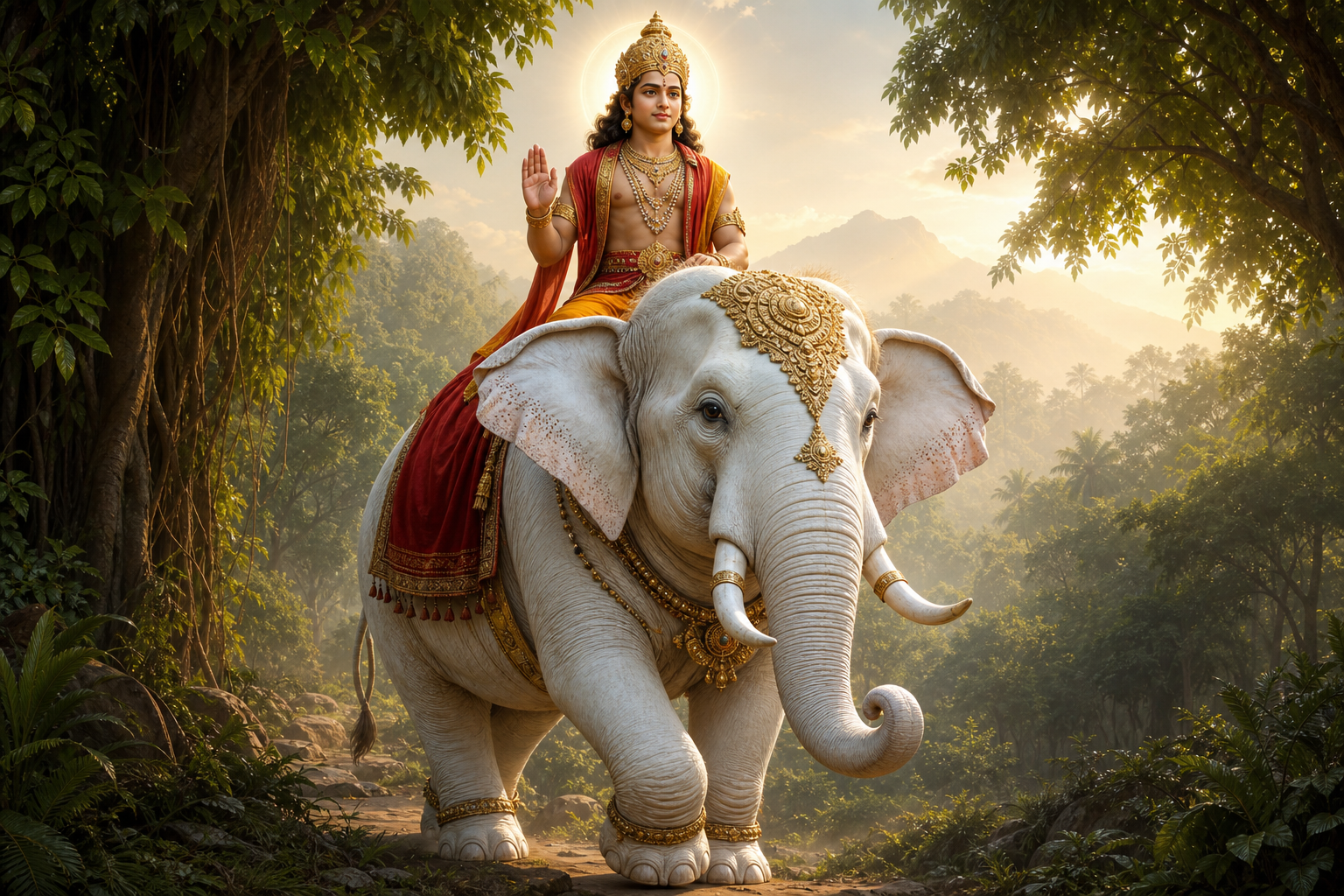
You may have seen Shasta riding a white elephant and wondered whether the animal is merely decorative, a sign of prosperity, or a different name for a more familiar Hindu symbol. The useful answer lies in the relationship between deity, vehicle, power, and direction.
The white elephant represents formidable mental power brought into clarity and placed under dharmic command. Shasta does not reject that power. He rides it. For you, the image offers a practical instruction: do not let fear, anger, ambition, pride, or even spiritual enthusiasm decide where your strength will go.
Why the white elephant is a meaningful alternate vehicle
The horse is widely recognized as Shasta’s principal vehicle, while the white elephant appears as a significant alternate form. That difference should not be treated as an error or flattened into a single universal formula. Hindu iconography can bring different aspects of a deity’s teaching to the foreground through different vehicles.
A vahana does more than carry a deity from one place to another. It gives visible form to an energy associated with the deity’s presence and rule. The important question is therefore not simply, “Why an elephant?” Ask instead: “What kind of force does this elephant embody, and what happens to that force when Shasta directs it?”
This also gives you a sound way to approach an unfamiliar murti or painting. Identify the deity, note the vehicle, observe how the two relate, and then check the temple or regional tradition before declaring that one feature has a fixed meaning everywhere. A symbolic interpretation can illuminate an image without pretending that every sampradaya explains it in identical terms.
The elephant is strength governed, not strength destroyed
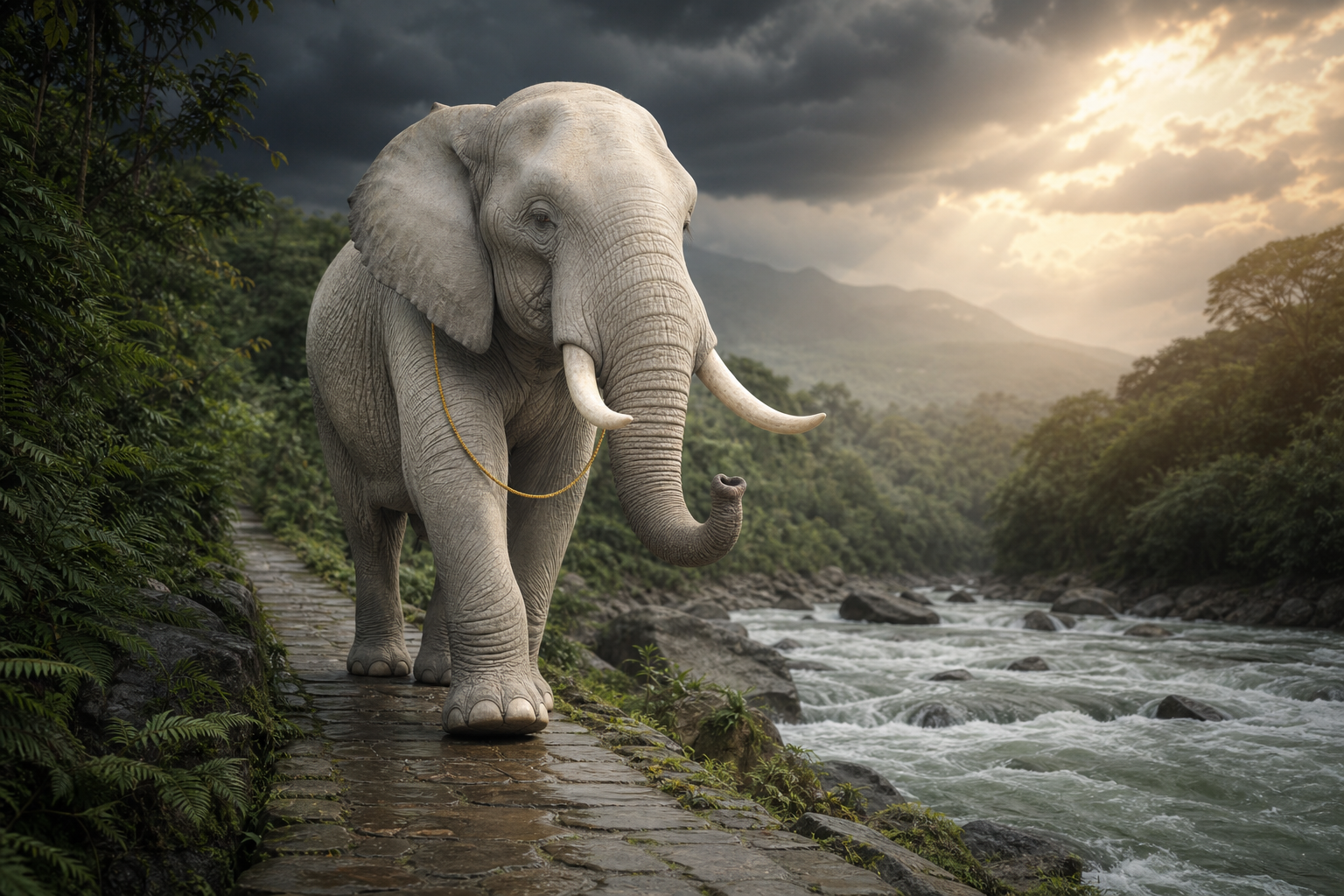
The elephant works as an image of the mind because both power and governability are at stake. A restless mind is not necessarily a weak one. It may have enormous memory, imagination, determination, and emotional force, yet still move in the wrong direction when an impulse takes command. The problem is not the amount of energy. The problem is who holds the reins.
Shasta’s relationship to the restless mind symbolized by the elephant corrects two common mistakes. The first is indulgence: assuming that a powerful feeling must be obeyed because it feels urgent. The second is suppression: assuming that spiritual discipline requires you to crush every desire, emotion, or ambitious thought. Riding presents another possibility. The force remains, but it receives direction.
- Anger can reveal that a boundary or obligation matters. Dharma still decides whether you should speak, wait, protect, correct, or withdraw.
- Ambition can supply endurance. It becomes disordered when recognition, possession, or victory replaces the duty the effort was meant to serve.
- Fear can alert you to consequences. It should inform a decision, not assume the right to make it.
- Pride can preserve dignity. When it turns into ahankara, it makes personal status more important than truthful action.
When your mind is agitated, do not begin by demanding complete inner silence. First name the force that is moving you. Then ask what rightful task could employ that force without surrendering to it. That is much closer to riding the elephant than either chasing it or pretending it is absent.
White signifies clarified power rather than passivity
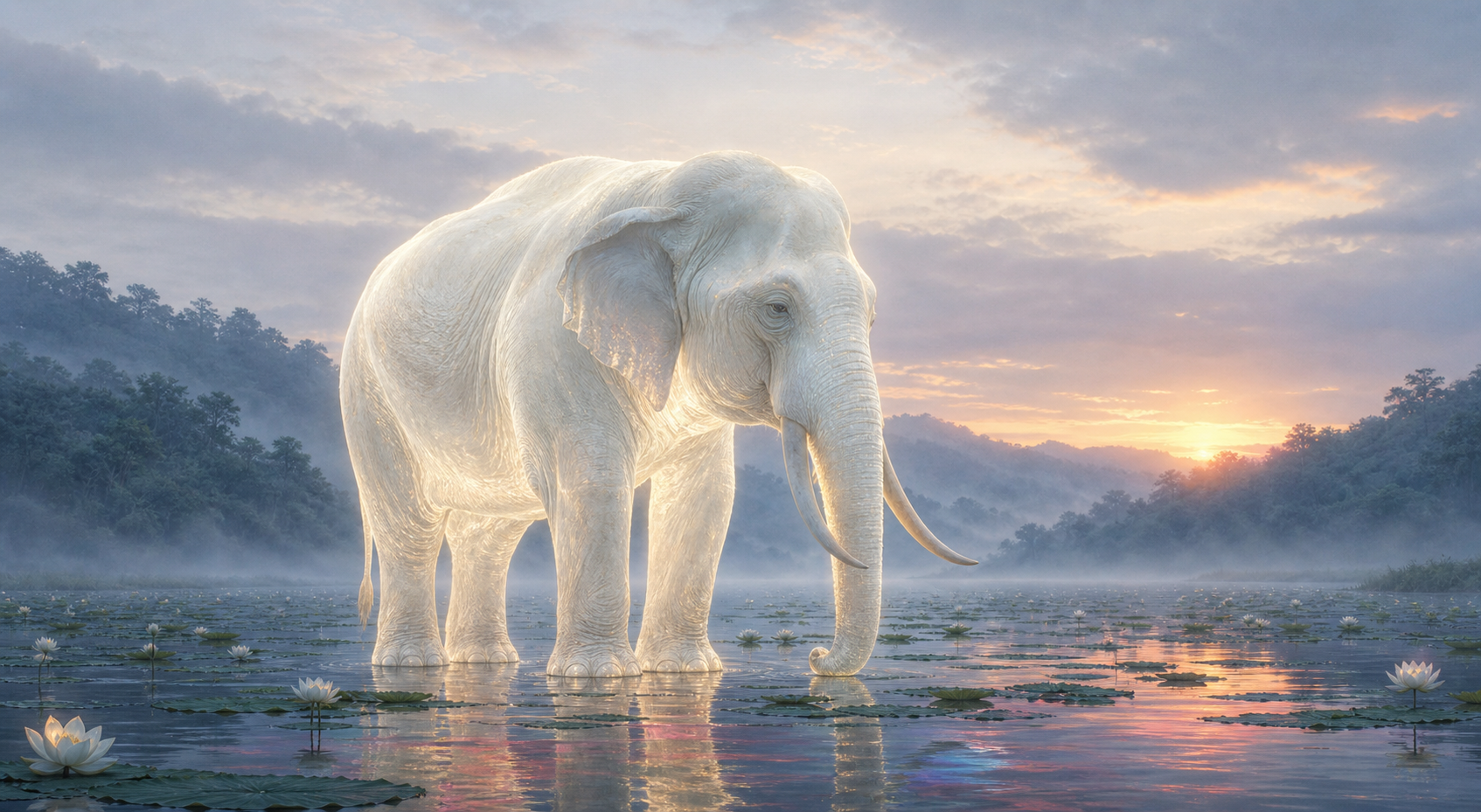
Within this symbolic reading, white qualifies the elephant’s power. It points toward purity, lucidity, and composure. The animal has not become smaller or harmless; its strength has become transparent to a higher purpose. The complete symbol therefore joins two qualities that people often separate: capacity and clarity.
Purity here should not be reduced to outward respectability, naivety, or the absence of difficult thoughts. A person can appear calm while being ruled by resentment. Another can act firmly while remaining free of hatred. The more useful test is whether motive, perception, and action have been cleared of the distortions that allow ego to impersonate duty.
Before acting on a strong impulse, use the white elephant as a three-part test:
- Clarify the fact. What do you actually know, apart from the interpretation supplied by fear, anger, desire, or loyalty?
- Clarify the motive. Are you trying to uphold something rightful, or to punish, impress, dominate, escape, or preserve your image?
- Clarify the proportion. Is the force of your response suited to the obligation, or has the emotion made every problem look like a battle?
If you cannot answer those questions plainly, the elephant is still choosing the route. Pause long enough to separate the duty from the story you are telling about the duty.
Shasta turns mastery of mind into the work of dharma
Shasta is also known as Mahasastha and Dharmasastha and is understood as born from the union of Hari and Hara. His identity brings preservation and transformation into one sacred frame. That matters because mature action often requires both: something worthy must be protected, while something disordered must be changed.
The white elephant is therefore more than a lesson in private calm. Mental discipline serves a moral purpose. Shasta represents dharma as a force that must be actively upheld, not an attractive idea admired from a distance. A steady mind matters because it allows you to recognize and perform the duty before you without handing that duty over to appetite or ego.
For a difficult decision, place four questions beside one another:
- What in this situation deserves to be preserved?
- What has become disordered and must change?
- Which part of the response is genuinely mine to perform?
- Which part merely protects my comfort, attachment, or self-image?
This test prevents a soothing but serious error: confusing dharma with whatever makes you feel peaceful. Duty can be uncomfortable. A calm feeling does not make avoidance righteous, just as an intense response is not automatically adharma. The decisive question is whether your power is governed by a clear obligation or commandeered by an impulse.
How to use the symbol in daily self-examination
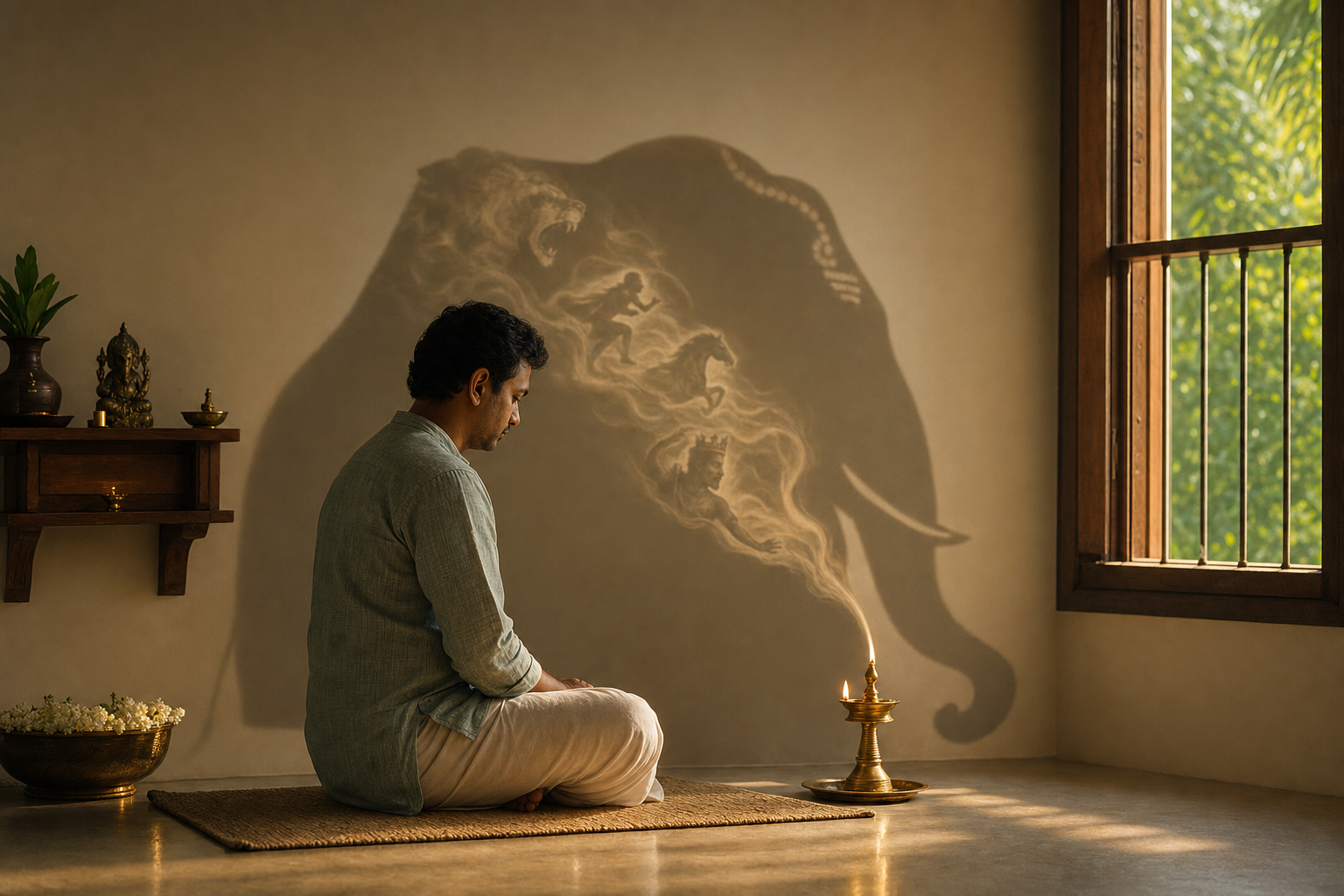
You do not need to invent a new ritual or detach the image from its living devotional setting. Use it as a compact form of self-examination while respecting the worship and explanations of the temple or sampradaya in which a particular form of Shasta appears.
- Locate the elephant. Name the actual force dominating your attention: anger, fear, craving, ambition, pride, confusion, or attachment.
- Clear the perception. State the relevant facts without accusations, flattering descriptions of yourself, or predictions you cannot know.
- Name the dharma. Express your immediate obligation in one direct sentence. If you can only describe what another person should do, you have not yet located your own duty.
- Give strength a route. Choose a bounded action that serves that obligation: speak truthfully, complete the neglected task, set a proportionate boundary, make restitution, seek necessary counsel, or refrain from a harmful response.
- Examine the result. Ask whether the action made your power steadier and more serviceable, or merely gave ego a religious justification.
Key takeaways
- The white elephant is a meaningful alternate vehicle of Shasta; it does not erase the horse’s better-known place in his iconography.
- The elephant represents powerful mental energy that must be directed rather than indulged or destroyed.
- White adds the qualities of clarity, purity, and composure without implying weakness.
- Shasta’s command of the elephant connects self-mastery to the active upholding of dharma.
- For a specific temple image, let the relevant regional or sampradaya tradition guide the precise interpretation.
The next time you encounter Shasta’s white elephant, do not stop at identifying the symbol. Ask what powerful movement within you currently needs direction, clarify the duty that should govern it, and give that strength one rightful task.
References
