
If you are arranging your family’s Hindu calendar for early 2026, mark two dates now: 23 February for Sri Guru Raghavendra Jayanthi and 14 March for Karadaiyan Nombu. The first follows a lunar tithi; the second depends on a Tamil solar-month transition. That difference determines what you need to verify before inviting relatives, preparing prasada, or beginning a vrata.
You do not need an elaborate programme for either observance. You do need the correct local timing, a manageable ritual plan, and clarity about the dharmic commitment you want the day to express.
Put both dates on your calendar, with one important note
| Date | Observance | Calendrical basis | What you should verify |
|---|---|---|---|
| 23 February 2026 | Sri Guru Raghavendra Jayanthi | Falguna Shukla Saptami | The Saptami alignment at sunrise in the Kannada or Telugu panchang used by your locality or community |
| 14 March 2026 | Karadaiyan Nombu | The transition from Maasi to Panguni | The local transition window; in India, the specified 2026 muhurat is 7:30 PM to 8:30 PM |
Enter more than the date in your calendar. For Raghavendra Jayanthi, add a reminder to confirm the sunrise-based tithi. For Karadaiyan Nombu, record the actual muhurat rather than treating the entire day as one undifferentiated ritual period. If you are coordinating a family gathering, send the confirmed local timing with the invitation.
The published dates give you a sound planning anchor, but a tithi or solar transition is not the same thing as a midnight-to-midnight civil date. A household in another country should therefore not simply convert an Indian muhurat into its own time zone.
Use the panchang rule appropriate to each observance

A tithi is a lunar day and can begin or end between ordinary clock dates. Sri Guru Raghavendra Jayanthi is observed on the seventh tithi of the bright half of Falguna, so the relationship between Saptami and local sunrise matters. The widely used date for most regions is 23 February 2026, but a Kannada or Telugu panchang appropriate to your location remains the practical authority for the final timing.
Karadaiyan Nombu works differently. Its decisive moment is the passage from Maasi into Panguni. In India, the 2026 window for tying the nombu thread and breaking the fast is 7:30 PM to 8:30 PM on 14 March. Outside India, use a regional panchang that calculates the Maasi-Panguni junction for your own place.
- Choose a panchang configured for your city or region, not merely one published in your preferred language.
- Follow the regional tradition your household actually observes. Do not combine a date from one calendar with a muhurat calculated under another convention.
- Write down both the civil date and the ritual condition: “Falguna Shukla Saptami at sunrise” or “Maasi-Panguni transition.” This makes it easier to resolve a conflicting calendar entry.
- If your family follows a temple, matha, or established community, use its announced local schedule for collective worship.
- For relatives in different countries, send each household the calendrical rule and ask them to confirm locally instead of imposing one global clock time.
This small amount of checking prevents the most common planning error: preparing the right ritual on the right civil date but performing its time-sensitive act outside the locally applicable period.
Build Raghavendra Jayanthi around worship, reflection, and seva
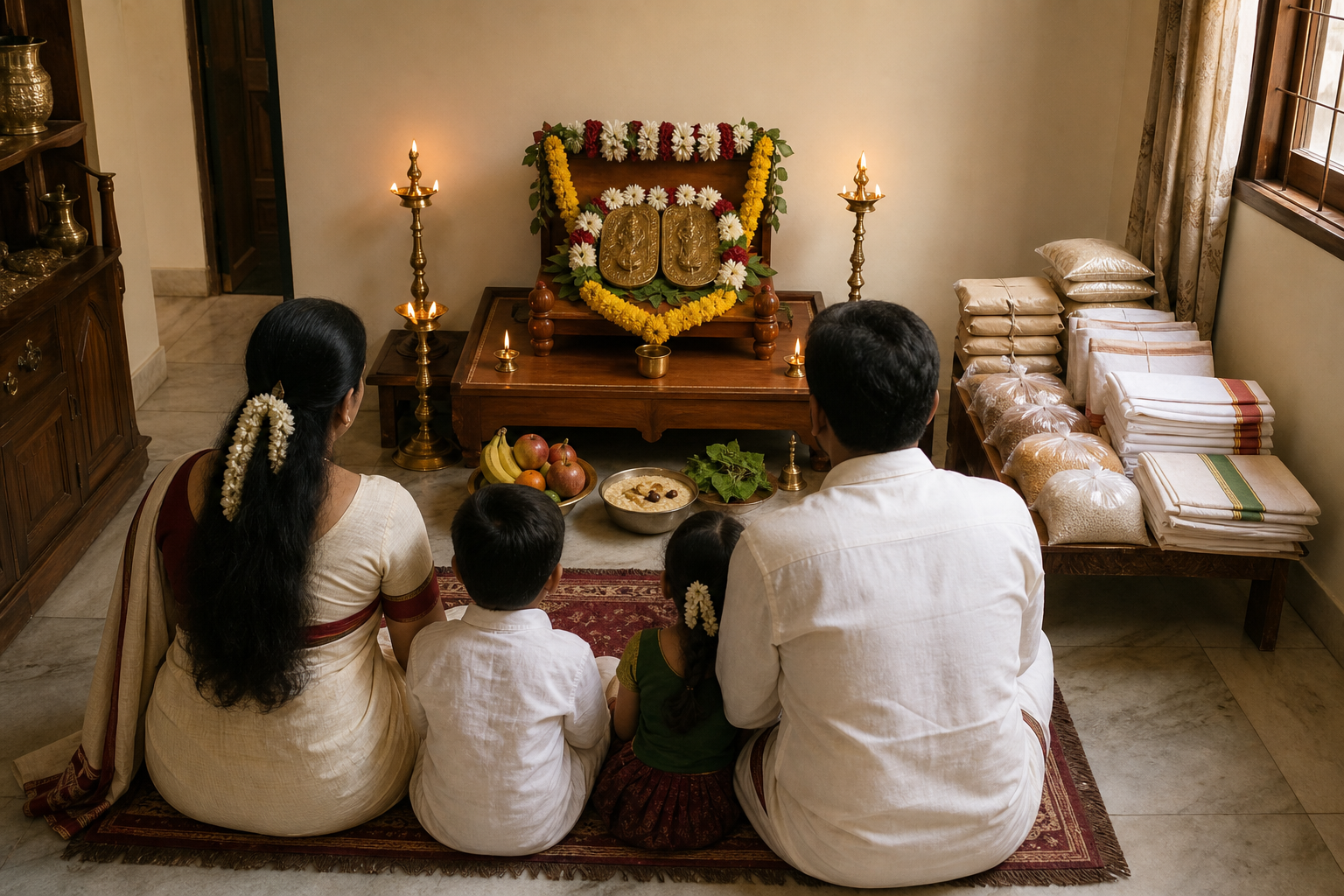
Sri Guru Raghavendra Jayanthi commemorates the birth anniversary of Sri Guru Raghavendra Swamy, whose saintly and scholarly legacy joins bhakti with disciplined conduct and compassionate service. A useful home observance should preserve that connection. The aim is not to reproduce a large temple festival in miniature, but to give prayer, learning, and service a definite place in the day.
- Set the worship time after confirming Saptami. Clean the puja space and prepare the lamp and customary offerings in advance.
- Begin with a simple puja. Light the lamp and offer your prayers to Sri Guru Raghavendra Swamy according to your family practice.
- Choose one form of recitation. Recite a Raghavendra stotra, hold a short parayana, or gather the family for bhajans. One complete, attentive practice is more useful than an overfilled programme that no one can sustain.
- Make the teaching concrete. Reflect on one quality associated with the Guru’s example: steadfast devotion, truthfulness, humility in learning, or generosity in action. Ask each participating family member to name one way to practise it after the celebration.
- Complete the observance through seva. Support annadana, make an appropriate charitable offering, help someone in your community, or undertake another practical act of care. Decide on the act before the day so that seva does not remain a ceremonial intention.
At Mantralayam, the observance includes special alankara, pujas, ceremonial offerings, devotional music, and collective prayer. If you are participating there or through a local temple, follow its stated procedures and allow the communal liturgy to shape your schedule. If you are at home, the same devotional structure can be expressed more simply through a lamp, recitation, reflection, and service.
Plan seva as carefully as the puja. For example, if your family chooses annadana, settle the recipient or organising institution and the contribution before 23 February. That turns generosity into a completed act rather than a promise postponed after the festival.
Prepare Karadaiyan Nombu before the evening muhurat begins
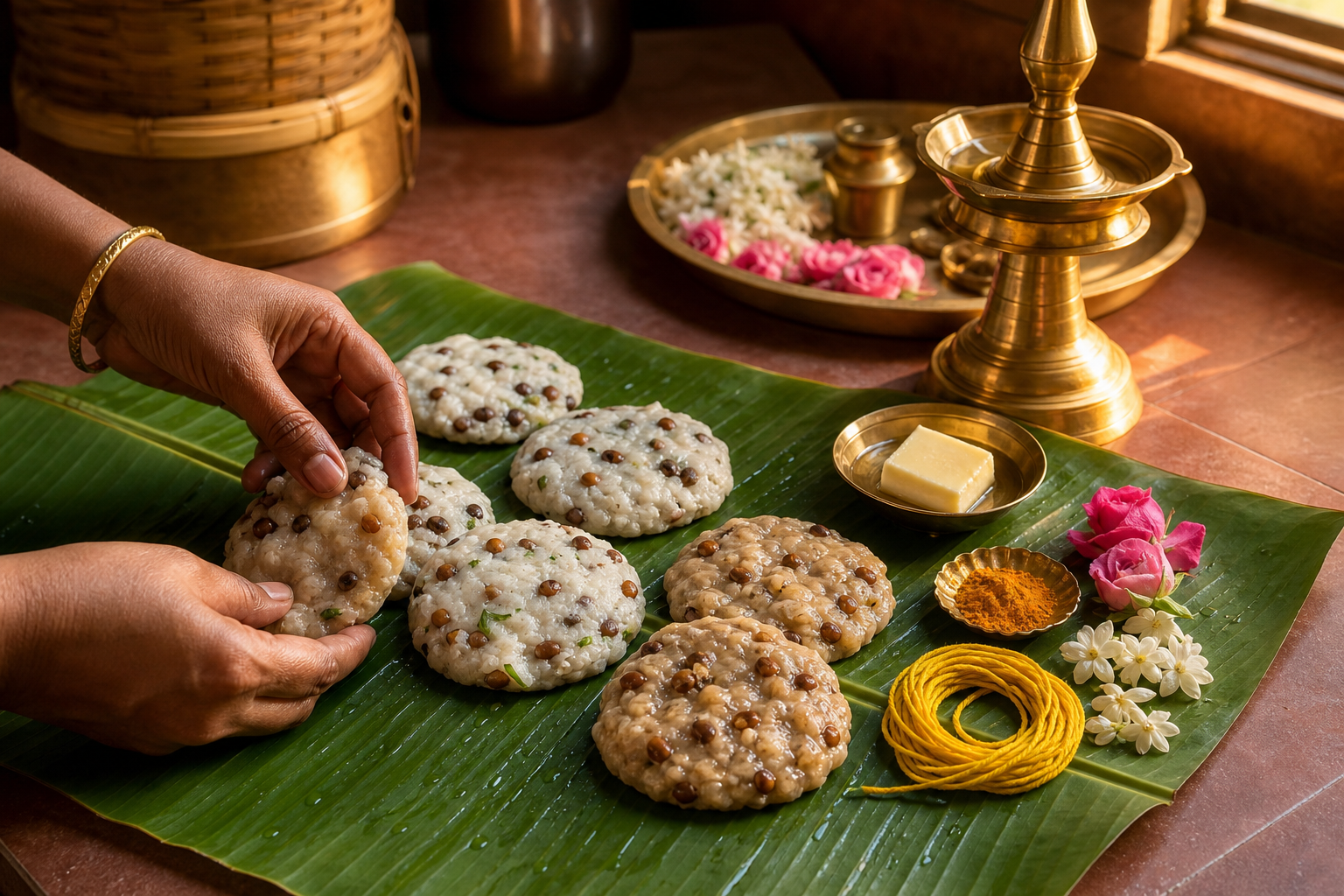
Karadaiyan Nombu, also called Karadayan Vritham or Karadayan Savitri Vritham, is a Tamil vrata dedicated to Goddess Shakti in the form of Kamakshi. Its ritual memory is associated with Savitri and Satyavan, placing steadfast resolve, family well-being, and fidelity to dharma at the centre of the observance.
The time-sensitive actions are tying the sacred yellow thread and breaking the fast. In India, these should be planned within the 7:30 PM to 8:30 PM muhurat on 14 March 2026. Do the cooking and altar preparation early enough that the junction is not consumed by searching for thread, finishing the karadai, or waiting for a late family member.
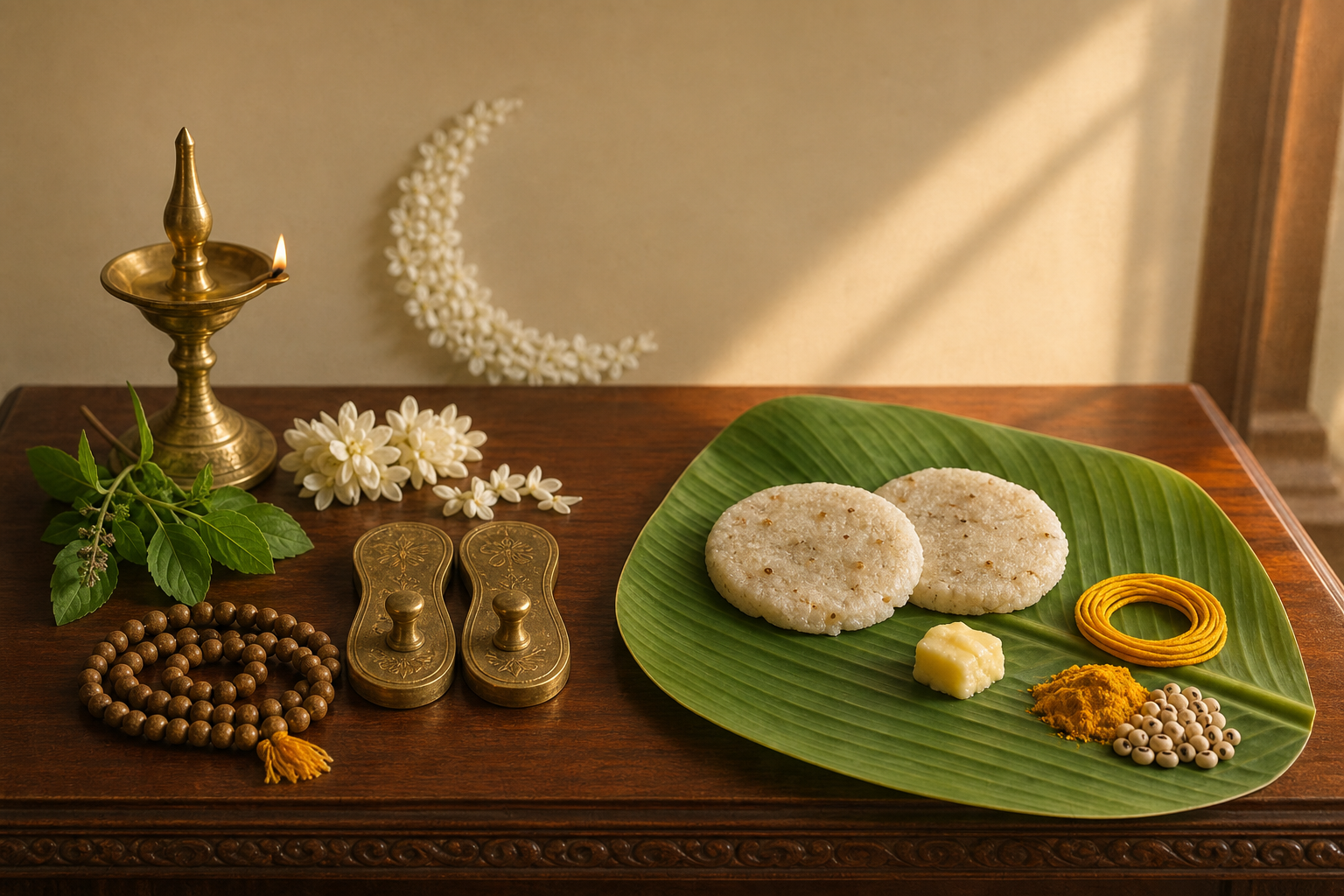
- Gather the materials ahead of time. Prepare rice flour and karamani, or black-eyed peas, for the customary steamed karadai. Sweet and savoury preparations may be made, with butter served alongside. Also set aside the yellow nombu thread, turmeric, kumkum, a lamp, and the items your household normally offers to Devi.
- Arrange a clean altar space. Place the naivedyam and worship materials where they will be ready before the transitional window.
- Undertake the vrata within your capacity. A person unable to maintain a complete fast may adopt a moderated observance with fruit or light food. The austerity should support the sankalpa, not displace the devotion that gives it meaning.
- Worship Goddess Kamakshi. Light the lamp, offer the karadai with butter, and recite the Devi prayers used in your family or community.
- Observe the local junction. During the applicable muhurat, participants tie the sacred yellow thread as a sign of their vow and then conclude the fast.
- Share the prasada without rushing the close. Leave enough time for gratitude and family prayer instead of treating the first meal after the fast as the sole objective.
The vrata is widely connected with marital harmony, but its ethical meaning should not be confined to a narrow transaction for a desired result. The thread represents a pledge involving fidelity, compassion, resilience, and responsibility within family life. Unmarried participants may also observe the vrata, praying for wisdom, stability, and supportive companionship.
If children are participating, give them a real task suited to the household ritual: arranging the offering plates, learning why the thread is tied, or helping serve the prasada. That transmits more than the external form. It teaches them that a vrata joins food, restraint, prayer, and ethical intention.
Key takeaways for your early-2026 calendar
- Mark 23 February 2026 for Sri Guru Raghavendra Jayanthi, then confirm Falguna Shukla Saptami at local sunrise through an appropriate Kannada or Telugu panchang.
- Mark 14 March 2026 for Karadaiyan Nombu. In India, plan the sacred-thread ritual and conclusion of the fast for 7:30 PM to 8:30 PM.
- Outside India, calculate the Maasi-Panguni transition locally. Do not merely convert the Indian muhurat across time zones.
- For Raghavendra Jayanthi, prepare one coherent sequence of puja, recitation, reflection, and completed seva.
- For Karadaiyan Nombu, obtain the thread and ingredients before the day, prepare the naivedyam before the junction, and keep the muhurat free for worship.
- Treat ritual precision and ethical intention as partners: the timing preserves the inherited form, while your conduct carries its meaning beyond the observance.
Put both entries in your calendar now, including the local-verification reminder. Then choose the recitation or seva for 23 February and make the ingredient-and-thread list for 14 March. Those two decisions will remove most of the last-minute pressure while keeping each observance centred on dharma.
References
- DharmaRenaissance Blog — Raghavendra Jayanthi 2026: Date, Meaning, and Mantralayam Rituals that Inspire Devotion
- DharmaRenaissance Blog — Karadaiyan Nombu 2026: Exact Muhurat, Ritual Guide, and Meaning of the Sacred Thread
