

If you are trying to decide whether Bangladesh’s 2026 election marks an ordinary change of government or a deeper regional danger, do not begin with rhetoric from either side. Begin with what the new authorities do when a Hindu family reports a threat, when an election petition reaches a court, and when Indian and Bangladeshi security officials need to cooperate across the border.
Those tests connect three questions that are too often discussed separately: Was the election credible? Will Dharmic minorities receive equal protection? Will political change in Dhaka weaken the security arrangements on which both Bangladesh and Bharat depend? The answers will emerge through institutions, enforcement, and repeated conduct rather than through one victory speech.
Read the landslide in two layers, not one
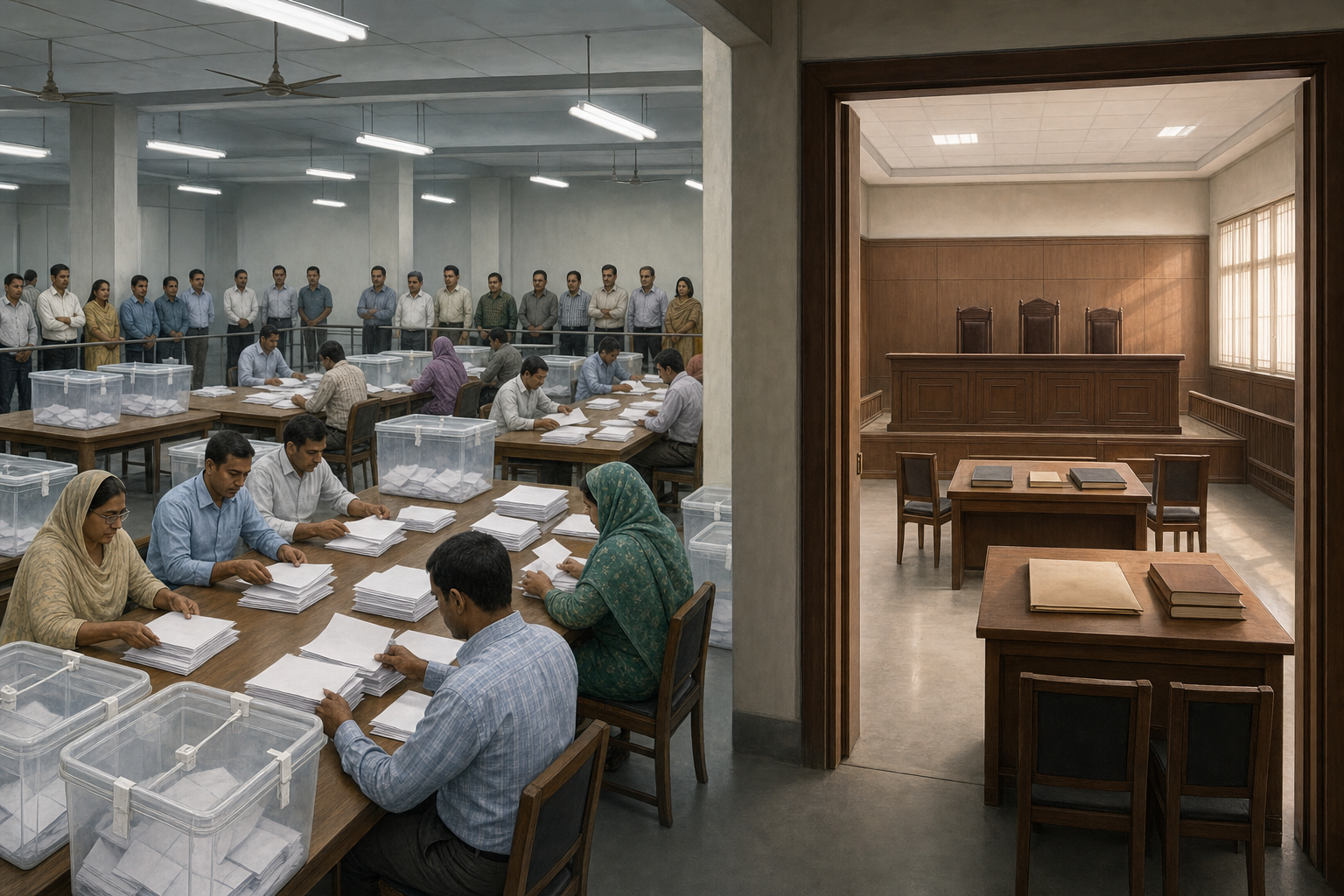
The Bangladesh Nationalist Party has secured a decisive parliamentary majority after successive Awami League-led terms. That establishes who can form the government. It does not, by itself, settle whether every constituency was fairly contested or whether the resulting parliament accurately reflects the country’s political and social diversity.
Bangladesh elects members from 300 single-member constituencies under first-past-the-post rules. Its 50 reserved seats for women are then distributed to parties in proportion to their parliamentary strength. This structure can turn a moderate shift in votes into a much larger shift in seats. A landslide in parliament is therefore not necessarily the same thing as a comparably overwhelming public vote.
That distinction matters when you encounter two common but opposing claims. The first says that a large majority proves the process was flawless. The second says that a large majority proves the election was manipulated. Neither conclusion follows from seat totals alone. Electoral legitimacy has to be judged through the conditions under which parties campaigned, the Election Commission’s administration of candidate scrutiny and polling, security at voting and counting locations, and the handling of complaints after the result.
Watch the sequence. Were opposition candidates and local organisers able to assemble and communicate? Were comparable rules applied to competing candidates? Were counting records and constituency outcomes open to meaningful scrutiny? If petitions, recount requests, or allegations of irregularity arise, do courts and constitutional bodies resolve them promptly and explain their decisions? A government can possess the votes needed to govern while still having work to do to consolidate democratic legitimacy.
This also explains why demands for transparency should not be treated as attempts to reverse an election. Predictable dispute procedures protect the winner as well as the loser. Clear deadlines, reasoned rulings, campaign-finance transparency, and credible non-partisan observation reduce the space in which every disagreement becomes a conspiracy theory.
Judge minority rights by enforcement, not constitutional language alone
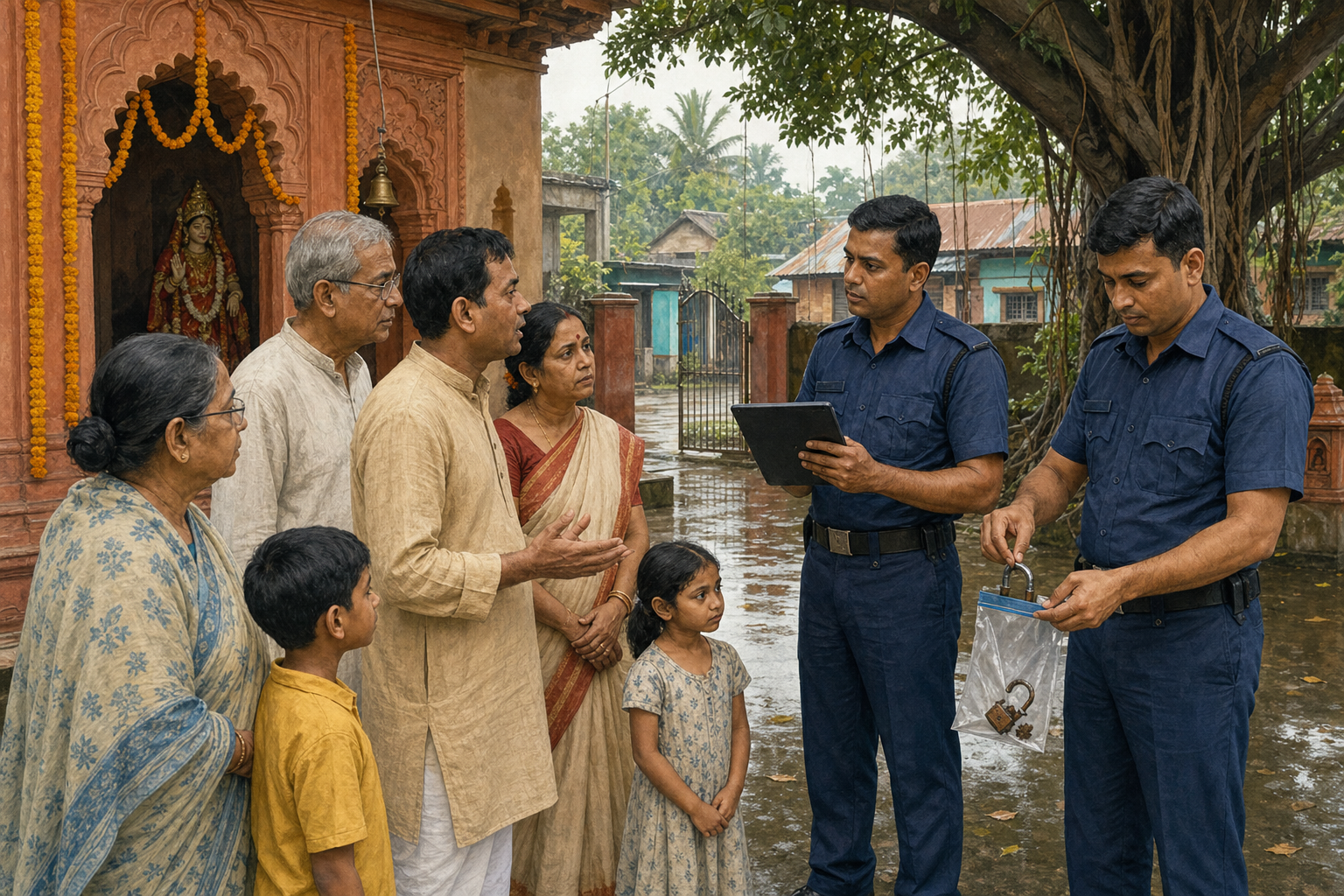
Bangladesh’s constitutional guarantees of equality and religious freedom provide an essential legal foundation. The practical test is whether a Hindu, Buddhist, Jain, Sikh, or Muslim citizen can invoke those guarantees against a politically connected offender and receive the same police protection, investigation, and judicial remedy.
Early constituency signals indicate an apparent contraction in Hindu representation in the Jatiya Sangsad. The final scale and causes need careful constituency-level examination. First-past-the-post voting can disadvantage a dispersed population; party nomination decisions, constituency boundaries, local concentrations of voters, coalition arrangements, and strategic voting can all change how many minority candidates win.
A lower number of Hindu MPs does not by itself prove that every Hindu voter was excluded, just as the presence of several Hindu MPs would not prove that every temple or household is safe. Representation and protection are different measures. Both matter. Parliamentary presence affects which experiences reach committee rooms, party leadership, and national debate. Local enforcement determines whether citizens can live normally.
Use four concrete tests. The first is prevention: are police visibly deployed in mixed and previously vulnerable localities during the sensitive period around the transfer of power? The second is response: when intimidation, arson, land seizure, or communal incitement is alleged, are complaints recorded and investigated without asking which party benefits? The third is repair: do victims receive timely protection and compensation for documented damage? The fourth is inclusion: does the government place qualified minority citizens in positions where they can shape policy rather than merely appear at ceremonial events?
For Buddhists in the Chittagong Hill Tracts, land alienation and local intimidation deserve particular attention. The much smaller Jain and Sikh communities can be politically invisible even when individual families or institutions face disruption. Their numerical size must not determine the seriousness with which the state treats their rights.
The most revealing indicators are ordinary ones. Can a family keep its shop open after dark? Can children attend school without an election-related interruption? Can a temple hold a festival without negotiating informal protection from political actors? Can a victim approach the police without being pressured into silence? These are not secondary social questions. They show whether citizenship is functioning at street level.
Political parties also have a longer-term responsibility. Transparent local consultations, serious recruitment of first-time minority candidates, and published diversity targets would make inclusion measurable. Boundary delimitation should use objective criteria, public consultation, and judicial review so that compact minority neighbourhoods are not casually divided or diluted. Electoral reform can be debated, including limited proportional correctives, but parties do not need to wait for a new system before nominating credible Dharmic candidates.
For India, the first security test is institutional continuity

Bharat does not need every government in Dhaka to share the same ideology. It needs Bangladesh’s institutions to prevent their territory, ports, financial channels, and digital networks from being used against Indian or Bangladeshi citizens. The central question is whether working relationships between police, intelligence services, border forces, customs authorities, and military commands survive the political transition.
Over the preceding decade, bilateral coordination helped restrict insurgent sanctuaries, organised crime corridors, and other cross-border threats. These gains can erode quietly. A delayed intelligence exchange, an inactive working group, or inconsistent enforcement along a sensitive border sector may matter more than a week of hostile political speeches.
Watch whether operational agencies retain enough autonomy to act against extremist networks irrespective of partisan alignment. Previous crackdowns disrupted organisations, but disruption is not permanent elimination. Networks can reassemble, shift recruitment online, adopt new names, or exploit local grievances. Cyber-monitoring must remain tied to due process so that counter-extremism does not become a pretext for suppressing lawful dissent. Community policing and interfaith trust are also security measures: neighbours who communicate are harder to isolate with rumours and communal provocation.
The bilateral agenda offers several practical continuity tests. Teesta water negotiations, coordinated riverine patrols, border-management technology, trade facilitation, customs digitisation, military hotlines, and standing working groups all require routine contact after the television cameras leave. Progress on every dispute is unlikely to be immediate. Continued meetings, data exchange, and incident-management mechanisms would still show that political disagreement is not paralysing state cooperation.
The Bay of Bengal adds a larger strategic layer. Bangladesh’s ports, energy routes, logistics infrastructure, fisheries, and disaster-response capacity sit where India’s Neighborhood First and Act East policies meet China’s Belt and Road Initiative. Dhaka will continue to balance major partners, and engagement with China is not automatically evidence of an anti-India turn. The sharper questions are whether agreements preserve Bangladeshi sovereignty, whether infrastructure creates opaque dependencies, and whether port or security arrangements alter the maritime balance.
You should therefore separate normal diplomatic diversification from a security shift. Cabinet appointments, the continuity of counter-extremism cooperation, access arrangements connected to strategic infrastructure, and the handling of concrete border incidents are stronger indicators than slogans delivered to a domestic audience.
Three scenarios can organise the next 12 to 18 months

No one result fixes Bangladesh’s trajectory. A useful way to read the next 12 to 18 months is to compare new events with three scenarios. These are not predictions or assigned probabilities. They are a discipline for updating your judgement as conduct replaces campaign language.
| Scenario | Signals to watch | What it would mean |
|---|---|---|
| Institutional stability | An inclusive cabinet, visible rule-of-law commitments, credible handling of election disputes, impartial protection of minorities, and continued counter-extremism cooperation with India. | The BNP majority consolidates authority without treating political dominance as permission to weaken equal citizenship or bilateral security mechanisms. |
| Political polarisation | Growing hard-line influence, sharper communal or anti-India rhetoric, selective policing, contested legal changes, and reluctance to prosecute politically connected offenders. | Risks rise for Dharmic minorities, domestic cohesion, investment confidence, and India-Bangladesh relations even if formal institutions continue operating. |
| Prolonged contestation | Extended legal challenges, by-elections, unresolved allegations, administrative bottlenecks, or recurring disputes over the legitimacy of decisions. | Uncertainty increases, but credible courts and negotiated institutional remedies could still create a path toward compromise. |
Do not classify the country permanently after one incident. A prosecution can be encouraging without proving that policing has become impartial. One inflammatory speech can be dangerous without proving that every state institution has changed direction. Look for repetition across districts, agencies, and several months. Patterns reveal governing policy; isolated events require investigation before they become a national verdict.
Disinformation is likely to make this harder. Images may circulate without dates, local crimes may be given communal explanations before facts are established, and genuine attacks may be dismissed as fabricated because other claims were false. Before amplifying an allegation, check the location, date, identity of the affected community, police record if available, and whether independent local accounts describe the same event. Verification protects victims by keeping demonstrably false claims from discrediting real ones.
Key takeaways: a disciplined watchlist
- Do not confuse seats with the entire electorate. First-past-the-post rules can magnify a national swing, so examine constituency outcomes and process integrity before interpreting the size of the mandate.
- Measure minority safety through state conduct. Complaint registration, police deployment, prosecution, compensation, and the return of normal school, market, and temple activity reveal more than constitutional assurances alone.
- Treat representation as an early warning indicator. An apparent fall in Hindu MPs deserves scrutiny because persistent legislative exclusion can create policy blind spots, even though representation is not a substitute for equal protection.
- Watch working institutions across the India-Bangladesh border. Intelligence exchange, patrol coordination, customs systems, hotlines, and counter-extremism action are better security indicators than partisan rhetoric.
- Read the Bay of Bengal through the terms of actual arrangements. Port access, infrastructure dependencies, energy continuity, and maritime cooperation matter more than the mere fact that Dhaka engages India, China, or another partner.
- Verify communal claims before sharing them. Record dates, locations, affected institutions, official responses, and corroborating accounts so that advocacy rests on evidence rather than viral assertion.
If you follow Bangladesh closely, keep a simple monthly record under five headings: electoral adjudication, minority incidents and official responses, inclusive appointments, India-Bangladesh operational cooperation, and major port or infrastructure decisions. This will help you distinguish a temporary disturbance from a sustained change in state policy.
Dharmic organisations and diaspora groups can contribute by documenting verified cases, supporting non-partisan emergency contact mechanisms, and demanding prosecution of offenders regardless of party. Advocacy loses moral and strategic force when it turns the safety of Bangladeshi Hindus into a licence for hostility toward ordinary Bangladeshi Muslims. Equal citizenship is the standard, not collective blame.
The next decisive signal will not be another grand declaration. It will be whether institutions act consistently when doing so is politically inconvenient. Watch that conduct, preserve the facts, and judge the new order by the security and dignity it provides to every citizen.
References
