

If you are being asked to support, forward, or reject a call to cancel Kunal Kamra’s Bengaluru show, do not let the argument collapse into a choice between Hindu dignity and free expression. Your first task is narrower: establish what happened, identify the conduct being challenged, and decide whether the requested remedy fits it.
On 1 August 2026, Hindu Rashtra Samanvaya Samiti sought cancellation of Kamra’s planned Bengaluru performance. That establishes an organised cancellation demand framed around opposition to material regarded as anti-Hindu. It does not establish that the show has been cancelled, banned by an authority, or examined through a completed public process.
Key takeaways
- A Hindu organisation has sought cancellation; a demand is not the same as a cancellation or an official prohibition.
- The anti-Hindu characterisation should be tested against the exact joke, statement, recording, and context at issue.
- Criticism, rebuttal, representation to a venue, boycott, peaceful protest, and cancellation are different remedies. The evidentiary burden should rise with the severity of the remedy.
- A dharmic response should be truthful, non-threatening, disciplined, and precise about who said what.
- Before sharing an update, verify the event’s current status with the organiser or venue and distinguish confirmed information from campaign language.
Use the right words before taking a side

Four descriptions are likely to be confused in this dispute. Keeping them separate prevents a political demand from turning into misinformation.
- Opposition means that objections to the performance have been raised.
- A cancellation demand means that a group has asked the organiser, venue, or another decision-maker not to let the event proceed.
- Cancellation means that the party responsible for the event has confirmed that it will not proceed as scheduled.
- A ban should be used only when there is a documented prohibition, not merely because campaigners have used the word in a slogan or appeal.
The accurate formulation at this stage is that Hindu Rashtra Samanvaya Samiti has sought cancellation of the show. Do not convert that into claims that Bengaluru has banned Kamra or that the performance is cancelled unless a named organiser, venue, or responsible authority confirms the change.
The same precision is required when using the label anti-Hindu. No exact joke, remark, recording, transcript, or surrounding context accompanies the cancellation claim in the information presently available. That does not prove the grievance is unfounded. It means the grievance still needs particulars before an undecided reader can assess it.
If you encounter a clip or quotation elsewhere, ask three questions before forwarding it: Is it complete enough to preserve the speaker’s meaning? Can its date and origin be verified? Does it show contempt for Hindu dharma or Hindus as a community, or does it criticise a politician, party, organisation, or public policy? Those categories can overlap, but they are not interchangeable.
A cancellation demand carries a higher burden

Hindus do not have to remain silent when deities, sacred practices, or the community are treated with contempt. Freedom to perform does not create immunity from criticism, withdrawal of support, or peaceful public opposition. Yet cancellation is the highest rung in an ordinary civic campaign because it asks a third party to remove the platform altogether.
That does not make cancellation inherently illegitimate. An organiser or venue may decide that material violates its standards, damages audience trust, or creates a problem it is unwilling to host. But the stronger the remedy, the more clearly campaigners should show the conduct, context, harm, and reason that a narrower response would be inadequate.
A credible case should proceed in this order:
- Identify the exact material. Provide the complete clip, transcript, publication date, or other verifiable record. A general reputation is not a substitute for the conduct being challenged now.
- Classify the objection accurately. State whether the complaint concerns a false factual assertion, ridicule of a deity or sacred practice, hostility towards Hindus as a community, political criticism, or an alleged threat. Each requires a different answer.
- Explain the injury. Show why the material crosses the line from disagreement or poor taste into the category being alleged. Avoid relying on adjectives alone.
- Name one primary remedy. Ask for a clarification, apology, withdrawal of particular material, conditions on the event, or cancellation. A list of incompatible demands makes resolution harder and hides what the campaign actually wants.
- Address narrower alternatives. If cancellation is necessary, explain why a rebuttal, boycott, peaceful demonstration, or public discussion would not adequately answer the conduct.
- Record the response. Publish whether the organiser or venue acknowledged the representation and what decision was communicated. Do not expose private contact details or encourage harassment of staff.
This method also protects the Hindu case from two common distortions. Critics should not dismiss every instance of anti-Hindu contempt as harmless comedy merely because it happened on a stage. Campaigners, in turn, should not automatically treat criticism of a political leader, party, government, priest, or Hindutva organisation as an attack on Hindu dharma itself. Precision makes it harder for a legitimate grievance to be caricatured and harder for a weak allegation to borrow the authority of Hindu hurt.
Make the Hindu response recognisably dharmic
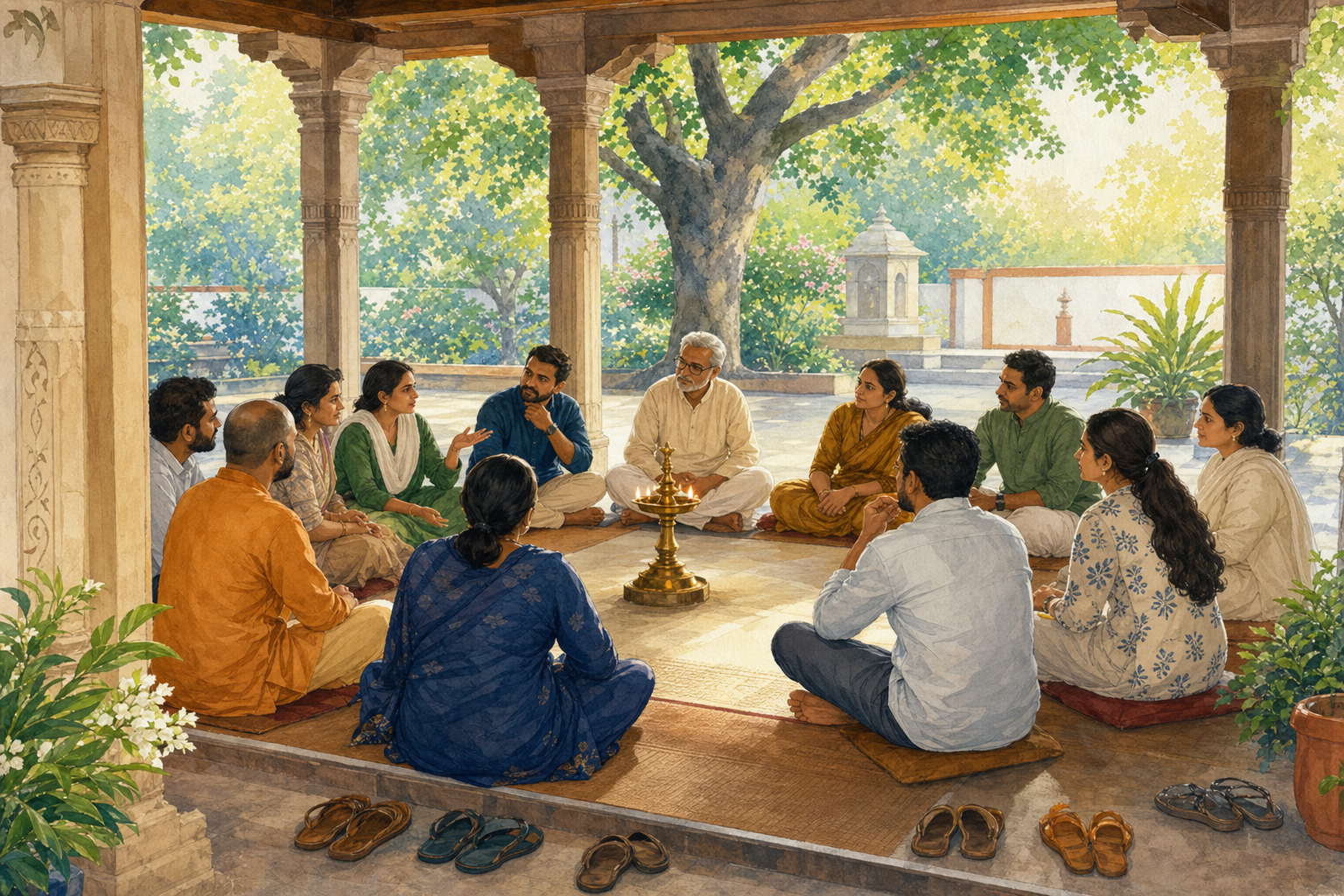
A campaign undertaken in the name of Hindu interests is judged not only by its demand but by its conduct. Satya, ahimsa, viveka, and maryada provide a practical standard here: tell the truth, avoid intimidation, distinguish unlike things, and keep public conduct within civil bounds.
- Practise satya. Share full context, identify uncertainty, and correct an inaccurate post even when the error appears to help your side. Do not present an allegation as an adjudicated fact.
- Practise ahimsa. Reject threats, property damage, stalking, abuse of venue workers, and publication of private addresses or telephone numbers. None of these establishes the truth of a grievance.
- Practise viveka. Separate offence from falsehood, falsehood from hostility, and hostility from a direct threat. The emotional reaction may be similar, but the appropriate civic response is not.
- Practise maryada. Use a named spokesperson, a written statement, and one verified set of materials. Do not let anonymous accounts redefine the campaign through slurs or menacing language.
Peaceful action does not mean passive action. You can write to the organiser, ask the venue to publish its standards, decline to buy a ticket, organise a lawful demonstration, support a counter-event, or publish a point-by-point rebuttal. If you attend a protest, follow the designated boundaries and safety directions, do not obstruct uninvolved people, and leave if participants begin threatening anyone.
A short representation is usually stronger than a stream of angry posts. It can follow this structure: We object to [exact material], delivered or published on [date], because [specific reason]. The complete context is available at [verifiable location]. We request [one remedy]. Our advocacy will remain peaceful, and we will correct any factual error brought to our attention.
Do not fill the brackets with assumptions. If the date, context, or event status cannot be verified, pause the campaign message at that point and ask for the missing information.
Decide whether this campaign has earned your support
You do not have to choose between ignoring Hindu concerns and endorsing an inadequately supported cancellation call. Withholding amplification until evidence appears is a responsible position, not neutrality towards contempt.
Before sharing or joining the campaign, look for five affirmative answers:
- Is there a current, verifiable event rather than an old or misidentified listing?
- Has the exact material behind the anti-Hindu allegation been supplied in sufficient context?
- Does the description of that material remain fair after the full context is considered?
- Has the responsible organiser or venue received a clear representation and had a reasonable opportunity to answer?
- Is the requested remedy proportionate, and are campaign organisers explicitly rejecting threats and harassment?
Pause if the case depends only on labels, a cropped clip, an unattributed quotation, or claims about cancellation that no responsible party has confirmed. Withdraw your support if personal information, threats, or collective abuse are being used as leverage. Even when the original grievance is sound, those methods create a separate wrong and make the stated concern easier to dismiss.
If the evidence eventually supports the objection, state it plainly and choose a remedy you can defend under questioning. If it does not, correct the claim without treating that correction as a concession against Hindu interests. A movement confident in dharma should be able to distinguish a substantiated insult from an unsupported label.
Your next useful action is simple: before reposting the cancellation call, attach the exact evidence and describe the show’s status accurately. If those two things are unavailable, ask the campaign organisers for them. Truthful and disciplined advocacy will protect Hindu dignity more effectively than a viral assertion that fails under its first serious question.
References
