
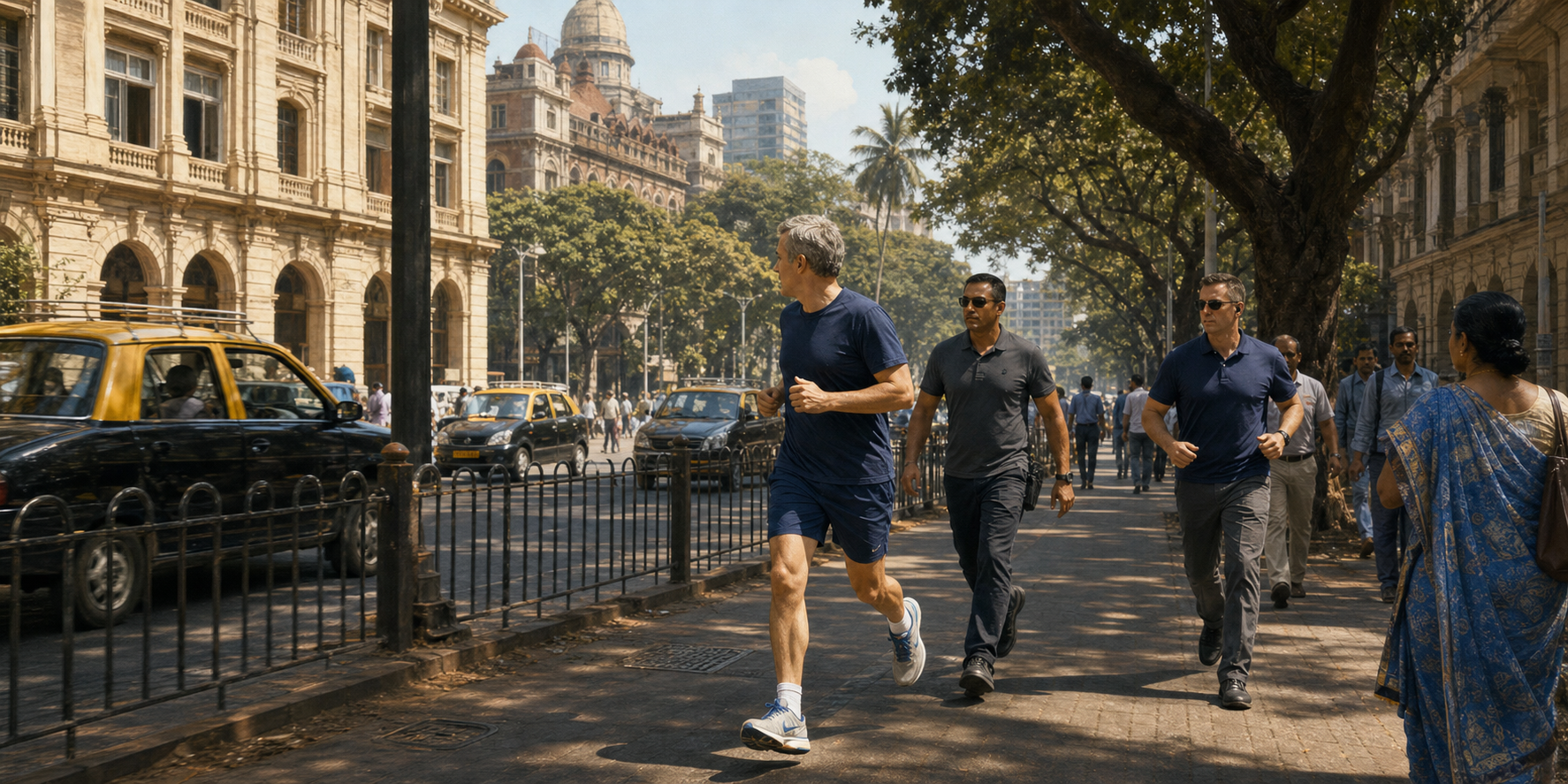
If you saw a few seconds of Emmanuel Macron running through Mumbai, you may have wondered whether it was anything more than a carefully arranged photo opportunity. That is a reasonable question. The useful answer, however, is neither automatic admiration nor automatic cynicism.
The jog mattered because diplomacy is conducted through public impressions as well as closed-door negotiations. Macron’s late-morning run through the Churchgate area, reportedly around 11 a.m., condensed several messages into one memorable scene: personal discipline, confidence in Mumbai, trust between India and France, and comfort within an Indian public space.
The jog compressed a large relationship into a simple image
Most citizens do not encounter foreign policy through communiques. They encounter it through an image that survives after the formal language has been forgotten: two leaders embracing, a visiting dignitary entering a temple, a military honour guard, a shared meal or, in this case, a president running along a city street.
That is the practical function of public diplomacy. It gives an emotional and human frame to relationships that would otherwise be discussed only through defence contracts, maritime strategy, technology standards and diplomatic protocol. The image does not replace those matters. It influences how people receive them.
Macron’s run could speak differently to three audiences at once. A Mumbai resident could see a foreign president moving through familiar streets rather than remaining inside a sealed ceremonial venue. An Indian audience could read his apparent ease as confidence in the country and its security arrangements. A French or international viewer could see Mumbai presented as energetic, accessible and capable of hosting a prominent visitor in the midst of ordinary urban life.
None of these impressions proves that a policy has succeeded. A photograph cannot establish the value of a defence agreement, resolve an argument about artificial intelligence or guarantee long-term strategic alignment. Yet dismissing the scene because it was visual would miss how political attention works. A short, shareable moment can establish the narrative through which a much longer visit is remembered.
When you assess such an appearance, therefore, do not ask only whether it was planned. Official appearances usually are. Ask what the planning was designed to communicate, whether that message fits the wider relationship, and whether the subsequent work supports it.
Mumbai was a participant, not merely a backdrop
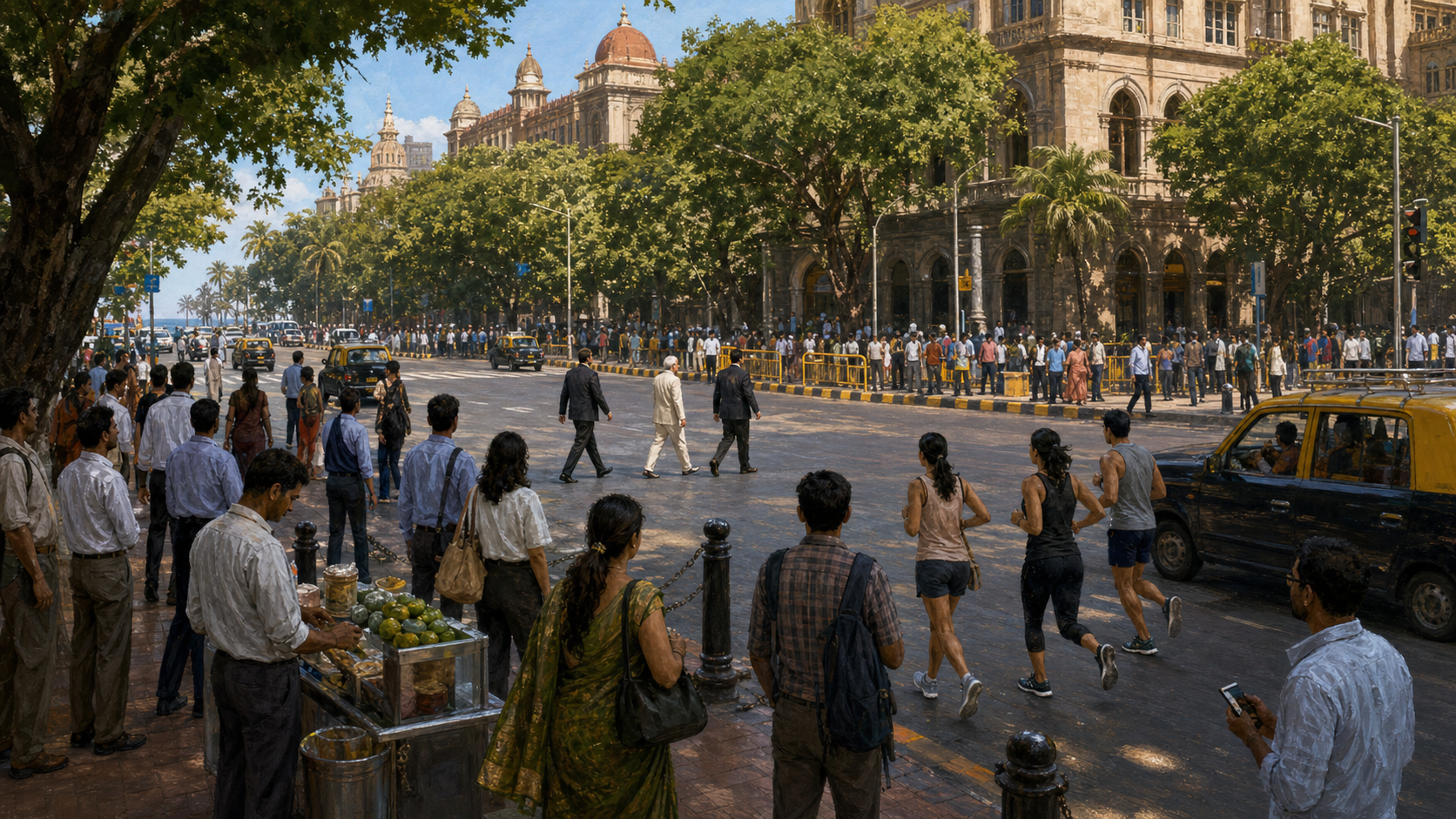
Location changes the meaning of a diplomatic image. A run inside a hotel gym would communicate a personal habit. A run through Churchgate during a working day turns the city itself into part of the message.
Churchgate carries the recognisable rhythm of central Mumbai: offices, institutions, traffic, pedestrians and the movement of a commercial capital. Its continuous urban routes and familiar downtown geography also make it more workable than an unpredictable or badly connected corridor for a short protected movement. The setting was public enough to feel immediate, yet structured enough to remain manageable.
The presence of onlookers and smartphones was not incidental. Public diplomacy needs witnesses. Residents who suddenly see a global leader pass a familiar corner become participants in the event, recording and redistributing it through their own networks. The official visit briefly enters the city’s everyday memory instead of remaining confined to government halls.
For India, that carries a subtle but important message. Bharat is not simply a destination at which foreign leaders complete formal obligations. Its cities are platforms from which international figures seek to communicate with large domestic and global audiences. The distinction matters. It reflects India’s growing importance as an audience, a partner and a setting in which political meaning is made.
A confident Indian response should not treat foreign attention as the source of Mumbai’s worth. The city does not become cosmopolitan because a European president jogged through it. The more grounded interpretation is that a visiting leader considered engagement with Mumbai’s public environment valuable enough to build into a tightly managed schedule.
Nor should an open-looking scene be mistaken for an unprotected one. Moving a head of state through a functioning city normally requires route reconnaissance, attention to choke points, linked security teams, medical readiness and diversion options. The compact detail visible around a leader is only the innermost part of a wider protective arrangement.
This distinction helps you read the symbolism accurately. The jog could signal confidence in Indian coordination without implying recklessness or spontaneity. Good public diplomacy often depends on making extensive preparation appear light. The public sees ease because protocol and security teams have already carried the complexity.
There is also a practical lesson for Indian cities. Routes suitable for a protected walk or run require many of the same things residents need every day: connected pavements, predictable crossings, adequate space and manageable choke points. Dignitary planning should not become an excuse to create temporary islands of order. The better legacy is urban infrastructure that remains safe and usable after the motorcades leave.
Fitness communicates discipline, but it does not prove leadership
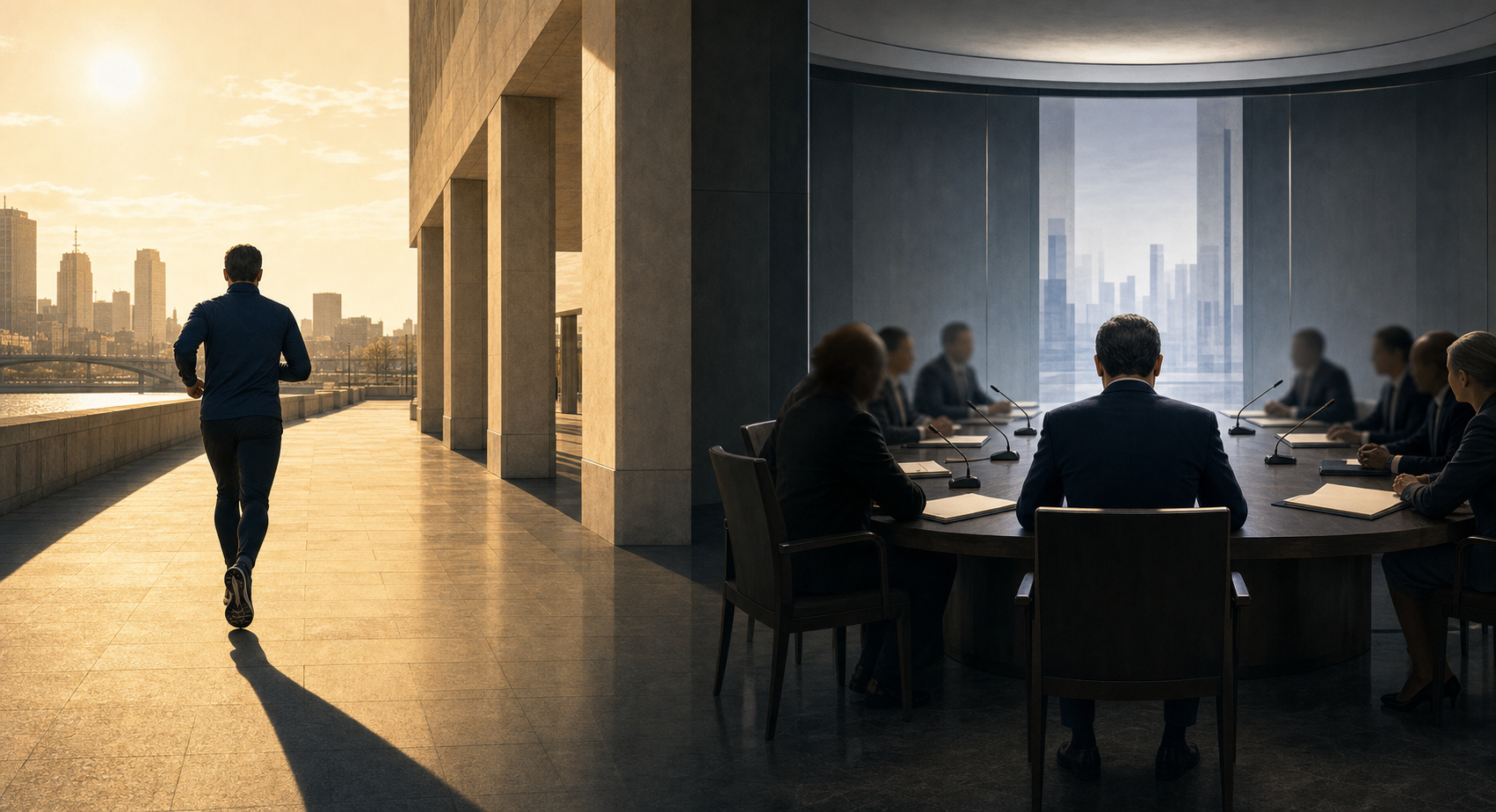
A leader in motion is a powerful political image because the body communicates before words do. Steady movement under public scrutiny can suggest routine, energy, composure and self-command. Those qualities are easily projected onto leadership, even though physical fitness and political judgement are not the same thing.
This is where a careful reading is necessary. Macron’s jog can reasonably be admired as an example of maintaining a fitness routine during a demanding international visit. It cannot, by itself, establish strategic wisdom, administrative ability or moral authority. A fit leader may govern badly, while a leader who does not resemble an athlete may exercise sound judgement and carry an exhausting public workload.
For a Dharmic audience, the more useful standard is not appearance but disciplined action directed toward duty. You can respect bodily discipline without turning body shape into a moral ranking. Dharma asks what self-command serves. When fitness supports steadiness, health and sustained public responsibility, it has civic meaning. When it becomes vanity or a substitute for performance, the symbolism has outrun the substance.
The Indian setting gave the gesture additional resonance because public exercise already fits familiar national themes. The Fit India Movement and the public prominence of the International Day of Yoga have helped make preventive health, movement and disciplined practice part of civic conversation. Macron did not introduce that vocabulary to India. His appearance entered a conversation India was already conducting in its own way.
Three tests help distinguish an effective fitness appearance from empty political theatre:
- Authenticity: Does the activity look like a plausible personal habit, or was it invented solely for the cameras?
- Proportionality: Is the gesture brief and natural, or has the public schedule been bent into an oversized spectacle?
- Respect for place: Does the appearance work with the host city’s rhythms and norms, or does it treat residents as props and impose needless disruption?
The Mumbai run was effective largely because it was modest. It was visible enough to attract attention but ordinary enough to remain legible as exercise. Its political value came from the contrast between the global status of the runner and the everyday nature of the act.
The real test lies in the India-France agenda behind the image

A symbolic gesture acquires weight when it rests on an established relationship. India and France are not trying to build familiarity from a single street appearance. Their strategic partnership already extends across defence cooperation, Indo-Pacific maritime security, space, climate action, education and urban innovation.
The context of the AI Impact Summit gave the visit another layer. India and France both have interests in responsible artificial intelligence, data governance and the rules that will shape digital systems. France’s emphasis on human-centred AI and India’s experience with inclusive digital infrastructure create room for cooperation, but a friendly image cannot settle the hard questions. Standards, safety, access, national interests and implementation still require patient negotiation.
The jog did not advance an AI framework in any technical sense. Its function was to make a policy-heavy visit more human and memorable. That matters because citizens are more likely to notice a bilateral agenda when it is attached to a recognisable moment. The danger begins only when the moment is allowed to stand in for the agenda rather than lead people toward it.
Use a three-stage test for summit imagery
When the next diplomatic image fills your feed, examine it in this order:
- Image: What immediate impression is the scene designed to create? In Mumbai, the likely impressions were energy, accessibility, urban confidence and personal discipline.
- Agenda: What substantive relationship gives the image relevance? Here, that includes a broad India-France partnership and cooperation around emerging technology.
- Delivery: What should happen after the cameras move on? Look for sustained cooperation, workable agreements, institutional contact and outcomes that serve Indian interests.
If there is an image without an agenda, you are probably seeing branding. If there is an agenda without delivery, you are seeing aspiration. When image, agenda and delivery remain aligned, public diplomacy performs a legitimate task: it helps citizens understand and remember a relationship that is producing real work.
What Bharat should carry forward
India should welcome respectful, human-scale engagement from visiting leaders. Such moments affirm the openness of Indian civic life and allow bilateral ties to be seen outside elite conference rooms. They can also bring together residents from different communities in the shared curiosity of a public event, expressing pluralism without requiring a speech about pluralism.
Indian leaders and protocol teams can learn from the format without copying its surface. The point is not that every office-holder must jog for cameras. The point is to find credible actions that connect a leader’s real habits and the visit’s policy purpose with the life of the host city. A walk, a transit journey, a sporting exchange or an encounter with local institutions can work, provided it remains authentic, restrained and relevant.
India should also insist that visibility remain reciprocal. A mature partnership is not measured by how warmly Bharat hosts a foreign dignitary alone. It is measured by whether Indian perspectives, security interests, technological capabilities and civilisational confidence receive comparable respect within the relationship. Hospitality and strategic clarity are not opposites.
Key takeaways
- Macron’s Churchgate jog was meaningful public diplomacy because it turned an abstract strategic relationship into a scene people could immediately understand and share.
- The setting did much of the communicative work: a functioning Mumbai street conveyed more openness and confidence than an appearance inside a controlled venue could have done.
- The apparent informality depended on serious Indian security and civic coordination; public ease should not be confused with an absence of protection.
- Physical discipline can strengthen a leader’s image, but it is not evidence of competent or ethical government. Judge the habit positively without confusing physique with public merit.
- The decisive question is what follows: India-France cooperation in defence, maritime security, space, climate, education, urban affairs and AI must supply the substance behind the image.
The next time a diplomatic gesture goes viral, resist the easy choice between adulation and dismissal. Identify the message, connect it to the actual agenda and then watch for delivery. Bharat can appreciate respectful engagement from a position of confidence while still asking the only question that ultimately matters: what durable benefit will the relationship produce?
References
