
If you are deciding when to complete an Ekadashi fast, begin an undertaking, or prepare for Pradosha on Saturday, February 28, the Gregorian date alone is not enough. You need to know which tithi prevails at the time of the act and whether the clock times have been calculated for your location.
For this date, the working baseline is Shukla Paksha Dwadashi until 8:04 PM, followed by Shukla Paksha Trayodashi. Treat 8:04 PM as a date-level starting point, not as a universal local verdict. Confirm the transition, sunrise, sunset, and solar noon in a Panchang set to your city before fixing an observance or muhurta.
One civil date carries two different tithis
A tithi does not begin at midnight. It changes whenever the angular separation between the Moon and Sun crosses the next 12-degree interval. Shukla Dwadashi covers the 132-degree to 144-degree interval, while Shukla Trayodashi covers 144 degrees to 156 degrees. The Moon’s apparent motion is not uniform, so a tithi also does not occupy a fixed number of civil hours.
That explains the practical shape of February 28. The morning and afternoon belong to Dwadashi under the stated baseline. Trayodashi begins in the evening after 8:04 PM. A morning puja and a late-evening puja can therefore fall under different tithis even though both occur on the same printed date.
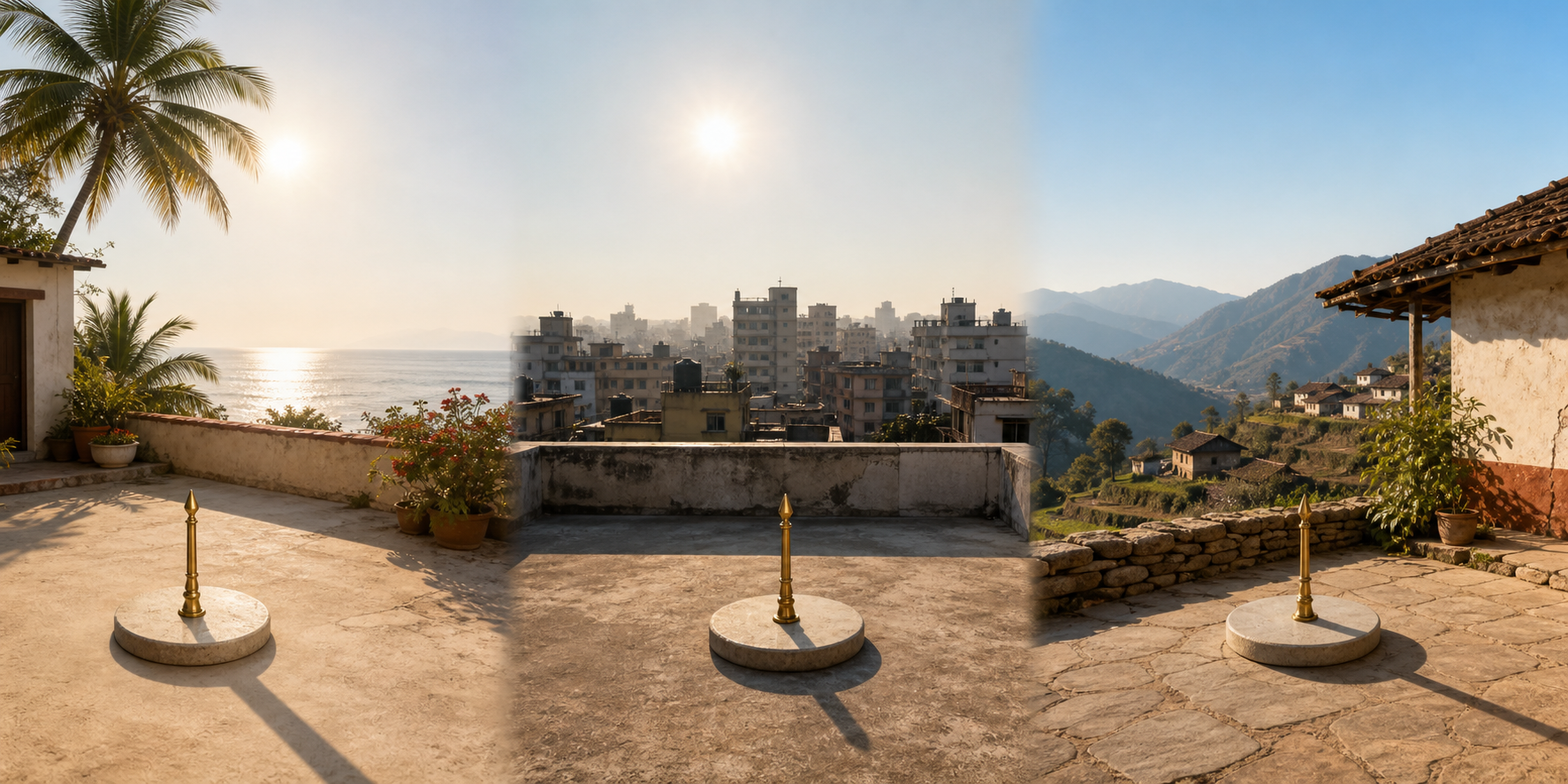
Location matters in two ways. First, you must express the lunar transition in the correct local time. Second, sunrise, sunset, solar noon, Rahu Kalam, Yamaganda, Gulika, Choghadiya, and Pradosha kala are all tied to local solar events. Copying a schedule prepared for another city can leave the tithi broadly right while making the usable clock windows wrong.
Key takeaways for February 28
- Use Dwadashi until 8:04 PM and Trayodashi afterward as the initial timeline, then verify the transition for your location.
- If you observed Ekadashi and your tradition calls for parana, plan it during the locally prescribed Dwadashi parana window rather than assuming that any hour before 8:04 PM is equally suitable.
- Calculate Saturday’s daylight periods from local sunrise and sunset. Gulika occupies the first eighth, Rahu Kalam the second, and Yamaganda the sixth.
- Do not infer Shani Pradosh merely because Trayodashi begins later that night. Trayodashi must prevail during the local Pradosha period around sunset.
- Look up nakshatra, Chandra Rashi, yoga, and karana for the intended time. Their values should not be guessed from the tithi alone.
Calculate Saturday’s local timing windows
You can calculate the three weekday-sensitive daylight segments with a short worksheet. Let S be local sunrise, E be local sunset, and q be one-eighth of the daylight duration: q = (E – S) / 8.
| Saturday period | Daylight segment | Local calculation | Practical use |
|---|---|---|---|
| Gulika | First | S to S + q | Mark it distinctly so it is not mistaken for a general shubh window. |
| Rahu Kalam | Second | S + q to S + 2q | Traditionally avoid this period for a discretionary new beginning. |
| Yamaganda | Sixth | S + 5q to S + 6q | Keep it visible when comparing possible muhurta windows. |
Do not divide a fixed 6:00 AM-to-6:00 PM day unless those are genuinely your local solar times. The Saturday segments must be derived from the actual daylight duration, which changes by city, latitude, and season.
For meditation, japa, or scriptural study, Brahma Muhurta provides an early-morning orientation roughly one and a half hours before local sunrise. Use the locally listed window when you need precise clock times.
For Abhijit Muhurta, begin with local solar noon rather than assuming that the Sun crosses the meridian at 12:00 on the civil clock. Abhijit is a short period centered on that solar transit. A location-aware Panchang should supply its exact start and end; the tithi transition by itself cannot provide them.
Choghadiya requires the same local discipline. Generate Saturday’s daytime sequence from sunrise to sunset and the nighttime sequence from sunset to the following sunrise. Amrit, Shubh, and Labh are generally treated as favorable, while Kal, Rog, and Udveg are approached cautiously. Because the ordering depends on the weekday and the relevant day or night span, do not transplant another city’s chart.
For an optional new undertaking, make a single comparison sheet containing the tithi, Rahu Kalam, Abhijit Muhurta, and Choghadiya at the proposed time. No one label should be made to carry the entire decision when your family, temple, or sampradaya follows a more specific muhurta rule.
Match each observance to the tithi that actually prevails
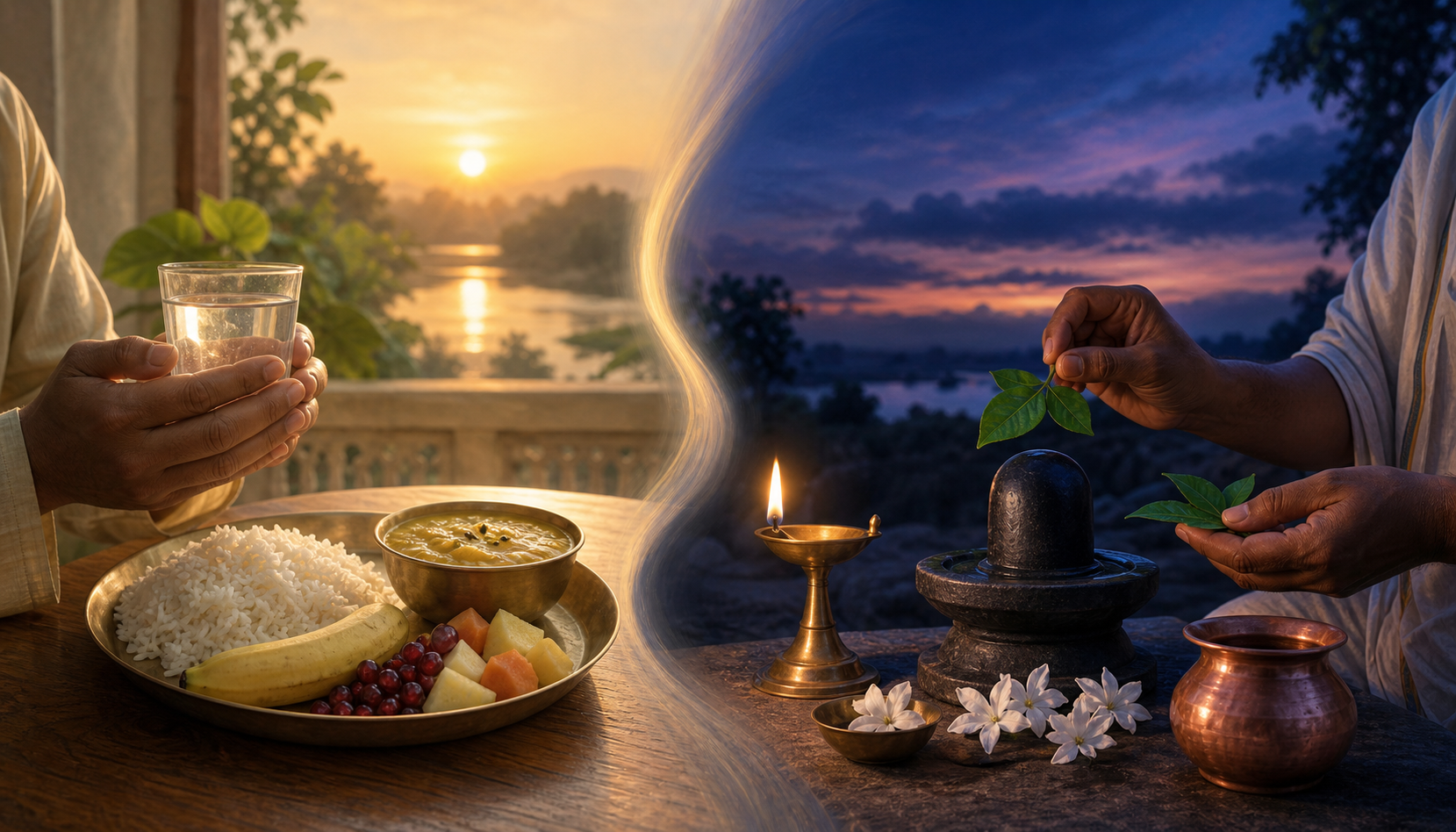
The shift from Dwadashi to Trayodashi suggests a clear rhythm, but it should be applied without turning the 8:04 PM baseline into a shortcut for every ritual question.
- Before sunrise: Use the local Brahma Muhurta for quiet meditation, study, or japa if that forms part of your practice.
- During Dwadashi: If you completed an Ekadashi vrata and parana is prescribed, follow the exact local parana window and your sampradaya’s rules. Dwadashi is also traditionally associated with Sri Vishnu worship, sattvic food, dana, and restrained japa.
- For a daytime undertaking: Check the proposed hour against Saturday’s locally calculated Rahu Kalam and the other muhurta factors. The fact that Dwadashi prevails does not automatically make every daytime minute suitable.
- Around sunset: Test Pradosha eligibility using the local Trayodashi transition and local Pradosha kala. If Trayodashi prevails during that period, the Saturday observance is Shani Pradosh. If Trayodashi begins only after the relevant sunset period, do not label that evening Shani Pradosh merely because the tithi arrives later at night.
- After the confirmed transition: Treat worship performed after the local change as Trayodashi practice. A late transition does not retroactively change the tithi that prevailed at sunset.
The Pradosha distinction is the most important place to resist a date-only answer. Under the 8:04 PM baseline, a location whose sunset and Pradosha period occur earlier would not qualify that evening. A location-specific Panchang remains decisive because both the tithi clock and the local sunset must be checked together.
Complete the Panchang before making a precise choice
Tithi is only one of the Panchang’s five limbs. The complete set is vara, tithi, nakshatra, yoga, and karana. February 28 supplies Saturday as the vara and gives a working Dwadashi-to-Trayodashi sequence, but it does not safely determine the remaining limbs without an exact ephemeris or location-aware Panchang.
Nakshatra divides the zodiac into 27 portions of 13 degrees and 20 minutes each. Chandra Rashi uses 12 signs of 30 degrees each. Because the Moon moves quickly, nakshatra and Moon sign can change within a civil date. Look them up for the hour of your intended activity, not just for the date printed at the top of a calendar page.
Yoga is calculated from the combined solar and lunar longitudes, while karana is a half-tithi division. These factors refine the character of a proposed time. They cannot be reconstructed merely by knowing that Dwadashi ends at 8:04 PM.
You may also see the lunar month called Magha in one regional calendar and Phalguna in another. This can result from the difference between amanta reckoning, in which the month runs from new moon to new moon, and purnimanta reckoning, in which the month is organized from full moon to full moon. The differing month label does not, by itself, indicate an error in the Dwadashi-to-Trayodashi sequence.
Before February 28, write down eight items from one trusted local Panchang: city, sunrise, sunset, Dwadashi end, solar noon and Abhijit, the three Saturday daylight periods, Choghadiya, and the nakshatra-rashi-yoga-karana combination at your intended time. Then place your parana, worship, or discretionary undertaking against that sheet. If one field is unavailable, leave the decision open rather than filling it with a clock time copied from another city.
References
