
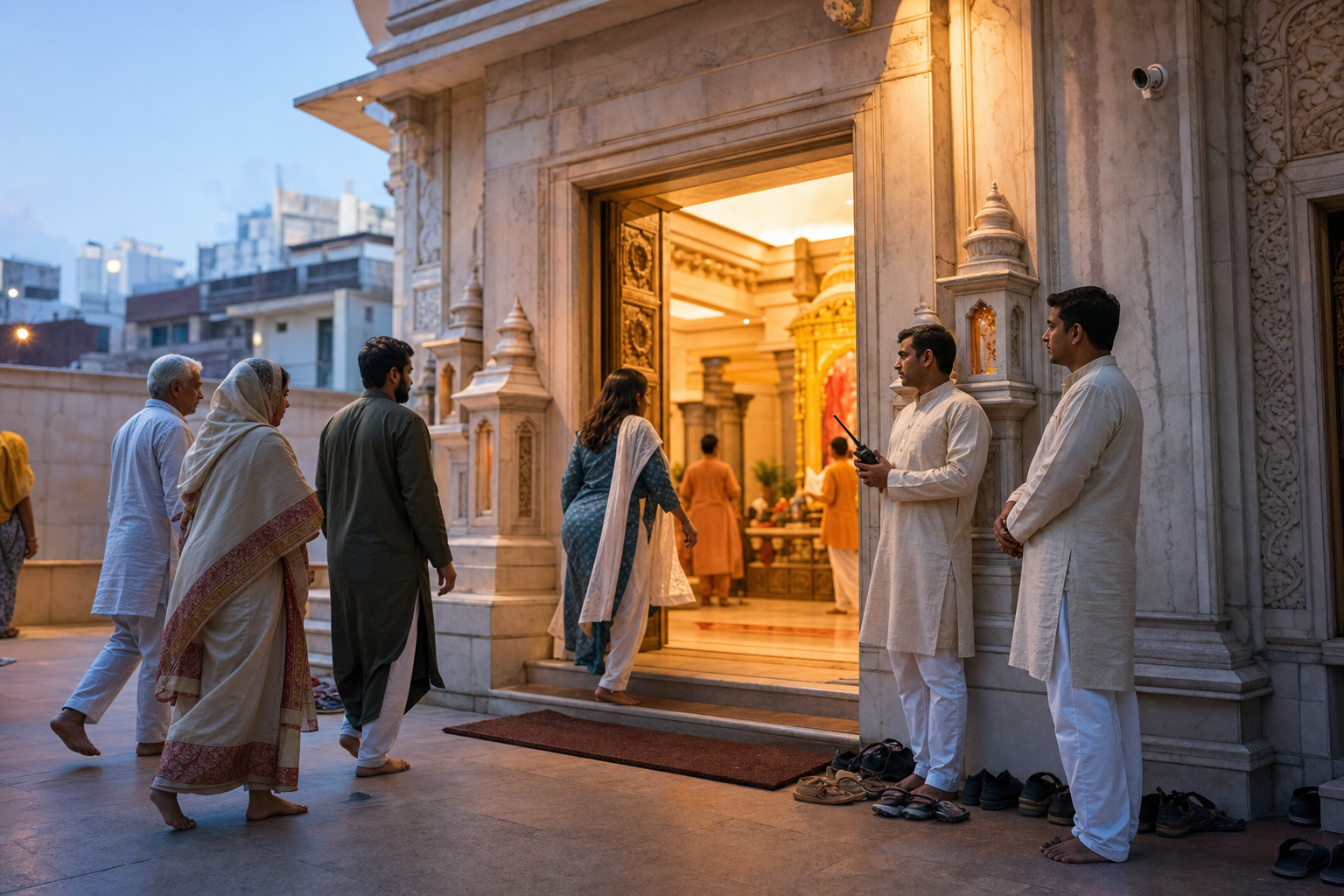
If you worship at a Delhi temple – or help run one – you need an answer more useful than either dismissing the danger or treating every visit as unsafe. The reported plot does not justify panic or rumor. It does justify a disciplined review of entry controls, surveillance, emergency communication and volunteer roles.
Your goal is straightforward: keep normal worship welcoming, make genuinely suspicious activity easier to notice, and make an emergency easier to manage. That requires alert people and clear decisions, not a fortress atmosphere.
Separate the reported facts from the allegations
On 23 February 2026, a multi-agency operation in the National Capital Region reportedly interrupted an attempted attack on a Delhi temple. The preliminary assessment attributed the alleged module to Lashkar-e-Taiba (LeT) and described guidance from an Inter-Services Intelligence (ISI)-linked handler operating out of Bangladesh. Investigators were said to have intervened after reconnaissance and preparatory coordination had begun.
Those claims are serious, but they remain allegations subject to investigation and judicial scrutiny. Four distinctions will help you judge further updates responsibly:
- A reported disruption is not a completed prosecution. Investigators still have to preserve evidence, establish links among the accused and alleged handlers, file legally sustainable charges, and withstand scrutiny in court.
- An alleged LeT connection is not yet proof of every accused person’s formal role. Investigators may examine communications, facilitation patterns, ideological material and other indicators, but each person’s alleged conduct must be proved separately.
- ISI-linked is not automatically identical to proved direct state command. The nature of the asserted link – inspiration, facilitation, contact or operational direction – matters.
- A handler operating from Bangladesh does not implicate Bangladesh as a country or Bangladeshis as a people. It identifies a reported investigative lead that requires lawful cross-border cooperation.
Do not fill the remaining gaps with forwarded messages. Unless police, a court or the affected temple confirms a detail, do not repeat a temple name, supposed attack time, weapon description, arrest count or identity. A confident caption attached to an old photograph is still misinformation. In a live security situation, such claims can misdirect devotees and complicate legitimate police work.
Understand where a temple plot can be interrupted

A planned attack normally develops through stages: choosing a target, observing it, arranging logistics, acquiring materials, rehearsing parts of the plan, and selecting a moment for psychological impact. Defenders do not need to predict the entire plan. They need several opportunities to notice that something is wrong before it reaches an execution window.
This changes what vigilance means. If administrators wait for an obvious weapon or a dangerous package, they may be looking too late in the cycle. Earlier indicators can include repeated attention to restricted entrances, attempts to inspect service access, persistent questions about security routines, or unusual interest in cameras and crowd-control arrangements.
No single behavior proves hostile intent. A visitor may photograph architecture, ask an awkward question or return several times for entirely innocent reasons. Escalate patterns and context, not appearance. Record what the person did, where it happened, when it happened and which direction the person went. Do not substitute religion, clothing, accent, nationality or caste for an observable security concern.
Temple committees can reduce exposure at each stage without publishing sensitive details. Keep security layouts, camera coverage and staff routines out of public social-media posts. Control access to keys, service corridors, storage spaces and security-system accounts. Review temporary vendor and worker access before a large utsav or yatra. Examine the complete arrival and departure route, including queues, parking areas, nearby transit points and emergency vehicle access.
The principle is layered protection. A missed observation at the outer approach should still meet a controlled entrance. A failure at the entrance should still meet alert stewards, useful camera coverage and protected internal access. If an incident occurs, marked exits, tested communications and assigned decision-makers should limit confusion.
What you should do when visiting a temple
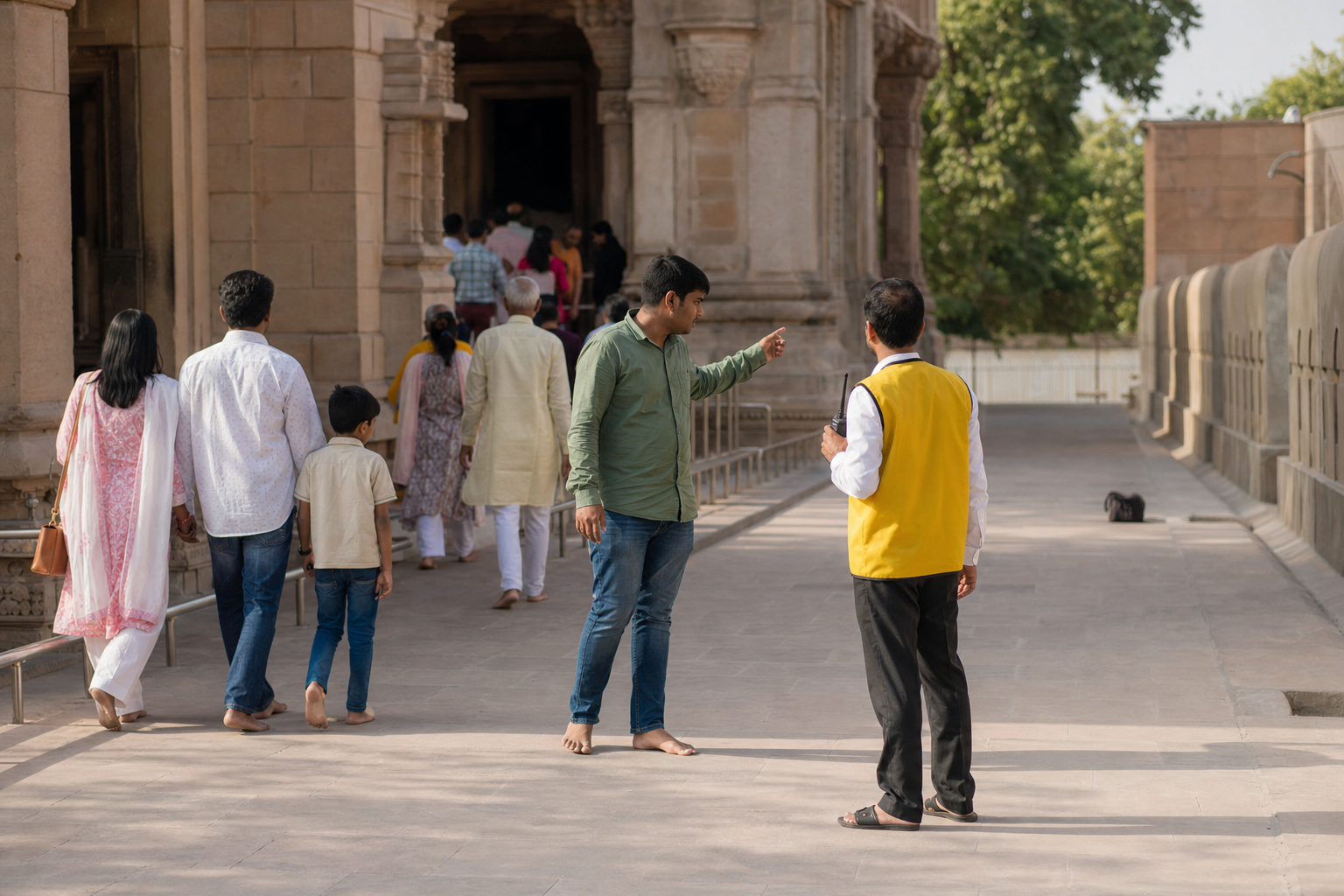
You do not need specialist training to improve safety. A few consistent habits are more valuable than dramatic suspicion:
- Notice the way out when you enter. Identify the marked exits and listen to any instructions from temple staff. If you are responsible for a child, older relative or person who may need assistance, agree to stay together rather than trying to reunite against the movement of a crowd.
- Cooperate with entry controls. Bag checks and managed queues can feel slow, especially during festivals, but bypassing them weakens protection for everyone. Bring only what you need and do not obstruct an emergency lane while waiting.
- Report an unattended object without touching or moving it. Step away calmly and tell a steward, security officer or police officer its exact location, appearance and what you observed. Do not gather around it, photograph it for social media or encourage others to inspect it.
- Describe conduct, not identity. If you notice repeated probing of locked access, attempts to evade screening or concentrated observation of security routines, report those actions. Do not confront, follow or detain the person yourself. Volunteers and devotees are observers and witnesses, not tactical responders.
- Follow official directions during an alarm. Move without stopping to film, keep exits clear, and assist someone nearby only when doing so does not place either of you in greater danger. If there is immediate danger and no temple official is available, contact police or emergency services.
- Apply the same discipline online. Use updates from police, the temple’s verified channel or another clearly identified authority. Do not forward suspect names, communal accusations, graphic material or purported intelligence screenshots whose origin you cannot verify.
Vigilance should not turn darshan into amateur investigation. Your useful role is to notice, report and comply with trained responders. Quietly passing an exact observation to the right person is more effective than alarming a queue with an uncertain accusation.
What temple committees should change before the next event
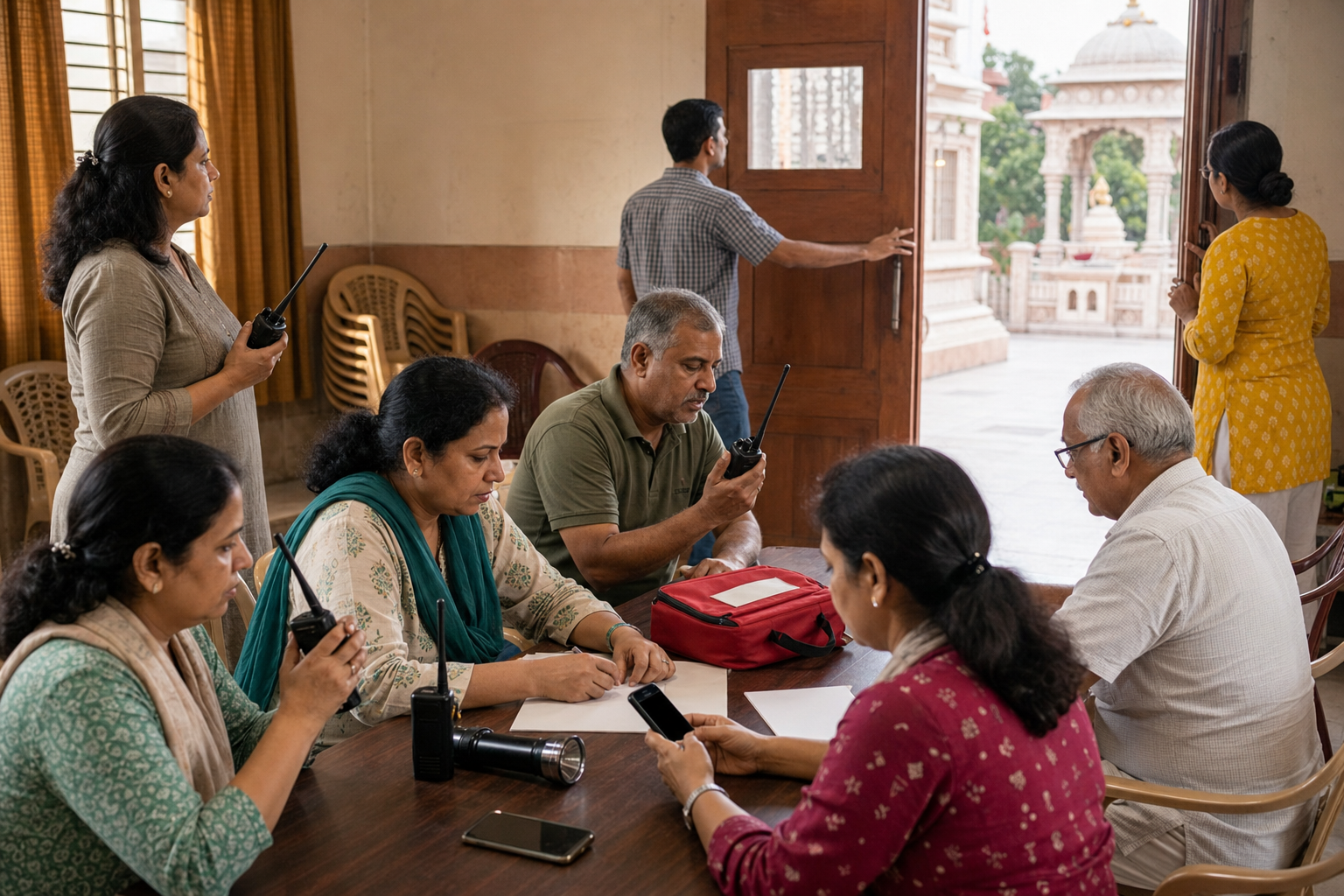
Hardware cannot compensate for unclear ownership. A camera records; it does not decide whether to pause entry, preserve footage, open an alternative exit or call police. Write those responsibilities down and assign them for every shift and major gathering.
Assign people to decisions
- Duty lead: decides whether entry should be paused, an area isolated or an evacuation initiated, in coordination with police when circumstances permit.
- Gate team: manages screening and queues, reports attempted bypasses, and prevents an entrance check from blocking emergency egress.
- CCTV operator: watches priority views, knows how to retrieve recordings and preserves relevant footage without circulating it informally.
- Egress stewards: keep marked routes usable, guide worshippers and prevent people from moving toward a suspected hazard.
- Emergency liaison: contacts police and other responders, provides an exact access point, and sends updates to the duty lead.
- Public-information lead: issues short, verified instructions and prevents competing messages from different office-bearers.
Every critical role needs a designated backup. Volunteers should know the limit of their authority: observe, report, guide and protect access. They should not search a suspicious object, pursue a person or conduct an interrogation.
Audit physical and digital layers together
Begin outside the sanctum. Walk the approaches, entrance queue, service access, congregation areas and departure routes as a visitor would. Identify camera blind spots, places where an unattended object could remain unnoticed, doors whose purpose is unclear, and points where screening could create dangerous crowd pressure.
Controlled entry must never become blocked emergency egress. A measure intended to stop an intruder can create a crowd or fire hazard if exits are locked, hidden by temporary structures or used for storage. Keep emergency routes clearly marked and physically usable whenever the premises are occupied.
Check whether CCTV covers approaches, queues, gates and service access rather than merely producing an impressive wall of screens. Confirm that recordings are usable, system time is correct, and authorized staff can retrieve relevant footage promptly. Restrict access to camera and donation-system administration, replace shared or default passwords, and enable stronger account protection when the equipment supports it.
Test panic and duress alarms through a planned exercise, not during a busy congregation without warning. Confirm who receives an alert, who calls police, what the duty lead sees, and how ordinary staff know whether they should hold entry, move people or wait for instructions.
Drill decisions rather than stage a performance
Use simple scenarios tied to real weaknesses. Place a clearly marked training object in an agreed location and see whether staff report it without touching it. Simulate a congested festival entrance and test whether screening can continue while an emergency path remains open. Test the emergency contact list and verify that responders would receive an unambiguous gate or landmark.
After each exercise, record the blind spot, assign a person responsible for correcting it, and confirm the correction. An authorized walk-through by someone unfamiliar with the daily routine can reveal assumptions that regular volunteers no longer notice. Keep the resulting vulnerability record restricted rather than publishing it with event photographs.
Before a yatra, utsav or unusually large congregation, coordinate with local police on expected crowd movement, vehicle access, temporary stalls, transit pressure and the route for emergency responders. The plan should connect temple volunteers, private security where present, and police instead of leaving each group with a separate idea of who is in charge.
Prepare the public message in advance
A useful emergency update answers practical questions: what has been confirmed, what worshippers should do now, which entrance or route has changed, and where the next verified update will appear. It should not guess at motive or identity. A preassigned spokesperson reduces contradictory announcements when facts are incomplete and time matters.
Protect the mandir without surrendering truth or social trust

An attack on a sacred place seeks more than physical harm. It seeks fear, communal retaliation and a lasting change in how people regard their neighbors. Protection rooted in dharma must therefore be firm and precise: defend worshippers, preserve evidence, tell the truth, and refuse collective blame.
The Bangladesh element should be understood as a reported lead involving a purported handler. It is not a case against Bangladeshis, migrants or Muslims in general. If the cross-border allegation is substantiated, the practical response is cooperation on communications, financial traces, digital evidence and facilitator networks – not suspicion directed at an entire population.
The same precision applies to the alleged ISI and LeT connections. Watch the language as the case develops. Contact, inspiration, logistical assistance and operational command describe different relationships. Arrest, charge and conviction also describe different legal stages. Demanding proof does not weaken counterterrorism; reliable evidence and a defensible chain of custody are what turn an intelligence disruption into lawful accountability.
Temples, gurdwaras, viharas and Jain derasars are not only ritual sites. They sustain charity, memory, family life and civic connection. Their security is strongest when neighboring communities, local officials and devotees know how to help without turning rumor into hostility.
Key takeaways
- The reported 23 February operation is significant, but the LeT, ISI and Bangladesh-handler claims remain allegations awaiting evidentiary and judicial testing.
- Devotees should notice exits, cooperate with screening, report unattended objects without touching them, describe suspicious conduct precisely, and avoid forwarding unverified claims.
- Temple committees need assigned decision-makers, controlled entry, unobstructed egress, useful CCTV coverage, tested alarms and police-coordinated plans for large gatherings.
- Behavior-based vigilance protects people more effectively than profiling by religion, clothing, language, caste or nationality.
- Future updates should be judged by the evidence they establish and the legal stage they represent, not by the confidence of a social-media caption.
Before the next high-attendance event, ask the temple office one practical question: who leads if entry must stop or the congregation must leave? If the answer is unclear, recommend a written role sheet and a police-coordinated safety walk-through. Calm preparation is how a foiled plot can lead to safer worship instead of durable fear.
References
