

You may accept that atman is unchanging and still get stuck on the practical questions. If the true self does not act, who earns karma? If past karma shapes your circumstances, what can you genuinely choose? And if moksha is already your deepest reality, why make any effort?
The apparent contradiction comes from using the word self for several different things. Hindu thought gives you distinct maps for embodied experience, moral agency and ultimate identity. Keep those maps separate, and you can take responsibility for your life without reducing yourself to your habits, history or passing state of mind.
Three models answer three different questions

Hindu traditions do not reduce the person to one simple definition. Different models become useful at different points in practice:
- The kosha model asks what you are presently identifying with. It examines body, vitality, mind, discernment and conditioned bliss as progressively subtler sheaths.
- The nara-jiva model asks who chooses and receives consequences. It treats the embodied person as a morally responsible agent with intention, intelligence and a capacity for discernment.
- The atman model asks what remains unchanged through every experience. In Advaita Vedanta, atman is the self-evident witness, not another object, mood or personality hidden inside the body.
These models should not be collapsed into one another. The body-person is born, grows tired and acts. Manas coordinates sense impressions and thoughts. Buddhi judges and discriminates. Ahamkara organizes experience around the sense of I and mine. Jiva is the embodied individual who appears as the agent and experiencer. Atman, in the nondual account, is the unchanging reality by which all those changing functions are known.
This produces a two-level answer to the question of action. At the everyday ethical level, the jiva deliberates, acts and bears consequences. At the level of liberating inquiry, atman is not modified by those actions. Practice fails when you use the ultimate claim to evade responsibility at the everyday level, or when you treat the everyday personality as the final truth about who you are.
The Sanskrit term nara is helpful because it names the situated human who can intend, discern, act and bear consequences. Nara has buddhi, iccha and kartritva: intelligence, intention and agency. That capacity gives a human being adhikara, or fitness, for dharmic and spiritual discipline. Human freedom is therefore not absolute control over circumstances. It is the meaningful ability to work with circumstances through attention, judgement and action.
The strongest claims about an unchanging witness belong to the Vedantic and especially Advaita framework used here. Other Hindu schools do not all describe the relation between the individual and ultimate reality in identical terms. Karma-yoga, jnana-yoga and bhakti-yoga nevertheless meet the same practical problem from the sides of action, knowledge and devotion.
The five koshas show where identification has taken hold
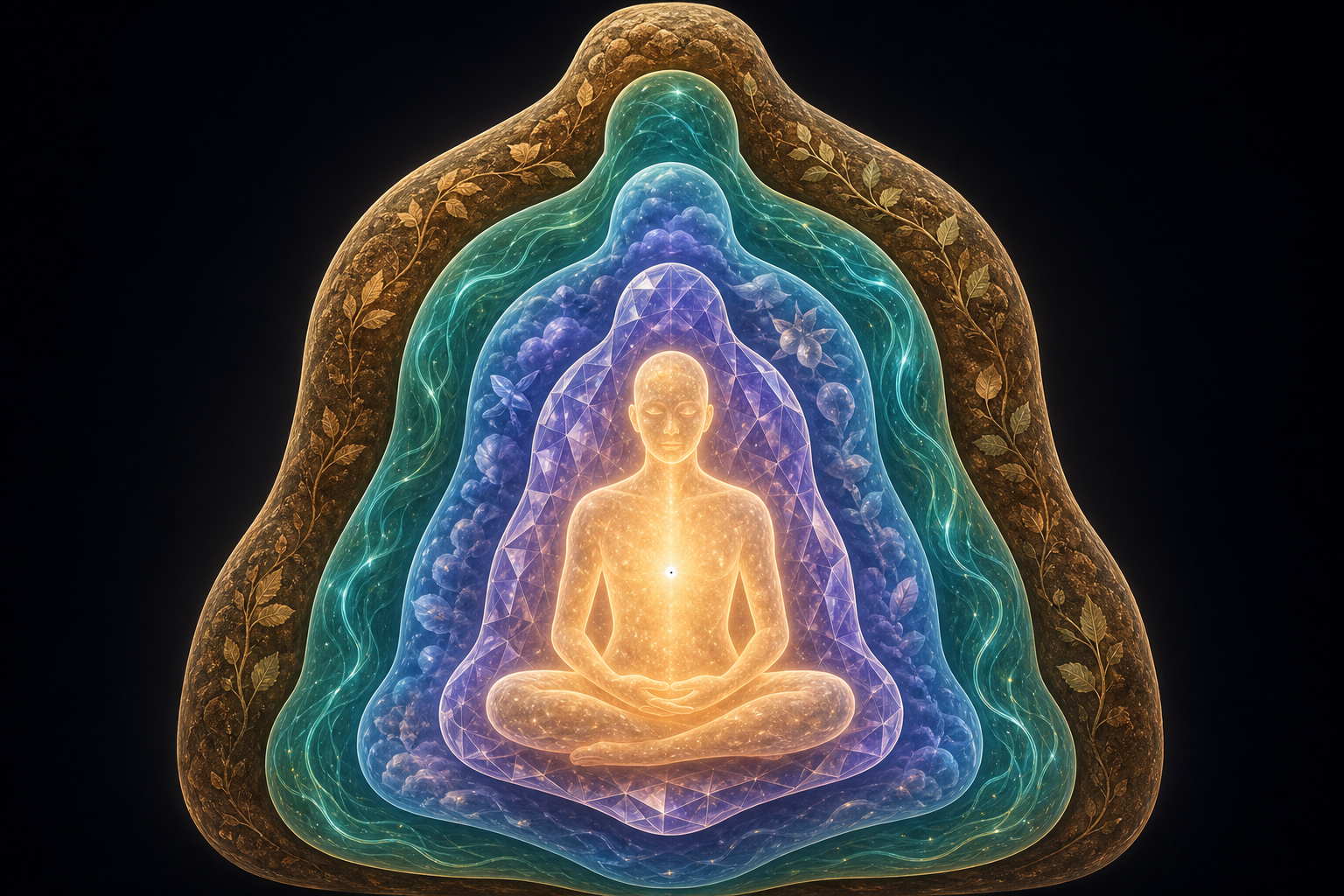
The Taittiriya Upanishad presents the five koshas as a movement from the gross to the subtle. They are not anatomical layers, fixed compartments or five spiritual ranks. They are changing modes through which consciousness appears limited. Their practical value is diagnostic: they help you locate the level at which confusion or reactivity is operating.
| Sheath | What it includes | What to notice | A fitting response |
|---|---|---|---|
| Annamaya kosha | The food-sustained physical body | Hunger, fatigue, poor sleep, illness, tension or bodily instability shaping your judgement | Attend to food, sleep, daily routine and suitable movement before turning every disturbance into a metaphysical problem |
| Pranamaya kosha | Vitality, breath and the movements of prana | Agitation, lethargy or an unsettled breathing pattern amplifying a reaction | Use measured, familiar pranayama, mindful movement and restraint to steady the instrument |
| Manomaya kosha | Manas, sense activity, emotions and vrittis | Repeated stories, sensory compulsion, resentment, fantasy or an impulse mistaken for a command | Practise pratyahara, mantra-japa and honest reflection; create a gap between stimulus and response |
| Vijnanamaya kosha | Buddhi, discernment and the organizing sense of self | Rationalization, rigid conclusions, intellectual vanity or a failure to distinguish preference from dharma | Use svadhyaya, satsanga, humility and viveka to test the conclusion rather than merely defend it |
| Anandamaya kosha | The causal register associated with deep sleep and refined absorption | Peace, blankness or bliss being claimed as final realization | Notice that the state arrives and departs; do not confuse a luminous experience with the awareness that knows it |
The related three-body model compresses the same field. Sthula sharira, the gross body, corresponds mainly to annamaya. Sukshma sharira, the subtle body, includes pranamaya, manomaya and vijnanamaya. Karana sharira, the causal body, corresponds to anandamaya. These are teaching aids, not substances that can be found by cutting the person into parts.
Atman is not a sixth sheath. Anything you can observe as changing cannot be the unchanging observer in this analysis. You can notice the body, breath, emotion, argument, sense of authorship and even a peaceful meditative state. The point of viveka is not to despise them. It is to stop granting any one of them the status of your complete and final identity.
Use the sheaths from gross to subtle, but do not turn them into a rigid sequence. If exhaustion is driving your anger, begin with annamaya instead of forcing an abstract inquiry. Once the body is steadier, examine the breath, the recurring thought and the judgement that endorses it. If a correct teaching has made you contemptuous of others, look closely at vijnanamaya: sound ideas can still be appropriated by ahamkara.
Agency is conditioned, not cancelled

Karma is often misread in two opposite ways. One treats it as fate, making present effort pointless. The other treats it as a promise that correct action will produce any desired result. Neither view leaves room for the mixture of inherited conditions, present intention and consequences beyond your control.
The traditional threefold distinction gives you a more workable account of conditioned agency:
- Sanchita karma is the accumulated stock of karma.
- Prarabdha karma is the portion presently bearing fruit in the conditions of this life.
- Kriyamana or agami karma is action now being performed, which helps shape what follows.
This distinction places responsibility at the point where it can do real work. You did not choose every condition now confronting you. You do choose intentions and actions within those conditions, although your available choices are influenced by body, habit, knowledge and circumstance. Present conduct can alter how a condition unfolds and create a different moral and practical direction.
Do not turn the three kinds of karma into an imaginary accounting system with which to judge other people. Another person’s suffering does not give you access to that person’s karmic history. The useful question is not, What hidden act caused this? It is, What does dharma require from me now? That change of question protects karma from becoming an excuse for indifference.
When you face a difficult choice, work through it in this order:
- Separate the given from the chosen. Write down the facts you cannot presently change: another person’s decision, an existing obligation, a past mistake or a bodily limitation. Do not call these facts your identity.
- Name the intention. Ask what you are trying to protect or obtain. Fear, status, revenge, care and duty can recommend outwardly similar actions for very different reasons.
- Apply a dharma test. Check the proposed action against truthfulness, ahimsa, responsibility and the legitimate claims of others. A choice that secures artha or kama by abandoning dharma has not resolved the whole problem.
- Choose the next action, not the guaranteed outcome. Your authority reaches intention, preparation and conduct more directly than it reaches every result.
- Learn from the consequence. Observe what the action strengthened in you. If it deepened honesty and steadiness, continue. If it strengthened compulsion, vanity or harm, revise the pattern instead of defending it.
This is why human birth is treated as spiritually valuable. The human condition contains enough constraint to make action consequential and enough discernment to make transformation possible. The Nara-Narayana relationship adds another dimension: human effort need not pretend to be self-sufficient. Arjuna as Nara and Krishna as Narayana presents agency as effort oriented by divine guidance, not as either isolated autonomy or helpless waiting.
Liberation corrects identification rather than manufacturing a self

In the Advaita account, moksha does not create atman, improve it or release it from a literal enclosure. The koshas never alter the reality of atman; they describe how limitation appears when the changing body-mind complex is taken as the whole self. Liberation is recognition of what was not absent, even while ignorance concealed its significance.
This explains why practice remains necessary. An unsteady body, reactive mind or self-satisfied intellect can repeat the sentence I am atman without dissolving mistaken identification. Practice prepares and clarifies the instrument through which knowledge becomes firm:
- Karma-yoga disciplines your relationship to action. You fulfil dharma while loosening the demand that every result confirm your identity or worth.
- Jnana-yoga uses shravanam, mananam and nididhyasanam: receiving the teaching, reasoning through doubt and contemplating it until knowledge is no longer merely verbal.
- Bhakti-yoga redirects the possessive ego toward devotion, remembrance, surrender and grace. Human effort remains, but it no longer imagines itself to be the only power at work.
These paths work on different aspects of the same knot. Ethical action reduces conflict and self-deception. Devotion softens self-centred appropriation. Discernment exposes the error of treating any known object as the knower. Meditation steadies the mind so that insight is not immediately buried under the next vritti.
Three false finishes
- Mistaking bliss for liberation. Anandamaya is still a kosha. Deep sleep, quiet meditation or absorption may be peaceful, but a state that begins and ends cannot be the unconditioned self. Value the peace without building an identity around having attained it.
- Mistaking intellectual fluency for realization. Vijnanamaya can discriminate, but ahamkara can convert that discrimination into superiority. If knowledge makes you less teachable or less responsible, the instrument still needs refinement.
- Using non-doership to excuse inaction. Saying that atman does not act does not cancel the jiva’s obligation to follow dharma. Refusing a necessary duty while claiming transcendence simply mixes the ultimate and everyday levels.
A practical sign of integration is not theatrical detachment. It is a growing ability to see a reaction without immediately obeying it, choose a dharmic response without demanding control of every outcome, and act without making the action the final definition of who you are.
Shared Dharmic disciplines should not tempt you to erase philosophical differences. Buddhist analysis of the skandhas loosens identification while teaching anatman rather than Vedantic atman. Jain thought distinguishes jiva from ajiva and describes karmic accretions that bind the soul. Sikh teaching confronts haumai through simran, seva and the guidance of the Shabad Guru. Ethics, attention and freedom from egoic compulsion create a practical bridge, but the traditions retain distinct accounts of selfhood and liberation.
Key takeaways for your next difficult decision
- When the word I appears in your thinking, identify whether it means the body, a feeling, ahamkara, the acting jiva or atman. The distinction often reveals the confusion.
- Work at the sheath where the disturbance is active. Stabilize the body and breath, examine the mental story, and then test the judgement with viveka.
- Treat past karma as part of the conditions, not as permission for fatalism. Present intention and action remain your field of responsibility.
- Do not use bliss, verbal knowledge or claims of non-doership as proof of liberation. Notice whether attachment, vanity and avoidable harm are actually declining.
- Convert insight into one dharmic action. A model of the self becomes useful only when it changes what you choose under pressure.
Take one unresolved decision and divide a page into two columns: given and chosen. Place the circumstances, past and other people’s conduct in the first. Place your intention, dharma test and next action in the second. Then act from the second column without pretending that either column is the whole of who you are.
References
- DharmaRenaissance Blog — Unlocking Kosha: From the Five Sheaths of the Self to the Treasury of Hindu Statecraft
- DharmaRenaissance Blog — Why Sanskrit Calls Humans Nara: Deep Origins, Dharma, and the Power of Karma
