

Perhaps a meditation made the boundary around ‘me’ feel thin. Or Chamunda’s fierce form left you wondering whether moksha requires the destruction of your individuality. Neither a dramatic experience nor hostility toward your own personality is liberation.
What matters is more exact: can you let the claim of an isolated owner fall away while remaining honest, responsible, and capable of love? This distinction separates ego-dissolution from self-erasure. It also gives you a practical way to judge spiritual insight when praise, blame, fear, conflict, and duty arrive.
Let the I-maker dissolve, not the functioning person
Ahamkara is often translated as the I-maker. It is the movement by which the mind gathers sensations, memories, preferences, possessions, and social roles around a presumed centre, then declares: this is me, this is mine, and this must confirm my importance. Ego-dissolution loosens that appropriation. It does not require memory loss, emotional blankness, passivity, or the inability to answer to your name.
You still need a functional identity. You must keep promises, protect appropriate boundaries, care for the body, make decisions, and accept the consequences of your conduct. Advaita Vedanta’s distinction between transactional and absolute reality keeps this point clear. At the absolute level, the body-mind cannot be an independent, final self. At the transactional level, actions still affect people, injury still matters, and dharma still governs conduct. Mithya means dependent reality in this framework, not absolute nothingness.
| What practice loosens | What dharmic life still requires |
|---|---|
| The need to defend every self-image | The ability to speak clearly and correct falsehood |
| Ownership of every passing thought and mood | Responsibility for your words and actions |
| Taking a family, professional, or religious role as your final identity | Faithful performance of the duties attached to that role |
| The demand that experience prove a special attainment | Humility, discernment, and willingness to learn |
| The belief that disagreement diminishes your being | The capacity to set boundaries without hatred |
The proper target is appropriation, not capacity. Anger may arise, but ahamkara adds the claim that your essential worth has been attacked and must be restored through victory. A role may be performed, but ahamkara says that losing the role would erase what you are. When that additional claim is seen through, you can respond to the actual situation without turning it into a referendum on your existence.
This is why passivity is a poor measure of realization. You may act firmly without acting from wounded vanity. You may refuse wrongdoing without manufacturing an enemy. You may admit an error without experiencing the admission as annihilation. The person continues to function; it simply stops pretending to be a separate, self-sufficient absolute.
Keep the four Dharmic maps distinct as you use them

Hindu, Buddhist, Jain, and Sikh teachings all confront egoic clinging, but they do not make one interchangeable metaphysical claim. Treating every term as a synonym creates confusion precisely where careful discrimination is needed. Their convergence is practical and ethical: bondage is sustained by grasping, self-importance, passion, or false independence, and freedom changes how you relate to all four.
- Hindu paths: Advaita Vedanta uses discrimination to show that the changing body, senses, mind, and intellect cannot exhaust Atman. The recognition of Atman as Brahman dissolves the presumption of a separate owner. Yoga distinguishes the seer from mental fluctuation, while bhakti offers doership to the Divine and Karma Yoga relinquishes possessiveness about results. These methods are not identical, but each refuses to grant ahamkara final sovereignty.
- Buddhist paths: Anatman and shunyata challenge the belief that a person or phenomenon possesses permanent, independent existence. Dependent origination prevents emptiness from becoming nihilism: things function through conditions even though no isolated essence can be found. When reification and clinging weaken, clarity and compassion should become more available, not less.
- Jain paths: Liberation is not the destruction of jiva. The work is the conquest of kashaya – the passions that bind and obscure – and the unveiling of kevala jnana. Anekantavada also disciplines intellectual ego by reminding you that a finite assertion discloses a standpoint rather than exhausting many-sided reality.
- Sikh paths: Haumai is the veil of self-centredness that makes the individual behave as though separate from Ik Onkar. Mann marna means subduing the tyrannical mind, not harming the person. Naam-simran, kirtan, and seva loosen possessive identity by joining remembrance to service. The test is whether the claim of ‘I alone’ yields to truthful participation in the One.
These distinct approaches to nondual or non-separate realization can illuminate one another without being collapsed. Atman and anatman should not be made verbally identical. Neither should the Jain jiva or Sikh account of haumai be forced into an Advaita template. Use the vocabulary of your lineage first, because each discipline is designed to correct a particular error.
When comparing paths, ask a precise question: what is being denied or overcome here? It may be identification with the body-mind, belief in inherent existence, domination by passion, or the self-centred veil of haumai. That question produces understanding. The vague declaration that all paths say exactly the same thing does not.
Practise recognition instead of hunting for ego-death

Ego-dissolution becomes distorted when you chase a spectacular state. A loss of bodily boundaries, a quiet mind, an unusual vision, or a wave of bliss may occur in contemplation. Because every experience arrives and departs, no such event can by itself establish irreversible liberation. Use experience as material for discernment, not as a certificate of spiritual rank.
- Choose an ethical anchor before turning inward. Name one duty that spirituality must not help you avoid. Then name one restraint, such as ahimsa, truthfulness, or non-grasping, that governs the practice. Ethics reduces the agitation and self-deception that can impersonate insight.
- Take the witness position. Let a sensation, sound, mental image, or mood appear. Notice simply that it is known. Do not manufacture a visual picture of a witness sitting behind the mind. Rest in the immediate fact of knowing before a description is added.
- Apply neti neti without rejecting life. ‘Not this’ does not mean that the body is worthless or that emotion is unreal in the sense of nonexistent. It means that changing content cannot exhaust the identity of the knower. Notice the body as known, the thought as known, and the role as known. Then remain with what does not need to be turned into another object.
- Move from gross to subtle. Begin with bodily contact and physical sensation. Notice breath and vital movement, then mental tone, discernment, and any quiet sense of ease. This follows the practical logic of the five koshas: annamaya, pranamaya, manomaya, vijnanamaya, and anandamaya. Do not stop by declaring any pleasant layer to be the final Self; notice that it too is present to awareness.
- Release ownership in a real action. Choose a duty already in front of you. Perform it carefully, without using detachment as an excuse for poor work. Relinquish the demand that the result confirm your value. This brings Karma Yoga into the place where ahamkara usually hides: the claim to control outcome, recognition, and reward.
- Return deliberately to relationship. Speak with someone, complete a commitment, or perform seva. Observe whether contemplation makes you more attentive and less defensive. An awareness that seems spacious only while your eyes are closed has not yet been integrated into conduct.
The Mandukya Upanishad’s analysis is especially useful here. Waking, dream, and deep sleep change, while turiya points to the awareness that is not another temporary experience alongside them. You therefore do not need to manufacture an exotic fourth sensation. The practical inquiry is whether the knowing presence is absent when the contents of experience change.
If self-inquiry becomes arid or overly cerebral, use the medicine native to your path. Bhakti can surrender the possessive ‘I’ through devotion. Naam-simran can return attention to the Divine Name. Seva can expose how quickly the ego demands status even while serving. Meditation, devotion, knowledge, and action correct different forms of contraction; you need not turn one method into a total spiritual personality.
Do not literalize decapitation imagery, imitate cremation-ground rites, force advanced breath practices, or undertake specialized tantra on the strength of general reading. Such disciplines depend on preparation and qualified guidance. If contemplation brings continuing terror, serious disorientation, loss of sleep, inability to fulfil ordinary responsibilities, or concern that you may harm yourself, pause the intensive practice. Seek a mature teacher for spiritual guidance and a qualified mental-health professional when functioning or safety is affected. Nondual language is not a substitute for appropriate care.
Use Chamunda’s severed head on the ego’s actual battlefield
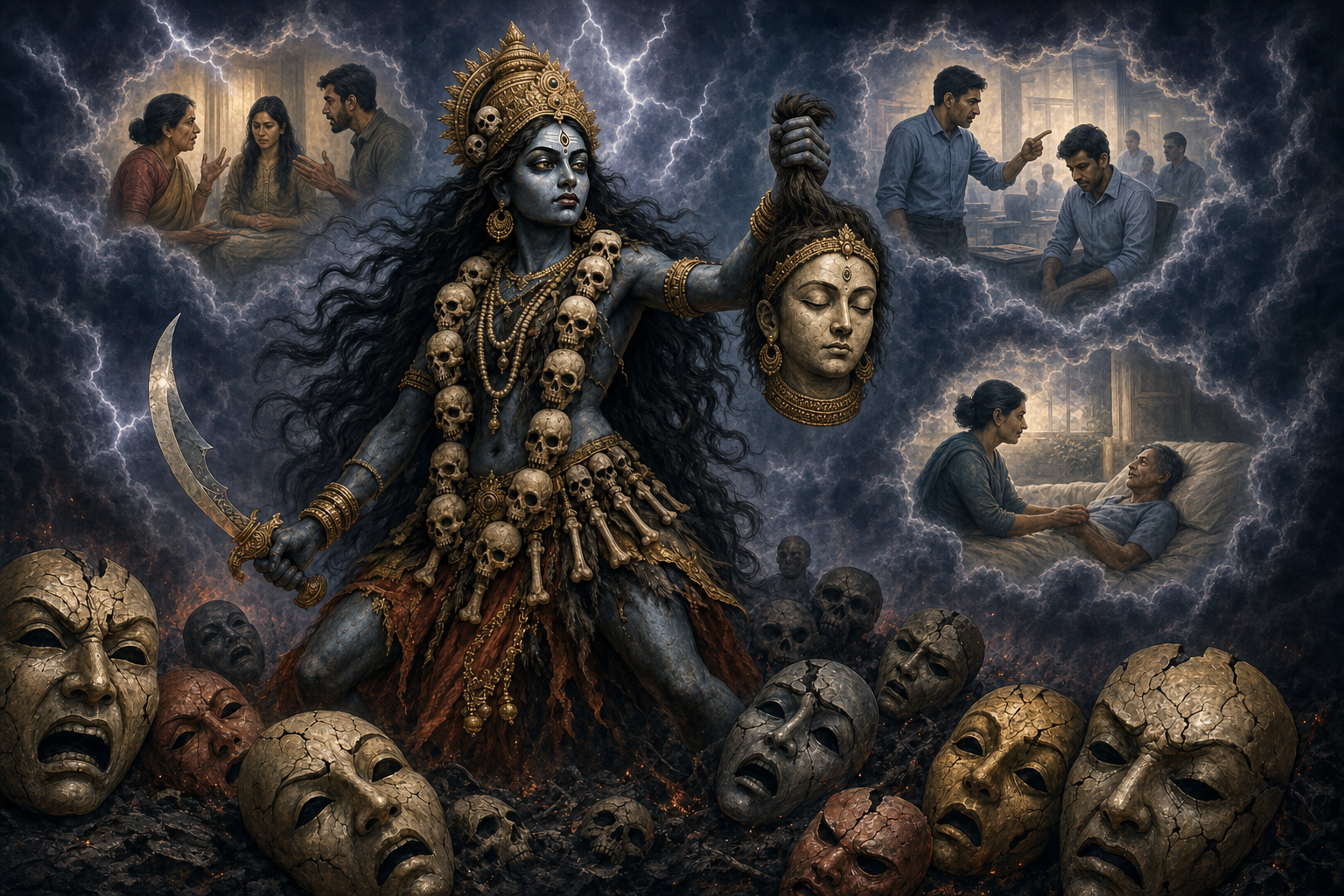
Chamunda’s iconography gives ego-dissolution a form that cannot be reduced to polite self-improvement. The severed head is frequently composed with a calm or smiling face. That expression changes the meaning of the image: the head does not merely display defeat; it depicts the serenity disclosed when ahamkara no longer rules. The visual language of the smiling head, sword, skull garland, skull cup, and cremation ground turns fearsome elements into instructions about discrimination, impermanence, and freedom.
The sword can be read as viveka, the capacity to cut truth from superimposition. The cremation ground removes the fantasy that bodily form, reputation, and possession can be made permanent. The mundamala can represent identities, delusions, and afflictions that no longer bind. The kapala reverses the meaning of what frightens the ordinary mind: the vessel associated with death becomes a vessel of wisdom or amrita. Fierceness serves compassion because bondage is not always undone by reassurance.
You can use this symbolism without pretending to perform tantra. Bring it to the moment when the ego actually tightens:
- Catch the contraction. Before explaining or defending yourself, locate the tightening in the body and notice the thought accelerating around it.
- Name the threatened identity exactly. It might be the competent professional, the respected elder, the good child, the learned devotee, or the person who must always be right. Precision weakens the identity’s ability to masquerade as your entire being.
- Separate the fact from the ego’s addition. ‘They rejected my proposal’ may be a fact requiring a response. ‘Their rejection proves that I am worthless’ is an identity claim. The sword of discrimination cuts the second without denying the first.
- Preserve the dharmic obligation. You may need to explain, apologise, correct an injustice, withdraw consent, or say no. Cut possessiveness and vindictiveness, not discernment or responsibility.
- Check for the smile rather than the victory. The relevant sign is not the thrill of defeating another person. Look for reduced inner rehearsal, less compulsion to retaliate, and greater freedom to take the next truthful action.
This inner decapitation is not submission to abuse. Ahimsa does not require you to cooperate with harm, and nonduality does not erase distinctions between truthful and destructive conduct. A boundary can be defended without hatred. A wrong can be opposed without making enmity your identity. Chamunda’s victory is mastery over bondage, not permission to dominate another person.
The smile is therefore a demanding standard. Numbness is not serenity. The inability to care is not detachment. Avoiding a necessary conversation is not transcendence. When the self-referential story is genuinely cut, more attention becomes available for reality, responsibility, and the person standing before you.
Key takeaways: test liberation where ‘me’ is challenged

- Ego-dissolution loosens exclusive identification and possessive doership; it does not require personality loss, self-hatred, or incapacity.
- No altered state proves liberation. A passing experience remains something known, however subtle or blissful it may be.
- Hindu, Buddhist, Jain, and Sikh paths address egoic bondage through distinct doctrines and methods. Respect those differences instead of hiding them beneath a vague claim of sameness.
- Absolute insight does not cancel transactional duty. Promises, consequences, ethical boundaries, and the effects of conduct still matter.
- Reliable signs of maturation include less reactivity, greater honesty, steadier compassion, lighter attachment to status, and more faithful action.
- Claims of special realization, contempt for ordinary duties, indifference to harm, and the use of ‘nothing is real’ as an excuse are signs of spiritual avoidance, not freedom.
- If intensive practice disrupts safety or ordinary functioning, pause and obtain the appropriate spiritual and professional support.
At your next moment of defensiveness, do not attempt a grand disappearance. Name the role under threat, separate the fact requiring action from the story demanding vindication, and do the next truthful thing without feeding that story. Repeated at this ordinary point of friction, the sword of viveka becomes more than sacred imagery. Ego-dissolution becomes the freedom to live dharma without making yourself the centre of it.
References
- DharmaRenaissance Blog – Why Chamunda’s Severed, Smiling Head Signifies Bliss: Decoding Ego-Death and Moksha
- DharmaRenaissance Blog – Dissolving Matter’s Mirage: Dharmic Wisdom on Returning to the Primordial, Nondual Source
