
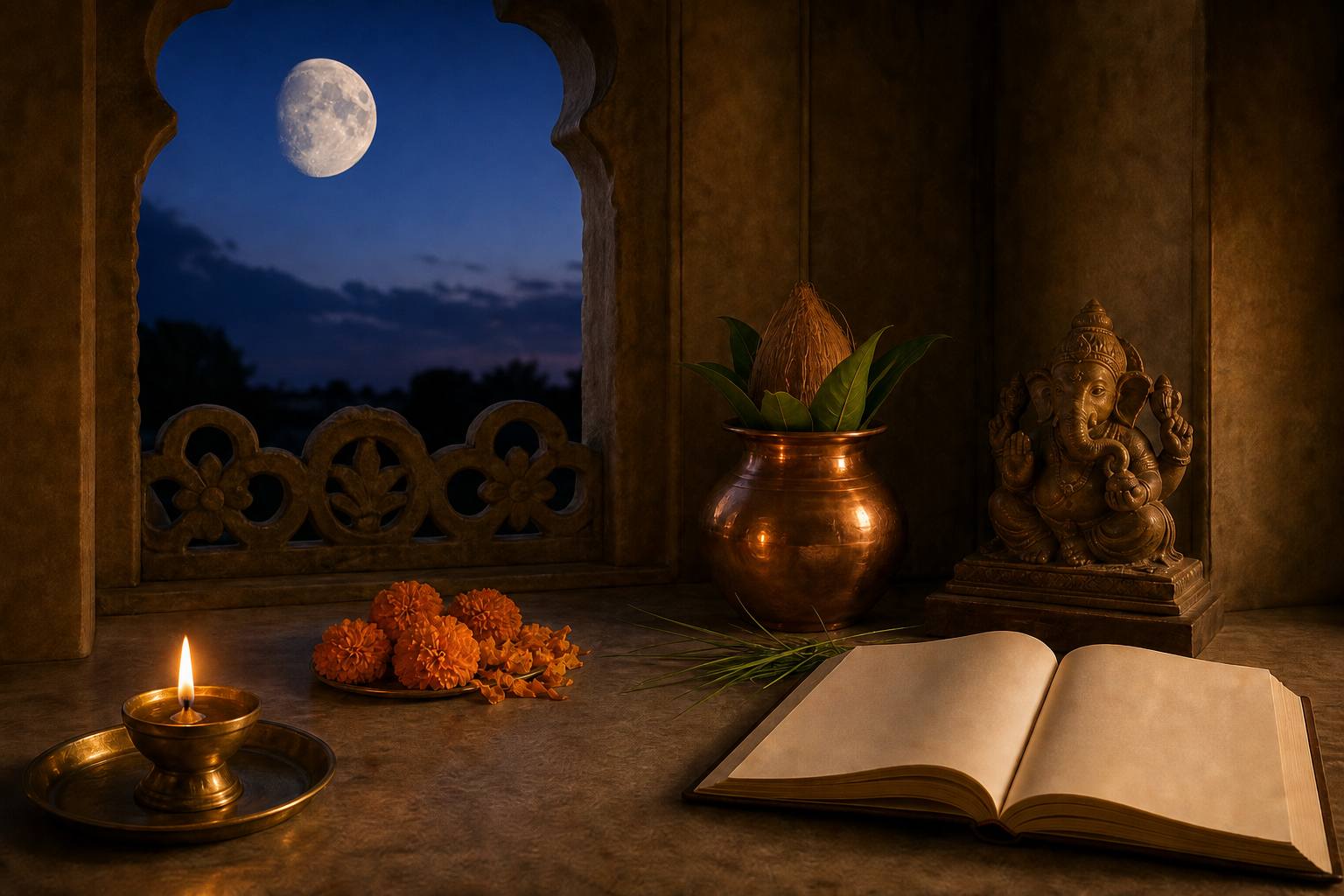
If you are deciding when to perform puja, begin an important undertaking, or observe Sankashti on Friday, March 6, one boundary matters first: Krishna Paksha Tritiya continues until 5:15 PM in standard Indian references, after which Krishna Paksha Chaturthi begins.
Treat 5:15 PM as an IST-based reference, not as a universal local-clock time. If you are outside India, convert it to your time zone and then verify the date against a Panchang calculated for your city. For Sankashti observance, you will also need your local moonrise; the tithi boundary alone does not tell you when to complete the evening worship.
March 6 Panchang: key takeaways
- Weekday: Friday.
- Morning and afternoon tithi: Krishna Paksha Tritiya.
- Tithi transition: Tritiya ends at approximately 5:15 PM IST in standard Indian reckoning.
- Evening tithi: Krishna Paksha Chaturthi.
- Primary evening observance: Many households may observe Sankashti Chaturthi with Ganesha worship and conclude the vrata after local moonrise.
- Muhurta rule: Calculate Rahu Kalam, Yamaganda, Gulika and Abhijit from your own location’s sunrise, solar noon and sunset.
- Values still requiring local confirmation: Nakshatra, yoga, karana, Chandra Rashi and moonrise.
Let the tithi decide the kind of activity
A tithi is not a fixed box running from midnight to midnight. It is measured through the angular separation of the Moon and Sun, with each tithi covering a 12-degree interval. The boundary therefore occurs whenever that astronomical relationship reaches the next interval. This is why one civil date can contain two tithis and why the Hindu day’s most important change may occur in the middle of your afternoon or evening.
Before 5:15 PM IST, the governing tithi is Krishna Paksha Tritiya. Tritiya belongs to the traditional Jaya group of tithis. Its character is associated with initiative, resolve and constructive work requiring steady effort. If you have some flexibility, this is the more natural part of the date for work that involves advancing an existing plan, taking a determined step or handling a demanding responsibility.
That does not make every minute before 5:15 PM automatically auspicious. A serious muhurta decision still considers the weekday, nakshatra, yoga, karana and the day’s avoidance periods. Tritiya supplies one favourable component; it does not replace the other limbs of the Panchang.
After 5:15 PM IST, Krishna Paksha Chaturthi begins. Chaturthi belongs to the Rikta group, for which many muhurta traditions advise caution with major inaugurations and first-time commencements. If you can choose between beginning an important venture before or after the transition, do not treat the two periods as interchangeable.
Rikta classification does not mean the evening is spiritually empty or unsuitable for worship. Chaturthi is especially connected with Bhagavan Ganesha, the remover of obstacles. On this date, the evening transition gives the day a clear devotional direction: many communities will turn from ordinary activity toward Sankashti Chaturthi vrata, Ganesha puja, katha, lamps and simple offerings.
If your family observes Sankashti, distinguish three moments: the start of Chaturthi, the beginning of your household worship and local Chandra-darshan. They need not coincide. Follow the established practice of your family or sampradaya, and obtain the moonrise time for the city where you will actually be present. A moonrise copied from another city can shift the completion of the vrata away from the intended local observance.
Calculate Friday’s avoidance periods for your city

Fixed clock charts for Rahu Kalam are only approximations. The traditional calculation divides the interval from local sunrise to local sunset into eight equal segments. Because daylight length changes with latitude, season and location, the segments will not always match the familiar clock ranges printed on a generic calendar.
For Friday, the relevant positions are exact within that eight-part framework:
- Yamaganda: the third segment after sunrise.
- Rahu Kalam: the fifth segment after sunrise.
- Gulika: the seventh segment after sunrise.
To calculate them, subtract sunrise from sunset and divide the result by eight. Beginning at sunrise, count equal segments forward. Mark the third, fifth and seventh segments before considering a time for a new or important undertaking. Do not divide the full midnight-to-midnight day; these periods are based on daylight.
Abhijit Muhurta is centred on local solar noon, so it also shifts by place and date. Some traditions additionally consult Vijaya Muhurta in the late afternoon. Neither label should be copied as a universal clock range. Calculate or read the local span, check whether it overlaps an avoidance period, and keep the method consistent with the Panchang you have chosen.
This matters especially on March 6 because the late-afternoon planning question sits close to the 5:15 PM tithi transition. A window that begins under Tritiya may continue into Chaturthi. For an ordinary task, that may simply be useful context. For a sankalpa, homa, vrata completion or formal inauguration, check which tithi prevails at the precise moment prescribed by your tradition.
Confirm nakshatra, Moon sign and calendar system locally
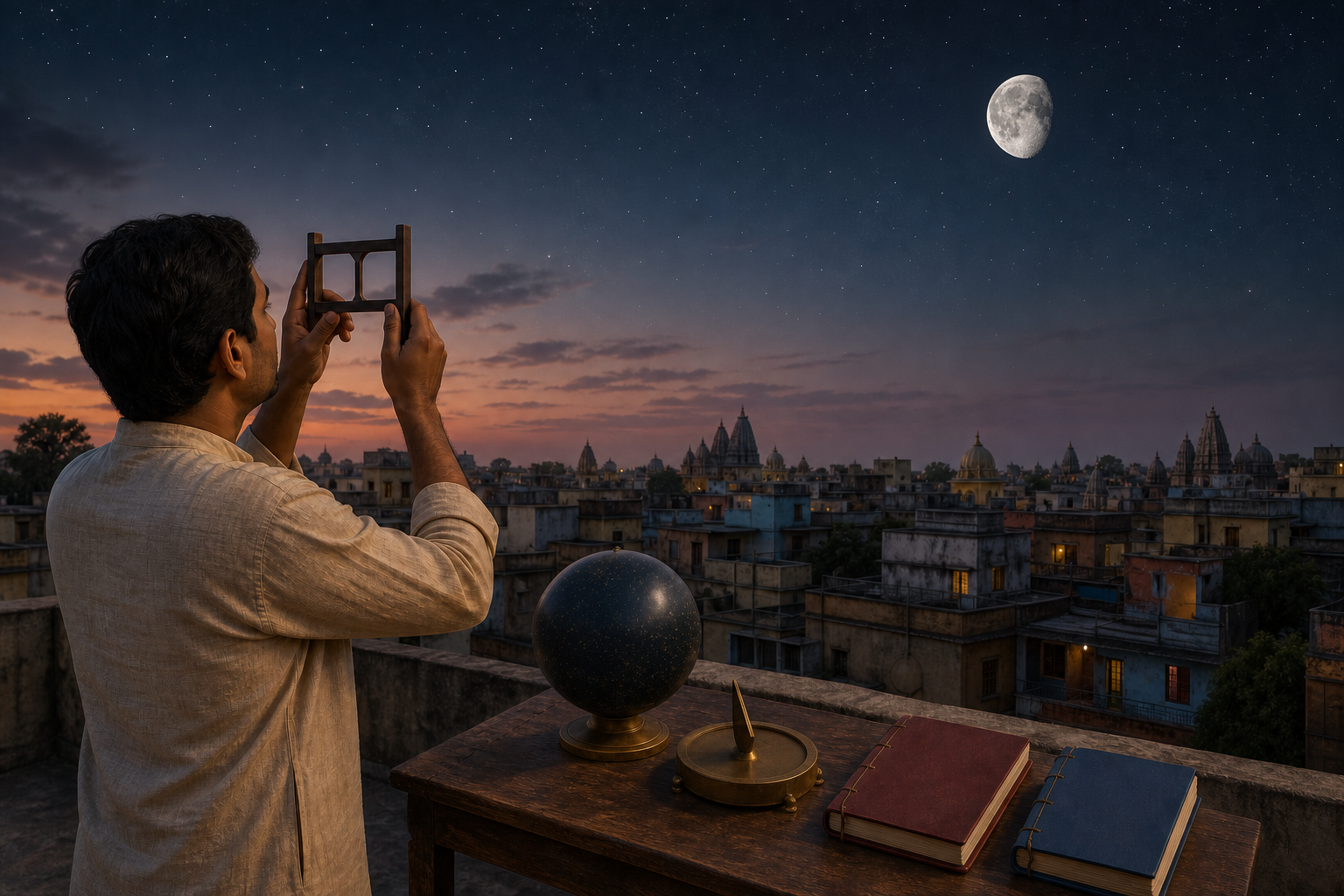
A trustworthy March 6 entry should not present one nakshatra or Chandra Rashi as though it covers every location and every hour without qualification. Nakshatra records the Moon’s position among the 27 lunar mansions, while Chandra Rashi records its sidereal zodiac sign. Either may change during the civil day, independently of the Tritiya-to-Chaturthi boundary.
Before using the date for a personal muhurta, enter your city and intended time in a location-aware Panchang and record four separate items: nakshatra, yoga, karana and Chandra Rashi. If any of them changes during your proposed window, note the transition time rather than relying only on the value shown at sunrise.
Tarabalam and Chandrabalam require another layer of personal information. Tarabalam compares the day’s nakshatra with your janma nakshatra through a repeating ninefold tara cycle. Chandrabalam evaluates the day’s Moon sign in relation to your janma rashi. A general daily calendar cannot determine either one for every reader, so use a personalized Panchang if these measures form part of your family’s muhurta practice.
You may also encounter different lunar month names for the same date. Under Purnimanta reckoning, commonly followed across parts of northern and northwestern Bharat, this dark fortnight is often identified as Phalguna Krishna Paksha. Amanta calendars, common in western and southern traditions, place month boundaries differently and may label the same astronomical span under another month. That difference is calendrical, not evidence that one tradition has calculated the tithi incorrectly.
Small timing discrepancies can also arise between Drik and Vakya Panchangs, from the selected ayanamsa, or from rounding at a boundary. Lahiri ayanamsa is common, but it is not the only computational convention. When a ritual depends on a precise time, choose one authoritative local Panchang and use its tithi, moonrise and muhurta values consistently instead of assembling them from several calendars built on different assumptions.
A five-minute verification before you plan the day
- Set the correct location. Use the city where the worship or undertaking will occur, not your birthplace or a default Indian city.
- Check the time zone. Treat 5:15 PM as an IST reference. Convert it outside India and account for any local daylight-saving rule.
- Confirm the tithi boundary. Make sure your chosen local Panchang also places the relevant part of March 6 under Tritiya before Chaturthi begins.
- Record sunrise and sunset. Use them to identify Friday’s third, fifth and seventh daylight segments for Yamaganda, Rahu Kalam and Gulika.
- Read all five Panchang limbs. Check tithi, weekday, nakshatra, yoga and karana at the intended time rather than judging the muhurta from tithi alone.
- Add the Moon factors. Confirm Chandra Rashi and, where your tradition uses them, personal Tarabalam and Chandrabalam.
- Check local moonrise for Sankashti. Use that local time for planning Chandra-darshan and the customary completion of worship.
- Stay with one calculation system. If two calendars differ by a few minutes, do not combine the earlier boundary from one with the later moonrise from another.
Your practical next step is to open a trusted Panchang for your city and write down the Tritiya ending time, nakshatra transitions, sunrise, sunset and moonrise before arranging March 6. If you are observing Sankashti, let the locally verified Chaturthi and Chandra-darshan timings guide the evening rather than a generic all-India clock chart.
References
