

You sit down for japa or Self-inquiry, but your throat has other plans. It feels dry or constricted. You keep swallowing, clearing your throat, or adjusting your voice. Hunger or thirst suddenly occupies the mind. The disturbance may be small, yet it repeatedly pulls attention away from the teaching.
Advaita gives these ordinary experiences a precise place without turning them into spiritual drama. Krikala is a subsidiary movement of prāṇa associated with the throat, tongue, appetite signals, swallowing, and protective reflexes. You can work with it to make the body-mind a quieter instrument. You should not mistake that refinement for liberation itself.
Know what Krikala is—and what it is not
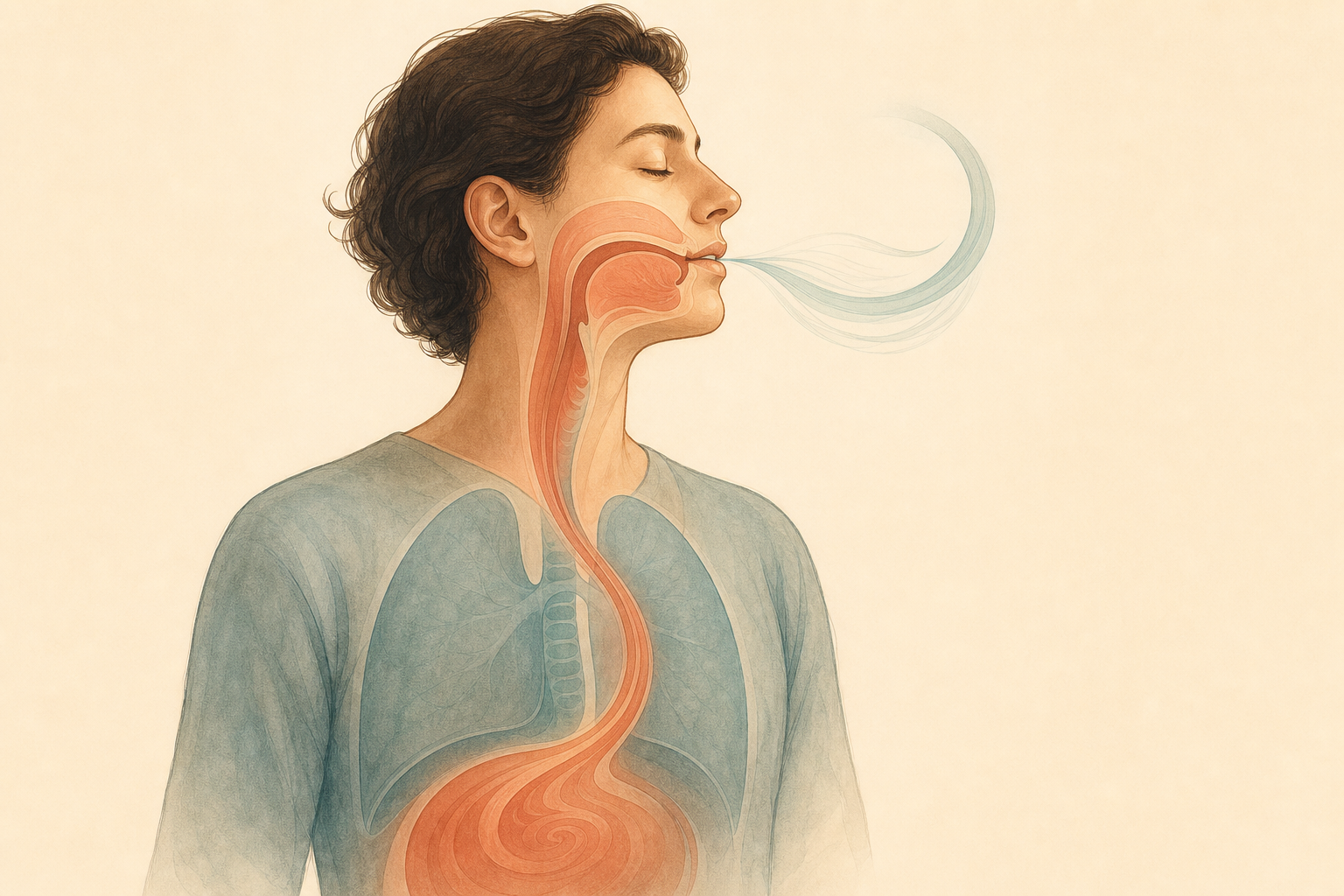
Within Advaita’s map of the subtle body, five principal prāṇas work alongside five subsidiary currents, or upaprāṇas. The principal five are prāṇa, apāna, samāna, udāna, and vyāna. The subsidiary five are nāga, kūrma, Krikala or Kṛkara, devadatta, and dhananjaya. Krikala is traditionally placed in the throat and tongue region and associated with hunger, thirst, swallowing, and expulsion reflexes such as sneezing.
It is more useful to understand Krikala as a function than as a little object hidden in the throat. It is a name for a recurring pattern within embodied life: the body signals that it needs nourishment or water, coordinates intake, and reacts when the upper airway needs protection. This functional reading keeps you attentive without encouraging fantasy.
Krikala is also not another name for udāna. Udāna is the upward-moving principal prāṇa closely connected with speech, vocal expression, growth, and vitality. Krikala supports the conditions under which speech can remain comfortable: an easy swallow, an adequately moistened throat, clear appetite and thirst cues, and reflexes that do not have to overreact. When your voice feels strained, both currents may be relevant, but they are doing different work.
The other principal prāṇas remain involved. Primary prāṇa participates in breathing and its coordination with swallowing. Samāna governs digestion and assimilation, so Krikala’s hunger signals must eventually cooperate with it. Vyāna distributes energy throughout the organism, while apāna completes the larger rhythm of intake and elimination. You therefore do not balance Krikala by isolating the throat from the rest of the body.
The throat also corresponds to the viśuddha region in yogic anatomy, but the two ideas should not be collapsed. Viśuddha names a broader energetic locus associated with expression and purification. Krikala names a particular subsidiary prāṇic function. Treat the shared location as a practical relationship, not an identity.
Read the signs without diagnosing yourself
A balanced Krikala is usually unremarkable. That is important. The aim is not to produce an exotic throat sensation. It is to reduce the amount of attention demanded by routine functions so that recitation, listening, reflection, and meditation can proceed without needless friction.
- Your swallow feels comfortable rather than forced or repeatedly intrusive.
- Your voice remains reasonably steady during japa, study, or conversation.
- You recognise thirst without waiting for pronounced dryness or turning every dry sensation into alarm.
- Hunger appears as a usable bodily cue rather than becoming confused with agitation, boredom, or emotional urgency.
- Stress produces less throat tightening, compulsive clearing, or vocal strain.
These are observations, not a diagnostic checklist. A dry room, prolonged speaking, illness, inadequate hydration, anxiety, or vocal overuse can all affect the same region. One sneeze does not reveal a prāṇic disorder, and the absence of sneezing does not prove spiritual balance. Look for repeated patterns and the conditions surrounding them.
Do not spiritualise persistent physical symptoms. Painful or difficult swallowing, continuing voice changes, unusual thirst or appetite changes, recurrent choking, or any breathing difficulty warrants appropriate medical assessment. Breathwork and mantra are not substitutes for medical care. Stop a practice that causes pain, dizziness, choking, or increasing throat irritation.
Use a gentle sequence before japa or inquiry
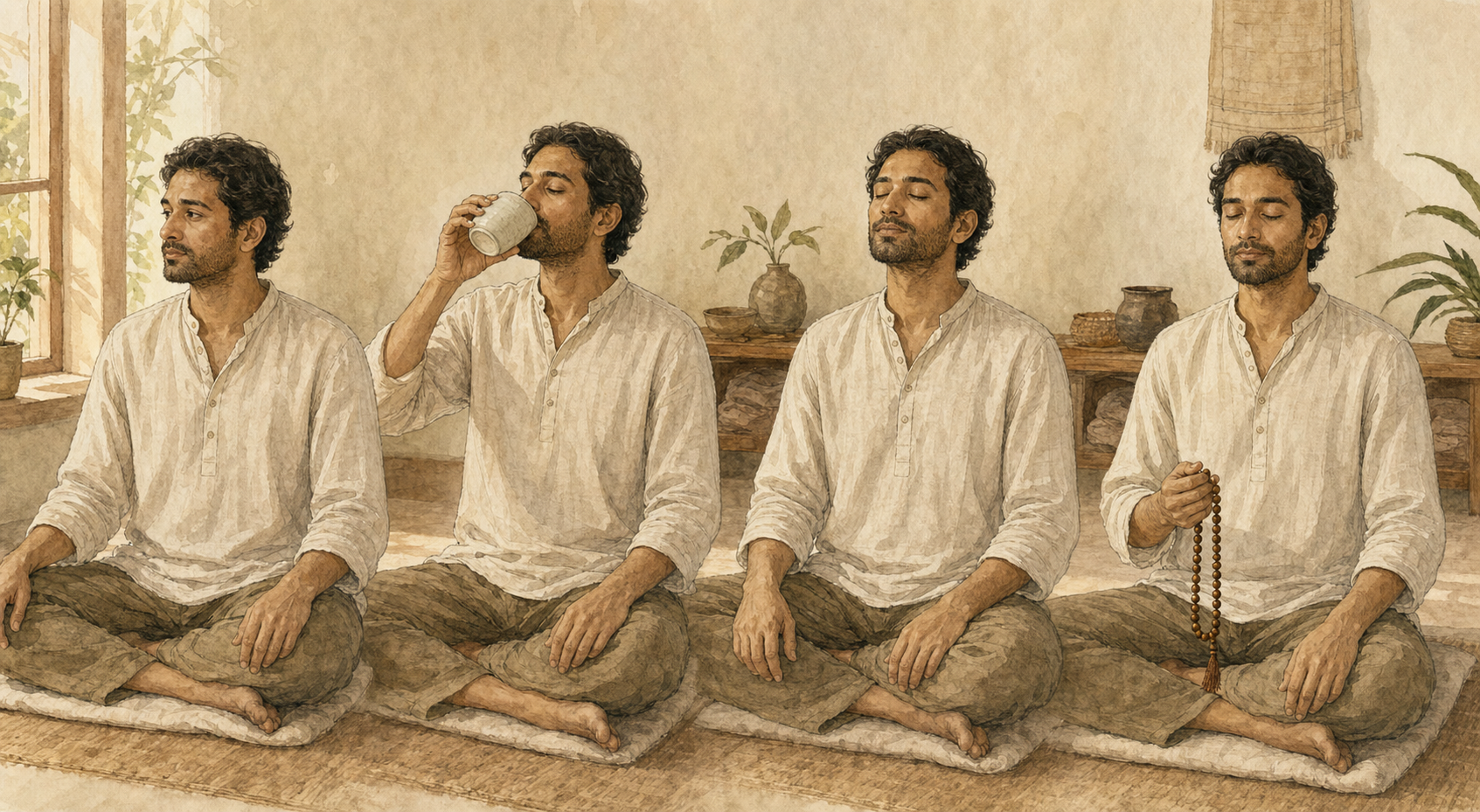
Krikala tends to respond better to space, regularity, and mild resonance than to pressure. Use the following sequence as preparation, not as a test of endurance. There is no need for a demanding breath ratio or dramatic sound.
- Notice before correcting. Observe whether the throat is dry, tight, repeatedly swallowing, or asking to be cleared. Also notice hunger and thirst. Name the immediate experience without deciding that it is a spiritual blockage.
- Set an uncomplicated posture. Sit upright with the spine neutral. Let the shoulders settle. Release the jaw, soften the base of the tongue, and avoid pushing the chin forward. This creates room for breathing and swallowing to coordinate naturally.
- Establish ordinary nasal breathing. Let the breath become even and allow the exhalation to finish without being driven. If simple breathing already settles the throat, remain with it. A special technique is not automatically better.
- Add very light ujjayi if it remains comfortable. Use only enough narrowing at the glottis to create a soft, uniform texture in the breath. Continue for several minutes without forcing volume, depth, or duration. The sound is feedback for even flow, not the object of the practice.
- Follow with a few rounds of bhrāmarī. Inhale comfortably through the nose and hum through a relaxed exhalation at an easy pitch. Feel the resonance around the throat and face without trying to make the vibration intense. Do not strain or prolong the exhalation beyond comfort.
- Move into mantra with less effort. Intone Om, so’ham, or the mantra already established in your practice. Use moderate volume, clear diction, and an unforced pitch. Let meaning and attention lead; do not turn japa into a vocal performance.
- Release the technique. Once the throat and breath are settled, allow breathing to become natural. Continue with śravaṇa, manana, nididhyāsana, or silent inquiry. Krikala preparation has done its job when you no longer need to keep checking it.
If ujjayi makes the throat rougher, return to ordinary nasal breathing. If humming feels irritating, omit it. More effort does not produce more subtlety. An easy practice repeated consistently is more useful than an impressive practice that leaves you strained.
Jālandhara-bandha, the chin lock, does not belong in a beginner’s self-designed throat routine. It alters pressure relationships in a sensitive region and is traditionally learned progressively under qualified guidance. Do not combine it with forceful retention, especially when you do not know the relevant contraindications. Posture, natural breathing, light ujjayi, and humming are sufficient for the purpose described here.
Carry the practice into speech, hydration, and meals

A brief breathing session cannot compensate for a day of vocal force, ignored thirst, hurried meals, and habitual throat clearing. Krikala practice becomes stable when your ordinary habits stop provoking the same reactions you try to calm on the meditation seat.
- Support the throat plainly. Sip warm water periodically when that is appropriate for you. Gentle steaming may help in a dry season, but it should remain comfortable and should not be treated as a cure.
- Interrupt habitual throat clearing. First notice whether you are clearing an actual obstruction or responding automatically to tension. When appropriate, pause, take an easy breath, sip water, or swallow gently instead of repeatedly striking the throat with a forceful clearing action.
- Reduce vocal excess. During teaching, kīrtana, or extended recitation, use a sustainable pitch and pace. Clear articulation carries meaning more reliably than excessive loudness.
- Meet appetite before interpreting it. At mealtimes, pause long enough to distinguish bodily hunger from emotional urgency. Respect a genuine cue without worshipping it, suppressing it, or using it as a reason to abandon moderation.
Speech is part of this discipline. The throat is where bodily regulation and vāk, expressive speech, meet. A relaxed voice can still be careless, harsh, or untruthful; comfortable phonation alone is not purification. Use the extra ease to speak more deliberately. Slow down enough to hear whether your words are accurate, necessary, and proportionate.
A simple practice record can keep you honest. Before the exercise, note the ease of swallowing, steadiness of voice, clarity of thirst, and degree of stress-related throat reactivity. Check the same qualities after practice and later in the day. Use short descriptions rather than chasing a perfect score. You are looking for a sustainable change in function, not a dramatic experience produced by novelty.
If relief appears only while you are humming and disappears as soon as ordinary speech resumes, treat that as useful information. Short-term settling has occurred, but the daily causes have not changed. Review vocal effort, hydration, meal rhythm, stress, and the amount of force you are bringing to the practice.
Refine the instrument without confusing it with the Self

Advaita places prāṇa within the prāṇamaya-kośa, the vital sheath of embodied experience. Krikala therefore belongs to vyavahāra, the empirical order in which breathing, eating, speaking, learning, and practice occur. It can become more harmonious or less harmonious. Ātman does not undergo either condition.
This distinction prevents a common error. You are not purifying the Self by improving your swallow or voice. You are reducing agitation in the instrument through which Vedāntic teaching is heard, considered, and assimilated. Greater comfort may support sattva and one-pointedness, but it does not certify knowledge.
- During śravaṇa, throat ease helps you listen or recite without being repeatedly pulled into bodily adjustment.
- During manana, steadier prāṇa helps you reason through the teaching without treating every sensation as a revelation.
- During nididhyāsana, reduced bodily friction makes it easier to remain with the assimilated understanding instead of pursuing another altered state.
You can turn a Krikala disturbance into a direct lesson. First notice that tightness, dryness, hunger, or the urge to swallow is known to you. Then notice that the experience changes: it intensifies, softens, or disappears. What is changing belongs to the observed body-mind. Advaita inquiry concerns the nature of the knower, not the perfection of the passing condition.
Avoid three traps. Do not suppress hunger, thirst, sneezing, or swallowing to prove mastery; these functions help sustain and protect the organism. Do not measure attainment by vocal resonance or throat comfort. And do not substitute breath regulation for inquiry into the Self. We would treat a settled Krikala as readiness for practice, not the result of practice.
Key takeaways for your next practice
- Krikala is a subsidiary prāṇic function associated with the throat, tongue, hunger, thirst, swallowing, and protective expulsion reflexes.
- Krikala supports comfortable speech, but udāna remains the principal prāṇa most directly associated with vocal expression.
- Start with posture, a relaxed jaw and tongue, nasal breathing, and an unhurried exhalation.
- Use ujjayi and bhrāmarī lightly. Stop when they irritate the throat or create strain.
- Judge the practice by ordinary outcomes: easier swallowing, steadier speech, clearer appetite cues, and fewer stress-driven throat reactions.
- Once the disturbance settles, return to Vedāntic listening, reflection, contemplation, or inquiry. Do not make Krikala the new object of obsession.
At your next sitting, begin with the smallest effective adjustment. Release the jaw, establish an easy breath, add gentle resonance only if needed, and then move on. When the throat no longer demands attention, let it disappear from the foreground. That quiet transition—from managing the instrument to examining the knower—is where Krikala practice serves Advaita.
References
