
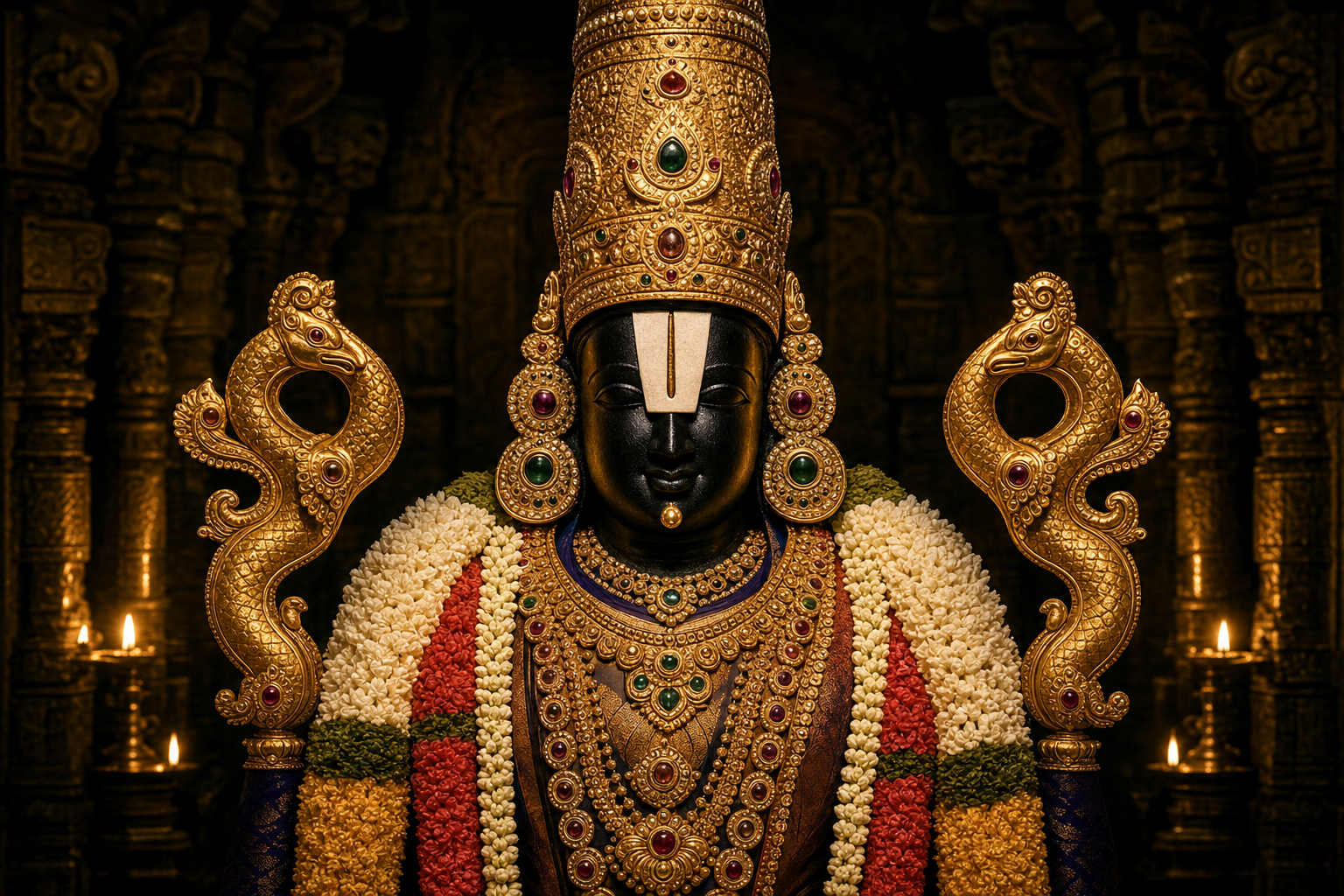
During a brief Tirumala darshan, you may notice two golden serpent forms near Lord Venkateswara’s shoulders. You may also miss them beneath the day’s garlands. Either way, knowing where they are and how the tradition reads them can turn a small visual detail into a coherent meditation on service, protection, and power governed by dharma.
These ornaments are the Nagabharana. Their primary meaning comes not from serpents in general, but from Adisesha: Vishnu’s eternal attendant, cosmic support, and protective presence. Read the ornament in that Vaishnava setting and the whole image begins to speak.
Start with the placement, not the serpent alone
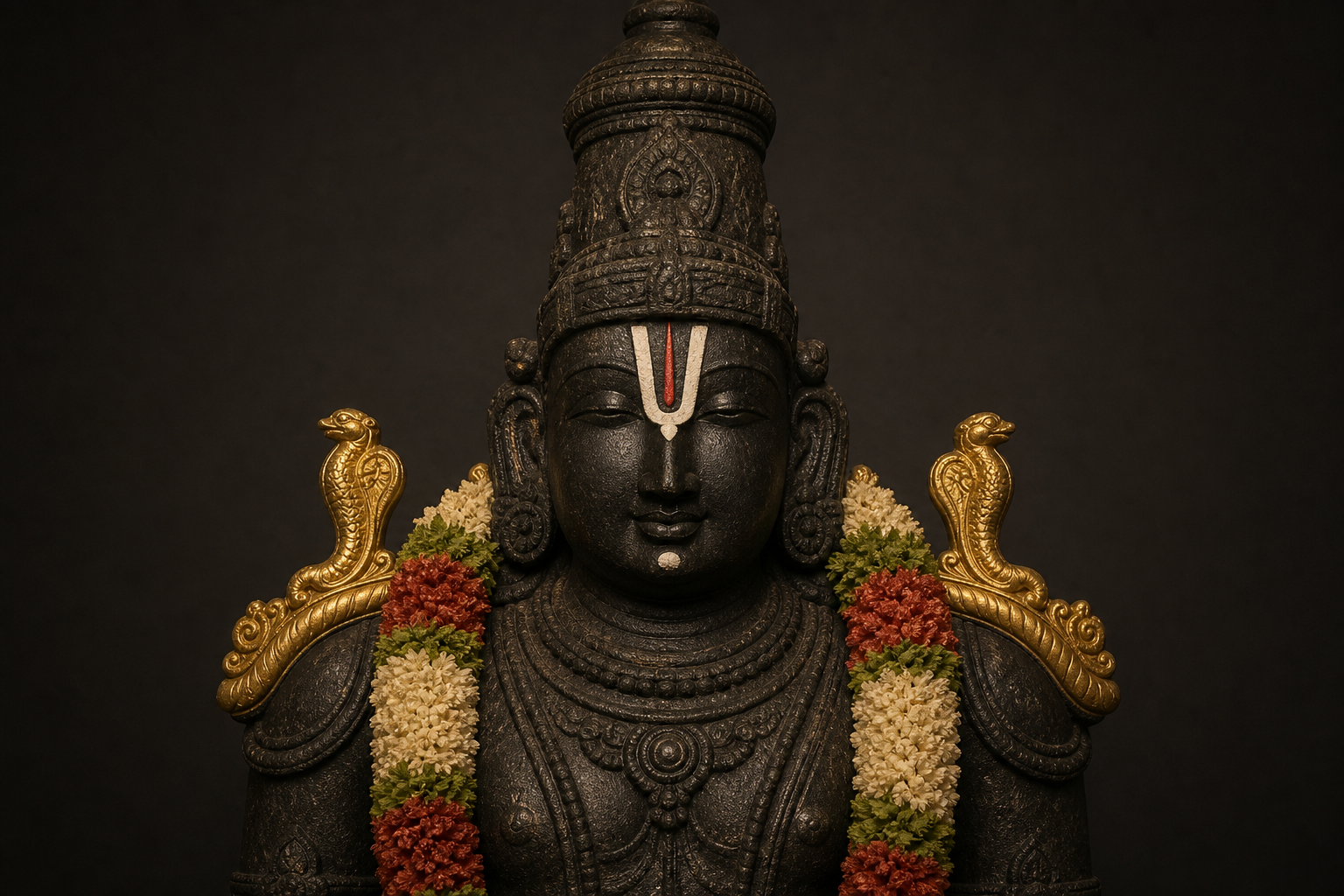
Nagabharana denotes a serpent-themed ornament. At Tirumala, it appears as paired golden serpent motifs resting on the Lord’s shoulders. All three parts of that description matter: the ornaments are paired, they are placed on the shoulders, and they belong to the sacred adornment of Venkateswara.
If you concentrate only on the serpentine shape, you can easily misread it as a generic sign of danger, occult force, or unrestrained energy. Temple iconography does not work through isolated shapes. Identity, position, relationship, and ritual setting determine what a form communicates.
The bilateral placement gives you the first interpretive key. A matched ornament on each shoulder conveys balance and vigilance rather than conflict. The nagas do not confront the deity or rise against him. They rest in ordered proximity to him. Their power has a place, a purpose, and a sacred relationship.
During darshan, use a simple visual sequence:
- Look toward the two shoulders rather than trying to inspect the entire alankara at once.
- Register the paired arrangement, even if flowers reveal only part of each form.
- Let your attention move from the shoulders toward the Lord’s arms and hands.
- Return your gaze to Venkateswara as the center of the composition.
This takes only a moment, but it prevents the ornament from becoming a disconnected curiosity. You see the naga in relation to the Lord it serves.
Adisesha gives the Nagabharana its Vaishnava meaning
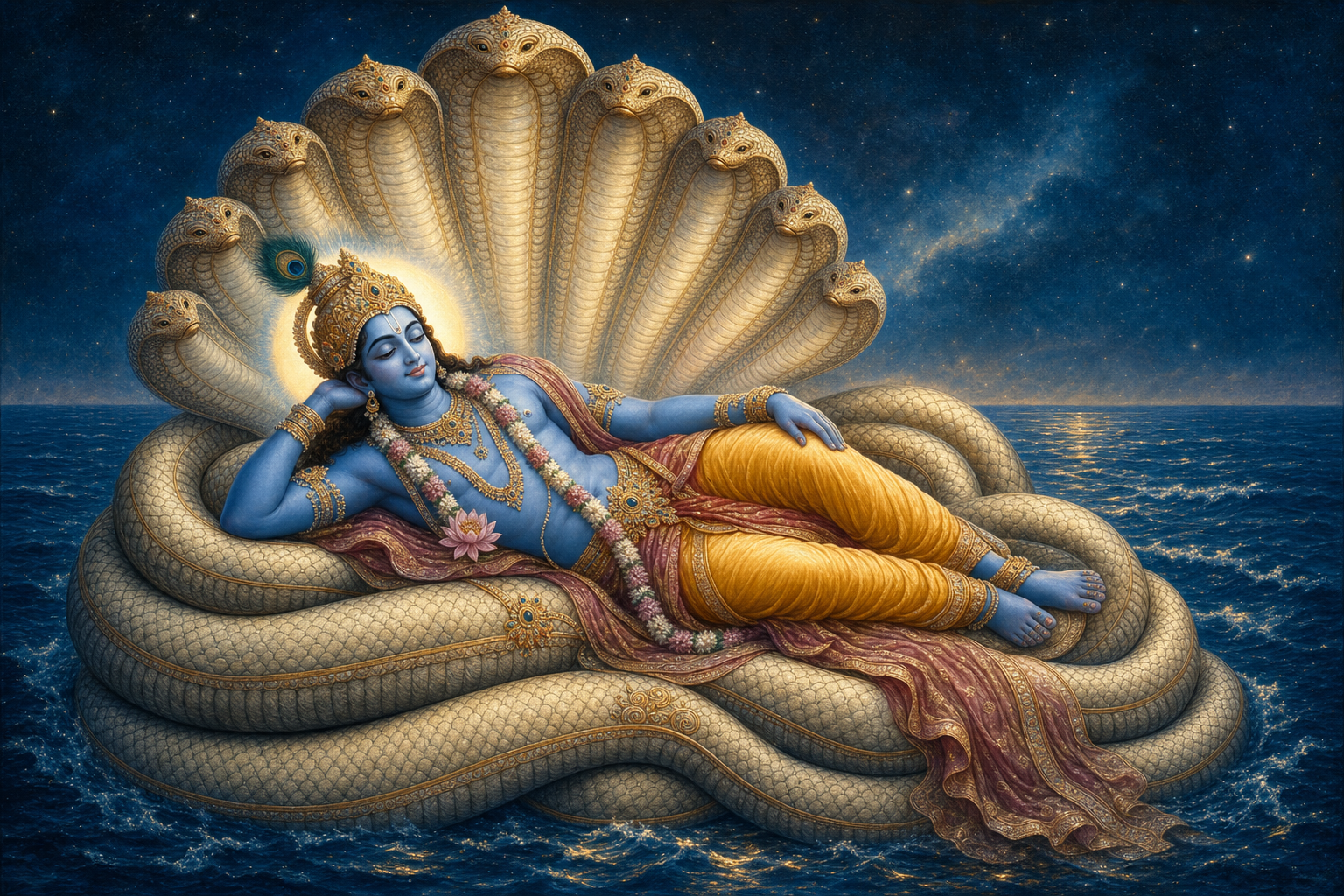
Adisesha is the eternal serpent upon whom Vishnu reclines. He embodies ananta, the intuition of the endless or infinite, but his symbolism is not exhausted by cosmic scale. He is also the model of kainkarya: steadfast, willing service offered to the Divine.
That combination is crucial. Adisesha possesses immense potency, yet his greatness appears through service, support, and shelter. The Nagabharana therefore does not merely announce that Venkateswara is powerful. It shows powerful existence brought into harmony with the Lord’s preserving order.
Tirumala’s sacred geography deepens this reading. One strand of temple tradition identifies the Seshachalam hills with the body of Adisesha, who accompanied Vishnu’s earthly manifestation as Srinivasa. The same relationship can then be perceived at several scales: Adisesha supports Vishnu cosmically, embraces the Lord through the landscape, and remains close through the shoulder ornaments.
You do not need to collapse these layers into a literal diagram. Sacred geography and iconography work through correspondence. The hill, the attendant, and the ornament reinforce one recognition: Venkateswara’s presence at Tirumala is surrounded by loyal service and vigilant protection.
This also clarifies the hierarchy within the image. Venkateswara remains the center. Adisesha is exalted precisely as the perfect attendant. A reading that makes the serpent independent of the Lord, equal to him, or dominant over him reverses the theological relationship the ornament expresses.
Comparable naga imagery appears elsewhere in the Dharmic world. Mucalinda shelters the Buddha, while the serpent canopy associated with Tirthankara Parshvanatha carries a protective resonance in Jain iconography. These parallels reveal a broad Indic vocabulary in which nagas can guard sanctity and sacred knowledge. They do not make the underlying doctrines identical. At Tirumala, the specific identity of Adisesha and his relationship to Vishnu remain decisive.
Why the serpents rest on the Lord’s shoulders
Shoulders are where a body bears weight and where strength passes into action through the arms. They naturally suggest capacity, responsibility, and readiness. Placing the nagas there connects their vigilance with the Lord’s active guardianship.
The relationship becomes clearer when you read the shoulders together with the arms and hands associated with abhaya and vara: assurance and blessing. The visual movement is from strength, through action, toward compassionate protection. The Nagabharana frames that movement. Power is present, but it is directed toward refuge rather than intimidation.
The paired arrangement adds another layer. Protection is not shown as a sudden reaction from one direction. It is balanced and watchful on both sides. Symmetry gives the serpentine form a sense of stability, allowing it to support the icon’s larger message of preserved cosmic order.
Serpents can also evoke continuity, renewal, coiled potency, and latent energy in Indic thought. Those associations can enrich contemplation, but they should remain secondary here. Beginning with a generic yogic or kundalini interpretation would detach the ornament from its Tirumala setting. The most precise path is to begin with Adisesha, then understand how the wider associations of naga imagery are placed under Vishnu’s order.
That ordering carries an ethical lesson you can use beyond iconography. Strength is not auspicious merely because it is strong. It becomes dharmic when joined to service, restraint, vigilance, and compassion. Adisesha does not lose potency by serving the Lord; service reveals the proper purpose of that potency.
Alankara turns ornament into an act of worship
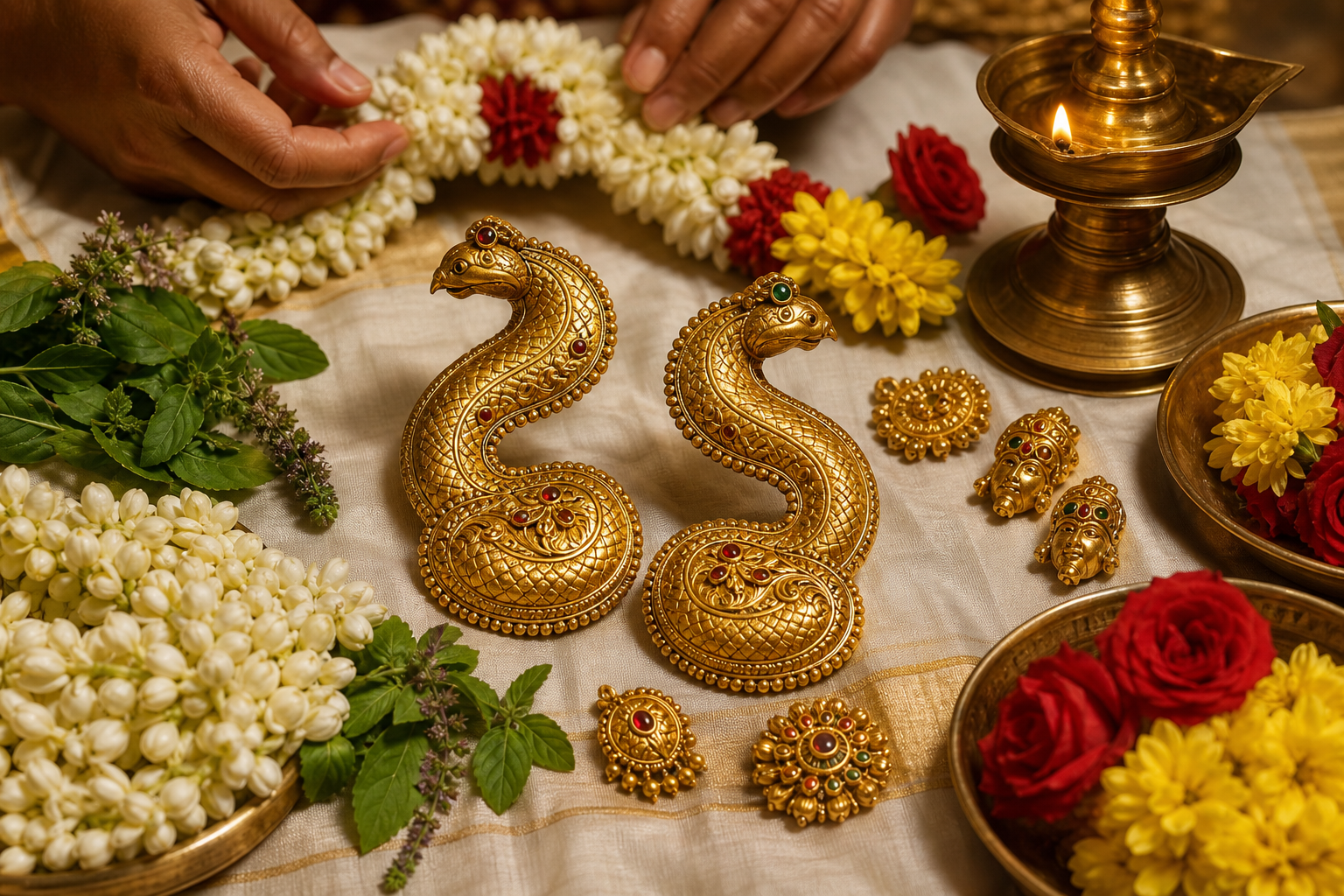
It is tempting to separate a temple icon into a sacred core and decorative accessories. The alankara tradition resists that division. An ornament placed according to ritual convention does not merely make the deity look magnificent. It participates in how the deity’s identity and attributes are made present to worshippers.
At Tirumala, ornamentation belongs to a liturgical order shaped by the Vaikhanasa Agama, seva schedules, festivals, and processional occasions. The adornment of the mūla-vigraha, the principal fixed icon, and the utsava-murti, the processional form, is therefore not equivalent to dressing an exhibit. Material, placement, timing, and ritual handling belong to an integrated practice.
Gold is especially suited to this purpose because its radiance and resistance to corruption can carry ideas of purity, auspiciousness, and enduring divine presence. Sacred metalworkers give the serpent form movement through curved profiles, hoods, scales, surface finishing, and carefully fitted anchoring points. Techniques associated with such work include repoussé, which raises a form from the reverse; chasing, which refines details from the front; and filigree, which creates delicate patterns with fine metalwork.
The craftsmanship is not separate from the theology. A rigid or poorly fitted form would fail both visually and ritually. The ornament must conform to the icon, remain secure, work with the surrounding vesture, and preserve the balanced rhythm of the deity’s appearance. Artisanship becomes a form of disciplined service, mirroring the very quality represented by Adisesha.
Visibility can change with the alankara of the day. Floral garlands may conceal the ornaments partly or almost entirely, while some seva or processional arrangements may leave their contours clearer. Do not make a promised sighting the measure of your darshan. The flowers and jewels are not obstacles placed over the meaningful image; they belong to the same living practice of worship.
Carry one clear idea into your next darshan
You do not need to remember every symbolic layer while standing before the Lord. Carry one sentence: Adisesha serves at Venkateswara’s shoulders, showing power transformed into protection through devotion.
If the ornaments are visible, notice their paired placement and then look toward the Lord’s hands. If they are hidden by garlands, recall their presence without straining to find them. In both cases, ask a practical question: what strength in your own life needs to become more disciplined, protective, or useful to others?
This is a grounded way to let iconography inform sadhana. The aim is not to invent a private meaning unrelated to the tradition. Begin with the established relationship between Venkateswara and Adisesha. Then let its ethical pattern – strength ordered by dharma and devotion expressed as service – examine your own conduct.
Key takeaways
- The Nagabharana consists of paired serpent ornaments associated with Adisesha and placed on Lord Venkateswara’s shoulders.
- Its primary frame is Vaishnava: Adisesha represents infinite continuity, loyal service, cosmic support, and protection.
- The shoulder placement links strength and responsibility with the Lord’s assurance and blessing.
- Broader meanings such as renewal or latent energy can enrich the symbol, but they should not replace its specific Tirumala context.
- The ornament belongs to alankara as structured worship, so partial visibility beneath garlands does not make a darshan incomplete.
- Its practical lesson is exacting: power becomes auspicious when it serves, shelters, and remains governed by dharma.
Before your next darshan, remember the shoulders, the hands, and the relationship between them. Look briefly, without turning worship into visual inspection. The Nagabharana has already done its work when it helps you recognize that divine protection is not raw force, but force made compassionate through service.
References
