
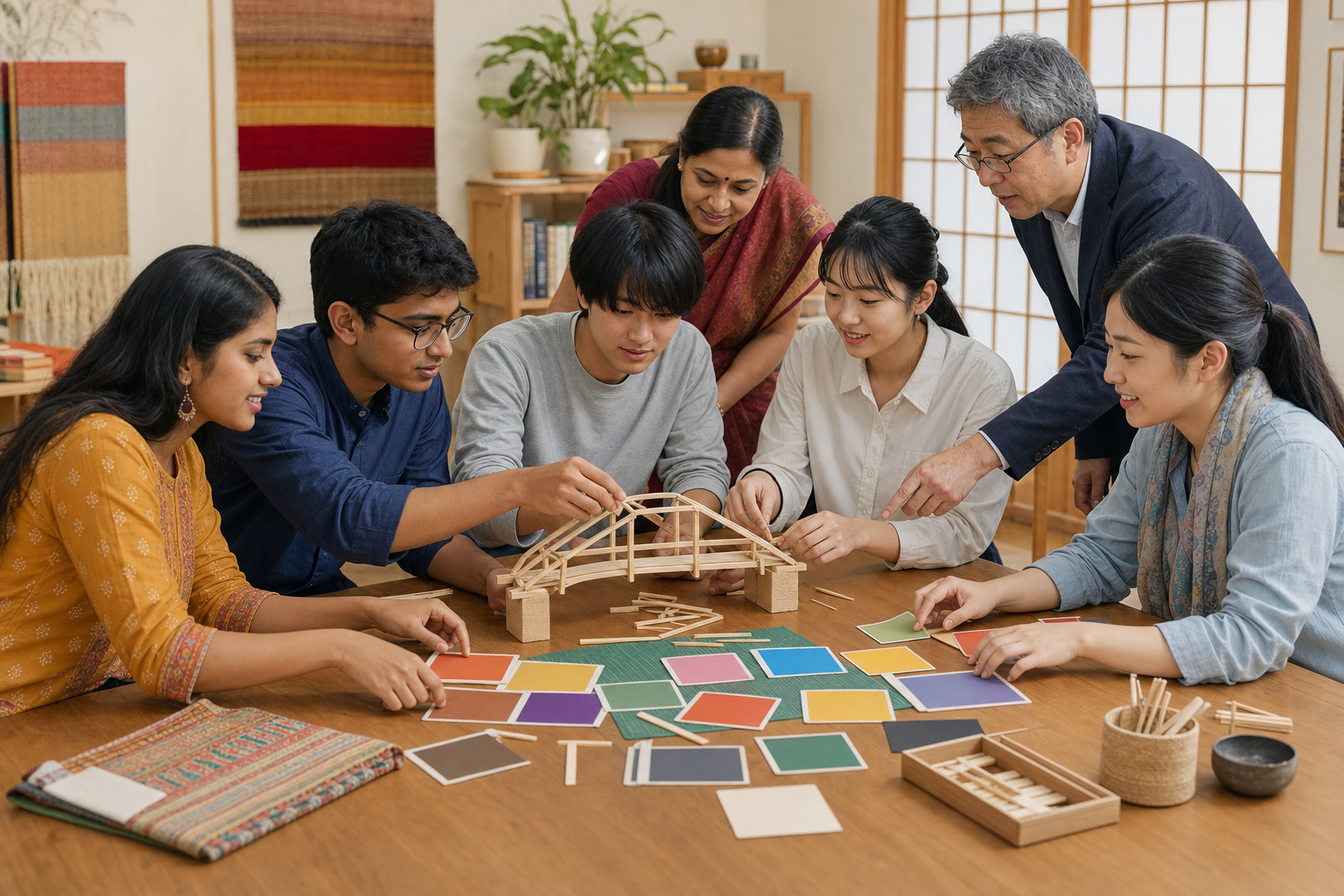
If you are planning an India-Japan school exchange, university partnership, cultural programme or state delegation, the hard part is not finding attractive symbols. Namaste, Sanskrit and Buddhism already offer recognisable points of contact. The hard part is preventing those symbols from becoming stage decorations that disappear as soon as the cameras leave.
A useful programme should leave students able to explain what they encountered, teachers responsible for the next exchange, and institutions ready to move from cultural familiarity into language, technical learning and sustained cooperation. That requires more than goodwill. It requires a deliberate sequence: meaning before performance, reciprocity before publicity, and continuity before claims of success.
A classroom exchange works only when both sides have agency
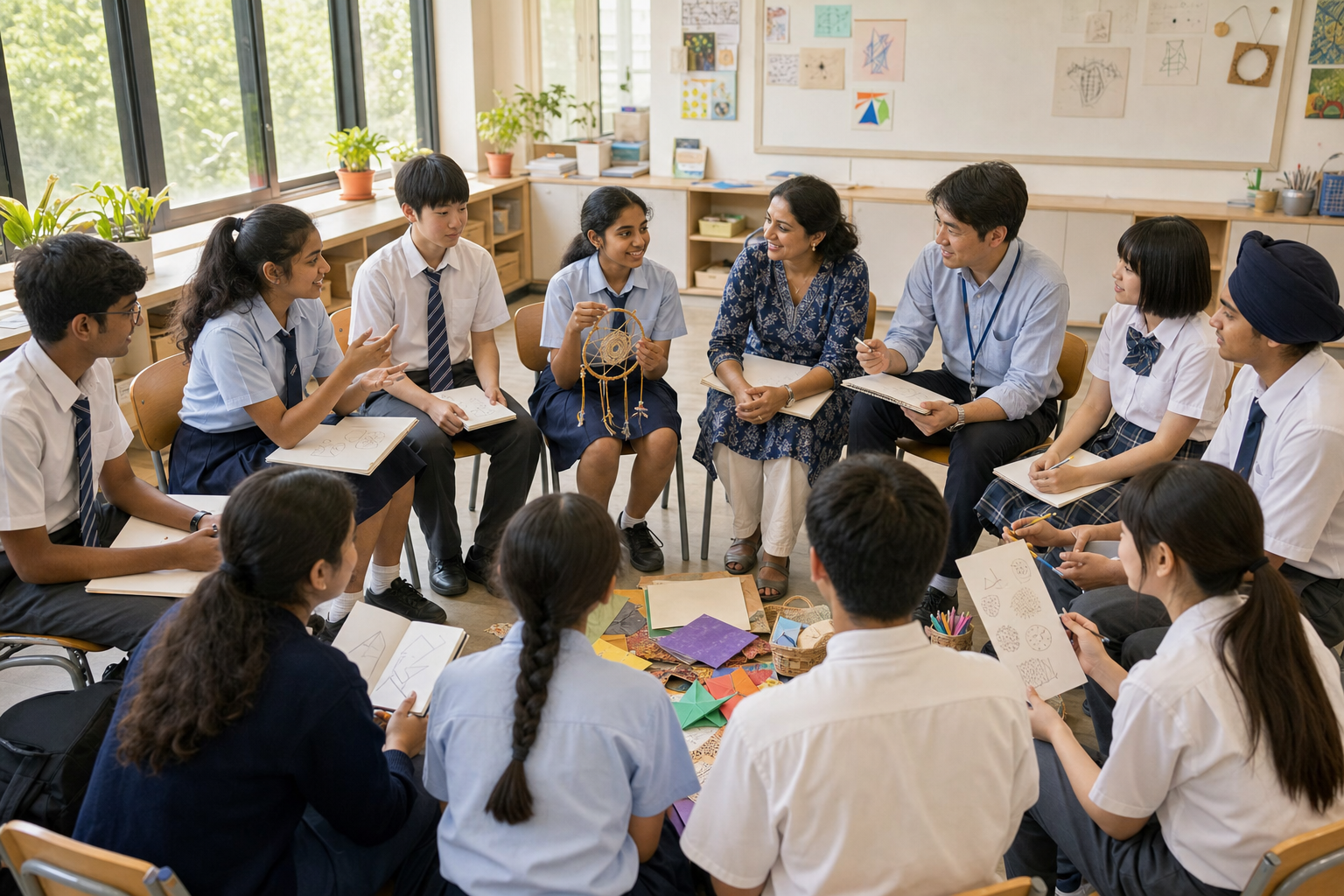
At Yamanashi Public School, a student greeted Uttar Pradesh Chief Minister Yogi Adityanath with namaste, touched his feet and recited Sanskrit shlokas. Adityanath responded to the recitation, and the delegation later distributed chocolates to the students. The memorable element was not simply that a Japanese child performed Indian customs. It was that the child offered something he had learned and the guest recognised his effort.
That distinction matters. Cultural diplomacy becomes credible when the learner remains a participant rather than a prop. A memorised greeting can open a relationship, but only if the programme also teaches what the gesture means, allows the learner to choose it freely and gives the visiting side something to learn in return.
Namaste is particularly suitable for an intercultural classroom because the joined palms of añjali mudrā can communicate courtesy even when spoken language is limited. Within a Dharmic understanding, the gesture also recognises dignity in the person being greeted. Hindu, Buddhist, Jain and Sikh settings differ in their customary forms, but humility, hospitality and respect for the other person offer a shared ethical vocabulary.
Touching an elder’s feet needs more care. Charan sparsha is not a generic Indian greeting. It belongs to a context of reverence for elders, teachers and knowledge-givers, closely associated with the guru-shishya ethos. It should never be assigned to foreign students merely because it will produce an emotive photograph. If a learner chooses it after receiving an accurate explanation, the accompanying narration should describe gratitude and responsibility rather than submission.
Use the following protocol when preparing a school encounter:
- Teach the meaning first. Explain the greeting, recitation or ritual vocabulary before students rehearse its outward form.
- Offer more than one respectful option. A student may use a verbal greeting, namaste, a Japanese bow or an agreed combination. Participation should not depend on performing an unfamiliar act.
- Build reciprocity into the programme. If Japanese students learn Sanskrit sounds or an Indian greeting, Indian participants should learn Japanese words, etiquette or an account of the shared heritage from the Japanese side.
- Let teachers interpret the encounter. A short classroom explanation has more educational value than a long ceremonial speech by a visiting official.
- Give the exchange an afterlife. Leave behind a bilingual bookmark, pronunciation recording, lesson sheet or paired assignment that students can use after the visit.
- Agree on the next contact before the event. A future classroom session, teacher conversation or exchange of student work turns hospitality into a relationship.
This approach protects everyone involved. Dharmic practice is not reduced to costume, Japanese students are not pressured to prove affinity with India, and the visiting delegation receives something more durable than a flattering ceremony.
Build the curriculum around a bridge Japan already possesses
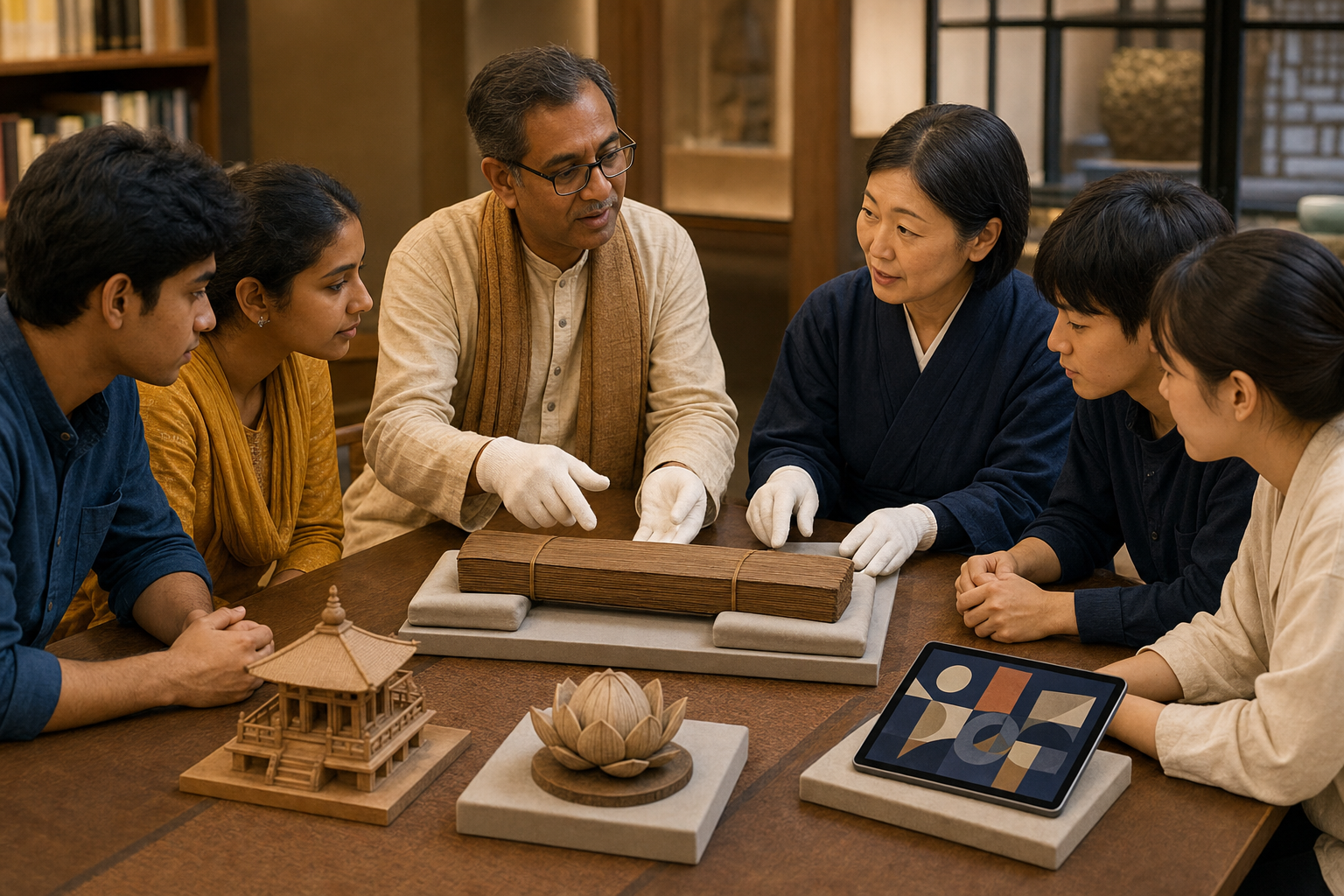
An India-Japan cultural programme should not behave as though Sanskrit is arriving in Japan for the first time. Siddham script and Sanskrit seed syllables survive in Japanese esoteric Buddhist traditions such as Shingon and Tendai, where they are known as bonji. This gives educators a historical bridge that is more substantial than a collection of generic cultural activities.
The strongest opening question is therefore not, How can India introduce Sanskrit to Japan? It is, How do Indian and Japanese learners encounter the same sounds and signs through different histories?
That question gives both partners authority. An Indian Sanskrit teacher can explain phonetics, metre, vocabulary and the intellectual setting of a selected text. A Japanese specialist can show where bonji appears, how it is understood in the relevant Buddhist tradition and why its Japanese life cannot be reduced to a surviving fragment of India. Students then study a connected inheritance without pretending that its Indian and Japanese expressions are identical.
A classroom module can follow this sequence:
- Locate the material. Begin with an authentic Japanese example of bonji and a carefully selected Sanskrit passage. Identify the setting and purpose of each before discussing symbolism.
- Hear the sounds. Have a qualified teacher model a limited selection of Sanskrit sounds. Students should hear, repeat and distinguish them before attempting a public recitation.
- See the scripts. Place Siddham, Devanagari and transliteration beside one another where appropriate. Ask students to notice how sound travels even when the visible script changes.
- Read for meaning. Supply a checked translation and enough context to prevent the shloka or syllable from becoming a decorative sound.
- Invite Japanese interpretation. Let Japanese educators explain bonji through their own religious, artistic and pedagogical setting. Indian participation should not displace local knowledge.
- Ask for comparison, not equivalence. Students should identify connection, difference and adaptation. A historical relationship does not mean that the traditions are interchangeable.
- End with a reciprocal product. Paired students might create a bilingual pronunciation aid, annotated image, short oral explanation or classroom display that requires input from both sides.
Sanskrit recitation can serve a pedagogical purpose beyond ceremony. Its rhythm can support attention, memory, articulation and the internalisation of difficult sounds. A secular language or literature class can use those features without falsely presenting a sacred form as merely a memory exercise. Teachers should name the original context and then explain the adapted classroom purpose.
Dharmic ethics offer another possible bridge. Ahimsa, truthfulness and self-discipline can be discussed as civic values through Hindu, Buddhist, Jain or Sikh materials, while Japanese participants contribute their own vocabulary and examples. The objective is not to dissolve distinct traditions into universal slogans. It is to let students examine how demanding ethical principles are interpreted and practised in more than one setting.
There is also a boundary that organisers should state clearly. Bonji demonstrates a real historical relationship; it does not prove that Japanese culture is simply Indian culture under another name. Japanese Buddhism is not a museum annex of Bharat. Cultural confidence does not require that claim. India can explain the roots, language and transmission of Dharmic knowledge while respecting the authority with which Japanese communities preserved and developed their own traditions.
Join cultural literacy to skills, institutions and investment
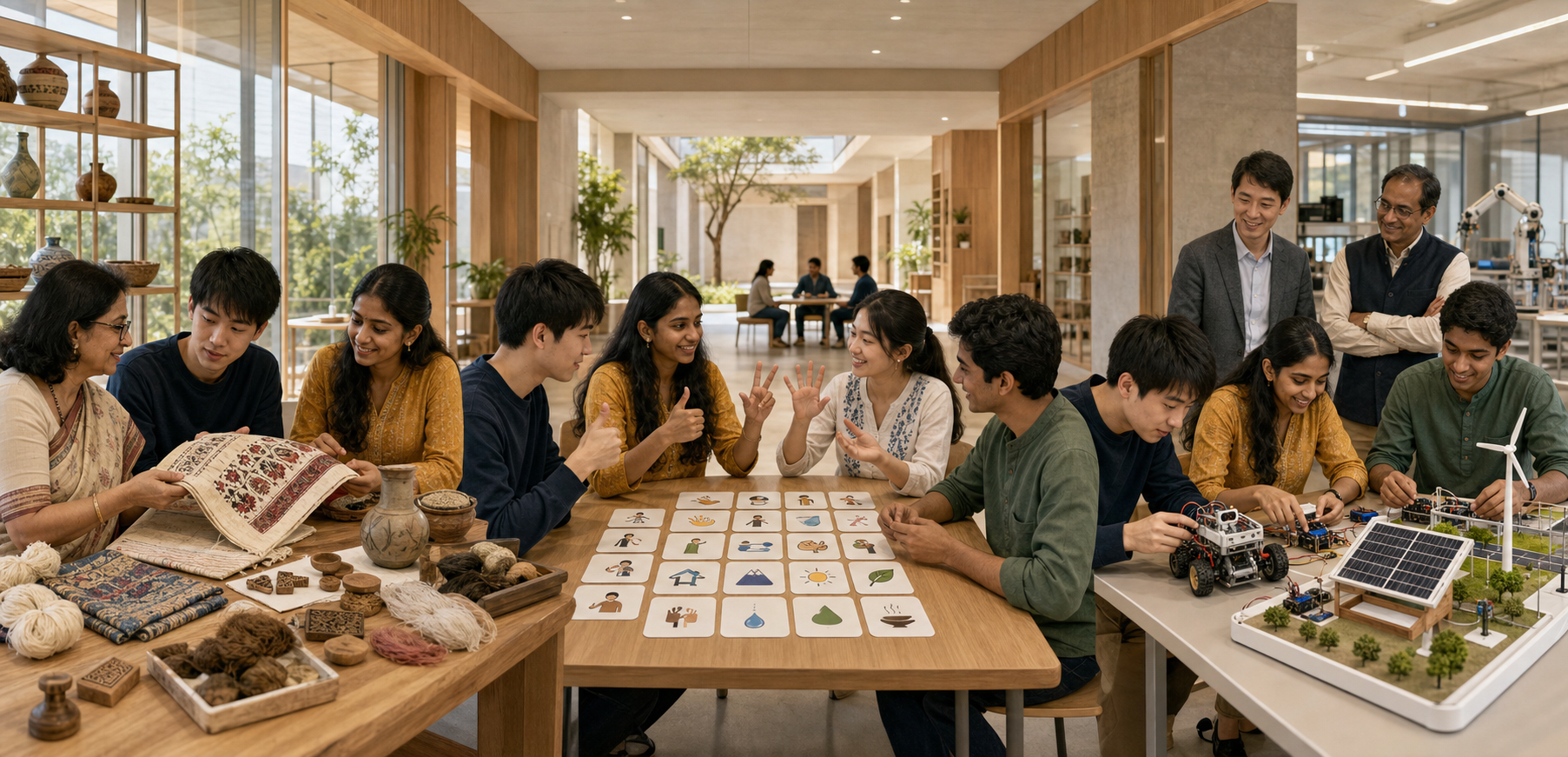
The classroom cannot carry India-Japan relations by itself. Nor should it be treated as a sentimental interlude before the serious meetings begin. The wider Yamanashi visit concerned trade, strategic cooperation and Japanese investment in Uttar Pradesh. Japan’s strengths in manufacturing, quality management and infrastructure systems make workforce capability important, while investors also pay attention to cultural compatibility, policy stability and the ability of local institutions to sustain cooperation.
Education diplomacy connects these agendas when cultural literacy improves the way people learn and work together. A student who can pronounce a ceremonial verse but cannot collaborate across language and institutional differences has received an incomplete preparation. A technical trainee who understands a production process but cannot read a partner’s expectations, etiquette or communication style is also incompletely prepared.
Build the programme around connected strands rather than isolated cultural days:
| Programme strand | Practical activity | Evidence of learning |
|---|---|---|
| Greeting and etiquette | Students practise Indian and Japanese forms of welcome, discuss when each is suitable and learn how to decline participation respectfully. | The learner can explain the meaning and context of a gesture instead of merely copying it. |
| Sanskrit and bonji | Indian and Japanese teachers jointly interpret selected sounds, scripts and settings. | The learner can identify both the historical connection and the differences in present use. |
| Language for cooperation | Participants prepare bilingual introductions, instructions or project notes relevant to their level. | Partners can complete a shared task without relying entirely on ceremonial vocabulary. |
| Technical learning | Students work through an age-appropriate manufacturing, quality-management or infrastructure problem. | The group produces a joint output and can explain how responsibilities were divided. |
| Dharmic and civic ethics | Learners apply non-harm, truthfulness or self-discipline to a concrete classroom or community decision. | They can describe a difficult trade-off rather than repeating an abstract virtue. |
| Institutional continuity | Partner teachers exchange materials and assign the next collaborative task. | A named owner, agreed activity and future contact remain after the delegation departs. |
The balance should change with the institution. In a school, technical learning may be a simple making, environmental or problem-solving activity. In a university or polytechnic, it can become a bilingual case exercise, laboratory collaboration or industry-linked assignment. During a state delegation, the educational element should have its own academic owners and follow-up mechanism rather than being attached to the itinerary as a courtesy visit.
This is where official diplomacy and people-to-people work overlap. Government-supported encounters involving educators, communities and non-governmental participants have the character often described as Track 1.5 diplomacy. Teacher, scholar and community relationships that continue outside formal negotiation sit closer to Track 2. The labels are less important than assigning responsibility.
Before announcing a partnership, identify these owners:
- An institutional sponsor who can remove administrative barriers and protect continuity when leadership changes.
- An academic lead on each side who approves content, translations and the level of difficulty.
- A local coordinator who manages schedules, classroom expectations and communication between visits.
- A cultural adviser who can detect mistranslation, decontextualisation and inappropriate performance requests.
- A safeguarding and communications lead who handles permission, student privacy, recording and publication.
- A continuity owner responsible for the next learning activity rather than the ceremonial event alone.
If nobody owns the next exchange, the partnership is still an event. If only officials own it, teachers and students will remain spectators. If only teachers own it but lack institutional backing, ordinary scheduling and staff changes can quietly end the work. Durable education diplomacy needs authority at the top and working relationships at the classroom level.
Measure the next interaction, not the viral moment
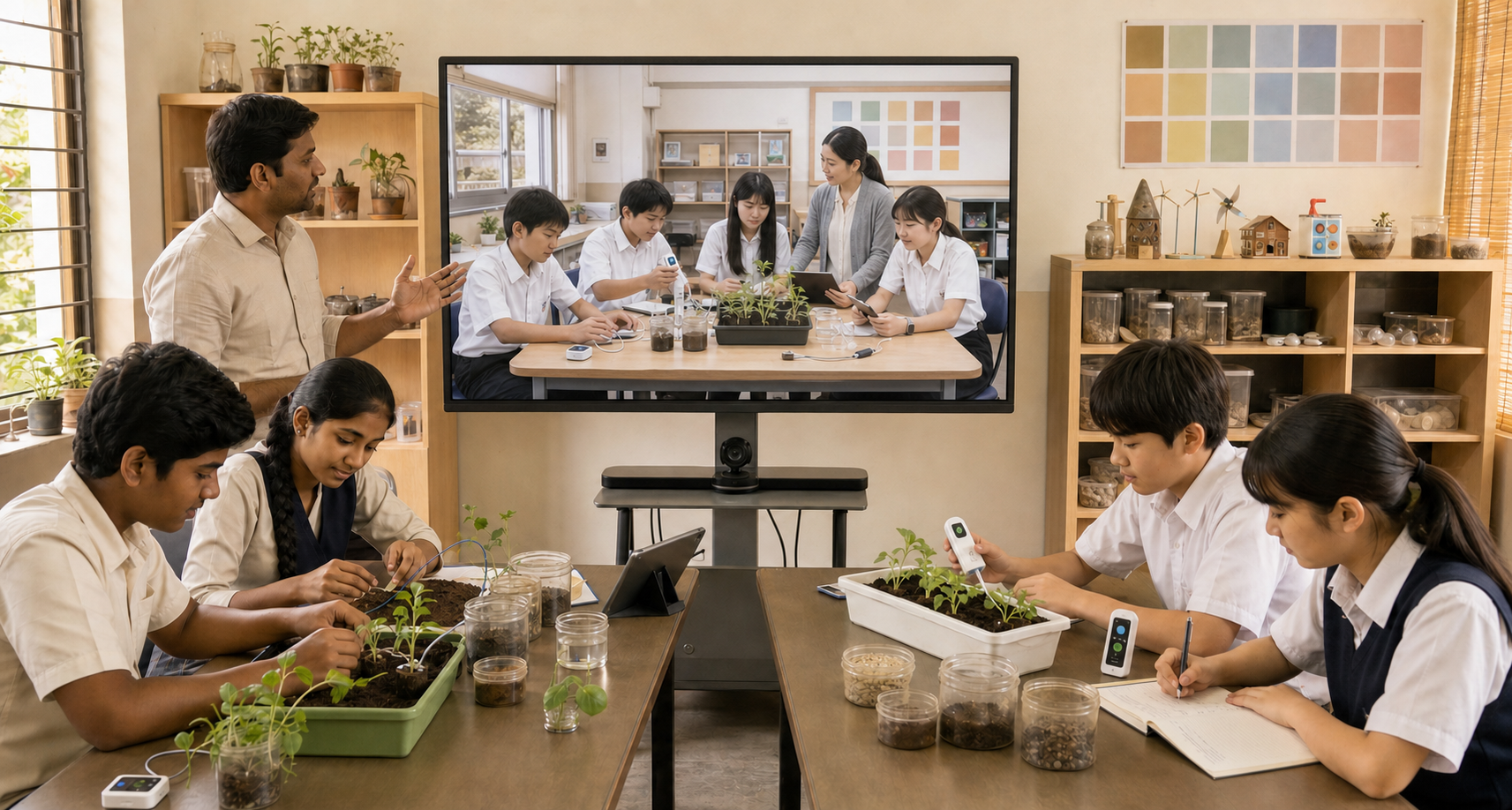
The Yamanashi classroom clip travelled widely because viewers could understand it without a policy briefing: a child welcomed a guest, displayed difficult learning and received recognition. Citizen-captured circulation gave the encounter a reach that formal diplomatic communication might not have achieved.
That reach is valuable, but views are evidence of attention, not evidence of trust. A cultural programme can perform well online while leaving students confused about meaning, teachers without a follow-up plan and partner institutions with no deeper connection. Do not use virality as the main measure of education diplomacy.
Use a simple scorecard built around questions the institutions can actually answer:
- Meaning: Can participating students explain the greeting, verse, script or ethical concept in their own words?
- Reciprocity: Did Indian and Japanese participants both teach, learn and shape the final activity?
- Local ownership: Did classroom teachers help choose the material, or were they handed a finished performance?
- Accuracy: Were pronunciation, translation, historical framing and visual materials checked by qualified people?
- Continuity: Is another contact, assignment or exchange already assigned to a named person?
- Progression: Does the cultural encounter open a route into deeper language, heritage or technical learning?
- Institutional depth: Can the relationship continue if a prominent visitor, enthusiastic teacher or communications officer moves on?
- Responsible communication: Were consent, student privacy, context and translation handled before publishing photographs or video?
Collect evidence that corresponds to those questions: the checked lesson plan, student explanation, paired project, teacher reflection, bilingual material and scheduled follow-up. A montage of smiling faces can accompany that record, but it cannot replace it.
Media teams also need a cultural protocol. Obtain permission through the school’s safeguarding process. Describe each gesture accurately instead of collapsing namaste, bowing and charan sparsha into a generic Indian welcome. Identify a Sanskrit passage only after its wording and meaning have been confirmed. Have subtitles reviewed by someone competent in the relevant language. Do not publish a child’s name or close-up merely because the clip appears positive. Show the guest’s reciprocal response, and tell audiences what educational activity will follow.
The decisive test is simple: if the camera were absent, would the encounter still produce learning and another contact? If the answer is no, you have designed event production, not cultural diplomacy.
Trust in public diplomacy is sometimes described as relational capital. It accumulates through repeated, respectful contact in which local people are participants rather than scenery. That makes the next interaction more important than the most successful clip from the current one.
Key takeaways
- Teach the meaning of a gesture or recitation before asking anyone to perform it, and keep culturally loaded gestures voluntary.
- Use Sanskrit and Japanese bonji as a shared field of inquiry, not as evidence that Indian and Japanese traditions are identical.
- Give both countries interpretive authority: India can explain Sanskrit and Dharmic roots, while Japan explains the heritage’s Japanese forms and meanings.
- Connect cultural literacy with language, technical learning and joint work if the partnership is expected to support broader economic cooperation.
- Assign academic, administrative, cultural, safeguarding and continuity responsibilities before the public event.
- Measure comprehension, reciprocity, local ownership and follow-up. Online reach is a communications result, not proof of a durable relationship.
If you need a practical place to begin, pair an Indian institution with a Japanese counterpart around a shared object of learning: a greeting, a Sanskrit sound, a bonji example, an ethical question or a technical task. Let each side explain what it knows, produce something together and fix the next learning activity before inviting the cameras. That modest discipline is how a memorable encounter becomes a durable India-Japan relationship.
References
