
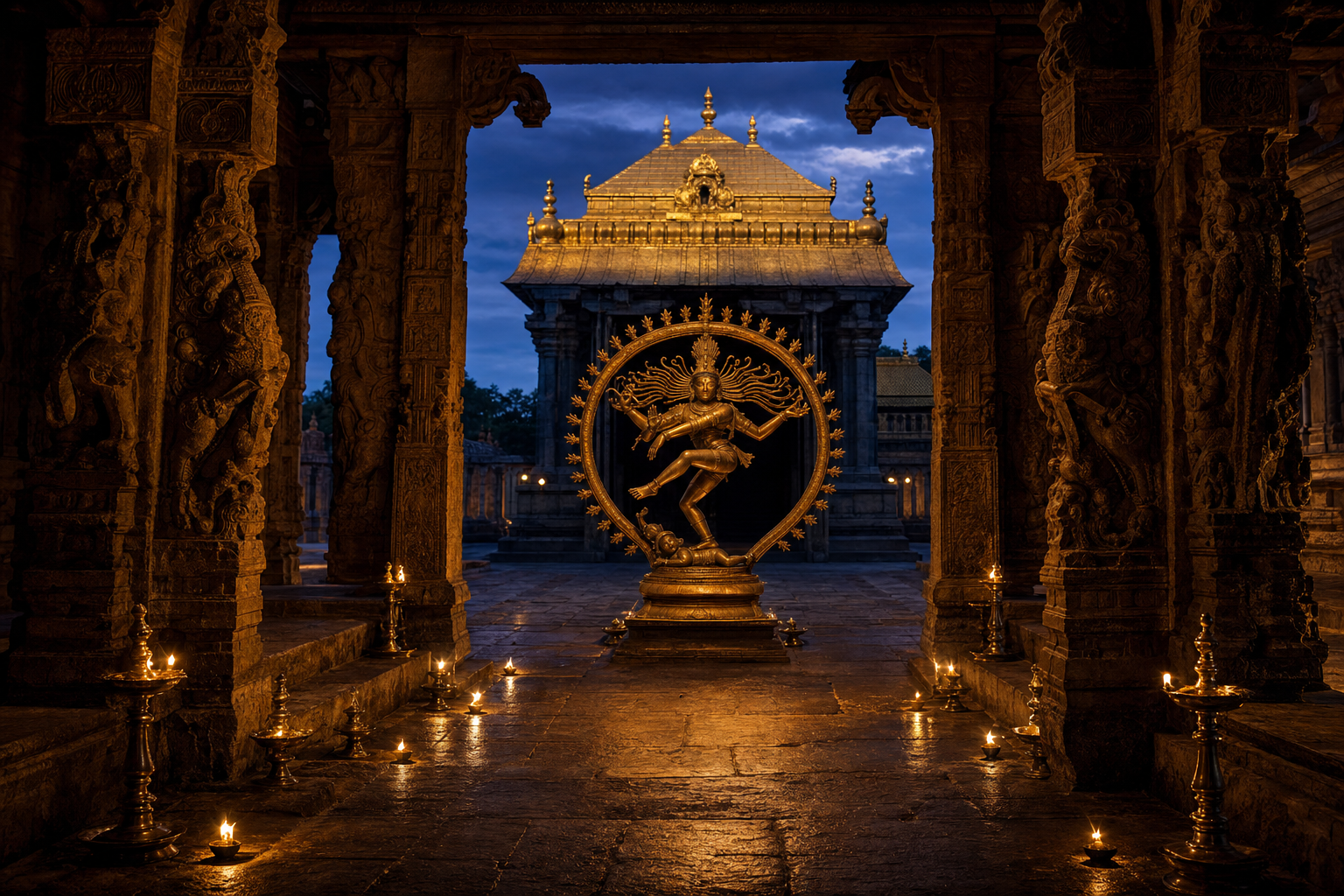
You may arrive at Chidambaram knowing only one tantalising line: the temple’s famous secret is an empty space. That line is close enough to the truth to be misleading. If you expect a concealed object, a supernatural spectacle, or a puzzle with a clever solution, the Chidambara Rahasya can seem strangely anticlimactic.
The more useful question is not, “What are they hiding?” It is, “What can sacred space reveal that an image cannot reveal by itself?” Once you ask that, Nataraja, the Akasha Linga, the five cosmic acts, the sages Patanjali and Vyaghrapada, and the presence of Govindaraja Perumal begin to form one coherent teaching.
The mystery is presence without an object
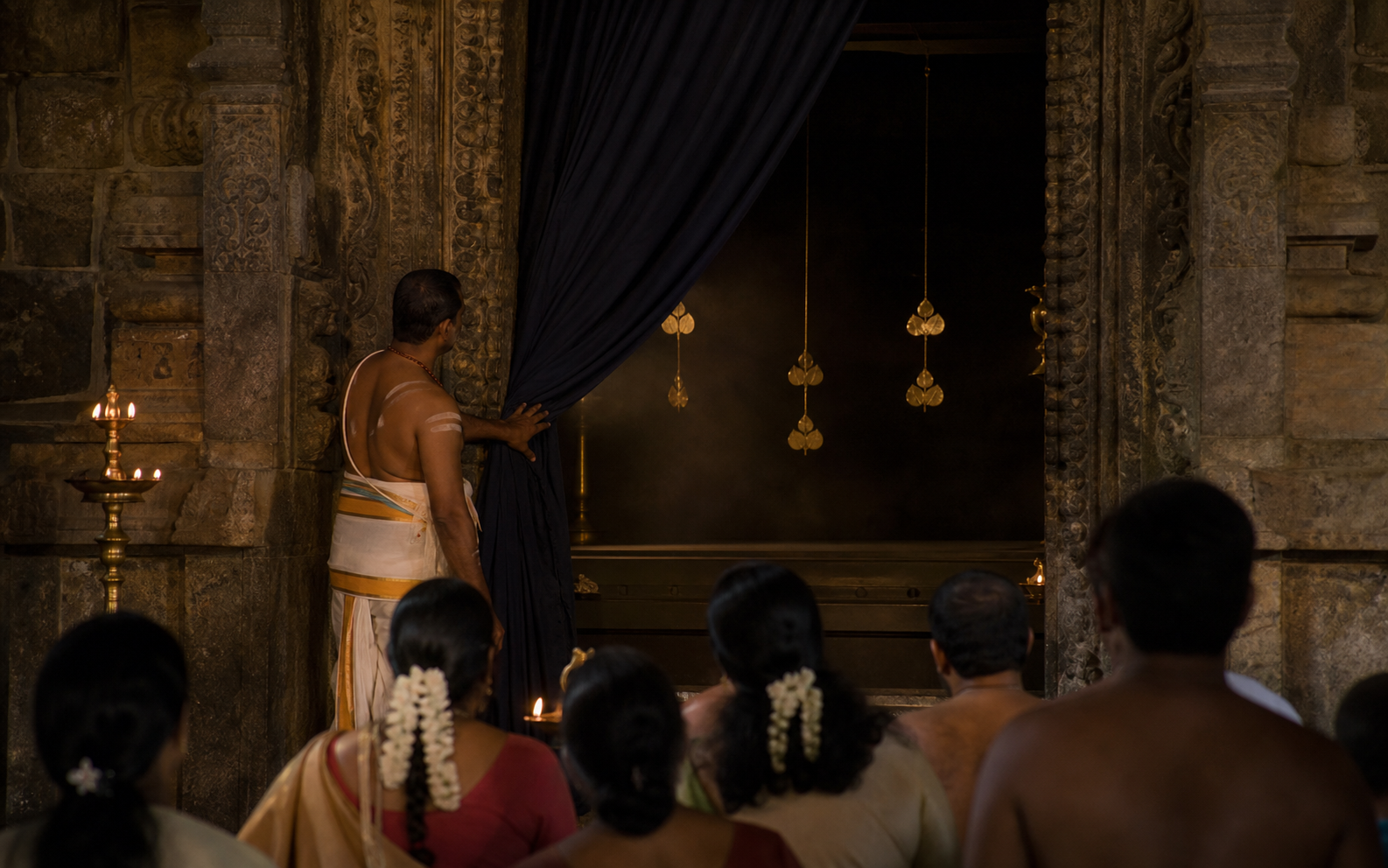
Chidambaram is traditionally understood through the language of chit, consciousness, and ambaram, space or expanse. Its innermost hall is accordingly called the Chit Sabha, the Hall of Consciousness. The word rahasya means secret, but this is not secrecy in the ordinary sense of information withheld from outsiders. It is a truth that cannot be exhausted by being stated.
Within this sacred grammar, Shiva is encountered in two complementary ways. Nataraja gives divine reality a visible form: a body dancing, a foot raised in grace, another foot subduing ignorance. The Akasha Linga points toward presence that cannot be confined to a carved object. What looks like empty space is therefore not a declaration that “nothing is there.” It asks you to recognise that the limitless cannot be reduced to something placed before the eyes.
This distinction matters. If you dismiss the Rahasya as an empty compartment, you mistake the absence of an object for the absence of the Divine. If you search for a material mechanism behind it, you turn worship into detective work. The mystery is received properly when visible form and ungraspable space are allowed to interpret each other.
Nataraja is not cancelled by the formless Akasha, and Akasha is not merely an invisible version of the murti. Form makes contemplation possible; sacred space prevents the mind from treating its form as a limit. Chidambaram holds both insights together.
Nor does the Rahasya need a forced scientific explanation. Nataraja’s dance can give a modern reader a powerful image of a dynamic cosmos, but the temple’s claim is theological and contemplative: the universe is an expression of Divine Consciousness. Akasha functions here within a sacred vision, not as a laboratory hypothesis that proves or disproves physics.
Key takeaways
- Chidambara Rahasya does not mean that the sanctum contains “nothing”; it points to divine presence that cannot be made into an object.
- Nataraja and Akasha belong together. The visible form supports devotion, while sacred space refuses every attempt to limit Shiva to form.
- The Ananda Tandava expresses five inseparable divine acts: creation, preservation, dissolution, concealment, and grace.
- The mystery is approached through attention and humility, not by hunting for a spectacle or decoding a secret device.
- Govindaraja Perumal’s presence in the same complex places the Shaiva revelation within a wider, interwoven Hindu sacred landscape.
Nataraja shows why the cosmos is a dance
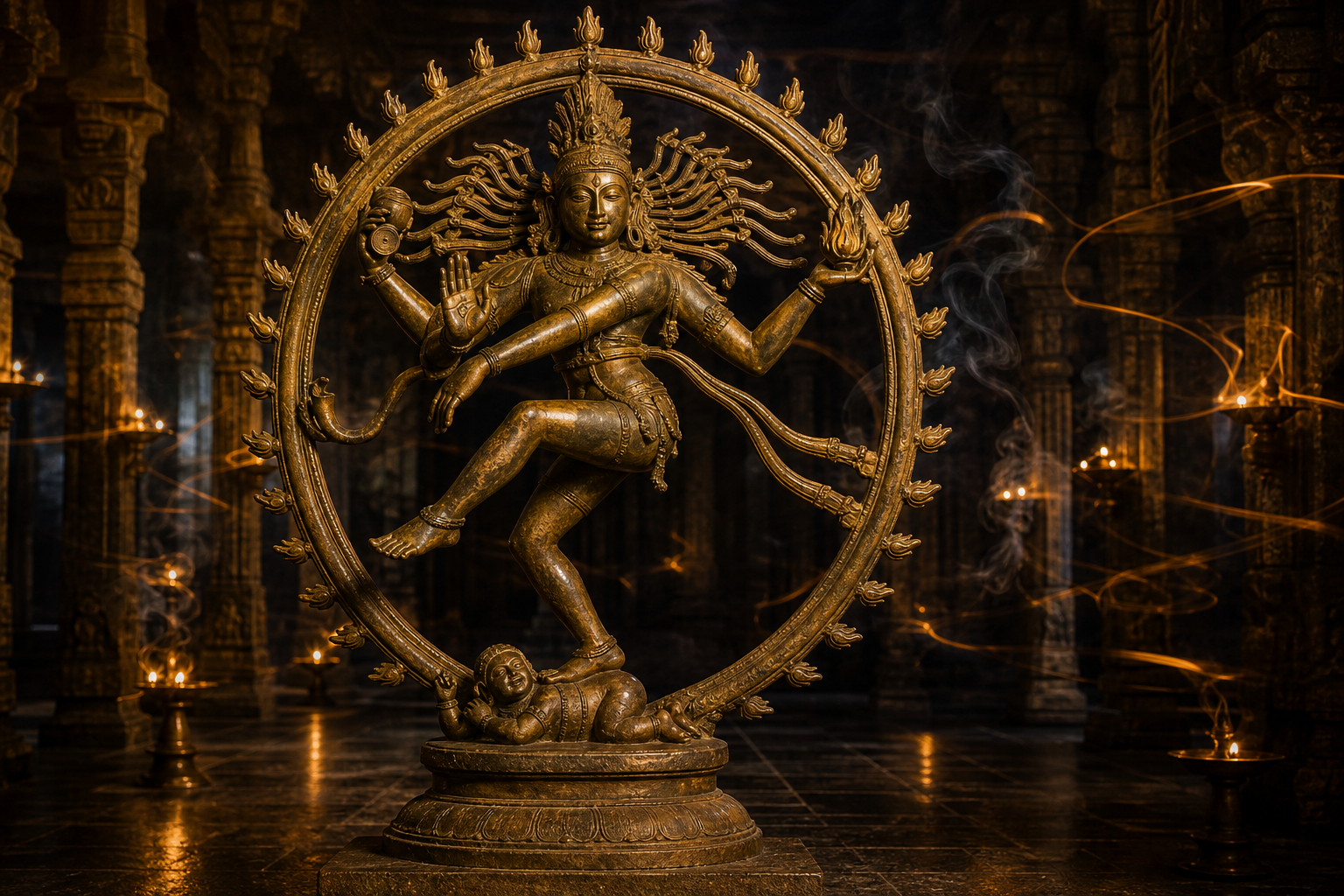
Nataraja is sometimes reduced to a graceful emblem of Indian art. At Chidambaram, however, the dance is not decoration added to theology. It is theology made visible. The Ananda Tandava, the Dance of Bliss, expresses the Panchakrityas, the five activities through which the cosmos continually unfolds.
- Srishti, creation: forms, lives, possibilities, and worlds arise.
- Sthiti, preservation: what has arisen is sustained long enough to develop and fulfil its place.
- Samhara, dissolution: formed things return, making transformation and renewed creation possible.
- Tirobhava, concealment: reality is veiled, allowing limitation, forgetfulness, and the experience of separation.
- Anugraha, grace: the veil can be lifted, bondage can loosen, and the being can turn toward liberation.
Do not read these as five unrelated events occurring in a remote mythic past. The dance holds them in one movement. Creation without dissolution would become endless accumulation. Dissolution without preservation would permit nothing to mature. Concealment explains why truth can remain present without being recognised. Grace means concealment does not have the final word.
The traditional account of the Daruka Forest gives this teaching a sharper edge. Its powerful sages trusted their mastery of ritual and mantra so completely that they treated ritual action and karma as the ultimate governors of reality. Shiva appeared as Bhikshatana, a wandering ascetic, while Vishnu appeared as Mohini. Enraged, the sages sent destructive forces from their sacrificial fire: a tiger, venomous serpents, and finally the dwarf Muyalaka, or Apasmara, representing ignorance and forgetfulness. Shiva turned the tiger skin into clothing, the serpents into ornaments, and subdued Apasmara beneath his right foot while raising his left foot in grace.
The lesson is not that ritual is worthless. Chidambaram is itself sustained through worship. The error is allowing sacred knowledge, technique, or status to feed the very ego they are meant to discipline. The sages could command formidable forces, yet their command did not amount to wisdom. Shiva’s dance placed power back within its divine order.
Apasmara also deserves more than a passing glance. Ignorance here is not simply a shortage of facts. It is forgetfulness of the ground of one’s being. That is why the dwarf remains under the dancing foot: forgetfulness must be held down while consciousness becomes free enough to dance. The raised foot then completes the image. Bondage is subdued, but release comes through anugraha, grace.
When you look at Nataraja, therefore, do not try to catalogue isolated symbols as though sitting an examination. Notice the total movement. Stillness and activity, concealment and revelation, destruction and compassion are not presented as contradictions. They meet in Shiva.
Patanjali and Vyaghrapada reveal how the mystery is approached
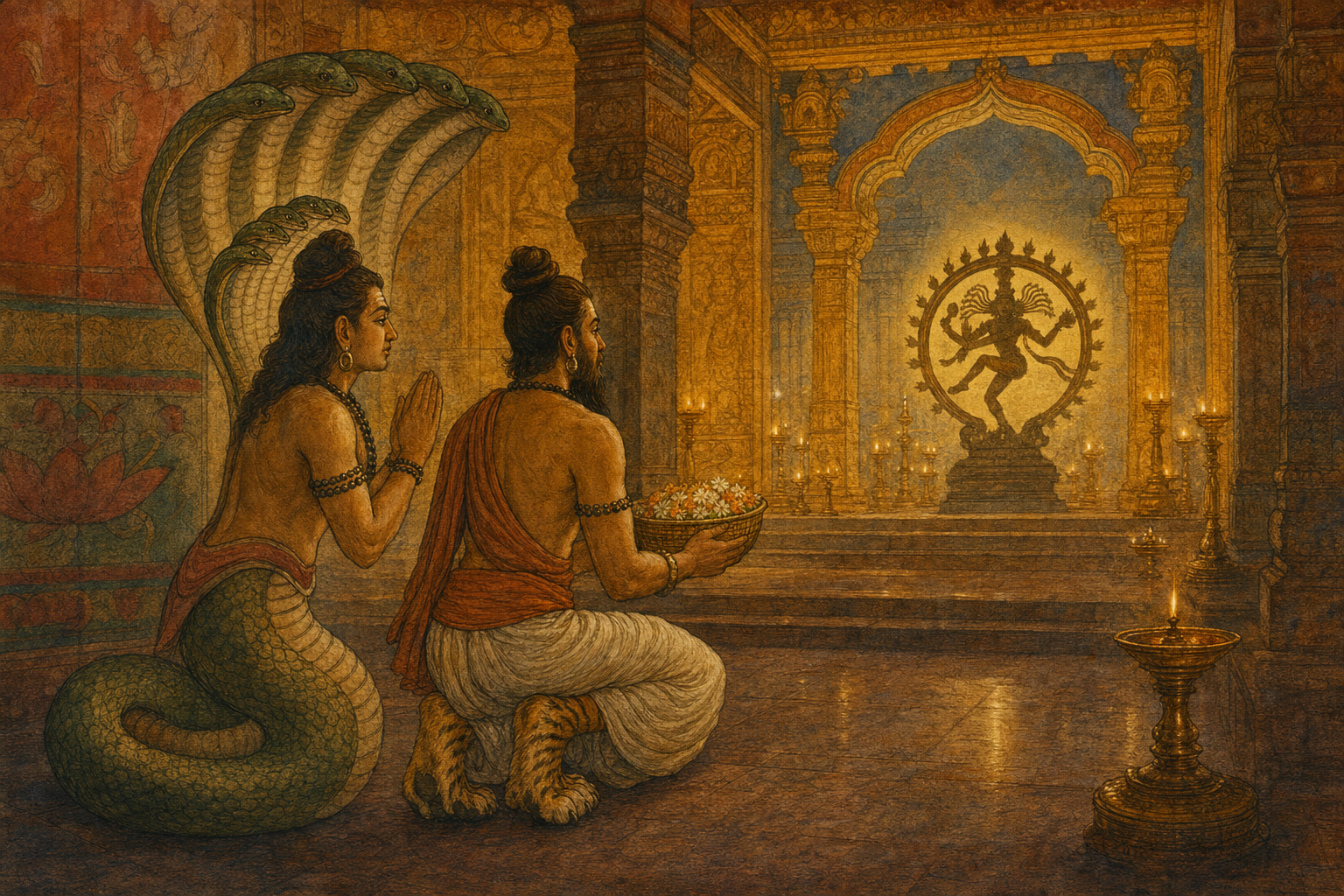
The sacred geography surrounding Chidambaram was remembered as Thillaivanam, the forest of thillai trees. In its Sthala Purana, two sages come to this landscape by different paths but with one longing: to behold Shiva’s cosmic dance.
Patanjali, revered in this account as an incarnation of Adishesha, saw the bliss Vishnu experienced while contemplating Shiva’s dance. Desiring that vision for himself, Patanjali was directed to Thillai. His journey begins with wonder: he recognises another being’s joy and seeks its divine cause.
Vyaghrapada’s path begins with service. He wanted to offer Shiva flowers that were fresh and untouched. To gather them before dawn without damaging them, he received the powerful feet and claws of a tiger, giving him the name Vyaghrapada, the Tiger-Footed Sage. His unusual form is not an ornament to the tale; it shows a body reshaped around the demands of devoted care.
After sustained tapas, both sages behold the Ananda Tandava in the Chit Sabha. Their images remain there as witnesses within the temple tradition. One comes through longing to see; the other through exacting service. Neither treats revelation as entertainment.
This is the practical instruction embedded in their story. Curiosity can bring you to Chidambaram, but curiosity alone cannot disclose its meaning. Give your attention a form before you arrive. You might learn the names of the five cosmic acts, sit in silence with the image of Nataraja, or reflect on what you habitually treat as “empty” merely because you cannot grasp it. The preparation need not be elaborate. It needs to be sincere enough to slow down the demand for instant explanation.
The narratives should also be allowed to remain sacred narratives. You need not flatten them into modern biography, nor empty them into “mere symbolism.” Within pilgrimage, they tell you what kind of person can receive the dance: one whose desire has become tapas, and whose service has become careful.
Govindaraja Perumal prevents a narrow reading of Chidambaram
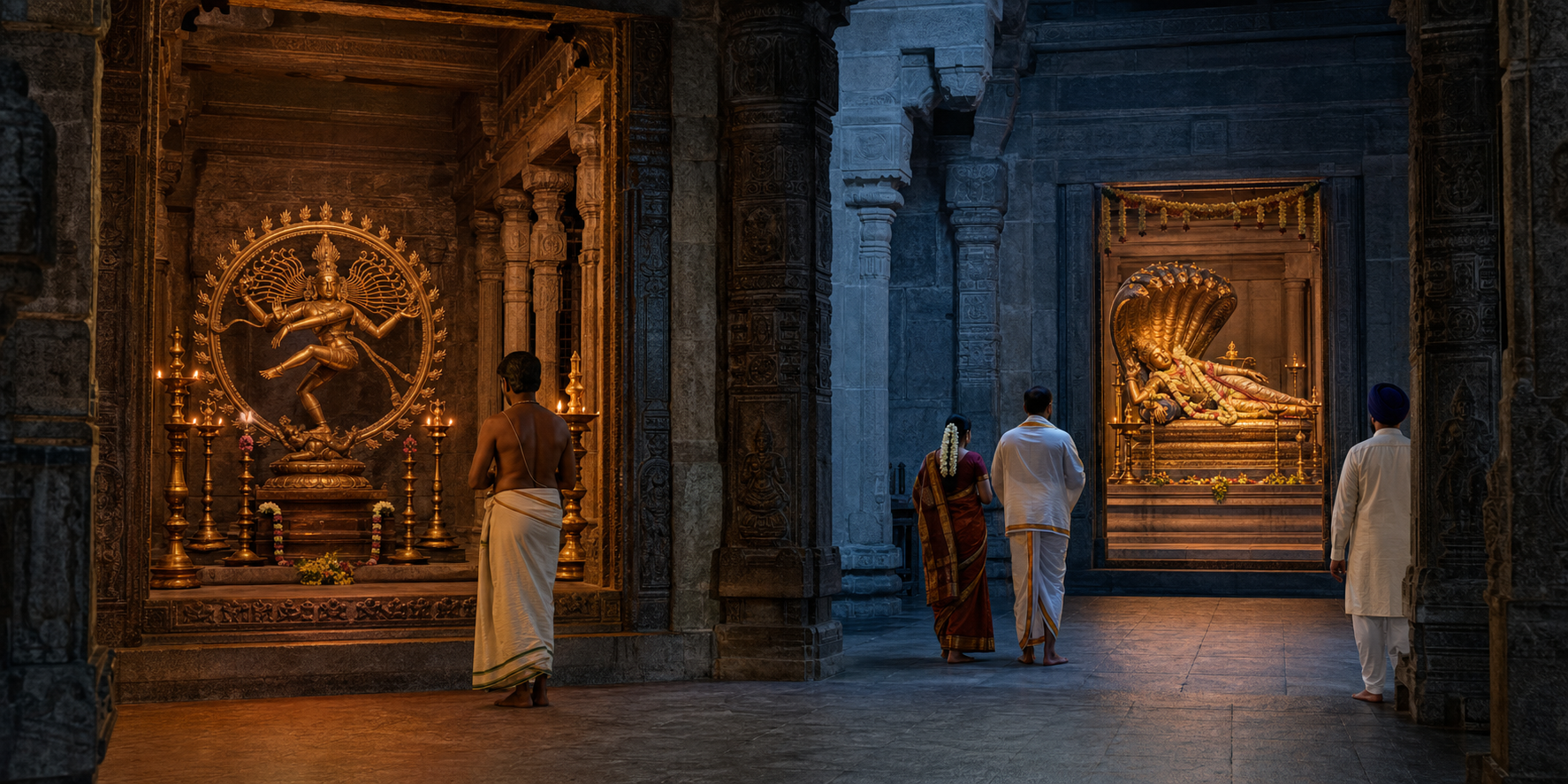
Chidambaram’s sacred mystery is unmistakably Shaiva, yet its temple complex also contains the reclining Govindaraja Perumal at Thiruchitrakoodam. This Vishnu shrine is counted among the 108 Divya Desams. Shiva’s Ananda Tandava and Vishnu’s reclining presence therefore inhabit the same sacred premises.
That coexistence should neither be ignored nor used to erase real distinctions between Shaiva and Vaishnava traditions. The two forms retain their names, their devotional vocabularies, and their modes of worship. Their proximity makes a subtler point: Hindu sacred geography has often held distinctive revelations together without requiring one to become a copy of the other.
The story of Patanjali already hints at this relationship. His longing for Shiva’s dance begins with Vishnu’s bliss on beholding it. Vishnu is not presented as diminished by Shiva’s glory. Divine delight becomes the bridge that directs another devotee toward Thillai.
When you contemplate or visit Chidambaram, do not treat Govindaraja as an unrelated annex to the “main” mystery. Let the two presences correct a sectarian habit of mind. Reverence for your chosen form of the Divine does not require indifference toward another. At the same time, respect does not require pretending every form says exactly the same thing.
How to approach Chidambara Rahasya without missing it
The following sequence is contemplative, not a claim about the temple’s required ritual order. On an actual visit, observe the temple’s current protocols and the directions of those responsible for worship. The purpose here is to organise your attention.
- Set aside the hunt for a hidden object. Remind yourself that the Rahasya concerns how presence is known, not what secret material might be concealed.
- Begin with Nataraja as a whole. Notice the union of movement and serenity, the foot restraining forgetfulness, and the foot opened in grace. Allow the form to address you before analysing its parts.
- Name the five acts slowly. Creation, preservation, dissolution, concealment, and grace provide the conceptual key to the dance. Ask which one you usually resist. Many people welcome creation but treat every dissolution as meaningless; the icon will not permit that selective reading.
- Turn toward the meaning of Akasha. When the symbolism presents apparently empty space, resist concluding that nothing is present. Let the absence of a conventional object expose the mind’s habit of equating reality with what it can possess, define, or display.
- Remember the two witnesses. Patanjali represents longing disciplined into tapas; Vyaghrapada represents service refined into care. Ask what preparation your own attention has received.
- Include Govindaraja in your understanding. The reclining Vishnu does not interrupt the Shaiva revelation. His presence widens your view of the sacred world in which that revelation lives.
You can continue this contemplation after leaving the temple, or even if you cannot travel there. At the end of a day, identify one thing that began, one thing sustained, one thing that ended, one thing still concealed from your understanding, and one opening you received but did not manufacture. This is not a replacement for puja or a claim that every setback should be sentimentally called grace. It is a disciplined way to notice that life is never governed by only the act you presently prefer.
Carry one question to Chidambaram rather than a demand for spectacle: what remains when the Divine is no longer treated as another object in the world? Nataraja gives that question a radiant form. The Akasha Linga keeps the answer from becoming a limit. Stand between the two, and the Rahasya has already begun to do its work.
References
