

If you have been asked to bring your mandir into Mandir Mahasangh, or to help form a regional temple federation, you need answers before slogans. Which decisions stay with the mandir? What information and resources will be shared? Who is accountable when something goes wrong? Most importantly, what will improve for the deity’s seva and for the devotee?
After National Coordinator Shri Sunil Ghanwat briefed him on Mandir Mahasangh, Param Pujya Vijayendra Saraswati called the effort highly commendable and described temple organization and unification as “the pressing need of the present time”. That endorsement gives the initiative moral weight. It does not remove the need for a careful operating model. The framework below is what trustees, archakas, sevadars and devotees should insist on as temple cooperation develops; it does not assume that every safeguard is already in place.
Unify capacity without standardizing worship

A useful federation is a network of cooperation, not a merger of sacred identities. A Shaiva mandir, a Vaishnava mandir, a Shakta pitha and a village devata temple do not need identical rituals to share fire-safety training, conservation knowledge or procurement support. The federation should strengthen the operational circle around the sacred core, not acquire control over that core.
This distinction must be written down. Verbal assurances about autonomy are too weak when questions later arise about ritual authority, endowments, records, donations or public statements. A federation charter should separate what the mandir reserves, what it delegates and what it agrees to coordinate.
| Area | The mandir should retain | The federation can coordinate |
|---|---|---|
| Worship and maryada | The deity’s seva, Agama or sampradaya, ritual sequence, festival form and authority of the appropriate religious functionaries | Calendar coordination, logistical assistance and voluntary exchange of non-doctrinal practices |
| Property and endowments | Custody and decisions under the mandir’s governing instruments and applicable law | Record formats, conservation guidance, professional referrals and shared maintenance knowledge |
| Daily operations | Local implementation and decisions specific to the premises | Safety checklists, volunteer training, helpdesk support and common maintenance frameworks |
| Information | Classification of sensitive records and authority to release them | A secure registry for agreed fields and exchange of non-sensitive operational information |
| Finance | Approval and accounting of the mandir’s own funds under its existing authority | Documented budgets, procurement controls and reporting for genuinely shared programmes |
Before your mandir adopts a federation resolution, mark every proposed power as reserved, delegated or shared. Reject open-ended authority that could later be interpreted to cover worship, assets, financial access or confidential records. Any proposal to change legal control, asset custody or endowment terms requires qualified advice under the law that governs the particular mandir; membership in a federation is not, by itself, authority to make those changes.
Begin with one regional problem that temples already share
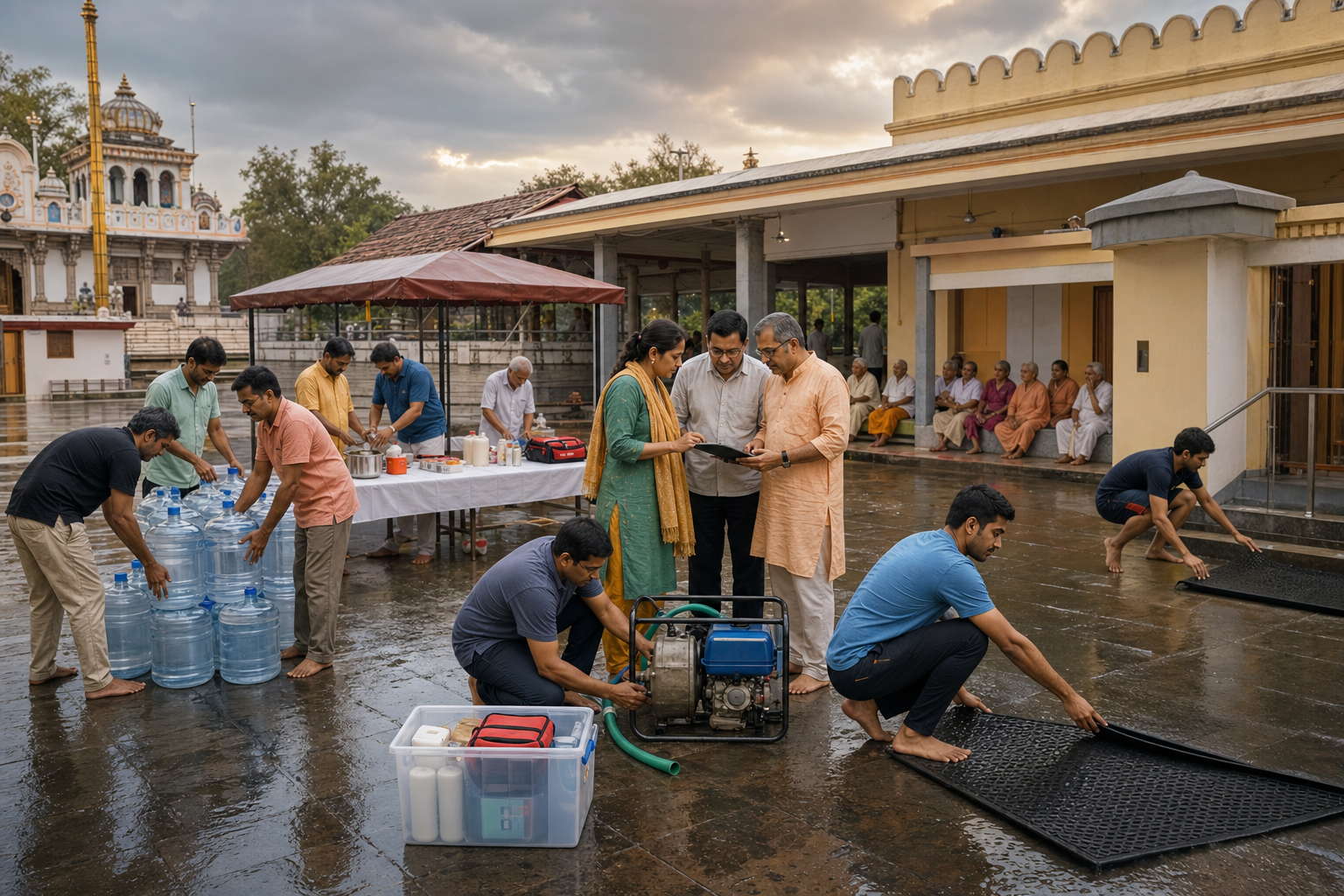
A federation becomes credible when recurring work becomes safer or easier. The first test should therefore be a regional pilot with a visible operational result. A large membership announcement, a conference or a messaging group may create contact, but none of them proves that temples can act together.
- Bring together representatives of trusteeship, worship, seva, facilities and finance from a manageable local cluster.
- Name one recurring pressure: festival crowds, electrical risk, volunteer preparation, conservation, procurement or incomplete records.
- Record each mandir’s non-negotiables, including ritual boundaries, local authority, data restrictions and practical constraints.
- Choose one shared deliverable, such as a festival-safety checklist, a training module, a conservation inventory template or a federated helpdesk.
- Use the deliverable in an actual operating cycle or a tabletop exercise, with named responsibility for each task.
- Hold a structured debrief, document what failed or remained unclear, and decide whether to retain, revise or retire the shared method.
Festival readiness is a strong pilot because the responsibilities are concrete. The working checklist should identify who monitors entry, exit and queue pressure; who checks fire equipment and electrical systems; where first aid, shade, hydration and sanitation are located; how a separated child or vulnerable visitor is assisted; who contacts local authorities; and who records lessons after the event. The checklist can be common while the festival and its ritual form remain entirely local.
Measure the pilot by what changed, not by how many mandirs appeared on a membership list. Useful evidence can include clearer volunteer assignments, issues found during an electrical or fire review, visitor feedback, volunteer hours, completed conservation work, annadanam outreach and environmental indicators. Post-event debriefs and a balanced set of operational measures allow the next temple to inherit a tested practice instead of repeating the same mistakes.
Larger mandirs should not become permanent commanders and smaller mandirs permanent recipients. A mentorship arrangement works better when local knowledge also travels upward. A major urban temple may contribute technical staff, while a smaller or older mandir may hold deep knowledge of ritual continuity, traditional materials, oral history or community participation.
Build a useful registry without exposing the mandir

A digital registry should help temples plan, preserve and respond. It should not become a public catalogue of everything a mandir owns. The safest starting point is to classify information before collecting it.
Separate public, operational and restricted records
- Public information: darshan arrangements, festival dates, pilgrimage access, accessibility information and non-sensitive visitor facilities.
- Operational information: maintenance cycles, facility condition, crowd-flow observations, energy use, volunteer requirements and conservation tasks shared with authorized teams.
- Restricted information: detailed asset and endowment records, sensitive sacred-art documentation, security arrangements, emergency-access details and confidential contacts.
GIS mapping also needs this separation. A public layer can help pilgrims understand routes and facilities. An access-controlled layer can help authorized teams plan emergency entry or protect vulnerable locations. Combining both into an unrestricted map would turn a useful planning tool into an avoidable security risk.
Give every field a purpose and an owner
Before adding a field, the registry team should be able to state why it is needed, who maintains it, who may view it, how an error is corrected and when its continued retention is reviewed. If the team cannot answer those questions, the information should not be uploaded merely because it is available.
The baseline controls are practical: multi-factor authentication for privileged access, permissions based on role, secure backups, restoration checks, awareness of phishing and a record of important changes. A local data steward should be able to correct the mandir’s entries. Otherwise stale or inaccurate information will gradually destroy confidence in the whole registry.
Interoperability does not mean placing every temple record in one unrestricted database. It means agreeing on common names and formats for the non-sensitive information temples have chosen to exchange, such as crowd patterns, energy use or maintenance cycles. A privacy-conscious registry with interoperable non-sensitive data can support regional planning while keeping sacred, financial and security information under appropriate control.
Make governance visible through safety, seva and stewardship
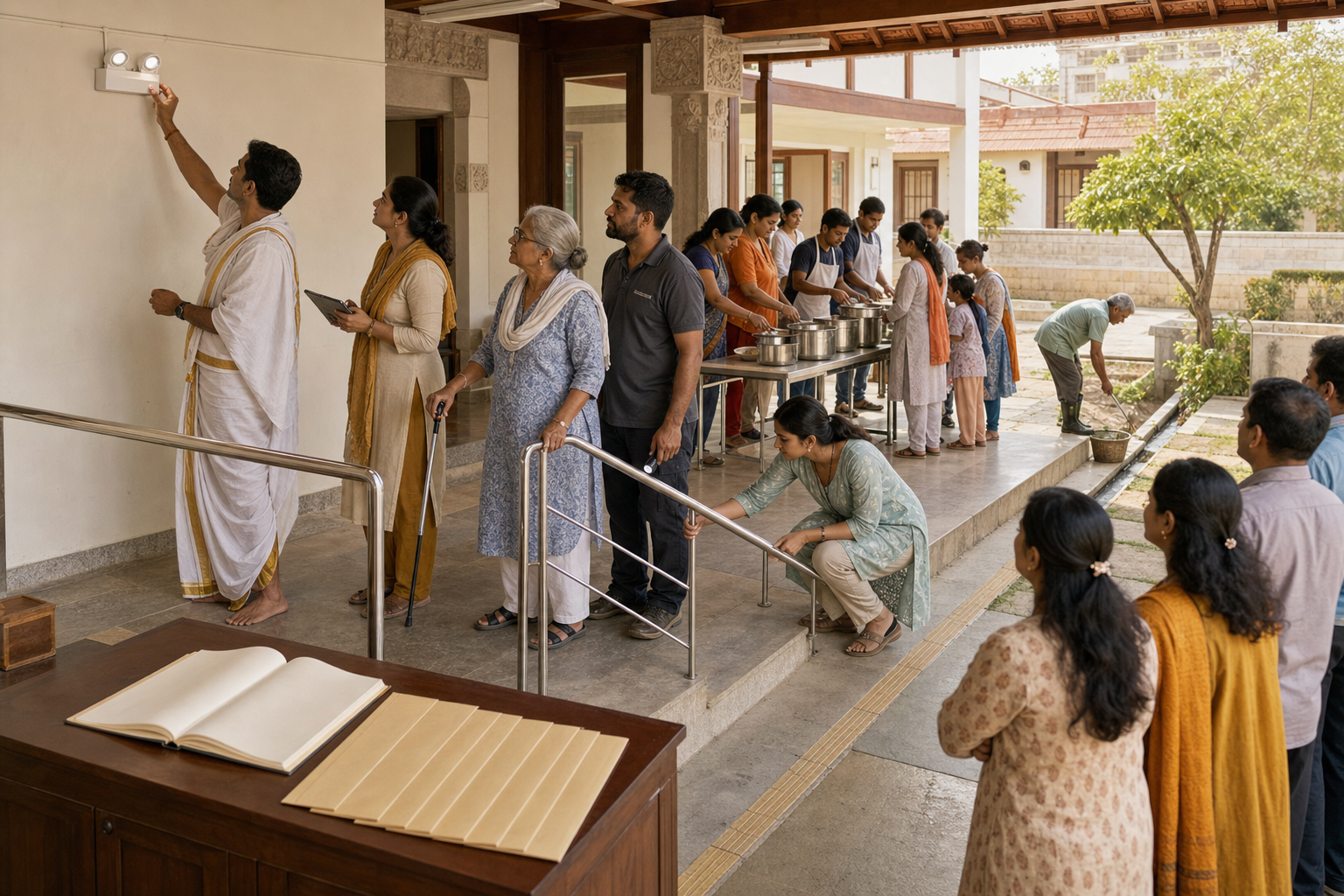
A federation will eventually face a decision that tests trust: a disputed vendor, an unclear donation, a safety failure, an inaccurate record or a complaint against an office-bearer. Governance must be ready before that moment. A concise governance pack should cover the following:
- A charter defining the powers and limits of trustees, federation committees, office-bearers and programme leads.
- A conflict-of-interest rule requiring disclosure and recusal where a decision-maker has a personal or financial connection.
- Separate, auditable procedures for temple donations, federation contributions, shared-programme spending and vendor selection.
- A grievance route that tells devotees, staff and volunteers where to report a concern and who must respond.
- Emergency plans, fire drills, electrical reviews, crowd-control preparation and coordination with local authorities.
- Cybersecurity responsibilities for accounts, backups, incident reporting and access removal when a role changes.
- A regular public update covering completed work, unresolved risks and the next corrective action.
Financial transparency should be understandable without insider knowledge. A shared purchase should show what was required, how the vendor was selected, who declared a conflict, who approved the expense and whether delivery was verified. Pooling funds before these responsibilities are clear creates both financial exposure and avoidable suspicion.
Reporting should remain small enough to maintain. Track measures that correspond to the federation’s actual work: visitor satisfaction, volunteer participation, conservation milestones, annadanam outreach, inclusion and environmental performance. Do not manufacture impressive targets merely to fill a dashboard. Record the starting condition, the action taken, the observed result and the correction that follows.
Devotees should be able to feel the result. Predictable darshan information, orderly queues, shade, drinking water and dependable sanitation are not cosmetic additions; they express hospitality and preserve dignity during pressure. Volunteers need role-based preparation in first aid, child safety, respectful communication, documentation, financial diligence, cybersecurity awareness and grievance handling.
Heritage needs the same operational seriousness. Cataloguing murtis, sculptures, paintings, textiles, inscriptions, oral histories and ritual sequences establishes what must be protected. Environmental observation, controlled lighting, pest management and material-appropriate cleaning reduce preventable damage. Apprenticeships in traditional crafts, music, dance and recitation keep living knowledge from becoming a database entry with no living practitioner.
A federated helpdesk and mentorship network can then carry these practices from one mandir to another. Shared procurement may reduce duplication for puja materials, lamps, conservation-grade supplies and routine maintenance, but price must not be the only criterion: ritual suitability, material quality, safety and local tradition still govern the choice. Women and young people should enter leadership and documentation pathways, not be treated only as extra labour during festivals. Local colleges and arts institutions can assist with research, cataloguing and event curation where the mandir authorizes their involvement.
Key takeaways
- A temple federation should coordinate shared capacity while each mandir retains its sampradaya, Agama, maryada and appropriate ritual authority.
- Put reserved, delegated and shared decisions into a written charter before transferring money, information or operational responsibility.
- Begin with a regional pilot that solves one recurring problem and produces a checklist, training module, registry template or helpdesk that another mandir can actually use.
- Classify registry information as public, operational or restricted before uploading it, and protect privileged access with basic digital controls.
- Judge the federation by safer operations, stronger seva, protected heritage and transparent stewardship, not by membership totals or ceremonial visibility.
Your next useful step is a working session involving representatives of worship, trusteeship, seva, facilities and finance. Put five items on one sheet: the local practices that cannot be delegated, the recurring problem to be solved, the accountable lead, the information that may be shared and the evidence that will show whether the pilot worked. That sheet can become the first page of a real federation charter.
Mandir unity becomes durable when every participating temple can say two things without hesitation: our sacred character remained intact, and our capacity to serve became stronger.
References
