
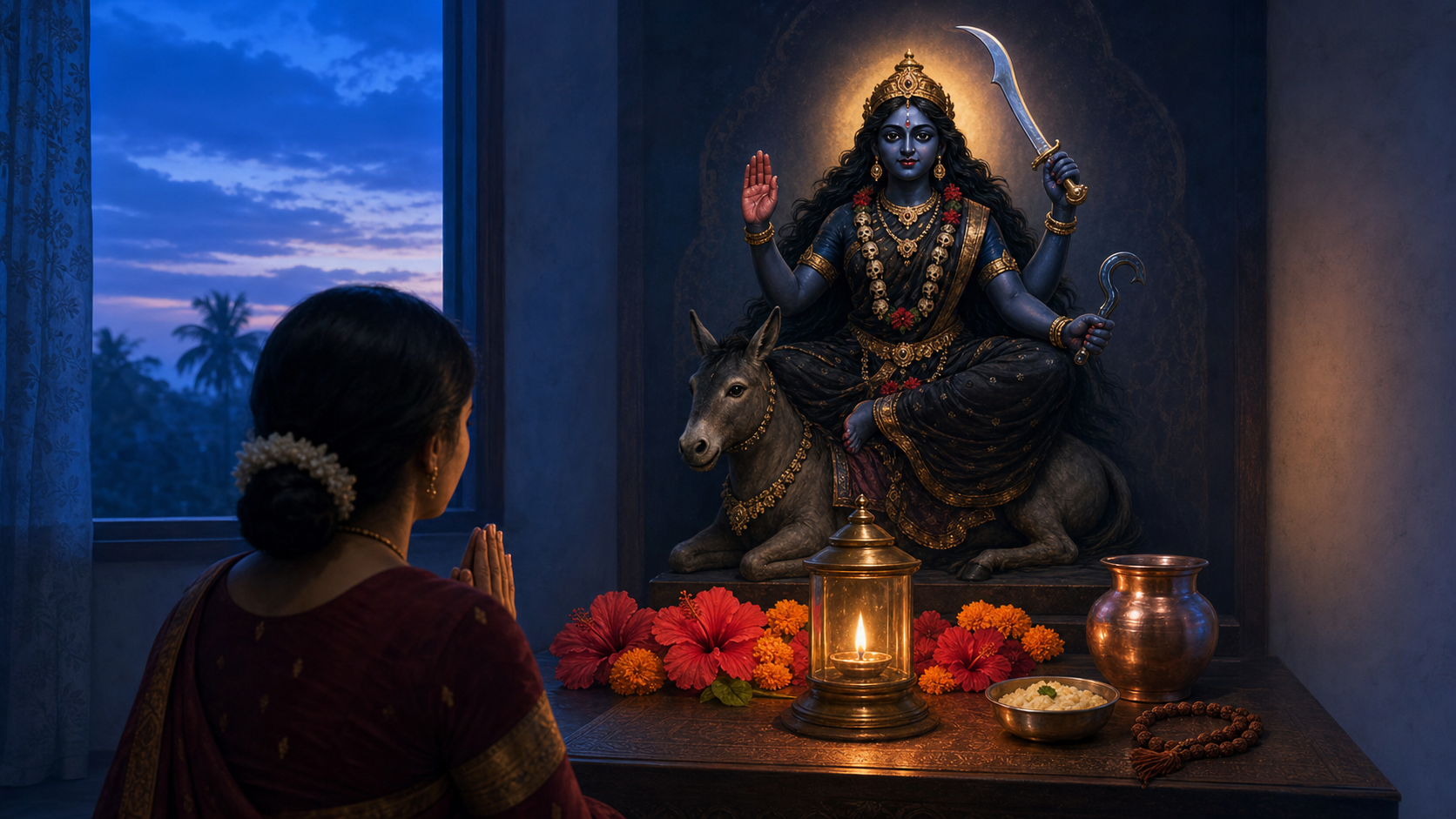
You may be planning a full Saptami vrat, fitting puja around work, or simply trying to avoid observing Navratri Day 7 on the wrong civil date. Settle the calendar first. In 2026, the working dates are Wednesday, March 25 for Chaitra Navratri and Saturday, October 17 for Sharad Navratri, subject to the panchang and temple tradition for your location.
Once the date is confirmed, you do not need an elaborate ritual to worship Maa Kalaratri sincerely. A clear sankalpa, a safe diya, measured mantra japa, an appropriate fast, and one concrete act of seva can make the observance coherent from morning to night.
Key takeaways
- Check a trusted local panchang before making plans. If Saptami spans two civil dates, many traditions observe it on the date when Saptami prevails at sunrise.
- Use March 25 for Chaitra Navratri Saptami and October 17 for Sharad Navratri Saptami as your starting dates, then confirm locally.
- A manageable home puja can consist of sankalpa, diya, water, flowers or fruit, Kalaratri dhyana, mantra japa, aarti, and a closing prayer.
- For the simple mantra “Om Devi Kalaratryai Namah,” choose 11, 54, or 108 repetitions according to your capacity. Steadiness matters more than a large count performed hurriedly.
- Fasting should support restraint and mental clarity. Hydration, fruit, or a light sattvik meal may be more responsible than a strenuous fast, especially when health conditions are involved.
- Complete the inward discipline with outward dharma through food donation, practical care, community service, or another useful act performed without display.
Confirm which Saptami your local tradition observes
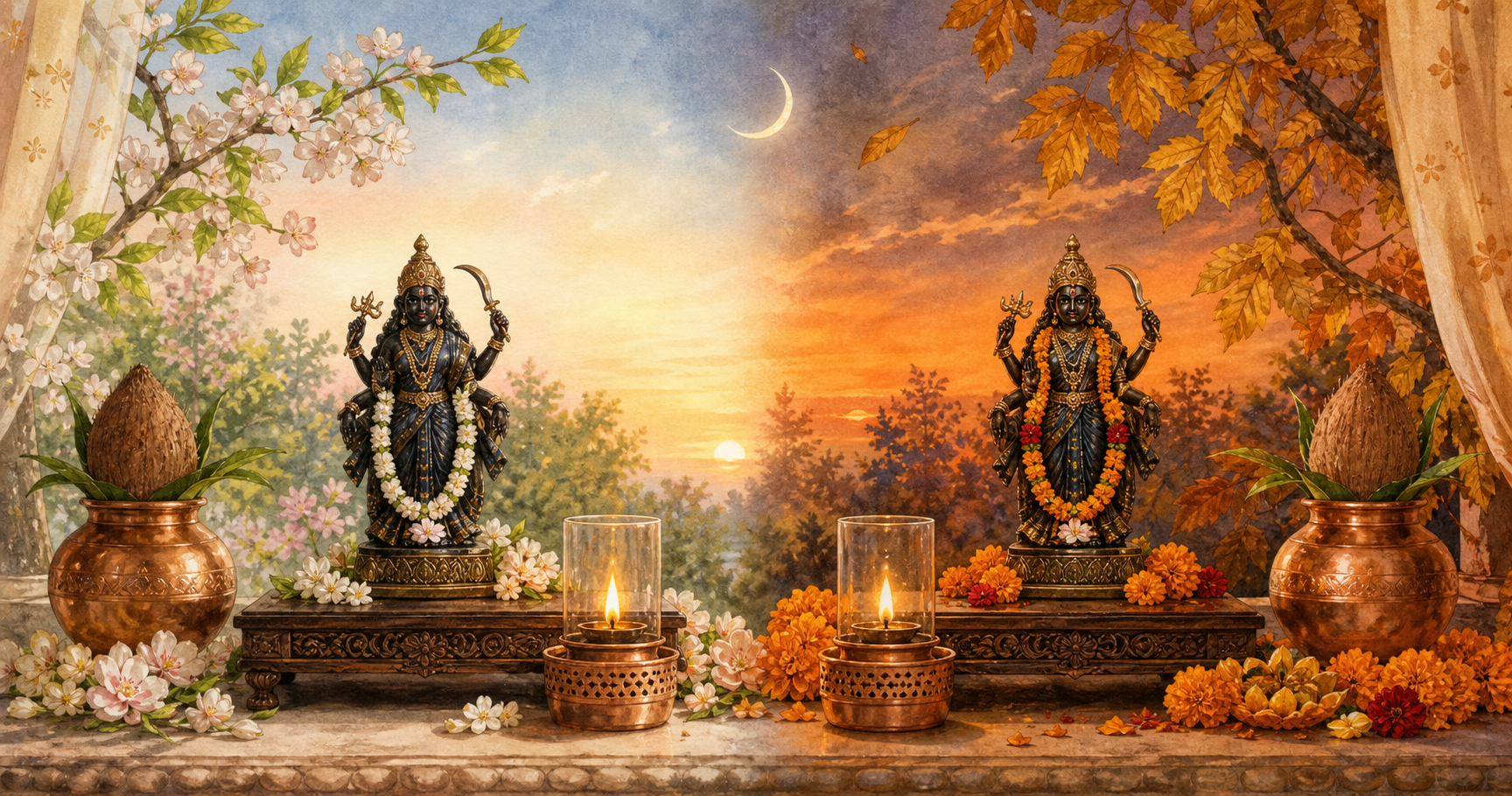
Kalaratri is worshipped on the seventh day of Navratri as Durga’s fearsome but protective form. She is also remembered as Shubankari, the one associated with auspicious well-being. Her dark and formidable iconography should not be mistaken for a celebration of fear. It represents the force that cuts through ignorance, inner obstruction, and adharma.
| Navratri | Working Saptami date in 2026 | What you should verify |
|---|---|---|
| Chaitra or Vasant Navratri | Wednesday, March 25, 2026 | Whether Shukla Paksha Saptami prevails at sunrise in your location |
| Sharad or Ashwin Navratri | Saturday, October 17, 2026 | Whether your local panchang or temple assigns Saptami to this civil date |
A tithi is not identical to a midnight-to-midnight calendar date. It may begin on one civil date and end on another. Many traditions use the tithi present at sunrise to assign the observance, while regional panchangs and established temple customs can differ.
Check a panchang configured for your city rather than relying only on a festival graphic circulating online. Note the stated start and end of Saptami and the tithi prevailing at sunrise. If your family worships with a particular temple or sampradaya, follow its announced schedule so that your home practice remains aligned with the community observance. When two calendars disagree, ask which location and sunrise convention each one uses; the disagreement may be calendrical rather than theological.
The two Saptamis do not require different forms of Kalaratri devotion. Sharad Navratri may provide more opportunities for Garba, Dandiya, group bhajans, and public aarti, while Chaitra Navratri may fit more naturally into a household schedule. Choose the setting available to you without treating a quieter observance as spiritually incomplete.
Build the home puja around a clear devotional core
Prepare the altar and state your sankalpa
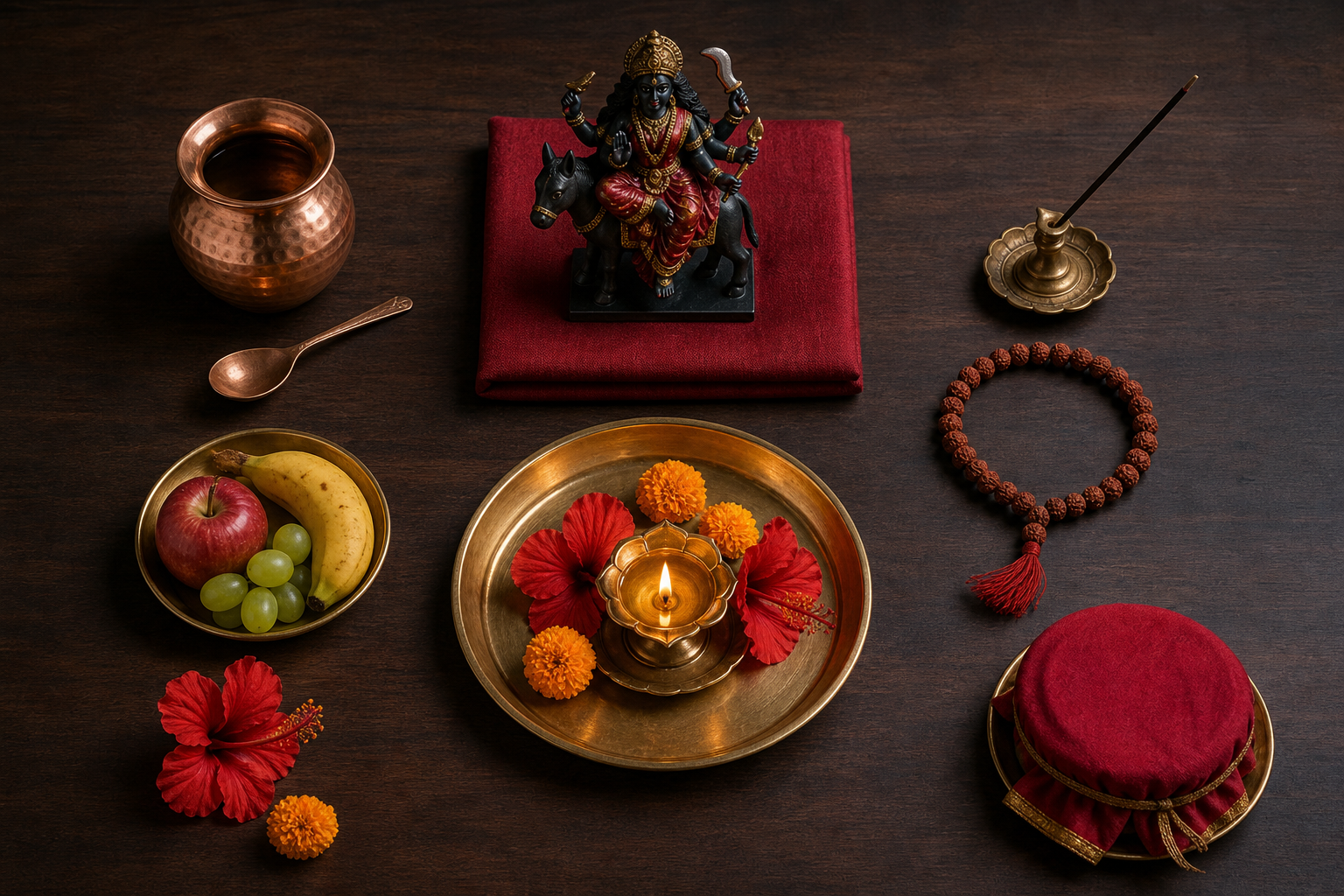
Begin after bathing and, if it belongs to your practice, achamana. Clean the worship space before adding decorations. Place an image or yantra of Kalaratri on a clean cloth. Grey is traditionally associated with this day as a sign of tamas being transformed into discernment, but it is a correspondence, not a condition for valid worship.
Light an earthen diya with ghee or sesame oil and place it on a stable, heat-resistant surface. Offer water, flowers, and akshata made from uncooked rice and turmeric. Seasonal fruit is enough for naivedya if you are not preparing a cooked offering. The altar should help you attend to Devi, not become a test of how many ritual objects you can assemble.
Make the sankalpa specific enough to guide the rest of the day. You might dedicate the observance to meeting fear without dishonesty, removing an obstacle without harming another person, gaining clarity in a difficult duty, or protecting the welfare of your family and wider community. Kalaratri’s fierceness becomes meaningful when it produces truthful and compassionate conduct.
Choose mantra and recitation according to your readiness
Sit steadily, let the breath settle, and bring Kalaratri’s form to mind before beginning japa. The accessible mantra “Om Devi Kalaratryai Namah” may be repeated 11, 54, or 108 times. Select the count you can complete attentively. A smaller vrata kept with steadiness is more honest than a larger count that turns prayer into a race.
You may also recite the “Ya Devi Sarvabhuteshu” verses. The Navarna mantra, “Om Aim Hreem Kleem Chamundayai Vichche,” is used in Devi worship, but practices surrounding it can be lineage-specific. If your sampradaya requires instruction, receive guidance rather than assembling an advanced procedure from disconnected fragments.
If Devi Mahatmyam or Durga Saptashati recitation is part of your observance, match the selection to your adhikara, meaning your preparation and ability to undertake it correctly. Devi Kavacham, Argala Stotram, Keelaka Stotram, and passages culminating in praise of Narayani are among the established choices named for the day. Learn nyasa and pronunciation from a reliable teacher where your mode of recitation calls for them. If you are not prepared for an extended reading, choose a shorter passage and give it undivided attention.
Close rather than merely stop
Offer the naivedya, perform aarti, and conclude with a Shanti Path or another peace invocation used in your home. A roli-kumkum tilak or a raksha-sutra may be included after prayer. Treat these as reminders of disciplined living, not as objects that excuse careless choices.
Kalaratri worship has a strong evening and night association. Some traditions favour Pradosh or Nishita, while Sandhya worship is a suitable household option. Do not guess a universal clock time for these periods; obtain the local timing from your panchang. Keep the room ventilated, avoid incense that causes sensitivity, and never leave a diya or havan flame unattended.
Use a morning-to-night schedule that you can actually keep
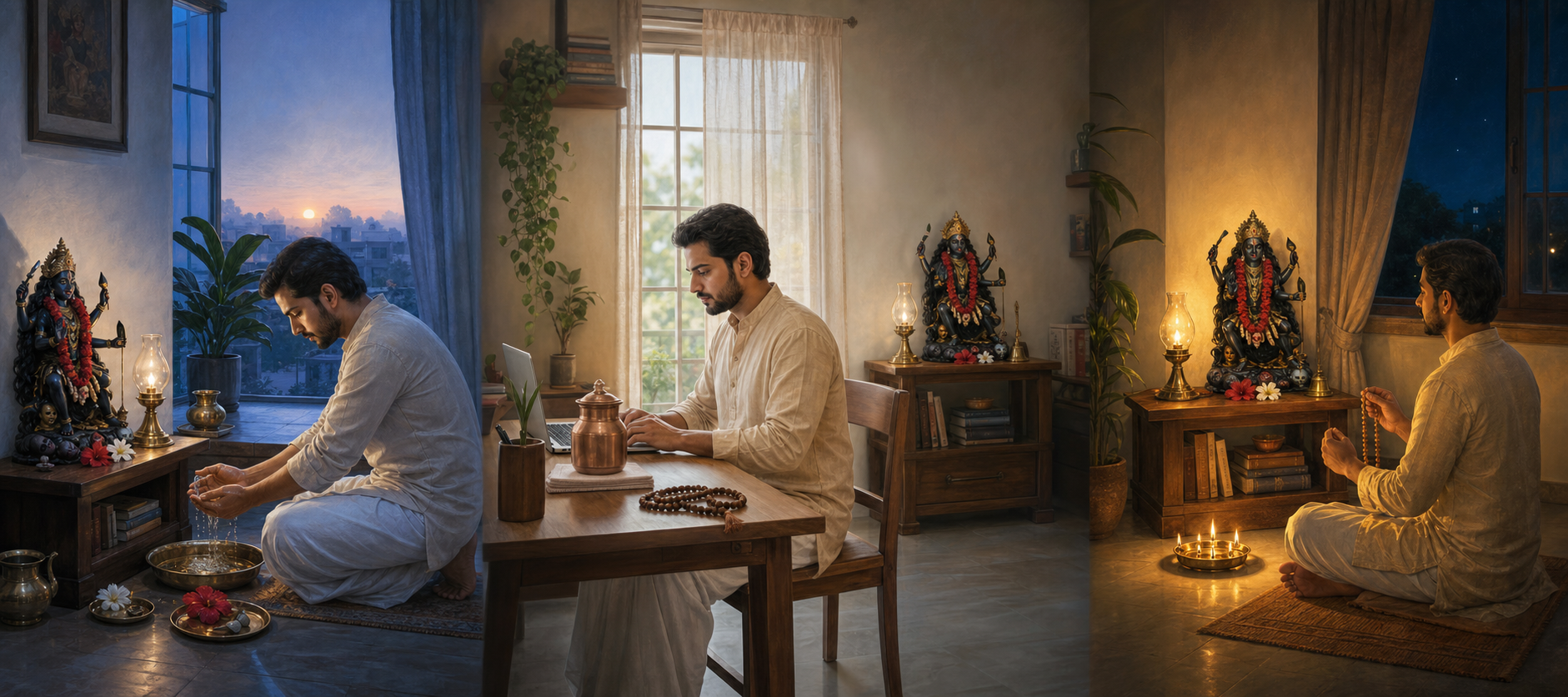
A working day does not prevent a serious observance. Separate the practices by purpose so that the day has continuity without requiring you to remain at the altar for hours.
- After sunrise, confirm the sankalpa, light the diya safely, make the basic offerings, and perform your chosen count of Kalaratri mantra japa.
- During the morning, carry the sankalpa into ordinary duties. Notice where fear, impatience, or avoidance begins to control speech and action.
- At midday, read a selected portion of Devi Mahatmyam or a familiar stotra. If an extended recitation is not realistic, do not begin one that you will have to abandon carelessly.
- During the afternoon, complete an act of daan or seva. Prepare the item in advance if you plan to donate food, grain, sesame, mustard oil, a blanket, or another practical essential.
- After sunset, undertake Sandhya, Pradosh, or the night worship followed by your tradition. Offer naivedya, perform aarti, and sit briefly in silence before closing.
- Before sleep, examine one fear, angry reaction, or unresolved grief that became visible during the day. Name the trigger, notice your habitual response, and decide on a less harmful action you can take when it returns.
If community worship is available, bhajans, quiet kirtan, satsang, and shared aarti can replace part of the solitary evening schedule. During Sharad Navratri, Garba or Dandiya may accompany the wider celebration. Participation should deepen collective spirit rather than become a reason to neglect the puja, the fast’s discipline, or consideration for neighbours and elders.
Let fasting, offerings, and seva express the same dharma
Fast for clarity, not for injury or display
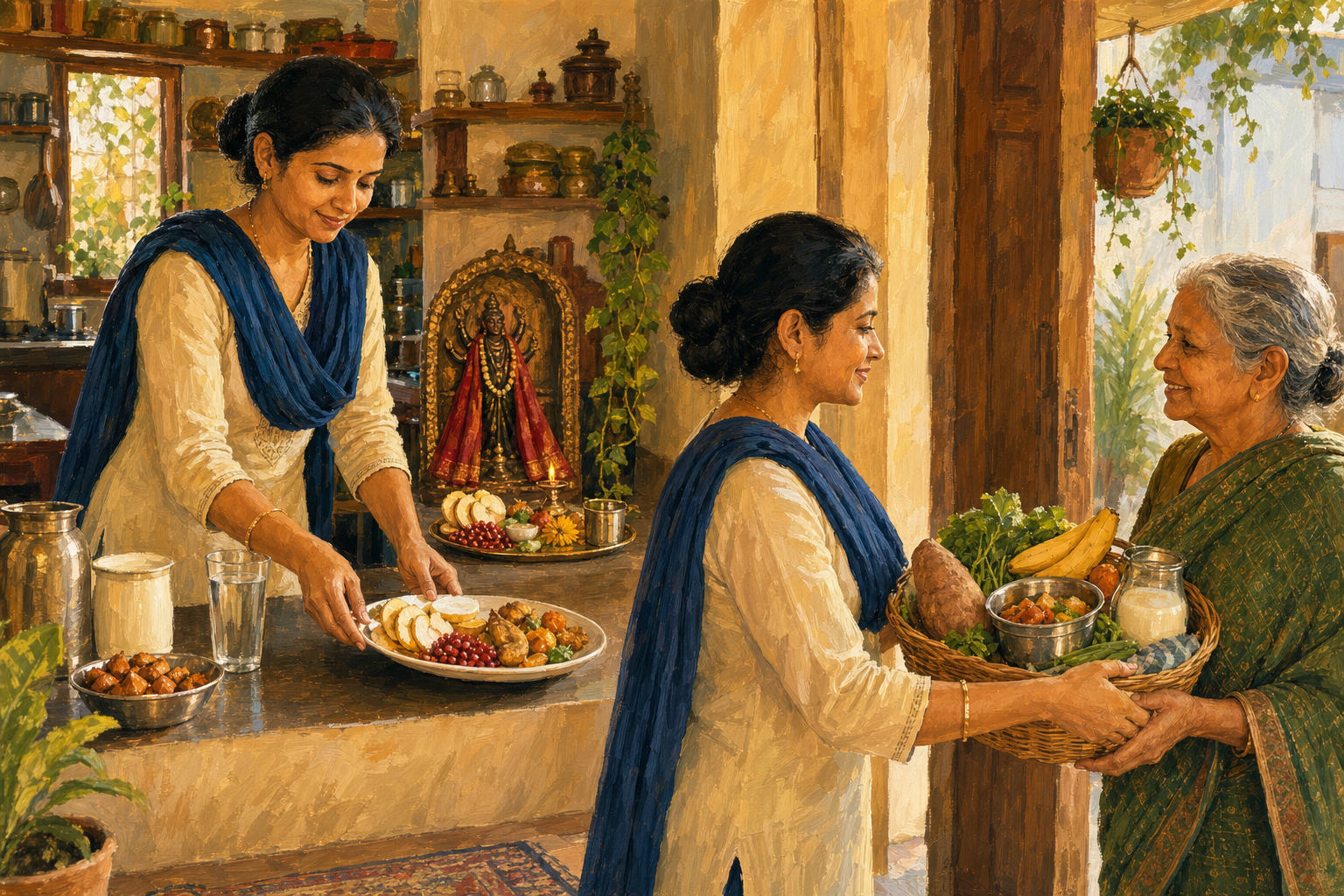
The purpose of the Saptami fast is restraint and mental clarity, not physical collapse. Hydration, fruit, or a light sattvik meal can be appropriate when a more restrictive fast is unsuitable. Anyone with a health condition should adapt the vrata responsibly rather than treating physical strain as proof of devotion.
If your household follows the customary vrat diet, avoid onion and garlic and keep the food simple. Jaggery preparations, sesame laddoos, milk-based kheer, and seasonal fruits are suitable household offerings. You do not need all of them. Choose what can be prepared cleanly, offered with attention, shared as prasad, and consumed without waste.
Move strength outward through daan and seva
Kalaratri’s power should leave another person safer, fed, warmer, or less burdened. Useful options include donating grain, black sesame, mustard oil, blankets, or simple meals; assisting a community kitchen; joining a neighbourhood clean-up; or carrying out an unadvertised act of care for someone nearby.
Some observances connect the day with remedial balancing of Saturn and Mars. If that correspondence belongs to your tradition, keep the remedy grounded in steadiness, truthful action, disciplined worship, and useful charity. Black sesame may be given as daan or, where you are trained and equipped to conduct a safe havan, offered in the fire. Fear-based claims should not displace ethical conduct, competent guidance, or ordinary fire safety.
Confront inner darkness without feeding it
Kalaratri’s symbolism gives you a practical question: what becomes powerful only because you refuse to look at it? Sit with gentle breath awareness and observe fear, anger, grief, or inertia without immediately justifying or suppressing it. Journaling can connect the insight to conduct: identify what activates the reaction, what the reaction makes you do, and which response would better embody truthfulness and ahiṁsā.
Maitri or loving-kindness contemplation can prevent this self-examination from becoming hostility toward yourself or someone else. Hindu reverence for Shakti remains the centre of Kalaratri Saptami, while the Buddhist discipline of mindful awareness, the Jain commitments to ahiṁsā and aparigraha, and the Sikh emphasis on seva and simran illuminate shared ethical directions. These resonances need not erase the distinct theology or practice of any path.
Kanya Puja is more commonly observed on Ashtami or Navami in many households, although some lineages perform it on Saptami. If it belongs to your family tradition, arrange it with dignity and consent. Offer simple sattvik prasad and gifts without turning children into decorative ritual objects; their comfort, safety, education, and well-being are part of the honour the rite is meant to express.
Keep the material side of the observance equally disciplined. Prefer an earthen diya, natural flowers, and reusable serving vessels. Minimise plastic, compost suitable organic offerings, control sound levels, and leave the worship area clean. Reverence for Devi should be visible in how you treat fire, food, shared space, and the people living around you.
On the evening before your locally confirmed Saptami, set out the altar cloth, lamp, offerings, text, and donation. Decide your japa count and the time of your evening prayer then, not in the middle of a crowded day. That small preparation leaves March 25 or October 17 free for the real work of Kalaratri worship: meeting darkness steadily and answering it with dharmic action.
References
