
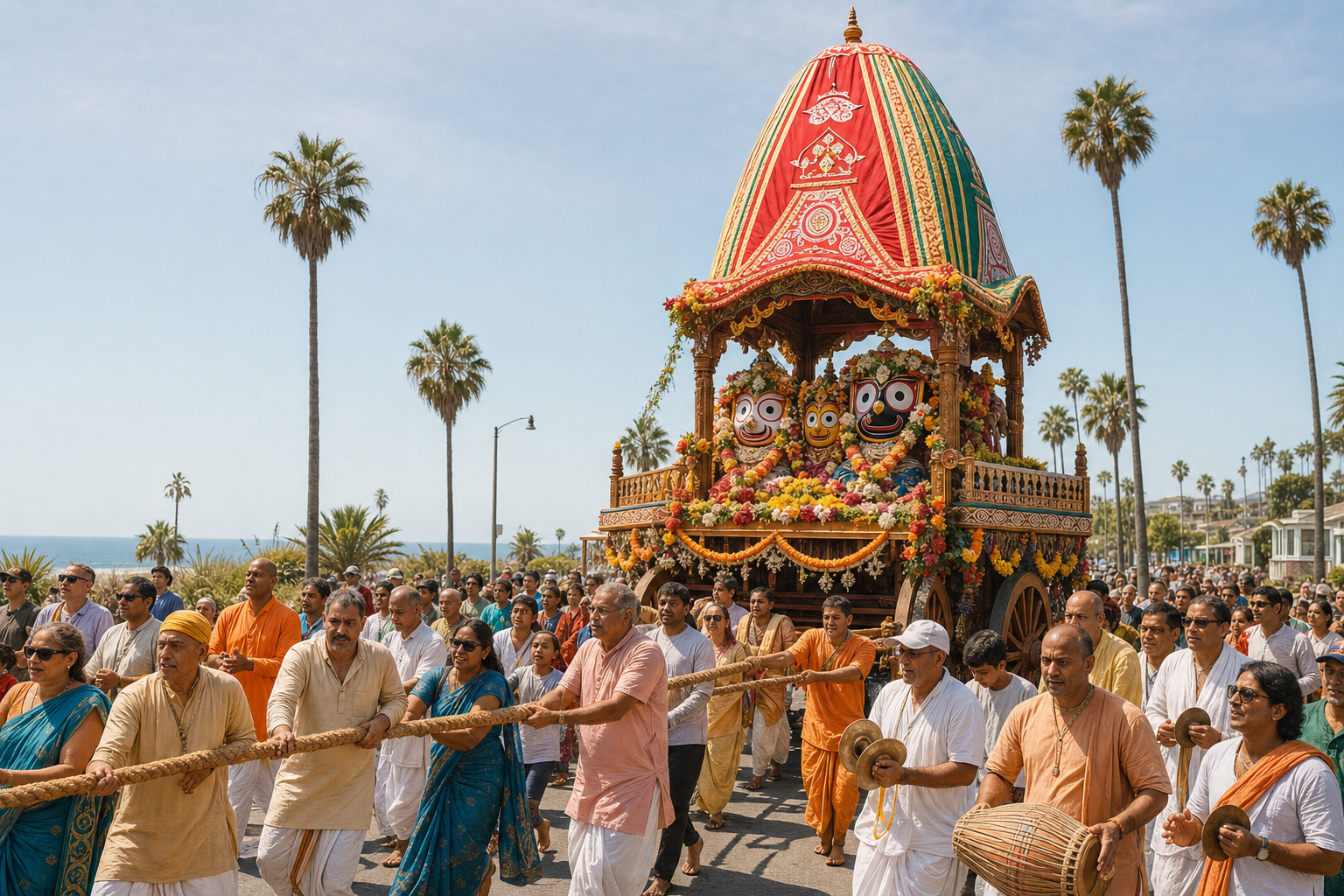
If the Los Angeles Rathayatra anniversary brought you here, you may be wondering what its fiftieth milestone actually asks us to celebrate. Longevity matters, but the deeper achievement is that a form of worship rooted in Bharat can still enter a modern American city as living practice rather than cultural decoration.
You don’t need insider knowledge to approach the festival well. You need to recognize the Deities at its center, understand what devotees are doing around them, and decide how you will move from watching to participating.
First, know what you are seeing
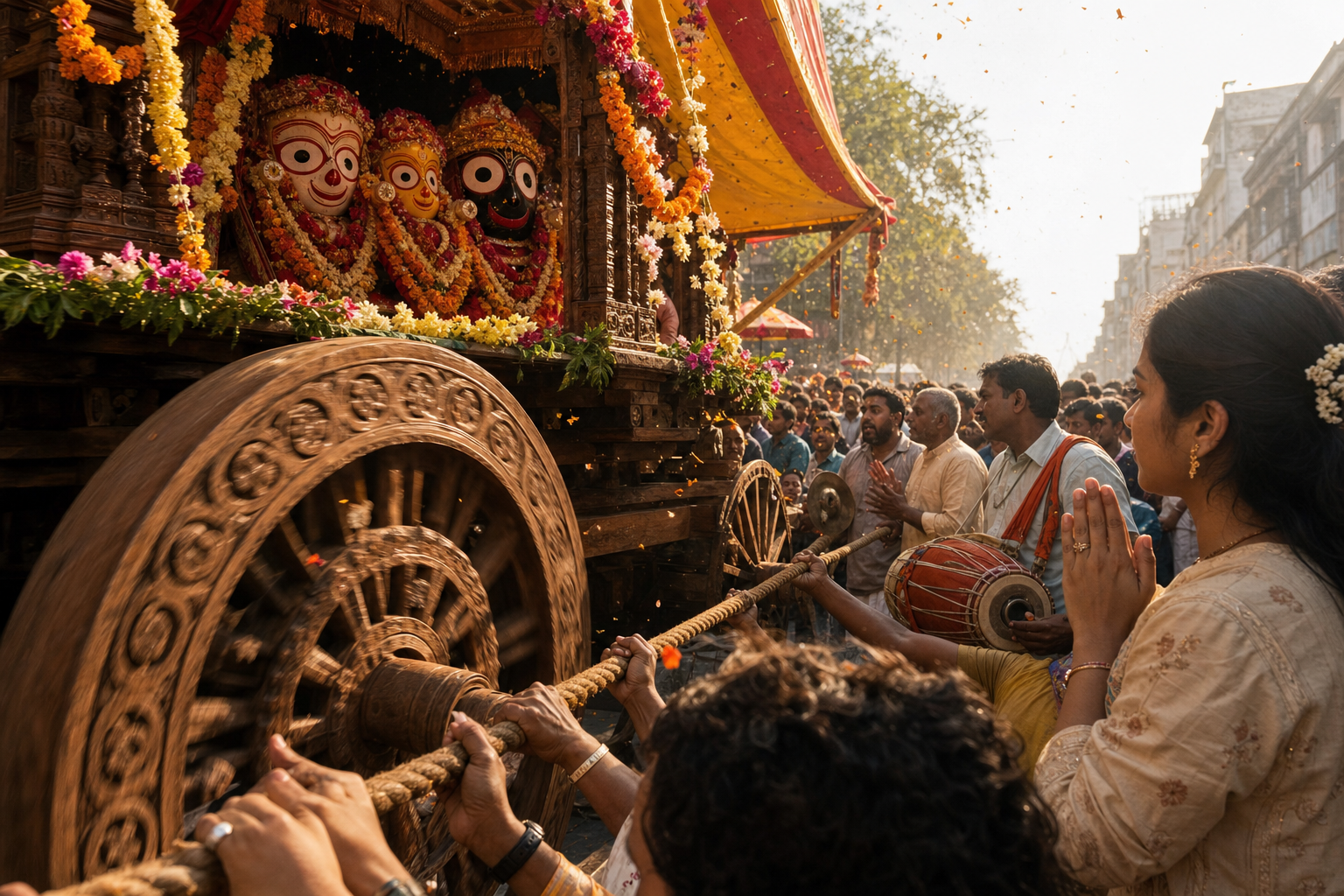
Rathayatra literally joins two ideas: ratha, a chariot, and yatra, a sacred journey or procession. Lord Jagannatha, accompanied by Baladeva and Subhadra, comes into public view on a chariot. In the Gaudiya Vaishnava tradition, Jagannatha is worshipped as Krishna in a distinctive and deeply beloved form.
That makes the chariot more than a parade float, the Deities more than visual symbols, and the chanting more than musical entertainment. The procession is worship moving through shared civic space. A person who would not ordinarily enter a temple can encounter the Deities, hear the divine names, meet devotees, and receive an invitation into spiritual life.
The Los Angeles fiftieth-anniversary Rathayatra belongs to ISKCON’s Gaudiya Vaishnava setting, the international movement established by A.C. Bhaktivedanta Swami Prabhupada. That context matters. This is not a generic celebration assembled from interchangeable Indian motifs. It is a particular act of Vaishnava devotion with its own theology, forms of service, and sacred vocabulary.
- Darshana is sacred seeing. Look toward the Deities with attention rather than treating them as scenery behind a photograph.
- Kirtana is congregational remembrance through chanting. Listen for the repeated divine names and join respectfully when you can follow the response.
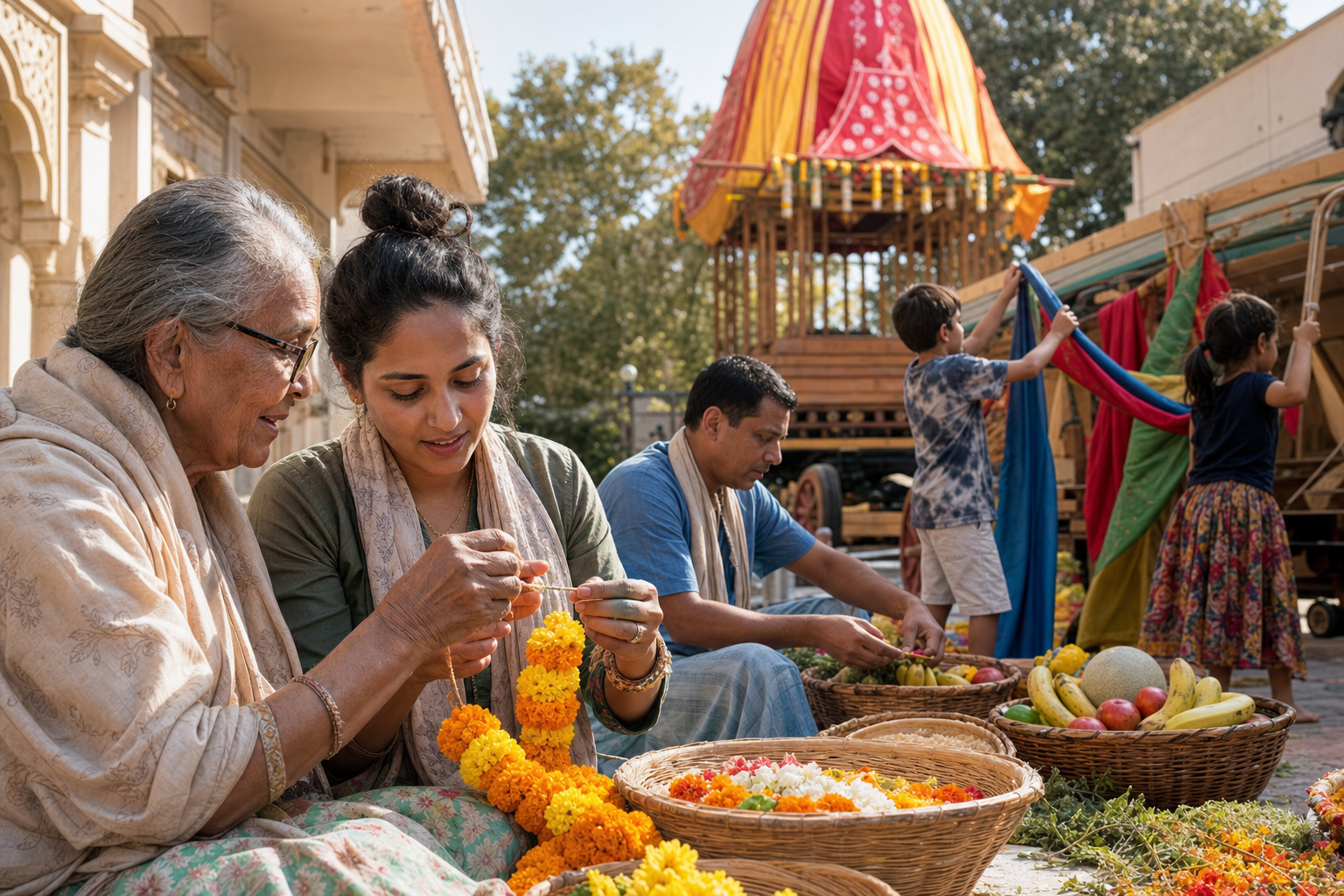
- Seva is service offered for the pleasure of the Divine. Pulling a permitted rope, guiding participants, preparing prasada, cleaning, singing, organizing, and documenting can all become seva when done under proper direction.
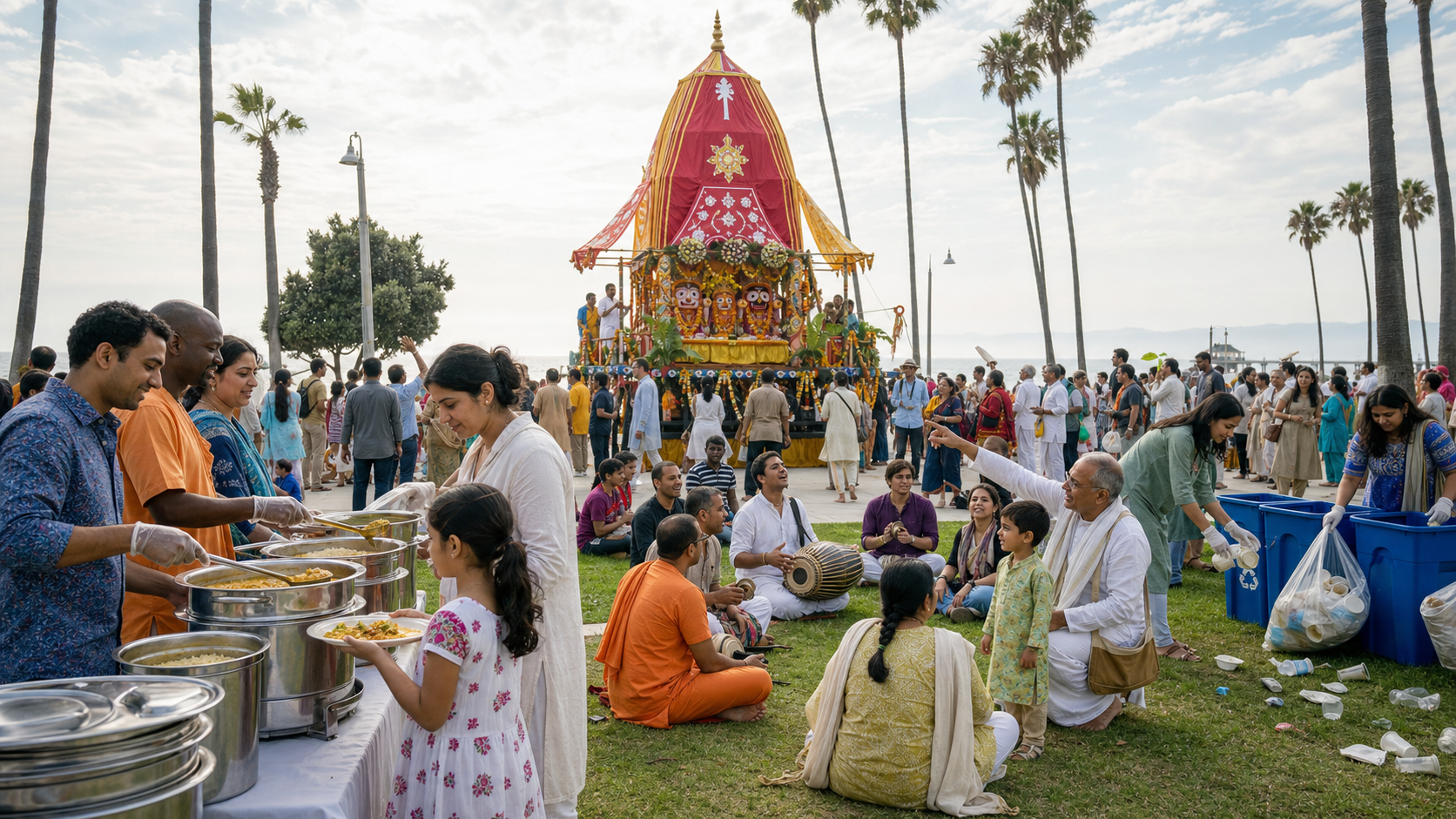
- Prasada is food offered to the Divine and then shared. If it is distributed, receive it as sanctified food rather than merely a complimentary meal.
These distinctions change the way you see the entire event. Instead of asking only whether the procession was large or visually impressive, ask whether it created darshana, supported kirtana, invited seva, and carried devotion into public life.
What fifty years does, and does not, establish
A fiftieth anniversary should not be inflated into a claim it cannot bear. The milestone alone does not prove that every annual celebration occurred without interruption, that the format never changed, or that every generation understood the festival in the same way. It identifies the present celebration with a history reaching back half a century. That is already significant.
The influence of Bharat abroad is sometimes discussed through monuments, commodities, celebrities, or borrowed vocabulary. Rathayatra gives you a more demanding measure: can a sacred practice be replanted while remaining recognizable as worship? Can families transmit not just an Indian identity, but the names of the Deities, the reason for the procession, the discipline of service, and the habits of devotion?
Los Angeles offers an important answer. A Bharatiya festival has taken public form in a city far from its geographic origin and has acquired its own intergenerational memory. That does not mean every spectator understands Vaishnava theology. It means the tradition has become visible, repeatable, and capable of gathering a community around sacred action.
Continuity depends on people whose names can easily disappear behind photographs of chariots and crowds. Kriya Shakti and Divyadristi Matajis appear by name in the anniversary presentation. Notice the significance of that simple fact: community history becomes more trustworthy when women, volunteers, teachers, singers, cooks, organizers, and other practitioners are remembered as people rather than compressed into an anonymous audience.
When you assess a jubilee, therefore, look beyond attendance and spectacle. Ask who learned a service, who taught it, whose contribution was preserved, and whether a newcomer was shown what to do next. Those are the signs that an anniversary is transmitting dharma rather than merely commemorating it.
Key takeaways
- Rathayatra is public worship centered on Lord Jagannatha, Baladeva, and Subhadra; it should not be reduced to an ethnic parade.
- The fiftieth anniversary marks a half-century horizon for Los Angeles devotees without, by itself, proving an unchanged or uninterrupted annual sequence.
- You can participate meaningfully through attentive darshana, responsive kirtana, directed seva, and respectful reception of prasada.
- The strongest evidence of continuity is transmission: sacred knowledge, practical responsibility, and community memory passing to another person.
- A useful anniversary leaves newcomers with a next step and preserves the names of the devotees who made the celebration possible.
How to take part without reducing worship to spectacle
Your role will differ depending on whether you encounter the anniversary in person or through a recording. In either case, the first discipline is the same: orient yourself toward the worship before reaching for commentary, photographs, or social media.
If you attend a Rathayatra in person
- Learn the three principal names before you arrive. Knowing Jagannatha, Baladeva, and Subhadra prevents the Deities from becoming unnamed images in your mind.
- Follow the direction of stewards and experienced devotees. Do not touch a chariot, rope, altar, or ceremonial object unless participants are invited to do so. Order around the procession protects both people and the dignity of the worship.
- Let the kirtana teach you its rhythm. Listen to the leader and respond with the congregation. If you do not know the words, attentive listening is more respectful than turning the chanting into background noise.
- Take photographs without obstructing darshana. Avoid stepping into the procession, blocking another person’s view, or occupying a service area for a better angle. First see the Deities; then decide whether a photograph will help you remember or explain the occasion.
- Receive hospitality in its devotional frame. If prasada is offered, accept it respectfully and follow local guidance about where to eat and dispose of plates or cups.
- Ask one useful question. Instead of asking only how large the event is, ask a devotee what service is being performed, how Rathayatra relates to Krishna bhakti, or how you can remain connected after the procession.
If you encounter the anniversary online
Online viewing can become passive very quickly. Give the presentation your full attention long enough to identify the Deities, hear the kirtana as prayer, and notice the forms of service surrounding the visible procession. The people guiding, singing, speaking, preparing, and caring for others are part of the sacred event even when the camera does not remain on them.
If you share a recording, add enough context to protect its meaning. Name Rathayatra, Lord Jagannatha, and the Los Angeles community. Describing it merely as a colorful Indian festival strips away the very thing that has endured: worship. A short, accurate explanation serves the tradition better than an enthusiastic but empty caption.
Make the jubilee serve the next generation
The practical question after a fiftieth anniversary is not whether the community can admire its past. It is whether someone now knows how to carry the tradition forward. Families, temples, and community organizers can test that outcome through a few concrete actions.
- Preserve names with roles. A caption should say who a person is and what service they performed, with appropriate consent. A name without context is fragile; an unidentified face is more fragile still.
- Record bounded memories. Ask a long-serving devotee who first taught them a particular service, what responsibility they initially received, or what newcomers commonly misunderstand about Rathayatra. Focused questions produce usable history.
- Give younger participants real responsibility. Observation has value, but transmission accelerates when someone is trusted to help with a defined task under an experienced guide.
- Explain sacred vocabulary in ordinary language. Terms such as darshana, kirtana, seva, and prasada should be retained, then explained. Translation should open the door to understanding without erasing the tradition’s own words.
- Create a next step after the procession. A temple visit, regular kirtana, scripture discussion, or supervised service opportunity allows interest awakened in public to mature within a devotional community.
- Keep women visible in the community’s memory. Naming Kriya Shakti and Divyadristi Matajis is a reminder to document contributions that are often essential even when they are not the most publicly visible.
You can begin with one action while the anniversary is still present in people’s minds: preserve a devotee’s memory, learn the meaning of the procession, volunteer under guidance, or bring a younger person into a real form of service. A jubilee becomes inheritance only when somebody receives what the previous generation carried.
References
