
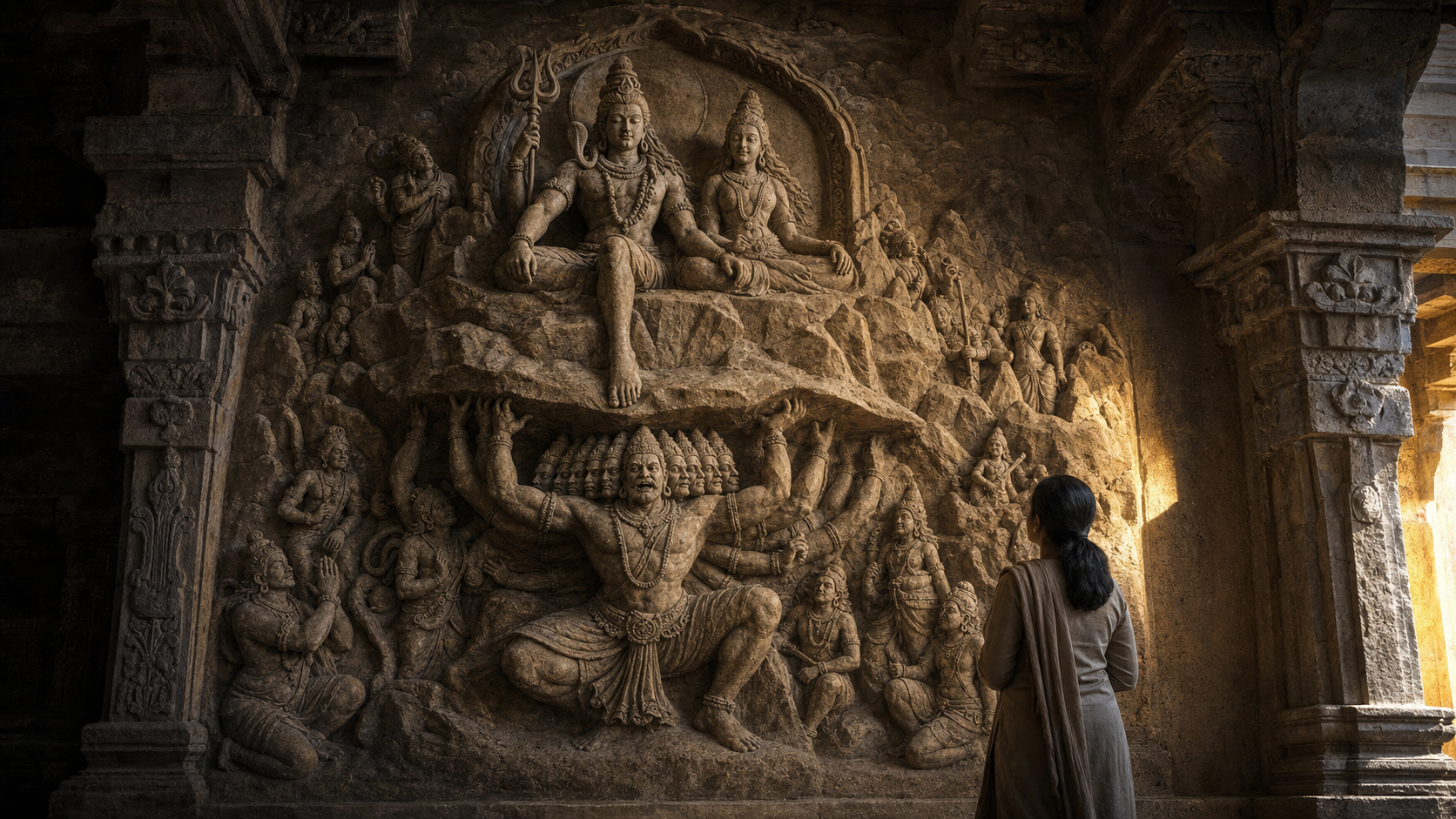
You are standing before a crowded temple relief. Shiva may look serene, fiercely active, or almost hidden within a mountain, family group, or contest. How do you tell whether the scene is about punishment, instruction, protection, or grace?
Do not begin by hunting for one identifying object. Find the person who needs Shiva, the crisis that person faces, and the divine action that changes the outcome. Once you learn that sequence, an anugrahamurti stops being an obscure sculpture and becomes a precise account of how grace meets fear, pride, devotion, responsibility, and power.
Grace is an action, not merely a gentle appearance
Anugraha is one of Shiva’s five divine acts: srishti, creation; sthiti, maintenance; samhāra, dissolution; tirobhāva, concealment; and anugraha, grace. An anugrahamurti gives visible form to that final act. Shiva protects, restores, recognizes devotion, corrects an imbalance, grants a boon, entrusts power, or opens the way toward moksha.
This gives you the first rule of identification: classify the scene by what Shiva does and what becomes possible afterward. A samharamurti foregrounds destructive action. An upadeshamurti foregrounds instruction. An anugrahamurti foregrounds a favourable divine turn. These modes can overlap within one image, so surface mood alone is unreliable.
Kalāntaka, for example, can show Shiva in forceful movement against Yama. Ravananugraha places an arrogant Rāvana under crushing restraint. Kirātārjuna begins with combat and testing. All three can look fierce, yet their narrative destination is grace: Mārkandeya receives protection, Rāvana is humbled and then favoured, and Arjuna becomes fit to receive a formidable weapon. The force is not incidental, but neither is it the last word.
Many grace-bearing forms nevertheless cultivate saumya and shānta qualities: gentleness, composure, and tranquillity. Look for abhaya-mudrā, the assurance of fearlessness, and varada-mudrā, the gesture of boon-bestowal. Relaxed seats such as sukhāsana or lalitāsana can reinforce the mood. The trishula, damaru, akshamālā, and deer help identify Shiva, but they do not by themselves tell you which story is present.
The Kāmikāgama, Suprabhedāgama, Kāranāgama, and Shilpashāstra traditions place this iconographic language within a disciplined religious framework. That matters during darshan. The hands, posture, companions, and spatial hierarchy are not decorative additions to a generic deity. They tell you what kind of relationship with the divine is being revealed.
Read the sculpture in six passes
A dense relief becomes easier to read when you resist the urge to identify it immediately. Move from the whole composition to the decisive detail.
- Establish the hierarchy. Locate Shiva before interpreting the smaller figures. Is he enthroned above a mountain, emerging beside a linga, standing over an adversary, receiving a river, appearing as a hunter, or seated with his family? Position and posture tell you what kind of encounter is underway.
- Find the recipient. Grace is directed. Look for the figure who strains below, clings to the linga, performs tapas, folds hands, receives an embrace, or stands near Shiva in an acknowledged place. If you cannot yet name the figure, describe the relationship you can see.
- Name the crisis. Ask what has gone wrong or what remains incomplete. The recurring problems are specific: arrogance, approaching death, untested ambition, overwhelming cosmic force, devoted service awaiting recognition, loyalty awaiting appointment, or devotion distorted by partiality.
- Locate the turning point. Shiva’s foot restrains, his presence interrupts death, his disguise tests character, his matted locks moderate a torrent, or his gesture confers favour. This is often the moment that distinguishes an anugrahamurti from a simple portrait.
- Read gestures and attributes as evidence. Abhaya confirms protection; varada confirms bestowal. Weapons, drum, rosary, deer, matted hair, and other attributes establish identity or capacity. Never let one attribute override the complete narrative.
- Read the witnesses. Umā, Ganesha, Kārttikeya, Nandi, and the ganas can enlarge the meaning from an individual blessing to familial protection, divine community, or cosmic order. A mountain, linga, forest setting, river figure, or child deity may settle an identification that the central figure alone cannot.
Finish by stating the transformation in one sentence: pride becomes surrender; fear of death becomes refuge; austerity becomes responsible empowerment; destructive force becomes life-giving flow; service becomes entrusted guardianship. If you can name that movement, you have understood more than the sculpture’s label.
When grace comes through restraint, refuge, or testing
Ravananugraha: power must first become humble
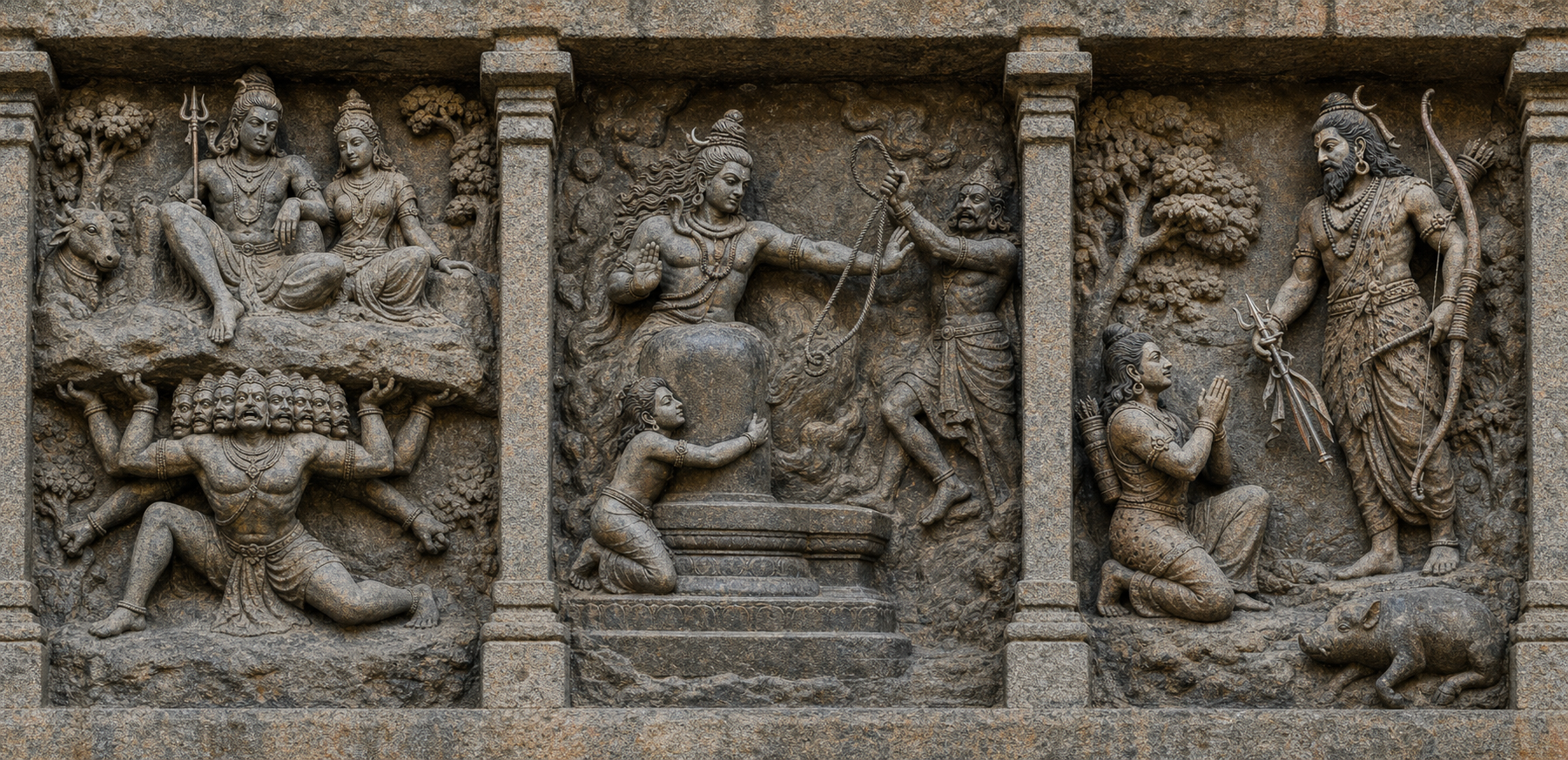
Look first for a vertical composition. Shiva and Pārvatī occupy Kailāsa above, often amid an inhabited mountain populated by ganas. Below them, the many-headed and many-armed Rāvana strains against the mountain. Some versions show him playing a veena fashioned from his own sinews. The unequal levels are the argument of the image: immense worldly power remains below divine sovereignty.
Rāvana attempts to uproot Kailāsa and is pinned when Shiva presses the mountain with his toe. His strength cannot solve the crisis that strength created. Recognition, praise, and surrender precede the granting of grace. The image therefore does not celebrate humiliation for its own sake. It distinguishes the destruction of ego from the destruction of the person.
This is the form to remember when your ability, authority, or learning tempts you to treat limits as insults. Ask a sharper question than whether Rāvana was powerful: what had to change before his power could exist within dharma? The answer is humility, not helplessness.
You may encounter major renderings of this episode at Elephanta, the Kailāsanātha Temple at Kanchipuram, and the Kailāsa complex at Ellora. The theme also appears in Khmer art at Angkor. Details and artistic emphases vary, but the basic relationship remains legible: Shiva is stable above while Rāvana’s self-assertion convulses below.
Kalāntaka and Mrityunjaya: devotion makes the linga a refuge
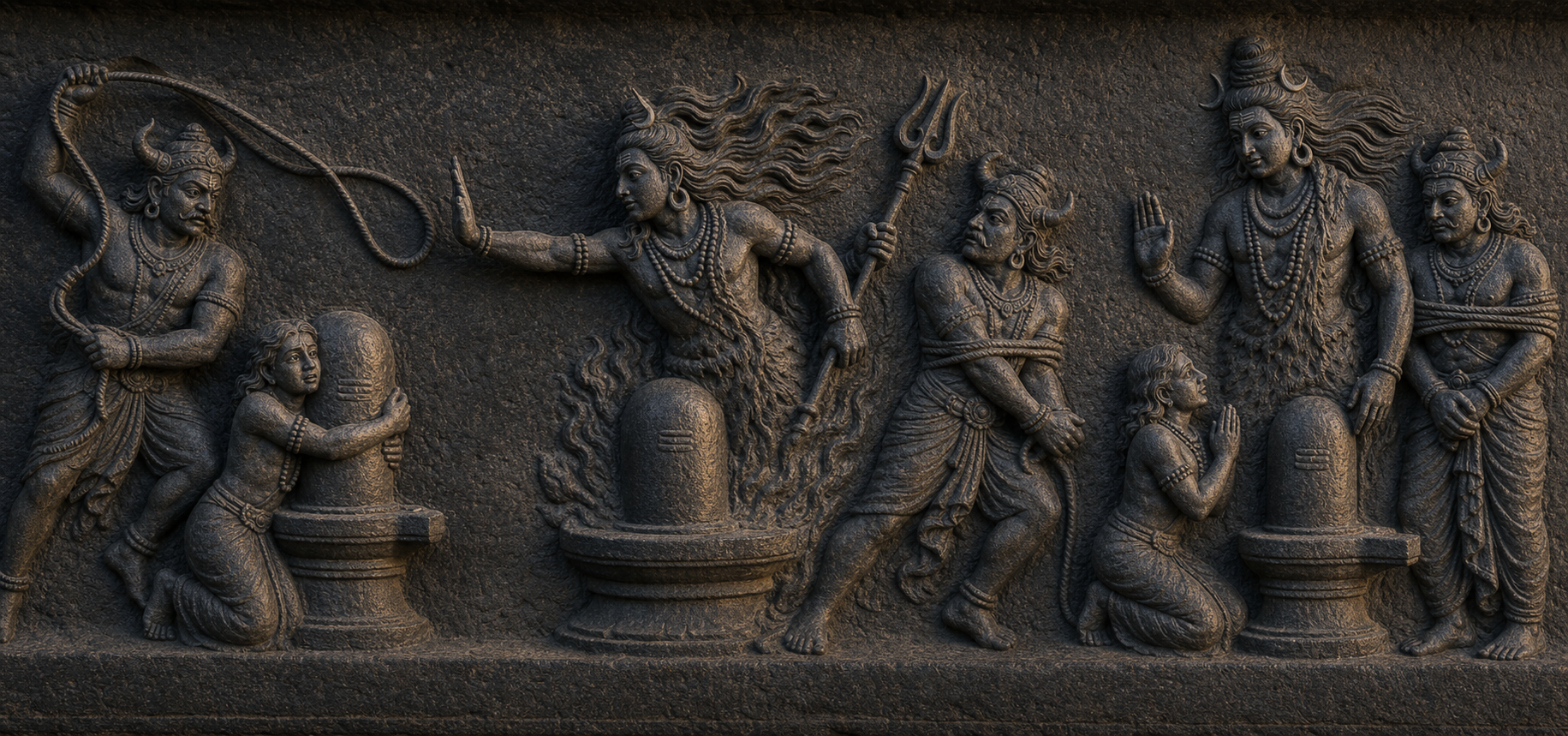
The indispensable figure here is Mārkandeya. When Yama comes to claim him at the end of his appointed span, the young devotee clings to the Shivalinga. Shiva intervenes, subduing or striking Yama and granting Mārkandeya renewed life and transcendence of ordinary mortality.
In a dynamic Kalāntaka image, Shiva may raise a leg to restrain Yama. In a more tranquil Mrityunjaya treatment, protective assurance can dominate the composition. Do not mistake the quieter version for a different theological purpose. Both turn the linga from an object located in the scene into the axis of refuge around which the crisis is resolved.
The reliefs at the Airāvateshvara Temple at Darasuram preserve this cycle, and the theme recurs across South Indian temples. When you identify it, avoid reducing its teaching to a bargain in which devotion guarantees exemption from physical death. Its deeper claim is that bhakti joins finite life to Shiva, so mortality and karmic destiny no longer define the devotee’s ultimate horizon.
Kirātārjuna: the gift is proportionate to tested character
Kirātārjuna can initially resemble a forest confrontation rather than an image of blessing. Shiva appears as a kirāta, a hunter, and tests Arjuna after the warrior’s austerities. The conflict exposes whether Arjuna possesses the humility and discipline required for the Pāshupatāstra. Only then does Shiva bestow the weapon.
The sequence matters more than the weapon. Tapas creates readiness, testing reveals character, and grace entrusts capability. The boon is not approval of ambition in the abstract. It is power placed under dharma after the recipient has been made answerable to it.
When reading a panel, look for the relation between the ascetic warrior and the hunter-divinity, followed by the act of bestowal. Versions occur at Ellora and in Hoysala temples. The monumental relief at Mamallapuram is often approached through the Kirātārjuna interpretation as well as the allied Descent of the Ganga interpretation. That ambiguity is a reason to inspect the entire composition and its setting, not to force certainty from one familiar figure.
For your own reflection, the practical question is immediate: are you asking for greater capacity without submitting to the discipline that should govern it? Kirātārjuna presents grace as trust, and trust brings responsibility.
When grace channels force, honours service, or creates belonging
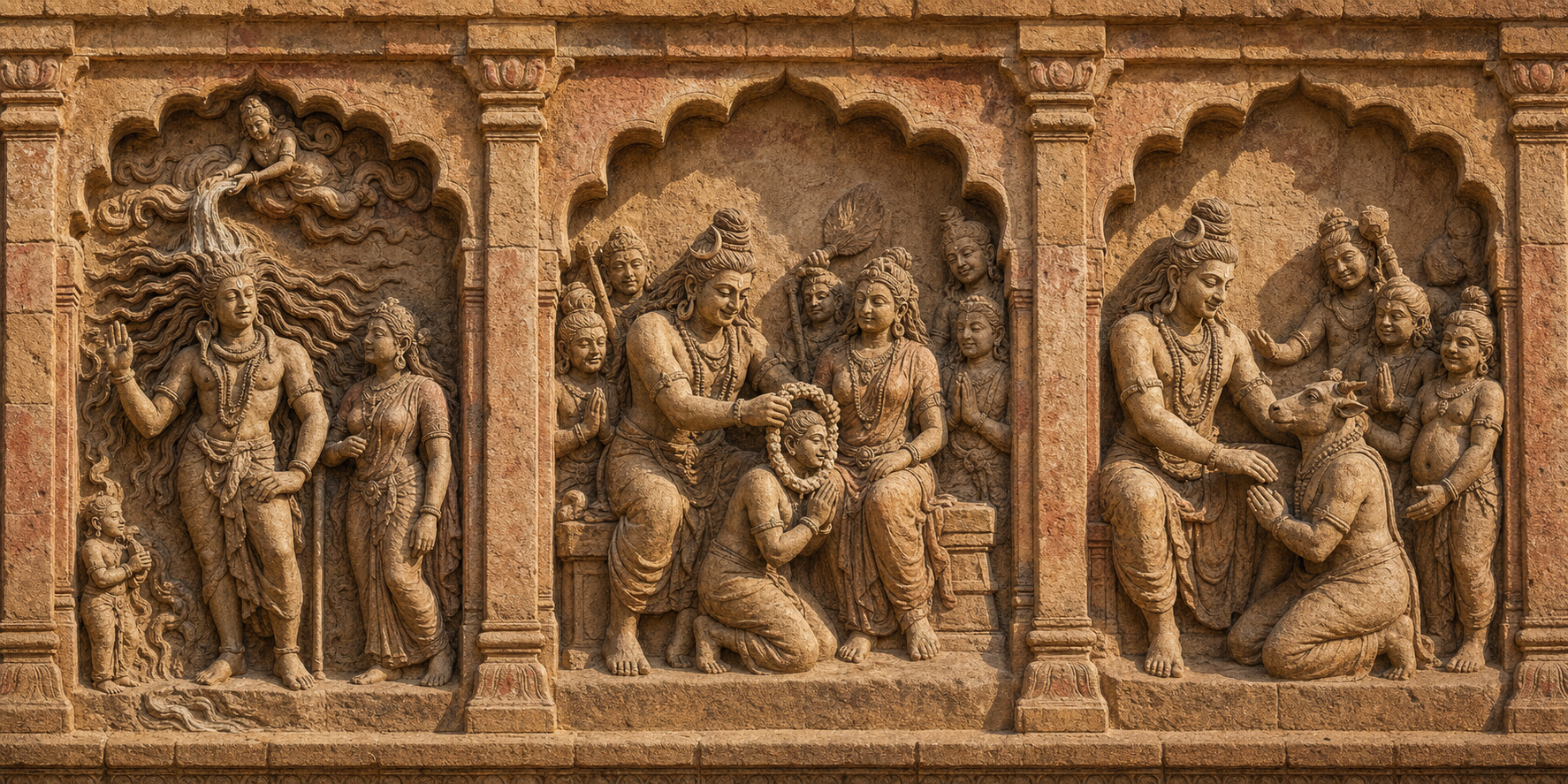
Gangādhara: compassion gives dangerous power a beneficial course
Gangādhara is identified by Ganga’s descent into Shiva’s matted locks. Bhagiratha’s austerities bring the celestial river toward the world, but an unmediated torrent would devastate the earth. Shiva receives and moderates the force so that descent becomes blessing rather than destruction.
Notice what Shiva’s grace does here. It neither rejects Ganga nor permits uncontrolled release. It contains, redirects, and makes fruitful. The lesson is especially useful whenever intensity is mistaken for effectiveness. Energy, knowledge, authority, and even righteous purpose can damage what they are meant to serve unless wisdom gives them a form the world can bear.
During darshan, let the matted locks hold your attention before the river’s final movement. They mark the difference between possession and stewardship. Shiva does not hoard the sacred current; he makes its life-giving descent possible.
Chandeshanugraha, Nandinugraha, and Bhringinugraha: grace reshapes the divine community
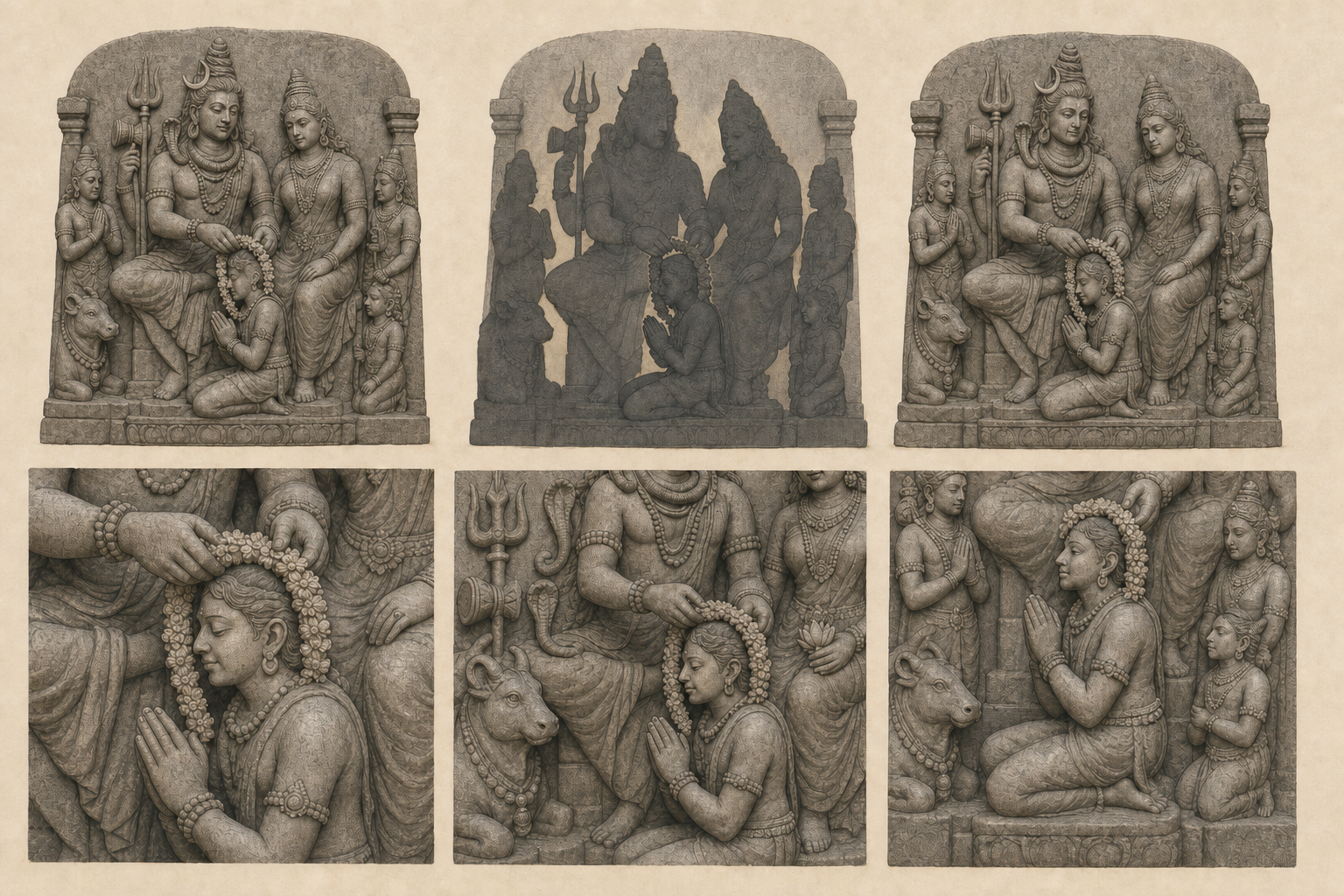
Chandeshanugraha brings the deity-devotee relationship into unusual intimacy. Chandesha, distinguished by unwavering service, appears with folded hands and receives Shiva’s embrace or boon. Shiva and Pārvatī may frame the act of acceptance. The devotee is not merely praised; he is elevated as guardian of temple wealth and ritual propriety.
South Indian processional bronzes can make this recognition especially direct. Look for proximity rather than spectacle: the shortened distance between Shiva and the devotee is itself part of the meaning. Seva has matured into entrusted responsibility. The proper response is therefore not to seek honour while neglecting service, but to perform the duty before you with the care of someone who may one day be trusted with more.
Nandinugraha develops the same principle through loyal service. Shiva appoints Nandi foremost among his ganas. Nandi’s steady orientation toward Shiva consequently models more than passive admiration; it joins bhakti to availability for service.
Bhringinugraha addresses a different need. Bhringi’s devotion is intense but imbalanced, and Shiva’s grace corrects rather than merely rewards it. This form helps you recognize that sincerity alone does not make every devotional attitude complete. Grace may affirm the devotee, expose partiality, and restore a fuller relationship at the same time.
Somāskanda and Kalyānasundara: grace appears as continuity and auspicious union
Somāskanda presents Shiva with Umā and the child Skanda. The composition gives grace a familial scale: divine companionship, protection, instruction, and the continuity of dharma across generations. The child is not a minor decorative figure. Skanda changes the image from a divine couple into a vision of transmitted life and responsibility.
The form became especially prominent in Pallava and Chola art. Somāskanda panels appear behind the main linga in many sancta, allowing the aniconic axis of worship and the visible divine family to interpret one another. If you see such a panel, do not treat it as background ornament. Its position enfolds the central worship of Shiva within household benevolence.
Kalyānasundara depicts the marriage of Shiva and Pārvatī. Its grace lies in auspicious union and cosmic welfare rather than rescue from an enemy. Temple festivals and bronzes bring this marriage into communal time, turning the joining of Shiva and Shakti into vows of protection, prosperity, and social stability.
These forms widen your understanding of grace. It is not always an emergency intervention for an isolated person. It can establish a household, sustain a lineage, unite complementary principles, and provide a sacred pattern for community.
Natarāja: do not overlook grace within the complete cosmic dance
Natarāja is more encompassing than the narrower narrative anugrahamurtis, yet grace is built into the dance. The damaru signals creation, fire signals dissolution, the planted foot gives stability, and the suppression of Apasmara overcomes ignorance. Amid that cosmic movement, the raised hand grants abhaya.
That open assurance prevents a common misreading. The dance is not a spectacle of destruction with a comforting gesture added afterward. Safety belongs within Shiva’s total activity. Creation, preservation, dissolution, concealment, and grace are held together, not divided among unrelated deities or moments.
Key takeaways for your next temple visit
- Identify the outcome before naming the mood. A fierce-looking Shiva can still be bestowing grace when force protects a devotee, humbles ego, or qualifies a recipient for responsibility.
- Find the recipient and the crisis. Rāvana below Kailāsa, Mārkandeya at the linga, Arjuna before the hunter, Ganga in the matted locks, or Chandesha near Shiva will usually tell you more than an isolated weapon or hand.
- Distinguish recognition from indulgence. Shiva’s grace may restrain arrogance, test readiness, correct partiality, or entrust duty. Compassion does not require the divine to approve the devotee’s present condition.
- Let gestures confirm the complete scene. Abhaya communicates fearlessness and varada communicates bestowal, but narrative, posture, setting, and accompanying figures determine the particular form of grace.
- Keep traditional meaning ahead of personal analogy. First identify the sacred narrative on its own terms. Only then ask how its movement from crisis to grace addresses your life.
At your next temple, choose one panel instead of trying to decode every image. Stand where you can see the whole composition. Name five things in order: recipient, crisis, Shiva’s intervention, gesture, and outcome. Then approach for darshan with one corresponding intention: humility before power, refuge amid fear, discipline before responsibility, restraint in handling force, or steadiness in seva.
That small practice changes the encounter. You are no longer looking at stone merely to recognize a myth. You are allowing the murti’s visual theology to ask whether you are ready to receive the kind of grace it reveals.
References
