
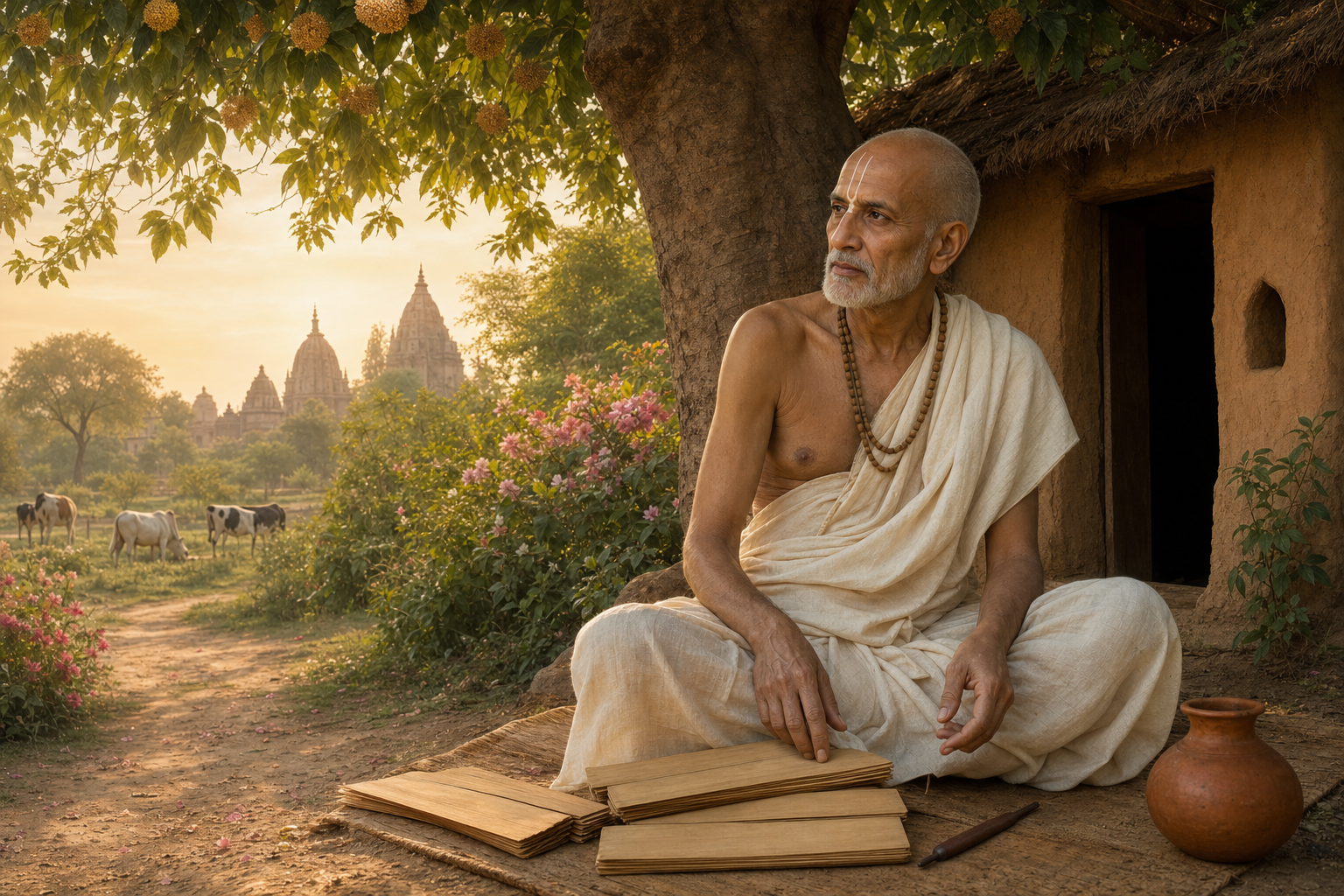
If you searched for Sanatana Goswami’s disappearance, the word may sound as though it points to an unresolved historical mystery. In Gaudiya Vaishnava usage, it means something different: a saint’s departure from visible earthly presence and the occasion on which devotees remember that departure.
That distinction lets you approach Sanatana Goswami with both faith and care. His life is richly remembered, his final place of bhajana and samadhi are identified, and his theological identity is preserved within the tradition. The exact circumstances of his departure, however, should not be embellished when the available information does not establish them.
What disappearance means in Sanatana Goswami’s case
The paired words appearance and disappearance frame a Vaishnava saint’s earthly life from a devotional standpoint. Disappearance does not, by itself, claim that the person’s body inexplicably vanished. It directs attention from the loss of visible association to the saint’s continuing presence through teachings, seva, sacred places and the lineage that carries the work forward.
Three kinds of statement should remain distinct. Biography tells you where Sanatana served and how he spent his final years. Gaudiya siddhanta explains his eternal identity and service. Historical restraint tells you not to invent a date, cause or dramatic mechanism that has not been established. Keeping these categories clear does not diminish devotion; it protects remembrance from avoidable exaggeration.
Sri Sanatana Goswami appeared in 1488 in a Sarasvata brahmana family in Bengal, five years before his brother Rupa. Sanatana, Rupa and Anupama were remembered as absorbed in bhava-bhakti from childhood. Their play already turned toward Vraja: they gave local forests names such as Talavana, Madhuvana, Kamyavana and Mahavana, and called favourite bathing ponds Radha-kunda and Shyama-kunda.
This childhood detail matters because it anticipates the direction of Sanatana’s entire life. Vraja was not merely a destination he encountered in adulthood. Its sacred geography had already shaped his imagination, and his mature service would help recover, organise and transmit that geography for others.
The four-part mission that shaped his work in Vraja
Sri Chaitanya Mahaprabhu gave Rupa and Sanatana a mission in Vrindavana with four concrete forms of service:
- Recover the places associated with Sri Krishna’s pastimes.
- Install Deities and arrange their puja.
- Compile scriptures devoted to bhakti.
- Teach and propagate the rules of devotional life.
Read these four tasks as one integrated programme. Sacred places require more than memory; they must be identified and cared for. Deity worship requires stable arrangements rather than occasional emotion. A tradition needs texts that preserve its reasoning and practice. Those texts must then become lived discipline within a community.
This gives you a useful way to assess Sanatana’s legacy. Do not reduce him to a writer, an ascetic, a pilgrim or an organiser. His importance lies partly in holding all four forms of service together: place, worship, scripture and practice. Removing any one of them leaves the work incomplete.
Forty-three years of scholarship rooted in village life
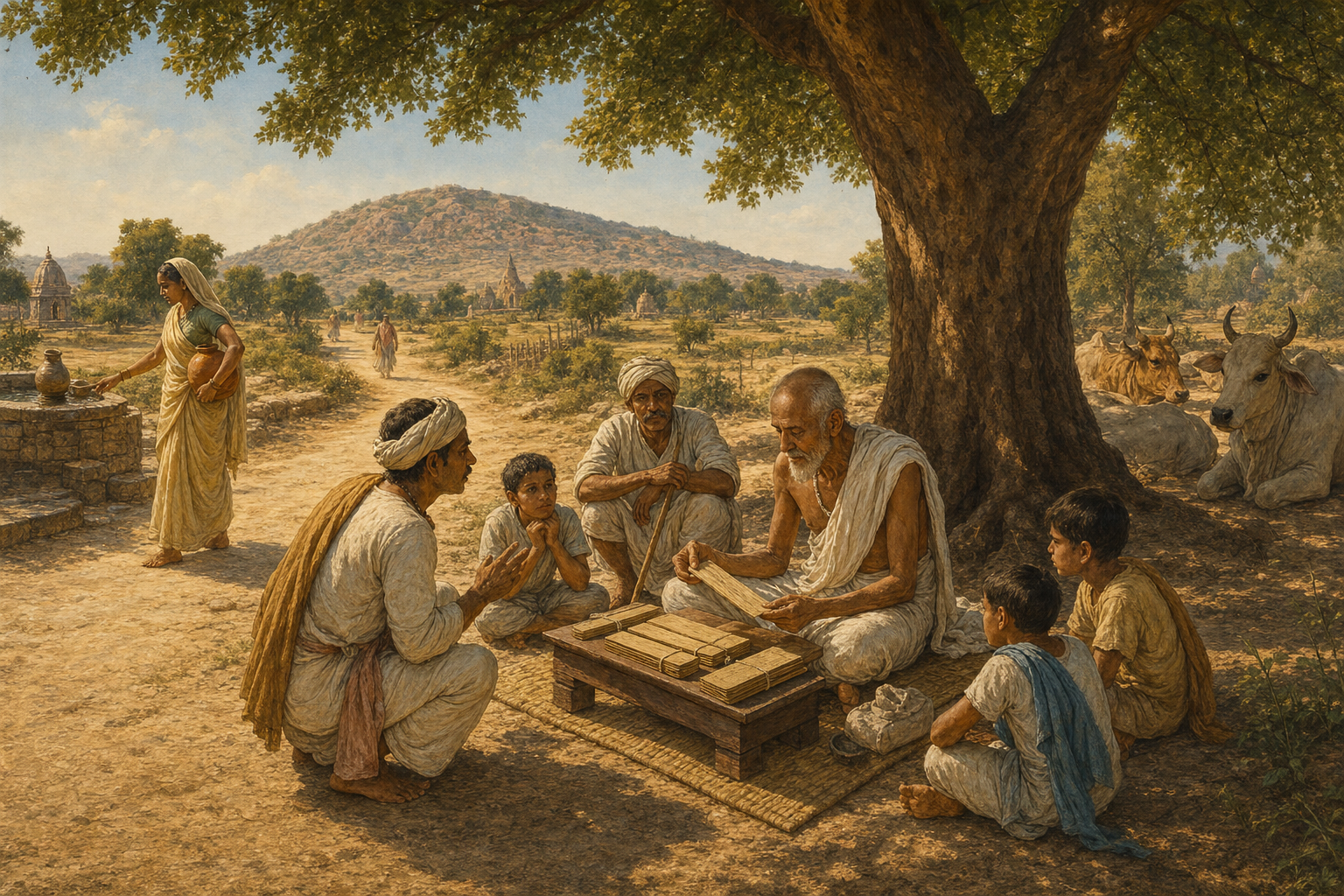
Sanatana spent forty-three years moving from village to village in Vrindavana. The Vrajavasis cared for him with the affection given to a father. He listened patiently to their difficulties and offered practical counsel, including help with improving crop yields and resolving family quarrels.
That aspect of his life corrects a common misreading of renunciation. Withdrawal from personal possession did not make him indifferent to householders, agriculture or conflict within families. His learning remained answerable to the actual people of Vraja. He heard their problems before giving advice, and spiritual authority took the form of dependable service.
If you want to imitate something attainable in Sanatana’s example, begin there. Listen long enough to understand the practical problem. Do not dismiss ordinary work as spiritually beneath you. A concern about a field, a household disagreement or a community arrangement may be precisely where patience and dharmic judgement are required.
His major literary contribution to the Gaudiya sampradaya includes Hari-bhakti-vilasa, Brhad-Bhagavatamrta and Brhad-Vaishnava-toshani. Naming these works matters. Vague praise for Sanatana as a great scholar is less useful than recognising the texts through which his thought entered the tradition.
Bhaktivinoda Thakura, writing in Jaiva Dharma, identified Sanatana’s distinctive authority with explaining the inner dimensions of Sri Krishna’s manifest and unmanifest Vraja-lila. His village counsel and theological writing therefore belong to the same life. One served the immediate needs of Vraja’s residents; the other clarified Vraja’s devotional meaning for generations of practitioners.
His final years, samadhi and the limits of the record
In his later years, Sanatana entrusted his Deity of Madana Mohana to his disciple Krishna Dasa brahmachari. This was more than a personal farewell. It ensured continuity of worship by placing responsibility in another person’s hands.
He then performed bhajana on the bank of Manasi Ganga beside Chakaleshvara Mahadeva at Govardhana. At the age of sixty-five, he maintained an extraordinary daily vrata: the older, longer Govardhana parikrama of twenty-four miles, together with 1,008 obeisances offered to Govardhana Hill and to the Vaishnavas he encountered.
These numbers reveal the severity and constancy of his personal vow; they do not establish a universal physical requirement for every devotee. The meaningful question is not whether you can reproduce his mileage or count. It is whether your own practice has a sustainable vow, a sacred centre and humility toward the people you meet. Admiration becomes useful when it produces steadiness rather than competitive imitation.
No exact date, eyewitness narrative, medical cause or physical manner of Sanatana’s departure is supplied by the biographical information cited here. A careful telling should stop at that boundary instead of filling the space with a dramatic story. What can be stated is that his samadhi stands behind the Radha Madana Mohana Temple.
Within Gaudiya theological remembrance, Sanatana Goswami is identified as Labanga Manjari, serving Srimati Visakha-sakhi in Radha-Madhava’s eternal nikunja-lila. This is a siddhantic statement about his eternal devotional identity, not a forensic description of how his earthly life ended. You can receive it within its proper theological category without turning it into an unsupported historical mechanism.
Key takeaways for remembering Sanatana Goswami
- When explaining his disappearance, define the Vaishnava meaning first. It denotes departure from manifest presence, not an unexplained vanishing.
- Organise your understanding of his life around Chaitanya Mahaprabhu’s fourfold commission: sacred places, Deity worship, bhakti literature and devotional discipline.
- Remember that his scholarship remained close to the Vrajavasis. Listening to family and agricultural problems was part of his service, not a distraction from it.
- Study at least one of his works by name rather than stopping at general admiration: Hari-bhakti-vilasa, Brhad-Bhagavatamrta or Brhad-Vaishnava-toshani.
- Treat his demanding parikrama and obeisances as testimony to his vrata, not as a contest or a compulsory benchmark.
- Keep biography, theological identity and unanswered historical questions distinct. Reverence does not require invented precision.
For a practical observance, choose one action that corresponds to Sanatana’s actual mission. Read a defined portion of one named work. Help sustain responsible Deity worship. Learn and transmit the identity of a Vraja sacred place accurately. Or give patient attention to a concrete difficulty in your community before offering counsel. Any of these moves remembrance from sentiment into seva.
If you visit Govardhana or his samadhi, go with the same discipline: verify local access and timings, do not treat an older twenty-four-mile route as an unqualified modern itinerary, and let the pilgrimage deepen practice rather than merely produce a completed checklist. Sanatana Goswami’s disappearance is best honoured by continuing the work his visible life placed before us.

References
