
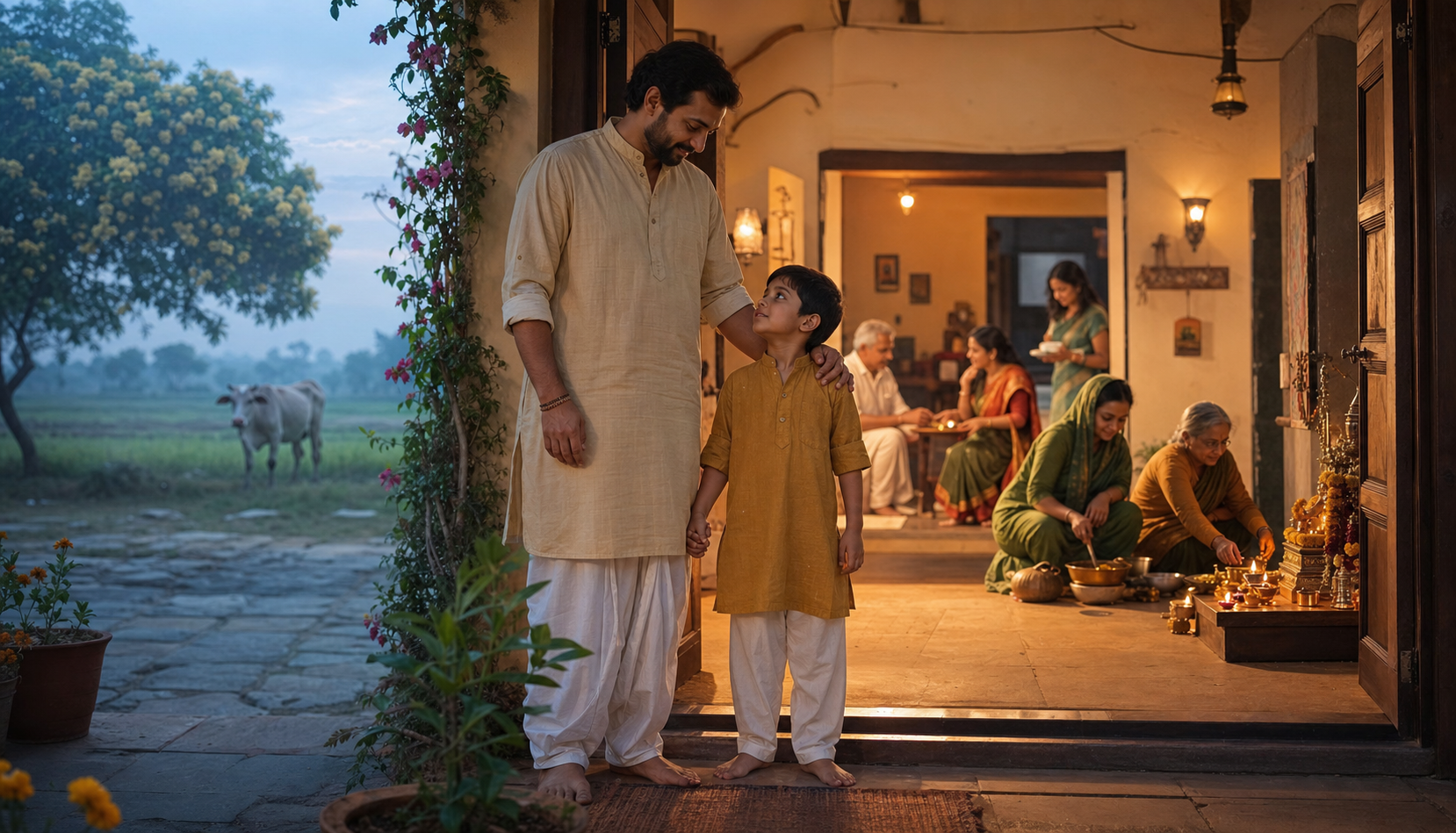
If you are raising a child you did not beget—or deciding whether to accept that responsibility—you may be carrying a question deeper than the practical ones: will this bond be regarded as fully real within dharmic life? Nandagopa gives a clear answer. He is remembered not as a temporary substitute standing in Vasudeva’s shadow, but as the father whose protection, cultivation, ritual participation and delight gave Krishna a home.
That answer must be used carefully. Nandagopa is a moral and spiritual archetype, not a modern adoption case. His life can show you what fatherhood requires, but it cannot determine custody, inheritance or the terms of a foster placement. The useful path is to hold both truths together: dharma can validate kinship beyond blood, while a present-day family must still secure the child’s rights under the law that applies to it.
Nandagopa is not a lesser or provisional father
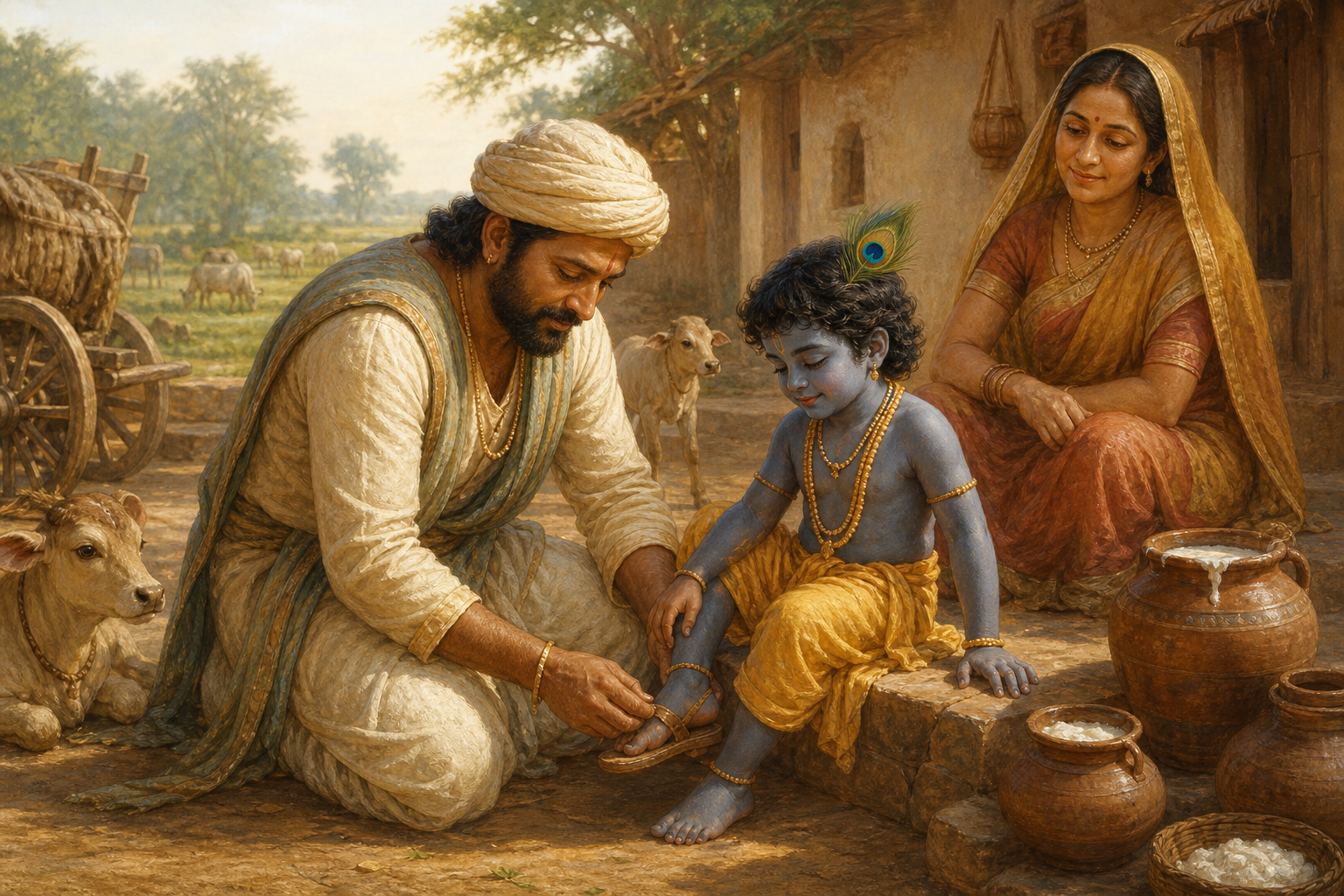
The Krishna narrative does not need to erase one father in order to honor another. Vasudeva is Krishna’s begetter and the father who carries him away from Kamsa’s prison. Nandagopa is the father who receives him into Vraja, anchors him in a household and assumes the visible obligations of care. Birth remains meaningful, but it does not make nurture spiritually second-rate.
This distinction is especially important when someone uses the phrase “real father.” It smuggles a hierarchy into the family: one man is treated as authentic because of biology, while the man who protects, provides and raises the child is treated as an imitation. Nandagopa’s honored place in Hindu memory refuses that hierarchy. Krishna is called Nanda-nandana, the joy of Nanda, because their relationship is part of Krishna’s identity rather than an embarrassing qualification attached to it.
“Foster-father” is therefore a useful description of Nandagopa only if you understand its limits. Krishna’s arrival in Gokula is shaped by divine concealment and rescue, not by a court order or the temporary mandate of a modern foster-care system. Nandagopa nevertheless becomes Krishna’s social and ritual father through accepted responsibility. The analogy illuminates fatherhood beyond begetting; it does not make the ancient narrative legally identical to adoption or foster care now.
Classical Dharmaśāstra also made room for filial relations beyond biological generation, including the datta-putra, or given son, and allied categories. Those categories arose in their own historical and juristic settings, so they should not be lifted intact into a current legal dispute. Their enduring insight is narrower and stronger: generation is one ground of kinship, but the deliberate assumption of paternal duty is another.
Comparable ethical notes appear across the wider dharmic family without making its traditions interchangeable. Buddhist traditions value compassion and guardianship; Jain ethics joins care to ahiṁsā, restraint and freedom from possessiveness; Sikh tradition places seva and human dignity at the center of communal life. A Hindu family, Buddhist family, Jain family and Sikh family may perform different rites and follow different authorities. What they can share is the refusal to treat a vulnerable person as worthy of care only when blood makes a claim.
For your household, the first rule is simple: do not make the child choose which relationship is “real” so that the adults can feel secure. Name every relationship truthfully. Honor a birth connection without belittling the parent who performs the daily work, and honor an adoptive or foster father without turning the child’s earlier history into a stain that must be removed.
Five duties turn affection into dharmic fatherhood

Nandagopa matters because his paternity is enacted. His example does not reduce fatherhood to warm feeling, a title or a ceremonial declaration. It gives you five demanding tests.
- Protection comes before possession. The childhood līlās repeatedly place danger near Nandagopa’s home: Pūtanā enters the household, the cart collapses and Tṛṇāvarta carries Krishna into a whirlwind. Nandagopa cannot control every danger, but he remains responsible for the child entrusted to him. The modern test is not “Does this child feel like mine?” It is “Is this child safer because I am here?” Follow the child’s care plan, know who may authorize medical and school decisions, protect private information and keep promises within the authority you actually hold.
- Provision is recurring work. Nandagopa leads a pastoral community organized around cattle, land, levies, festivals and collective safety. His fatherhood sits inside that ordinary labor. Your bond is formed in repeated acts as well: meals, transport, appointments, school communication, nighttime reassurance, boundaries and the unglamorous administration of a household. If one parent performs nearly all of this while the other claims the title, redistribute the work. Dharmic duty cannot be outsourced while paternal honor is retained.
- Saṁskāra means cultivation as well as ceremony. Nandagopa’s household gives Krishna a name, a community and participation in sacred custom. For a family now, ritual inclusion should be deliberate rather than improvised at the last minute. Ask a competent teacher or priest in your own sampradāya how adoption, foster status, guardianship, gotra and particular rites are handled. Practices can differ, and one local answer should not be advertised as the universal Hindu rule. Whatever form is appropriate, do not let uncertainty become an excuse to leave the child publicly outside the family’s sacred life.
- Belonging must be socially visible. Nandotsava, communal rejoicing and the name Nanda-nandana make the bond public. A child should not be treated as family in private and introduced as an exception in public. Agree on accurate family language before a festival, school event or gathering. Correct relatives who speak of an adoptive child as less than an “own” child, but do so without exposing details the child has not consented to share.
- A father must remain corrigible. During Govardhana-līlā, Krishna challenges an established practice and redirects attention toward Govardhana, cattle and the community’s immediate duties. Nandagopa accepts correction instead of defending custom merely because it is old. Adoptive and foster fatherhood will also confront a household’s habits: casual comments about bloodline, rigid expectations, secrecy or rituals designed around only one family pattern. When the child’s welfare or a clearer understanding of dharma exposes a bad habit, change it.
Nandagopa’s role is also inseparable from Yashoda’s. Their household prevents fatherhood from becoming a story about a lone male protector. If there is a co-parent, birth family, caseworker, relative or other lawful caregiver in the child’s life, coordinate rather than compete. Adult rivalry makes the child carry a burden created by adults. Seva asks each person to perform the responsibility attached to the relationship, not to win a contest over status.
One further boundary matters: ordinary parental care does not create a debt of gratitude. A child is not required to become a public example, defend the family’s decision or repay care through obedience. Nandagopa’s model dignifies the father because he embraces duty; it does not turn the child into compensation for that duty.
Make the promise that matches the relationship you have
Adoption, foster care, kinship care, step-parenting and guardianship can all embody dharmic care, but they do not carry identical promises. Their legal meanings vary by jurisdiction, and foster arrangements may be temporary or governed by a case plan. Moral seriousness begins with refusing to claim authority or permanence that has not actually been granted.
| Relationship | The faithful promise | The boundary to respect |
|---|---|---|
| Adoptive father | Accept enduring parental responsibility and make the child’s belonging visible in family life. | Do not use permanence as a reason to conceal, disparage or rewrite the child’s origins. |
| Foster father | Give wholehearted daily care for as long as the placement lasts, even when the outcome is uncertain. | Do not promise adoption, reunification or another legal outcome you do not control. |
| Kinship caregiver, stepfather or guardian | Carry the practical and moral duties that belong to your actual role. | Do not present affection, custom or a household title as legal authority you do not possess. |
| Birth father within shared kinship | Exercise responsibility in a way consistent with the child’s safety and lawful care arrangement. | Do not use biology as permission to destabilize the child’s caregiving home. |
This is where spiritual analogy must stop and professional guidance must begin. A temple rite, family declaration or reference to datta-putra does not by itself establish present-day custody, consent authority, inheritance or permission to travel with a child. Review the actual adoption, custody, guardianship or placement documents with the relevant caseworker or a qualified local family-law professional. Confirm who may make medical and educational decisions, what contact arrangements must be followed and whether wills, beneficiary designations or other instruments need to be updated.
For foster fathers, especially, wholehearted care and non-possessiveness must coexist. Loving the child fully does not authorize you to obstruct lawful, safe relationships or to make the child responsible for your fear of separation. Jain aparigraha offers a useful ethical lens here: care need not become ownership. You can be steadfast without pretending that every outcome belongs to you.
Build belonging before the next family ceremony

Families often affirm equality in principle but reveal uncertainty at a naming, festival, initiation, wedding, funeral or school form. Do not wait for a public moment to discover that nobody has agreed on language or ritual participation. Complete this household audit in advance.
- Choose truthful relationship words. Decide with the child, co-parent and relevant caregivers which terms are accurate and comfortable. In a foster placement, do not pressure a child to say “father.” In an adoptive family, do not qualify the relationship every time you introduce the child.
- Prepare a short response to intrusive questions. A useful family boundary is: “We honor the child’s birth history, and we do not rank one parent as real and another as unreal.” For a foster placement, add that the child’s personal story is private. You owe strangers clarity about respectful conduct, not access to the child’s history.
- Speak to the ritual authority privately. Explain the family relationship before the ceremony and ask what the living tradition requires. Settle questions about names, lineage conventions and participation away from the child and the assembled community. A public argument over eligibility can turn worship into humiliation.
- Check practical recognition. Make sure school contacts, emergency permissions, medical information and other records reflect the lawful arrangement. Where adoption or guardianship creates enduring responsibilities, obtain proper advice about inheritance and beneficiary documents rather than assuming affection will resolve them later.
- Teach relatives one standard. No jokes about “someone else’s blood,” no repeated demand that the child express gratitude and no disclosure of the child’s history as family gossip. A relative who cannot follow those limits should not be given private access to sensitive information.
- Preserve origins without turning them into a spectacle. Keep truthful information, names and meaningful connections when doing so is lawful and safe. Follow court orders and professional guidance in foster or contested situations. The child’s story belongs first to the child; it is not promotional material for the family or proof of its virtue.
Then look beyond ceremony. Is the child present in the family’s ordinary stories, responsibilities and expectations? Is affection offered only when the child behaves gratefully? Can the child ask about birth, loss or belonging without adults becoming defensive? Saṁskāra is cultivation over time. A flawless ritual cannot compensate for a home in which the child must continually audition for membership.
Key takeaways
- Dharmic fatherhood beyond blood is not imitation fatherhood. It becomes real through accepted and sustained duty.
- Honoring an adoptive or foster father does not require erasing the child’s birth history or treating biological kin as unreal.
- Nandagopa supplies an ethical archetype—protection, provision, cultivation, public belonging and openness to correction—not a substitute for modern legal process.
- An adoptive father may promise enduring parenthood; a foster father must give full care without promising an outcome outside his control.
- Ritual recognition and legal recognition solve different problems. A responsible family secures both where both are available and required.
- Care is the parent’s dharma, not a debt the child must repay through gratitude, silence or public loyalty.
Before your next festival or family gathering, choose one missing proof of belonging and complete it: brief the priest, correct a relative’s language, verify a legal permission or establish a shared household practice. Kinship becomes dharmic at the point where affection accepts a definite responsibility and keeps it.
References
