
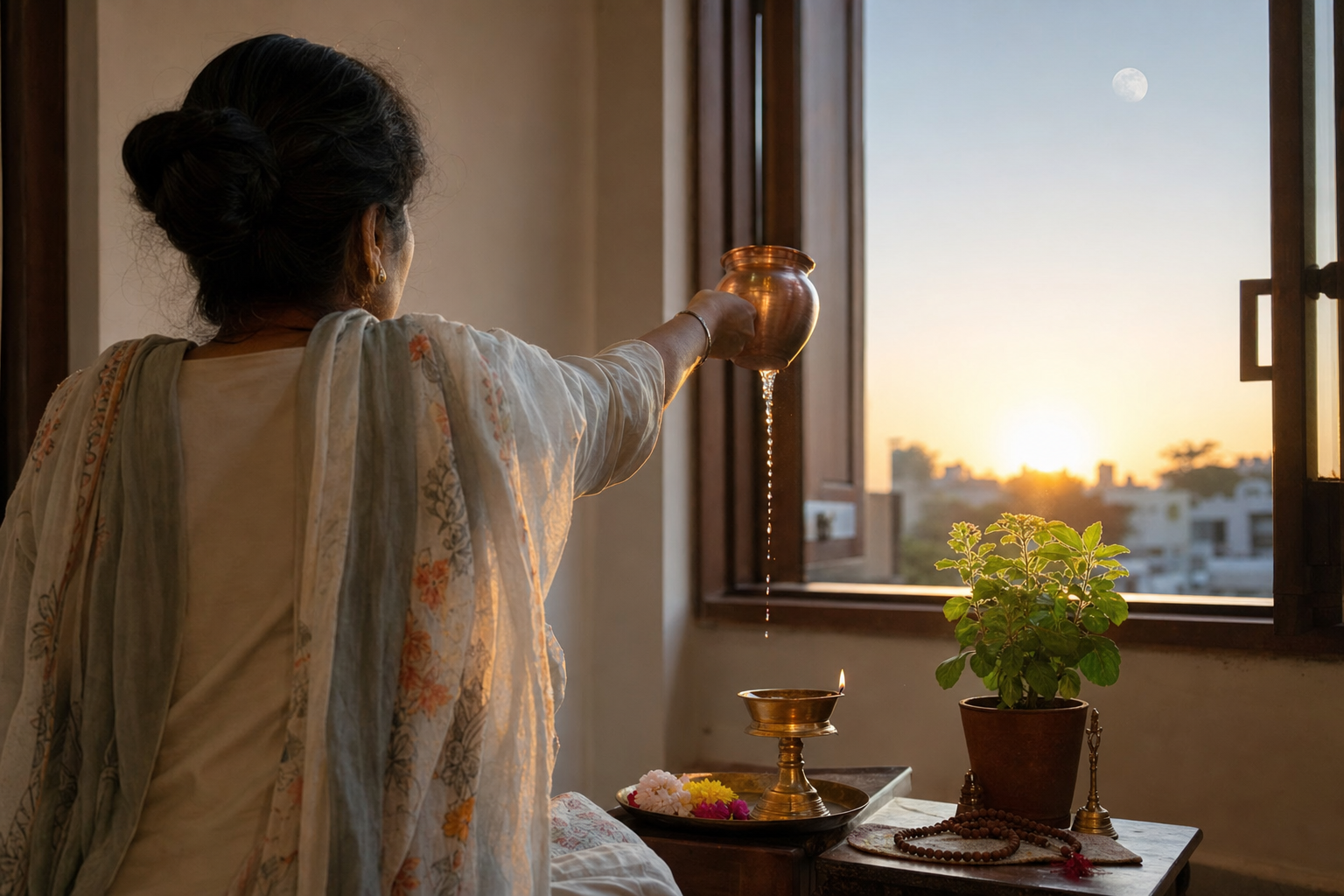
You want a steady daily practice, but the Hindu calendar seems to present a wall of competing instructions: sunrise, tithi, nakshatra, Rahu Kalam, Pradosh, Choghadiya and muhurta. The common mistake is assuming that every marker controls every ritual.
It does not. A sunrise offering, an Ekadashi parana and the beginning of a major undertaking answer to different clocks. Once you identify which clock governs the act in front of you, ritual timing becomes much easier to use without anxiety.
First decide which clock governs the observance
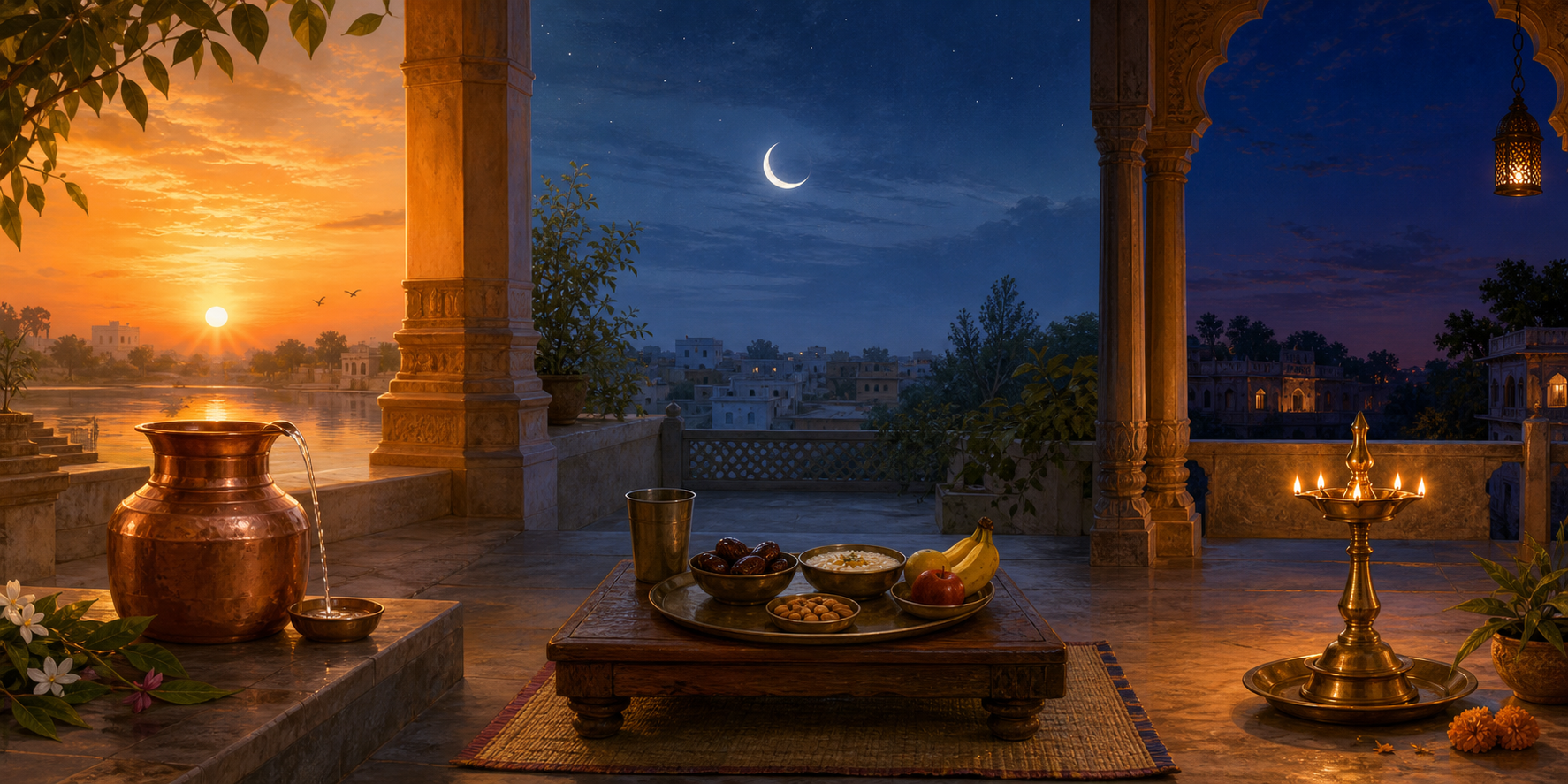
Hindu ritual time is layered. The civil date helps households coordinate. The solar day supplies thresholds such as dawn, noon and dusk. The lunar calendar supplies tithis and the observances attached to them. A muhurta further refines the time chosen for a particular beginning.
Before looking for an auspicious minute, ask one question: what condition makes this ritual timely?
- If it is a daily dawn or dusk practice, start with the local solar threshold. Surya arghya belongs near sunrise; evening sandhya belongs near dusk. You normally do not need to wait for Abhijit Muhurat or a favorable Choghadiya before performing a practice whose own appointed time has arrived.
- If it is a vrata or festival observance, identify the required tithi and ritual window. Some rules depend on the tithi at sunrise. Pradosh depends on Trayodashi prevailing during pradosha kala near sunset. Ekadashi parana depends on the prescribed Dwadashi interval and, where applicable, the end of Harivasara.
- If it is a chosen beginning, consult muhurta after defining the activity. Abhijit Muhurat, Choghadiya and avoidance periods such as Rahu Kalam are most useful when you can choose when to begin something. They are not a reason to postpone every act of worship or duty.
Key takeaways
- Use local sunrise and sunset for solar observances.
- Use the tithi prevailing during the ritual’s required window for lunar observances.
- Never copy an Indian clock time into another time zone without local recalculation.
- Treat Rahu Kalam, Choghadiya and Abhijit as planning tools for selected beginnings, not as universal permission slips for daily worship.
- Let your lineage govern the mantra and ritual form; let your actual location govern the clock.
Build a dependable morning practice around sunrise
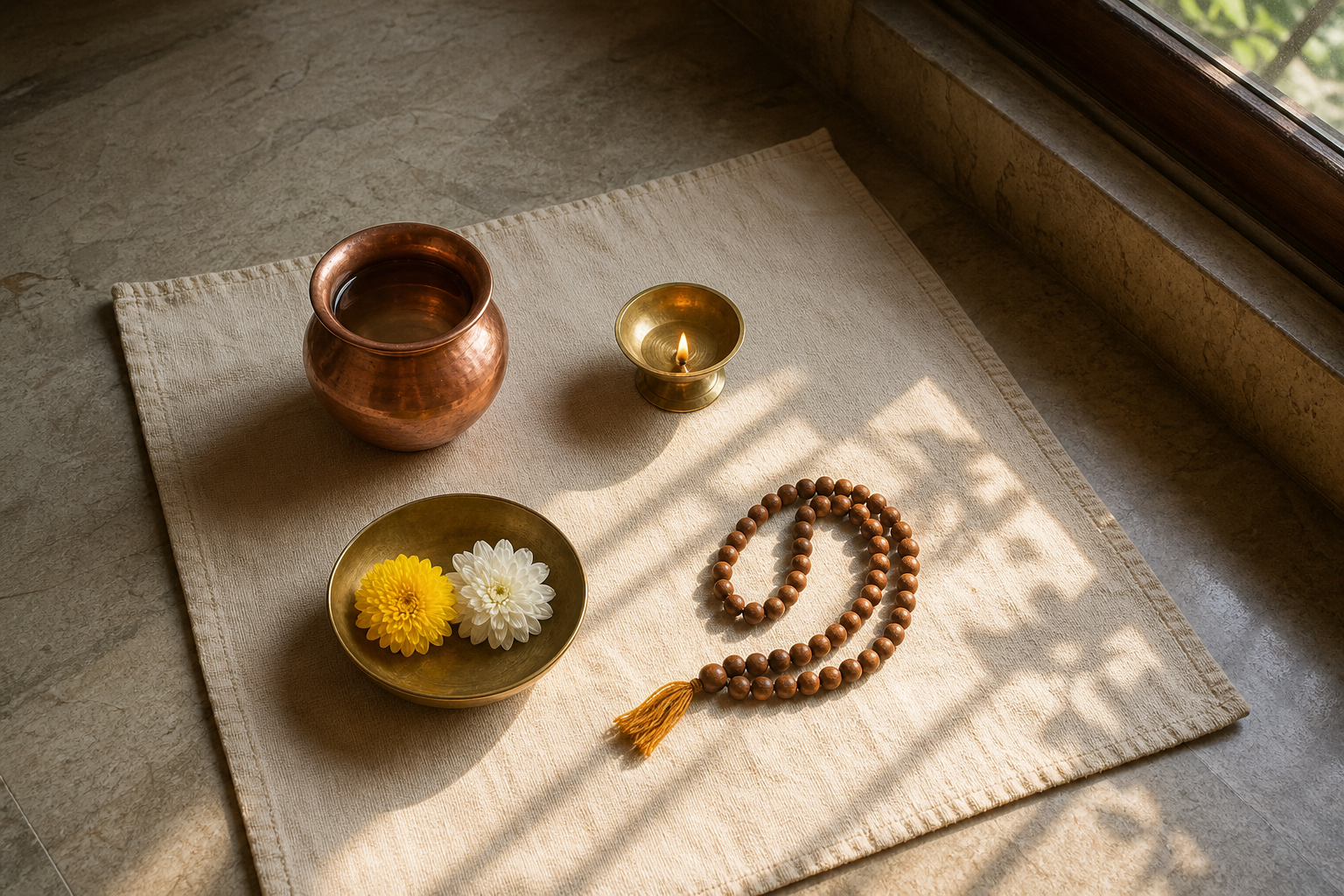
A daily observance succeeds when its essential form is clear enough to repeat. For a householder beginning Surya worship, the core can remain simple: prepare clean water, meet the local sunrise, offer it with a familiar mantra, pause and then enter the day’s duties deliberately.
A widely followed form uses three arghyas offered toward the rising Sun. Three is a common practice, not a demand that overrides instructions received from your family tradition, guru, temple or sampradaya.
- Prepare before the threshold. Use a clean vessel and a modest amount of clean water. Copper is traditional in many homes, but a clean suitable vessel is more important than delaying the practice because you lack a particular material.
- Face east near local sunrise. A courtyard, garden, balcony or other safe open place works. If water cannot be poured onto the ground, arrange a planter or another respectful place to receive it.
- Pour a thin, controlled stream. Offer from cupped palms or the vessel. Keep the gesture slow enough that breath, mantra and attention remain together.
- Use the mantra you can repeat faithfully. “Om Suryaya Namah” is a simple salutation. Gayatri recitation and “Ghrinih Suryah Adityah” also occur in established practice, while different lineages retain their own mantra sets.
- End in stillness rather than rushing away. Offer gratitude, steady the mind and dedicate the day’s work. This final pause turns the rite into a transition from private devotion to karma-yoga.
Surya arghya can be preceded by cleansing, a few rounds of pranayama or Surya Namaskar if these already belong to your routine. Do not make every optional addition a condition for beginning. First establish the practice you can actually keep; then expand it without displacing sunrise itself.
Morning light also gives the body a useful time signal. Early light exposure is associated with circadian alignment, daytime alertness and regulation of sleep timing. That benefit comes from being present in the morning light; it does not require staring at the solar disc.
Do not use the falling water as eye protection. A thin stream may diffuse and refract some glare, but it does not make prolonged direct solar viewing safe. Keep the practice to the softer light around sunrise or sunset, do not strain your eyes, and direct your gaze away immediately if the light is uncomfortable. The devotional purpose is attention and reverence, not a test of how long you can look at the Sun.
Read the Panchang by ritual moment, not headline date
A tithi is not a midnight-to-midnight date. It is defined by each 12-degree increase in the angular separation between the Moon and the Sun. Because that relationship does not change in neat 24-hour blocks, a tithi may begin or end at almost any civil time.
This produces the rule that prevents many calendar mistakes: check which tithi prevails at the moment your observance requires. Sunrise may determine one vrata’s designation, while the twilight period around sunset determines whether Trayodashi supports Pradosh.
Consider May 28, 2026 as a worked example. In the stated timing context, Shukla Dwadashi continues until 8:31 AM and Shukla Trayodashi follows. That creates two different ritual opportunities on one civil date:
- Early morning: Dwadashi can provide the parana interval for someone who observed the preceding Ekadashi fast. Parana is generally made after sunrise within the prescribed interval, unless Harivasara overlaps sunrise; in that case, the practitioner waits until Harivasara has ended.
- Evening: Trayodashi can support Shukla Pradosh if it remains in force during pradosha kala, the twilight interval commonly treated as roughly one and a half hours around sunset. The evening condition matters more here than the tithi that happened to prevail at sunrise.
The listed 8:31 AM transition is not a portable worldwide time. Longitude, local sunrise, time zone and daylight-saving rules can change the local clock time and may even move the astronomical event onto another civil date. If you live outside the calendar’s reference region, use a Panchang computed for your city or follow a local temple calendar that has already made the conversion.
Amanta and Purnimanta systems can give the lunar month different boundaries and therefore different month labels. They do not change the underlying tithi mechanics at a given astronomical moment. When two calendars appear to disagree, first check their city, time zone, daylight-saving setting and month convention before concluding that one must be wrong.
Use secondary timing windows for the jobs they actually do
Abhijit Muhurat is centered on local true noon, understood practically through the midpoint between local sunrise and sunset. It should not automatically be treated as the same fixed clock interval throughout the year or across cities.
Rahu Kalam, Yamaganda and Gulika are derived by dividing the daylight period from sunrise to sunset into eight equal portions and assigning weekday-specific segments. That is why a memorized time such as a fixed afternoon interval is only an approximation based on an assumed day length. Recalculate from the day’s local sunrise and sunset when the timing of a new undertaking genuinely matters.
Choghadiya offers another planning layer. Amrit, Shubh and Labh periods are generally favored, Char is commonly treated as usable, and Rog, Kaal and Udveg are avoided for beginnings. Use these classifications to choose among available times. Do not allow the search for a perfect overlap to prevent ordinary worship, study, service or necessary work.
Resolve competing signals with a clear hierarchy
When several Panchang markers appear on the same screen, more information does not always produce a better decision. Start with the defining condition of the observance, then add refinements only if they are relevant.
| What you are timing | Primary condition | What to check | Common mistake |
|---|---|---|---|
| Daily Surya arghya | Local sunrise | Sunrise for your present location, safe place and prepared water | Waiting for a separate muhurta after sunrise has passed |
| Morning or evening sandhya | Dawn or dusk threshold | Local solar time and your lineage’s procedure | Treating avoidance periods as a ban on nitya worship |
| Ekadashi parana | Prescribed Dwadashi interval | Local sunrise, tithi end and any Harivasara restriction | Using a generic calendar date without the parana window |
| Pradosh worship | Trayodashi during pradosha kala | Local sunset and the tithi prevailing around that twilight | Looking only at the tithi present at sunrise |
| A chosen new undertaking | An appropriate selected muhurta | Local Abhijit or favorable Choghadiya, plus avoidance periods if your tradition uses them | Copying fixed clock times based on a different city’s sunrise |
Do not force a generic online rule over a specific instruction from the tradition in which you are practising. Vaishnava, Shaiva, Shakta and Smarta households may use different mantras, sequences and devotional emphases without turning that diversity into a defect. The practical division is straightforward: lineage decides the ritual form, the Panchang establishes the astronomical condition, and your location converts that condition into local time.
Nakshatra and the Moon’s rashi can refine the choice for a particular rite, but they should be read from an ephemeris-based local Panchang rather than guessed from the civil date. If the observance you are performing does not prescribe a nakshatra condition, do not add one merely because the field appears on the calendar.
Keep continuity without pretending every time is equivalent
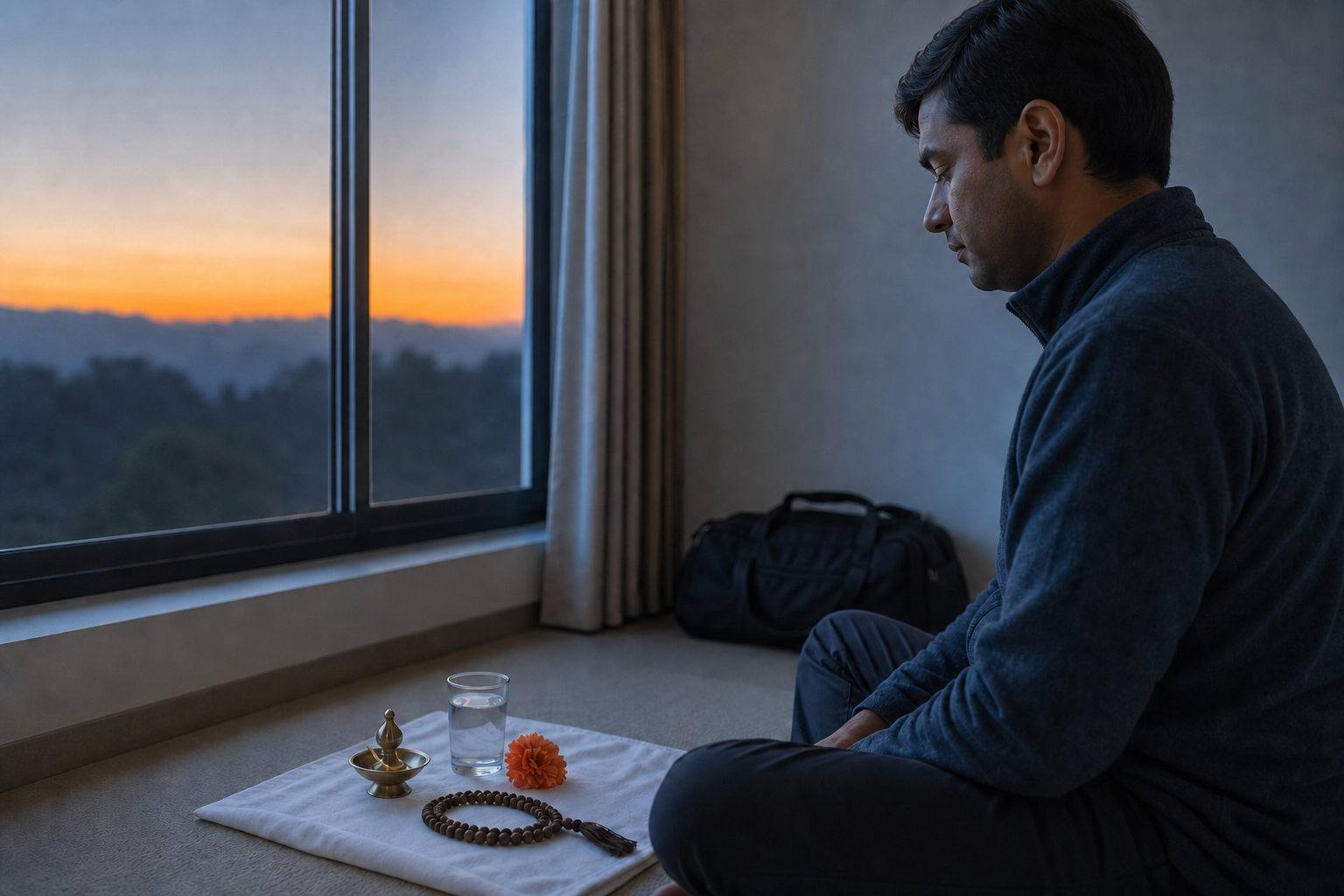
Weather, apartment living, travel and household duties can obstruct the ideal form of a daily observance. The answer is neither to abandon the practice nor to pretend that every hour is astronomically interchangeable.
- In a high-rise home: offer from a safe balcony or at a sunlit window, and return the modest quantity of water to a planter rather than spilling it onto a public area.
- On an overcast morning: sunrise still occurs even when the disc is hidden. Face east, offer the water and mantra, and let the clocked threshold rather than visibility determine continuity.
- When a physical offering is impossible: joined palms, mantra and a mental arghya can preserve remembrance. Perform the fuller physical rite when circumstances permit, without falsely labelling a much later act as the sunrise offering.
- While travelling: change the Panchang location to the city where you are physically present. Your home city’s sunrise, tithi transition and avoidance periods do not travel with you.
- For a time-bound vrata: do not improvise as freely as you might with informal personal devotion. If the parana or Pradosh window has been missed or is unclear, ask a knowledgeable local priest, temple or lineage authority rather than guessing retrospectively.
Make tomorrow morning easier tonight. Check local sunrise. See whether a vrata creates an additional tithi-based obligation. Choose the mantra you will actually use. Set out the vessel and decide where the water will go. If you are travelling, update the location before trusting any displayed time.
Then begin with one stable threshold rather than a crowded checklist. Meet the local sunrise, perform the essential act safely and let the discipline shape the day that follows. Precision serves dharma when it protects the meaning of an observance; it becomes a distraction when it prevents you from practising at all.
References
- DharmaRenaissance Blog — Arghya to the Sun: Vedic Symbolism, Subtle Physiology, and Daily Surya Worship Benefits
- DharmaRenaissance Blog — May 28, 2026 Panchang: Shukla Dwadashi–Trayodashi, Sacred Muhurats, Pradosh & Parana Guide
