
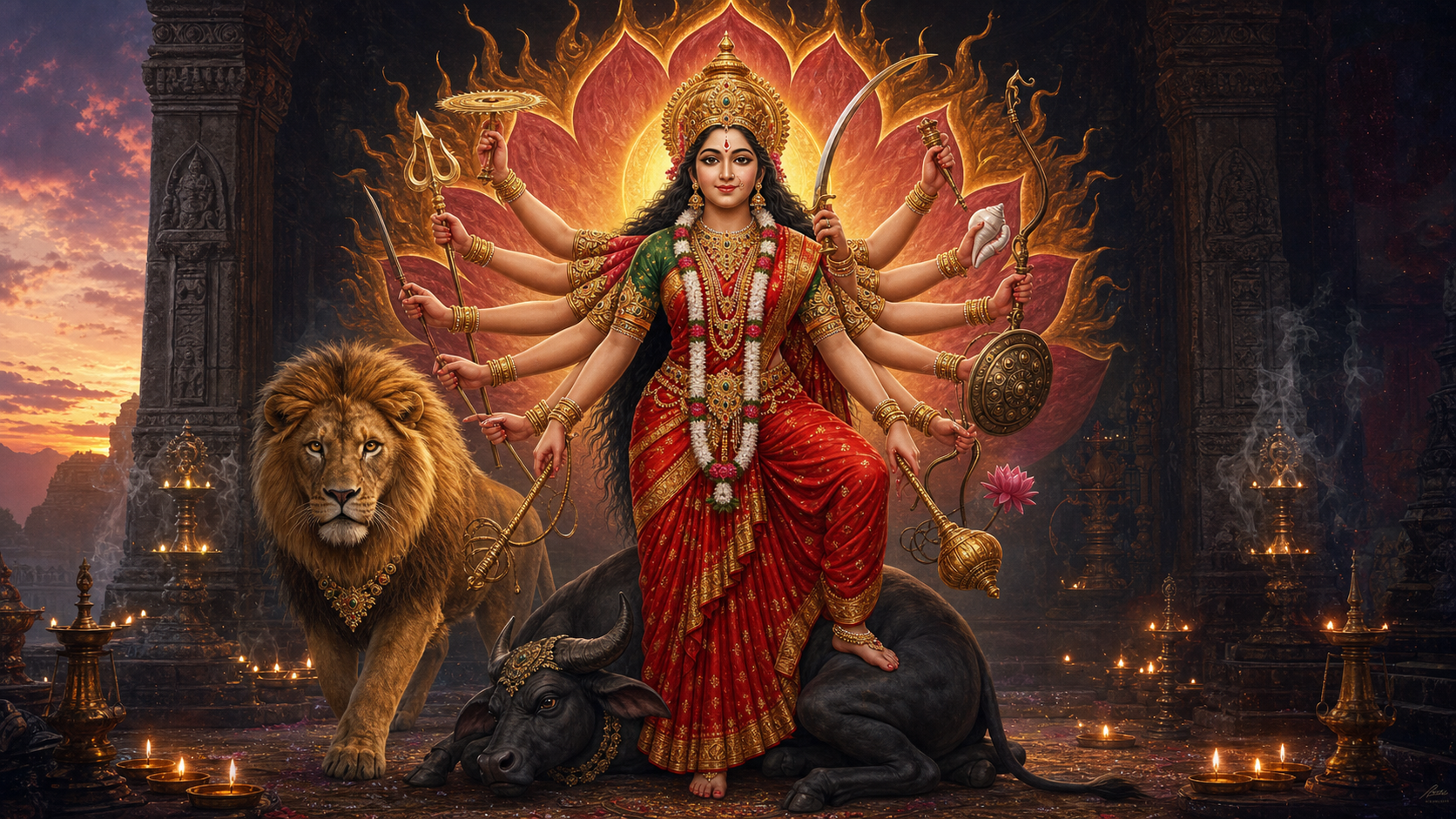
You may have encountered a many-armed Mahalakshmi holding a sword and discus, heard a hymn invoke her against an asura, or met a Kolhapur devotee who speaks of Ambabai as both mother and warrior. The image does not fit the familiar picture of Lakshmi seated peacefully on a lotus. Is this really Lakshmi, or has Durga simply been given another name?
That tension is real, but an armed or demon-slaying Mahalakshmi is not a mistake. Fierce Mahalakshmi belongs to several related traditions, each with its own theological setting. If you want to understand an image, visit a shrine, or begin a devotional practice, identify that setting before assuming that every form called Mahalakshmi is identical.
One name works in several theological registers
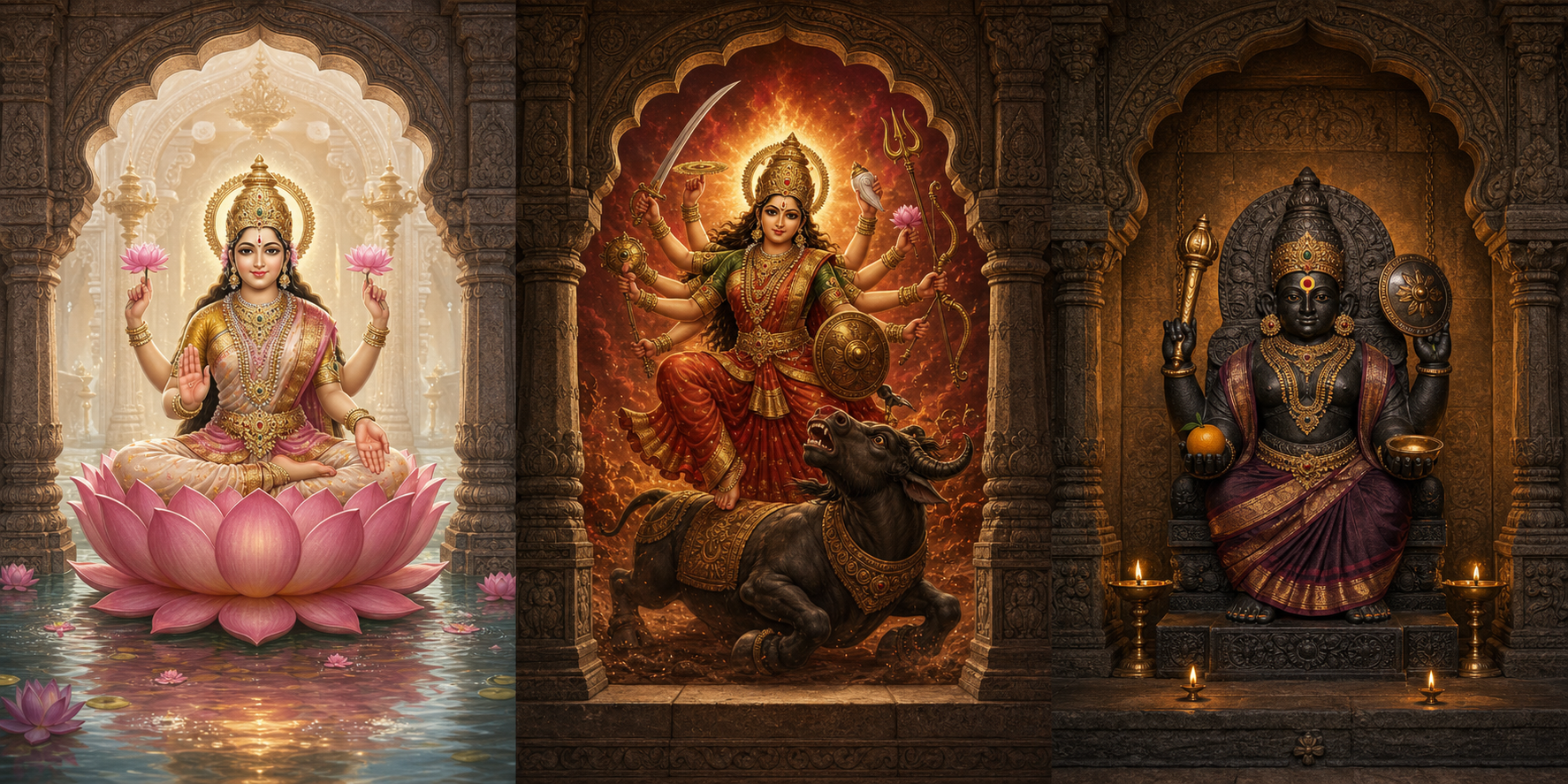
Two opposite mistakes cause most of the confusion. The first reduces Lakshmi to money and domestic good fortune, leaving no room for sovereignty, courage, or protection. The second treats Mahalakshmi as nothing more than an interchangeable name for Durga. Hindu traditions preserve a more careful range of meanings.
In a Vaishnava register, Sri or Kamala is Vishnu’s consort and inseparable divine power. She sustains auspiciousness, harmony, abundance, and the order in which dharmic life can flourish. Yet sustaining order is not necessarily passive. The Pancharatra Lakshmi Tantra develops Sri’s protective sovereignty through mantras, kavacas, nyasas, and contemplative disciplines. Here protection grows from her identity as the cosmic Shakti of Narayana.
In a Shakta register, Mahalakshmi can designate a primordial manifestation of the Great Goddess alongside Mahakali and Mahasaraswati. Within the threefold ritual understanding of the Devi Mahatmya, the martial Goddess associated with the defeat of Mahishasura is venerated as Mahalakshmi. She is not merely a peaceful household deity who temporarily becomes angry. She is sovereign Shakti actively restoring the cosmos when adharma has displaced its rightful order.
A third register is regional and rooted in sacred geography. At Karavira, present-day Kolhapur, Mahalakshmi is Ambabai, the ruling and protecting Goddess whose identity is inseparable from the defeat of Kolhasura. The Karavira tradition remembers her as the power who ends Kolhasura’s oppression and remains for the welfare of devotees. Prosperity and protection meet in the sovereignty of a Goddess who guards an actual place and community.
These registers overlap, but they are not interchangeable in every lineage. An integrative Shakta interpretation may understand Lakshmi, Durga, Chandika, and Ambika as functional revelations of one Shakti. A Vaishnava tradition may retain a sharper distinction between Sri, Vishnu’s inseparable consort, and the forms worshipped in Shakta ritual systems. You do not have to erase either position to recognize the shared conviction beneath them: divine grace must sometimes act decisively to preserve dharma.
Four fierce Mahalakshmi settings you should not collapse
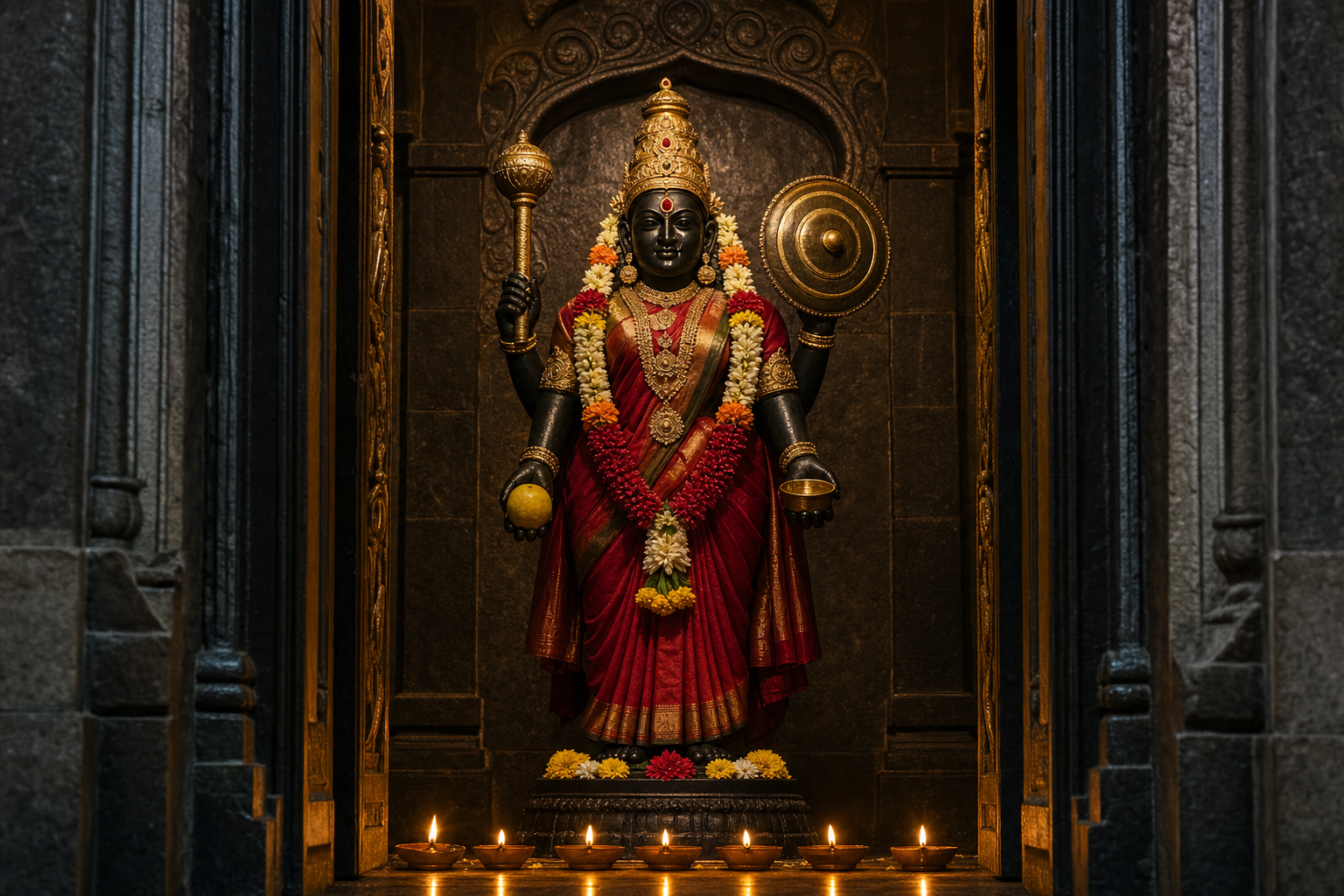
The expression fierce Mahalakshmi is best treated as a family of traditions, not as the name of one standardized pan-Indian image. This working map will help you determine what you are actually encountering.
| Setting | How protective power appears | What you should check |
|---|---|---|
| Karavira or Kolhapur Mahalakshmi | Ambabai defeats Kolhasura, restores order, and abides at the sacred city as its regal protector. | Look for the names Ambabai, Karavira, and Kolhasura. Let the temple’s own narrative and liturgy define the form rather than relabelling her as generic Durga. |
| Devi Mahatmya ritual tradition | The many-armed Great Goddess defeats Mahishasura. In the text’s wider liturgical system, this victorious manifestation is associated with Mahalakshmi. | Notice whether the setting invokes Mahishasuramardini, Chandika, Mahadevi, or the middle portion of a threefold Mahakali-Mahalakshmi-Mahasaraswati arrangement. |
| Ashtalakshmi worship | Veera or Dhairya Lakshmi embodies moral courage, while Vijaya Lakshmi embodies victory aligned with dharma. | Do not classify the entire Ashtalakshmi group as fierce. Identify the individual form and ask whether the emphasis is courage, victory, wealth, children, learning, or another blessing. |
| Pancharatra and Lakshmi Tantra | Sri acts as Vishnu’s sovereign Shakti through a protective ritual grammar that can include mantra, kavaca, visualization, and nyasa. | Distinguish accessible household devotion from practices requiring transmission. Protective theology does not automatically imply a martial image or permission to improvise tantric rites. |
The most important clue is context. A shared divine name can express a real theological relationship without making every narrative, icon, and ritual procedure identical. Record the deity’s exact temple name, the asura or sacred story invoked, the hymn being recited, and the lineage conducting the worship. Those details are more reliable than an isolated image caption.
Read the image as a sentence, not an inventory
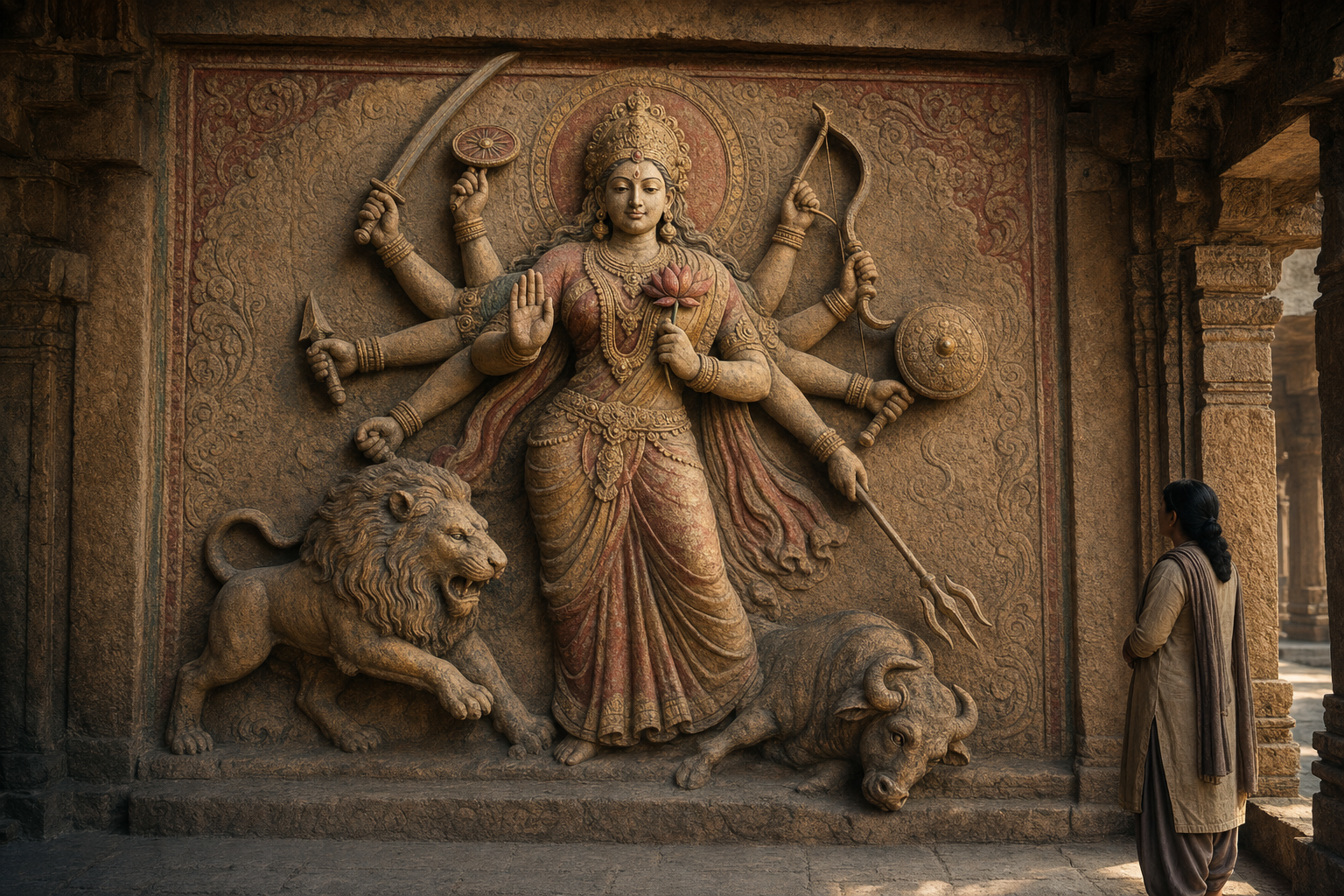
A weapon in Mahalakshmi’s hand does not cancel the lotus. It changes the sentence formed by the entire image. Fierce Mahalakshmi iconography often places martial attributes beside gestures of reassurance and generosity so that strength remains visibly governed by grace.
- Lotus, composure, and regal bearing: These retain the grammar of sri: beauty, fertility, rightful abundance, and ordered flourishing. Fierceness has not displaced auspiciousness; it has been placed in its service.
- Abhaya and varada mudras: The open hand grants fearlessness, while the boon-giving gesture communicates generosity. Their presence tells you whom the weapons are meant to protect.
- Conch and discus: These can emphasize Mahalakshmi’s Vaishnava relationship with Vishnu. In composite Goddess imagery, divine weapons can also belong to the armament given by the devas for the defeat of demonic power. The surrounding narrative decides the emphasis.
- Sword, spear, bow, and arrows: These indicate readiness for effective action. Devotion commonly interprets them as the disciplined power that severs delusion, arrogance, inertia, and other conditions sustaining adharma.
- Lion, battlefield setting, flamelike aura, or widened gaze: These intensify the protective mood. They communicate vigilance and concentrated energy rather than uncontrolled rage.
Do not identify a murti from one attribute. A discus alone does not settle its sectarian identity, and a lion does not make the name Lakshmi meaningless. Read the complete cluster: posture, weapons, gestures, vehicle, accompanying deities, local name, festival cycle, and recited narrative.
This iconography also gives you an ethical test. Ugra means concentrated and formidable power; it does not make cruelty sacred. The Goddess removes the force preventing dharmic order and then establishes refuge, nourishment, and stability. An interpretation obsessed with enemies, vengeance, or domination while ignoring abhaya, varada, and the restoration of sri has read only half the image.
A grounded way to approach protective Mahalakshmi worship
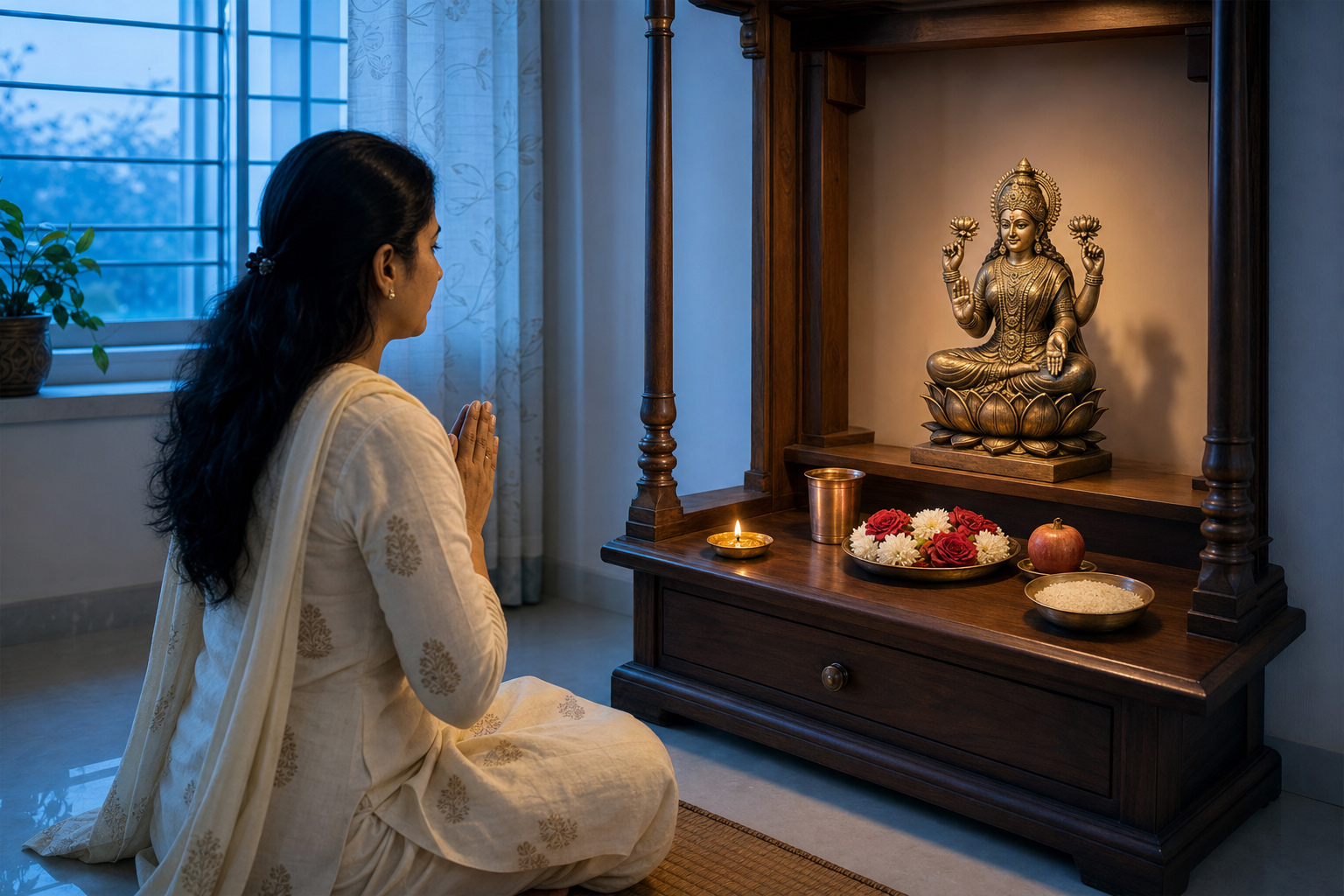
If you feel drawn to Mahalakshmi’s protective dimension, you do not need to assemble an improvised fierce ritual. Household worship can remain fully sattvika: a clean place, a steady lamp, vegetarian offerings, a suitable flower, clear recitation, and conduct that makes the prayer credible.
- Name the quality you are seeking. Form a sankalpa around courage, clarity, protection, disciplined action, or the restoration of harmony. Ask for the strength to meet a duty or resist adharma without hatred. A prayer aimed at harming a particular person contradicts the protective grace represented by the form.
- Choose one accessible devotional core. The Sri Sukta, Mahalakshmi Ashtakam, and Lakshmi Gayatri are established choices for stable household practice. A ghee lamp and vegetarian naivedya keep the observance within a familiar sattvika framework. Lotus or red hibiscus may be offered where that accords with family or temple custom. One recitation performed attentively is better than a collection of procedures you do not understand.
- Use sacred time without pretending there is one universal calendar. Friday is widely associated with Sri. A common Navaratri arrangement dedicates the middle three days to Mahalakshmi, while Kojagari or Sharad Purnima emphasizes luminous vigilance in eastern observance. Your family sampradaya and the calendar of the temple you follow should take precedence when they differ.
- Keep initiatory procedures within a lineage. Bija mantras, specialized kavacas, nyasas, homas, and complex visualizations are parts of an ordered discipline, not detachable techniques. Their practice can depend on transmission, pronunciation, sequence, and a teacher’s instructions. If you have not received that guidance, remain with non-initiatory hymns, nama-japa, a lamp, and straightforward puja.
- Pair removal with restoration. Fierce Mahalakshmi does not merely defeat an obstruction; she restores conditions in which life can flourish. Complete your worship with one concrete act of sri: honor an obligation, bring order to a neglected responsibility, give dignified help to someone facing want, support scriptural learning, or participate in community seva.
- Judge the practice by the character it produces. Protective devotion should make you more composed, truthful, courageous, and generous. It should replace anxious reactivity with alert steadiness. If a practice feeds paranoia, hostility, superiority, or fascination with occult power, return to simple worship and seek guidance from a trustworthy teacher in the relevant tradition.
This approach also clarifies the difference between courage and aggression. Veera Lakshmi does not bless reckless conflict; she represents the steadiness required to defend what is right. Vijaya Lakshmi does not make every success righteous; she represents victory governed by dharma. Mahalakshmi’s fierceness is therefore measured by what it protects and restores, not by how threatening it appears.
Key takeaways
- Fierce Mahalakshmi is a family of Vaishnava, Shakta, regional, and liturgical traditions rather than one standardized form.
- Vaishnava Sri expresses protective sovereignty as Vishnu’s Shakti, while Shakta Mahalakshmi can appear as the martial Great Goddess. The two registers overlap without becoming identical in every lineage.
- Karavira or Kolhapur devotion centers Ambabai’s defeat of Kolhasura and her abiding protection of the sacred city.
- The Devi Mahatmya ritual world associates Mahalakshmi with the Goddess who defeats Mahishasura, although Durga, Chandika, Ambika, and Mahadevi also remain important names.
- Veera or Dhairya Lakshmi represents moral courage, and Vijaya Lakshmi represents victory aligned with dharma.
- Weapons must be read alongside the lotus, abhaya, and varada gestures: the governing principle is protective and restorative grace, not rage.
- Household practice should remain simple and sattvika unless a qualified lineage teacher has transmitted more specialized procedures.
The next time you encounter a fierce Mahalakshmi, do not stop at asking whether she is really Lakshmi or Durga. Write down three things: her local name, the narrative invoked around her, and the liturgy actually performed. Those details will show you which tradition you are meeting. If you begin worship, choose one steady practice and one concrete act of protection, order, or generosity. Let the conduct that follows your prayer be the measure of your understanding.
References
- DharmaRenaissance Blog – Did Goddess Lakshmi Slay Demons? Scriptural Evidence on Kolhasura and Mahishasura
- DharmaRenaissance Blog – Ugra Lakshmi Unveiled: Fierce Iconography, Tantric Theology, and Living Rituals of Protective Grace
