
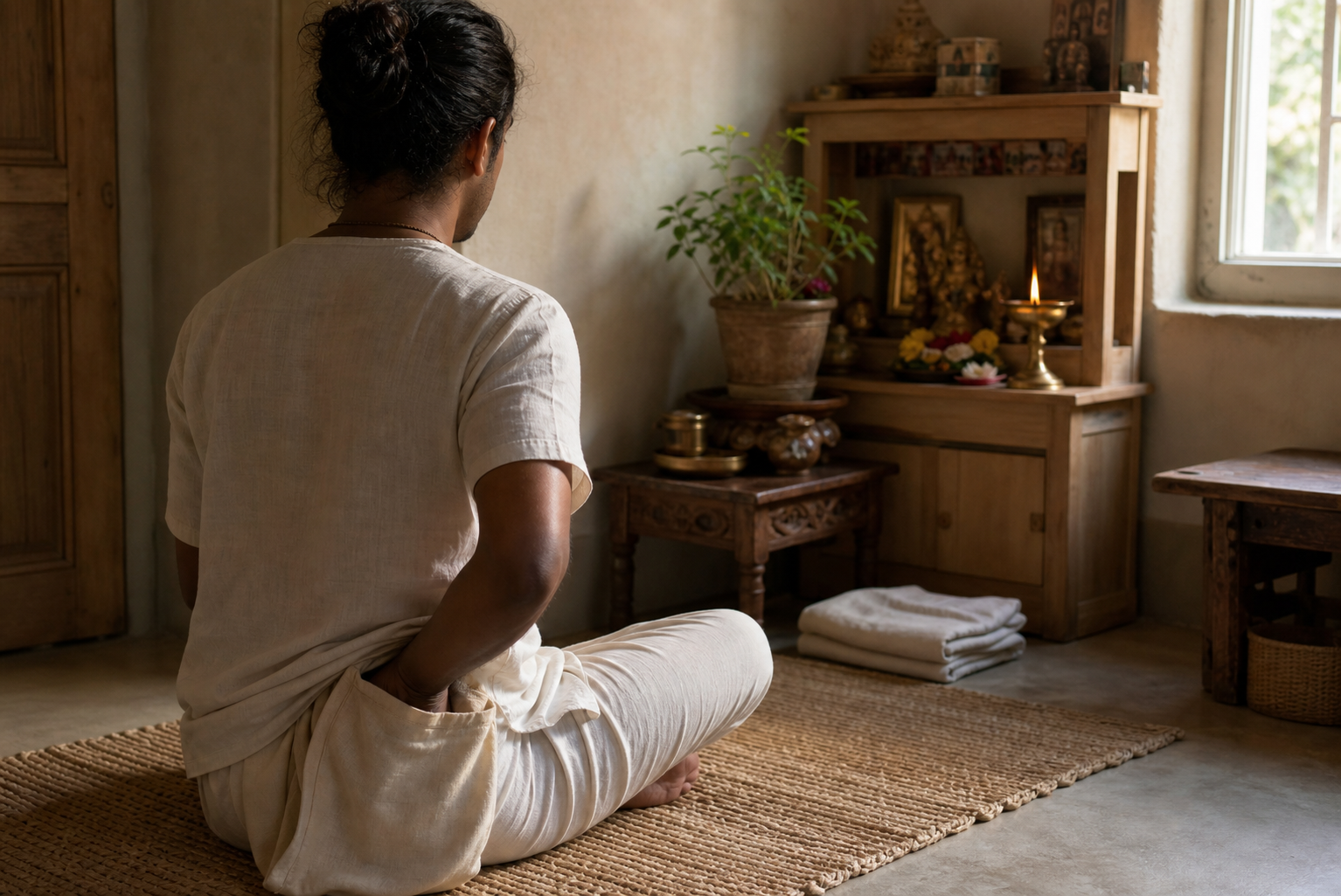
If you know the Hare Krishna maha-mantra but your practice keeps alternating between enthusiasm and neglect, you probably don’t need more devotional material. You need a rule of practice that still works on an ordinary morning, when attention is scattered and inspiration is absent.
Gaudiya Vaishnava practice becomes durable when sacred sound, scriptural understanding, association, and service stop competing for leftover time. Each begins to strengthen the others. The aim is not an impressive routine. It is a life in which remembrance of Krishna gradually governs attention, choices, speech, and conduct.
Begin with the centre: Krishna’s holy name
The first decision is theological, not logistical. Within Gaudiya Vaishnava theology, the holy name is understood as non-different from the Lord who is named. Japa is therefore not merely a concentration exercise or a method for producing a peaceful mood. You are trying to hear Krishna’s name as an encounter and an offering.
The Hare Krishna maha-mantra is:
Hare Krishna Hare Krishna Krishna Krishna Hare Hare
Hare Rama Hare Rama Rama Rama Hare Hare
For practical purposes, attentive japa asks you to align body, mind, and heart. When one of these is neglected, the weakness usually appears somewhere else: an unstable body makes the voice and pace erratic, a wandering mind stops hearing whole names, and a closed heart turns technically correct recitation into a quota-clearing exercise.
- Settle the body. Sit with a stable base, an upright neutral spine, and relaxed shoulders. Use a soft voice that is clear enough for you to hear. Volume is not the goal; complete articulation is.
- Give the mind an entry point. Place attention on the first Hare of every mantra. Follow the names to the end. If attention leaves, don’t continue arguing with the thought. Enter again through the next first Hare.
- Engage the heart. Before beginning, offer a simple prayer for the ability to hear, remember, and serve. This keeps technique connected to dependence on grace.
Pronounce the entire mantra. Don’t compress Krishna, swallow Rama, trail off at the end, or let a bead transition erase a name. Awareness at the tip of the tongue can help you notice consonants and vowels without turning pronunciation into a performance. A natural breath may carry one mantra, or you may use a quiet internal beat so that every name receives attention. Neither device is sacred in itself. Keep it only if it helps you hear.
Your mind will wander. The useful measure is not whether distraction ever appears, but how you respond when you notice it. Each return is part of the practice. A harsh inner commentary merely replaces one distraction with another.
Build a daily rule that survives ordinary life

Choose a fixed daily anchor before choosing an ambitious volume. Brahma-muhurta is traditionally valued because the surroundings are quieter and the day’s demands have not yet taken over. But an ideal hour you repeatedly miss is not yet a functioning rule. Establish the most reliable time available to you, then protect it.
If you have received a fixed commitment from a guru or established lineage, don’t casually redefine it when the schedule becomes difficult. Seek guidance about recurring obstacles. If you are beginning without such a commitment, choose a sustainable number of rounds and complete them carefully. Increase only after the existing practice has become steady enough that additional rounds won’t be purchased by hurried pronunciation or neglected responsibilities.
- Prepare one regular place. Keep beads and the text you study there. A clean space before deities, sacred pictures, tulasi, or another appropriate devotional focus quietly tells the body what is about to happen.
- Settle before touching the first bead. Use a quiet minute of relaxed breathing or gentle breath awareness. This is a transition into japa, not a separate achievement.
- State your intention. Remember that you are addressing Krishna and asking to become fit for service. One sincere sentence is enough.
- Chant the pre-decided rounds completely. Keep the pace unhurried, hear every name, and use the first Hare as the repeated point of return.
- Read from Bhagavad-Gita or Srimad-Bhagavatam. Stay within a recognised commentarial tradition, and identify one connection between the passage and the way you just chanted.
- Carry the sitting into seva. Name one concrete act of service that belongs to the day. Give it a person, place, or responsibility so that it cannot dissolve into the vague intention to be helpful.
A simple log can reveal whether your difficulty is spiritual aspiration, attentional technique, or poor routine design. Record the rounds completed, clarity of pronunciation, steadiness of attention, and the emotional tone of the practice. Use plain descriptions such as rushed, dull, attentive, resistant, or prayerful. Don’t turn the log into a score of mystical worth.
When the routine breaks, inspect the point of failure. Did you leave the time undecided? Was the space full of interruptions? Did you begin at a pace you couldn’t sustain? Correct the design and resume at the next established time. Dramatic self-reproach does not restore continuity; a specific correction can.
Diagnose weak japa without turning it into a moral crisis

Inattention has different forms, and each needs a different response. Calling all of them lack of devotion leaves you with guilt but no diagnosis. Notice the dominant symptom, then apply one adjustment during the next complete round.
| What you notice | What may be happening | What to change |
|---|---|---|
| You lose the mantra almost immediately | The beginning has no clear attentional cue | Deliberately enter through the first Hare and follow the names in sequence |
| Names are compressed or skipped | The pace is faster than clear speech | Slow down until every syllable is audible, especially near bead transitions |
| The voice fades and the cadence breaks | Breath and speech are poorly coordinated | Soften the voice and let a natural breath or even internal beat support the full mantra |
| You become dull or sleepy | Posture and enunciation have collapsed | Straighten gently, allow more light, and brighten the articulation without shouting |
| You feel agitated | Tempo, breath, and attention are accelerating together | Reduce the pace, relax the shoulders, and return to hearing one name at a time |
| The practice feels mechanical | Technique has become detached from relationship | Pause briefly, recollect whom you are addressing, offer a sincere prayer, and resume |
Don’t apply every correction at once. That turns japa into constant self-monitoring. Choose the adjustment that addresses the main obstacle, stay with it for a complete round, and then observe whether hearing became easier.
Technique also has a boundary. Hari-nama-cintamani, chapter 12, presents victory over distractedness as something that cannot be secured by personal effort alone and must also be sought through mercy. This protects you from opposite errors. Fatalism says there is no reason to train attention because grace does everything. Control says perfect mechanics can force spiritual realization. Gaudiya practice holds disciplined effort and dependence together.
Your conduct outside japa affects what you bring to the beads. Dishonesty, needless harm, uncontrolled speech, and unresolved conflict agitate the same mind you later ask to become still. Truthfulness, ahimsa, gratitude, and self-discipline don’t purchase the holy name’s grace, but they reduce the contradictions that keep attention divided. When japa remains turbulent, examine the day as well as the technique.
Let scripture, satsanga, and seva correct each other
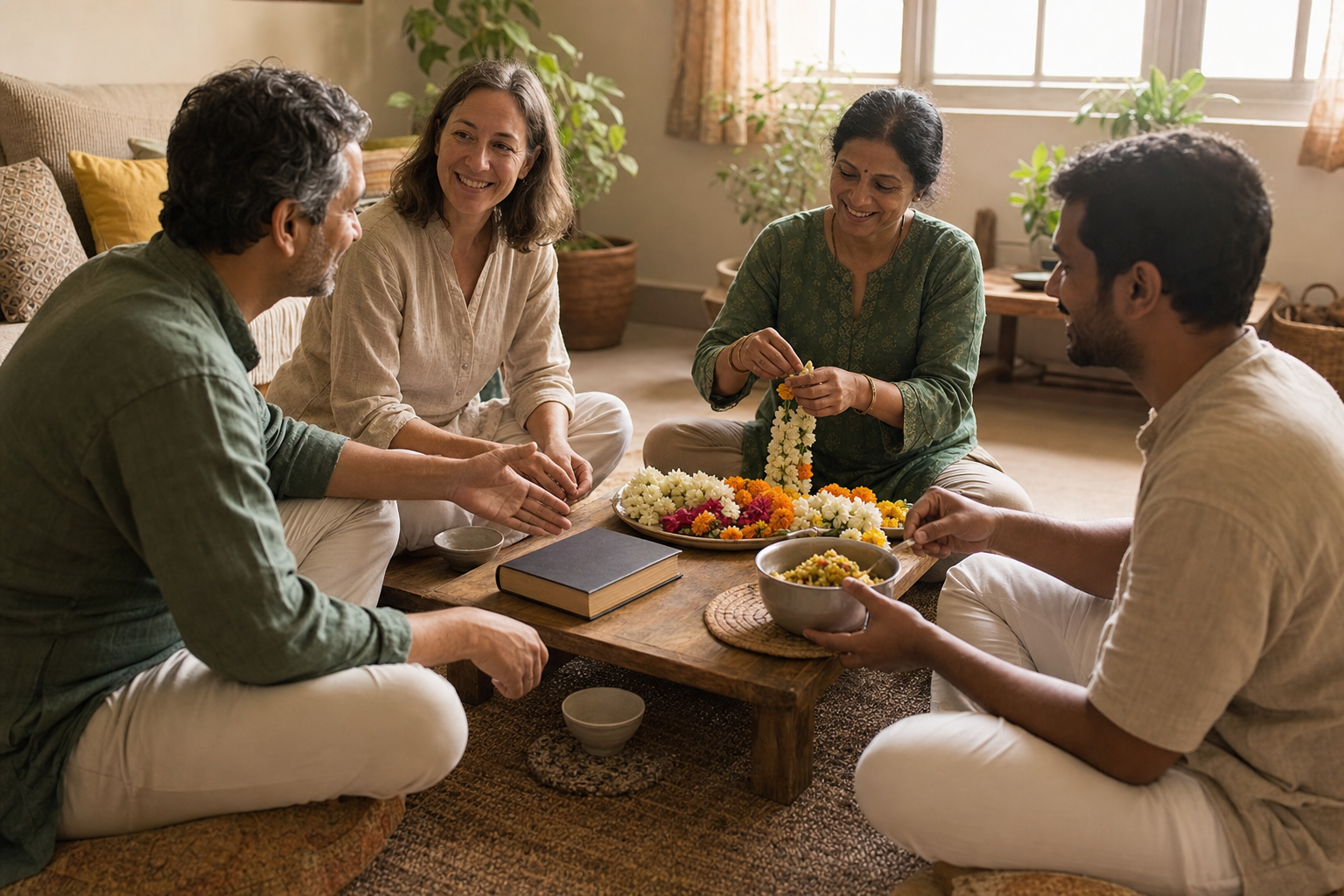
A daily routine becomes narrow if it consists only of counting mantras. Sacred sound is the centre, but scripture gives you language for understanding Krishna’s names, forms, qualities, and pastimes. Association shows how that understanding is lived. Seva reveals whether remembrance is changing your priorities.
Read Bhagavad-Gita and Srimad-Bhagavatam as instruction, not as content to accumulate. After a bounded passage, ask: What does this reveal about Krishna? What habit or assumption in me does it challenge? What service follows from it? If you cannot answer every question, carry one into discussion with a qualified teacher or serious devotee. The point is not to manufacture an interpretation but to make study answerable to the lineage and to life.
A stable devotional culture keeps guru, shastra, and sadhana in coherence. Guru without scriptural accountability can become personality dependence. Scripture without lived discipline can become intellectual collection. Practice without guidance can harden personal preference into supposed principle. When advice in one area appears to contradict the others, slow down and seek clarification rather than choosing whichever demand is easiest.
Satsanga is more than being around people who share a label. Seek association in which careful chanting, scriptural inquiry, humility, and cooperative service are normal. Notice what a community rewards. If visibility consistently matters more than reliability, or charisma more than principle, it will train those priorities in you as surely as a good community trains patience and service.
Congregational kirtan serves a different but complementary role to personal japa. Japa exposes how you direct attention when no crowd is carrying you. Sankirtana joins voice, breath, rhythm, and community in shared remembrance. Congregational sacred sound can counter isolation and organise attention, but emotional intensity in kirtan should not become an excuse to neglect the quieter discipline of hearing on your own beads.
Make seva specific enough to complete. Cleaning after a gathering, welcoming someone who is new, supporting a study group, or reliably helping with a recurring community need may look less dramatic than public devotional expression. That is precisely why such service is useful: it tests whether you can cooperate without making personal recognition the reward.
Don’t measure advancement by polished externals alone. A better practical test is whether practice is producing greater sincerity, steadiness, humility, and compassion. If chanting is increasing pride, harshness, or factional rivalry, more display will not correct the direction. Return to hearing, scriptural accountability, and service.
Carry Vrindavan’s devotional ecology into your own place
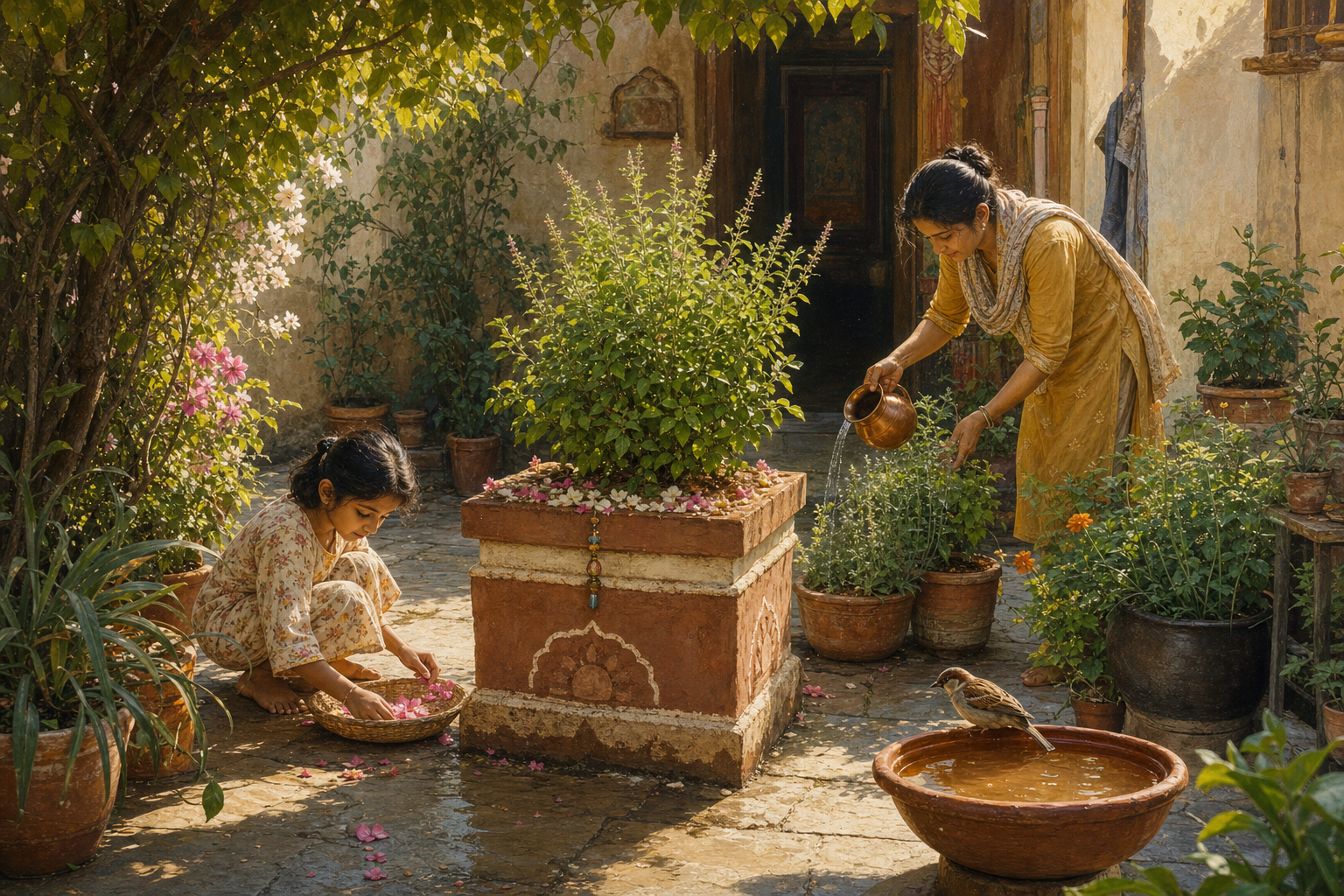
You don’t have to imitate the outward life of a resident of Vrindavan in order to learn from the Dham. In Gaudiya understanding, Vrindavan is not merely a geographic destination. Sacred space, remembered lila, sound, movement, darshan, and service form an environment that repeatedly turns perception toward Krishna.
This is why pilgrimage is embodied. The feet learn through parikrama, the tongue through japa and kirtan, the intelligence through hearing, and the heart through service. The Yamuna, Govardhan, and the lila-sthalis are not scenery added to devotion. They are part of a sacred cartography in which place and remembered pastime reinforce each other.
If you plan Govardhan parikrama, treat it as a substantial physical undertaking rather than a sightseeing loop. The route is commonly described as roughly twenty-one to twenty-three kilometres, depending on the path. Vraja-mandala parikrama, traditionally encompassing eighty-four kos, is more demanding still. Choose an arrangement appropriate to your physical capacity and local conditions. Walking through preventable harm is not proof of devotion.
Prepare for yatra by stabilising the practices you intend to carry there. During pilgrimage, let patience in crowds, care in speech, respect for the Yamuna, consideration for local residents, and responsible treatment of waste become part of the offering. After returning, preserve one concrete discipline the journey clarified. Otherwise, pilgrimage can remain a powerful memory without becoming formation.
At home, recreate the logic rather than the spectacle of the Dham. Give sacred sound a protected time. Give scripture a regular place. Keep devotional images and texts respectfully. Let kirtan and satsanga interrupt isolation. Let seva connect remembrance with another person’s actual need. A modest room can then function as an environment of repeated orientation, even though it is not Vrindavan.
Key takeaways
- Fix a dependable time and place before expanding the volume of your practice.
- Chant every name and syllable clearly; don’t let speed erase the mantra.
- Use the first Hare as your return point whenever attention wanders.
- Join effort to prayer: train attention while depending on Krishna’s grace.
- Pair japa with scriptural study, serious association, congregational kirtan, and concrete seva.
- Judge the direction of practice by growing sincerity, steadiness, humility, and compassion, not by devotional display alone.
At your next scheduled sitting, change only what most needs changing. Fix the time if the routine is unstable. Slow the mantra if syllables are disappearing. Add prayer if the practice has become mechanical. Then repeat the correction until it is no longer an occasional effort but part of your rule.
Bhakti becomes credible in daily life when the name you chant changes how you listen, speak, cooperate, and serve. Begin there, keep the practice answerable to guru and shastra, and let steadiness do the work that bursts of enthusiasm cannot.
References
- Dandavats – Honoring HG Kratu Prabhu Ji: A Life Immersed in Vrindavan Dham’s Divine Beauty and Bhakti
- Dandavats – Align Body, Mind, and Heart in Chanting (Japa): A Proven Framework for Deep Focus and Grace
