

If you are responsible for a temple, you may feel pushed into a false choice: resist state overreach or admit that temple administration needs reform. You do not have to choose. Ritual autonomy and institutional accountability protect different things, and a durable temple needs both.
A court case may stop one unlawful intervention, but it cannot repair a missing title record, recover an undocumented murti, resolve an unmanaged conflict of interest, or keep sevas running after an emergency. The practical task is to make the temple capable of governing itself through changes of trustees, disputes, disasters, regulatory scrutiny, and generational transition.
Separate ritual authority from secular administration
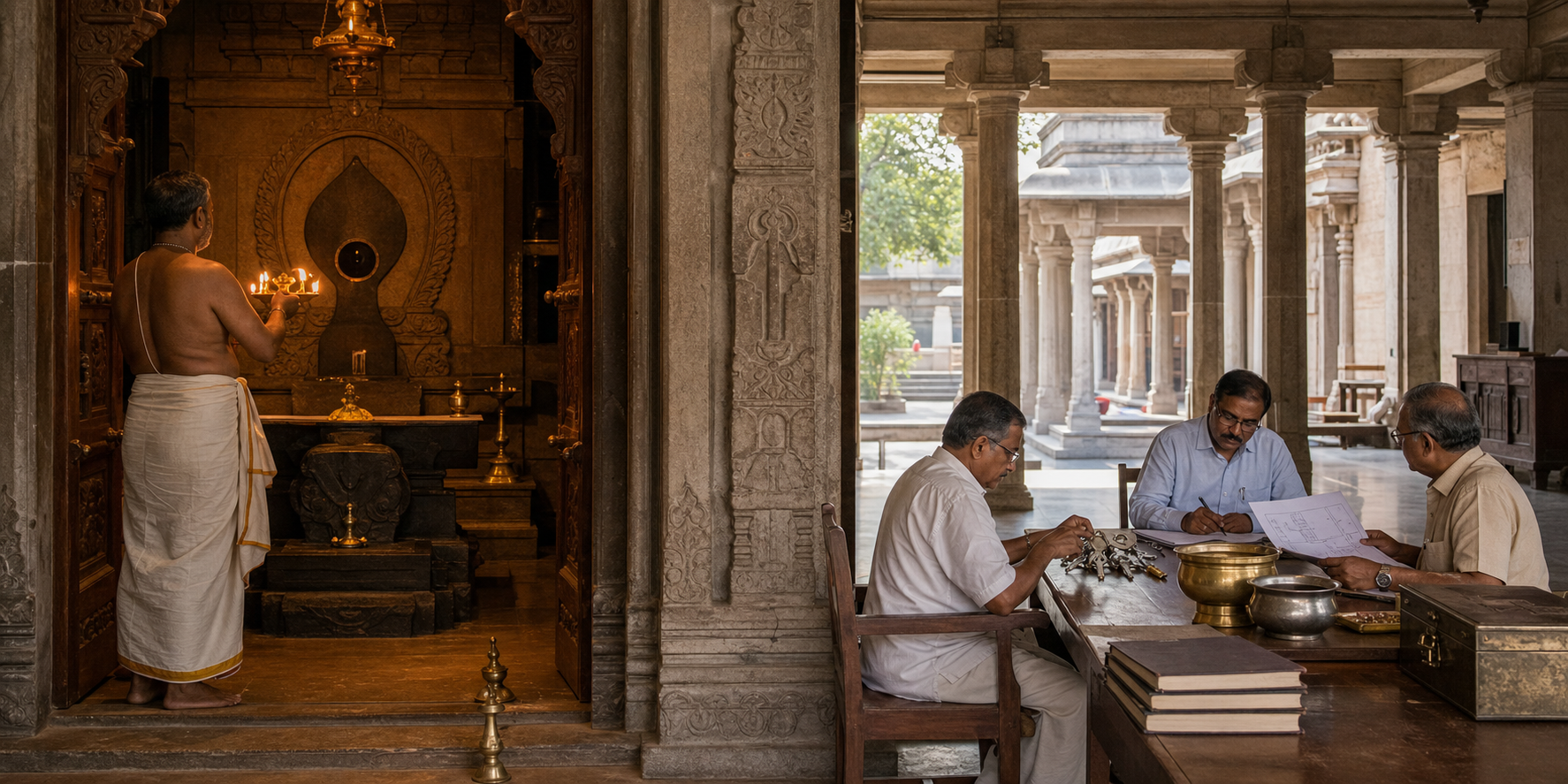
Temple autonomy is often discussed as though every decision belongs in one constitutional basket. That weakens the argument. Decisions about worship are not the same as decisions about accounts, leases, safety, or procurement, even when all of them affect the same institution.
Article 25 protects freedom of conscience and religious practice, subject to public order, morality, and health. Article 26 separately protects the rights of religious denominations to manage religious affairs, maintain institutions, own and acquire property, and administer that property according to law. The Shirur Mutt decision of 1954 distinguished essentially religious affairs from secular administration, which may be regulated for legitimate purposes.
That distinction cuts in both directions. Government cannot convert regulation of accounts into control of worship. A temple cannot label every financial or property decision religious and thereby place it beyond lawful scrutiny. Ratilal Panachand Gandhi v. State of Bombay, also decided in 1954, warned against regulating religious practice under the cover of administration. Dr. Subramanian Swamy v. State of Tamil Nadu in 2014 clarified another essential boundary: intervention used to correct proven maladministration must be temporary, with administration returned after the problem is remedied.
For a trustee board, the useful response is a written decision-rights map. Sort the temple’s work into four domains:
- Sacred affairs: the form and sequence of puja, festival observances, Agama or sampradaya requirements, qualifications for ritual service, treatment of sacred objects, and rules governing the sanctum.
- Property and finance: budgets, banking, leases, land records, maintenance contracts, procurement, insurance, donor restrictions, and investments permitted by the governing framework.
- Public accountability: audits, statutory filings, conflict disclosures, grievance handling, safety compliance, and publication of non-sensitive institutional information.
- Exceptional correction: the process for investigating credible misconduct, protecting records and assets, removing a conflicted decision-maker, and restoring ordinary governance after the defect is cured.
Attach that map to the trust deed, governing scheme, applicable court orders, and current regulatory directions. Add a short statement prepared with the acharyas, archakas, or other appropriate lineage authorities identifying which practices arise from Agama, sampradaya, or established custom. The point is not to turn theology into a bureaucratic manual. It is to stop a future trustee, official, or litigant from casually treating every question as interchangeable.
Property needs its own legal map. Article 300A says that no person may be deprived of property except by authority of law. A proposal that changes temple ownership, land classification, control, or income therefore raises questions about lawful authority, public purpose, procedure, proportionality, compensation where applicable, and appeal. Those questions become especially serious when endowed income sustains daily worship, maintenance, annadanam, pilgrim services, schools, clinics, or relief work.
Constitutional protection is not automatic in every dispute. Whether Article 26 applies to a particular institution, whether a practice is religious, and whether a measure is proportionate depend on the institution and the challenged action. Before filing objections or litigation, have counsel examine the actual text, title history, governing scheme, and evidence. A slogan cannot substitute for a fact-specific legal record.
Make accountability part of the temple’s architecture

Accountability should not arrive as an audit-season scramble. It should be built into how money, land, sacred objects, and authority move through the institution. This does not concede a case for permanent state control. It demonstrates that lawful self-governance has working controls of its own.
Begin with a governance charter that answers questions trustees often leave implicit. Which decisions require the full board? What can an office-bearer approve? What requires ritual consultation? Who signs contracts and operates accounts? What happens when a trustee has a family, business, tenancy, or financial connection to the matter under discussion? How are urgent decisions reviewed after the emergency passes?
A workable charter should produce visible evidence:
- A schedule of reserved matters that cannot be delegated to one office-bearer.
- Written financial and procurement thresholds, with the approval level required at each threshold.
- Conflict-of-interest declarations made before the relevant agenda item, followed by recusal and an accurate minute.
- A record of the reason for selecting a supplier, tenant, adviser, or contractor, not merely the final name and amount.
- A grievance register showing the issue, responsible person, target response date, action taken, and closure decision.
- A succession and handover checklist covering keys, passwords, seals, contracts, original records, pending cases, insurance, and statutory deadlines.
Do not give a conflict policy ceremonial status and then ignore it. A trustee connected to a proposed lease should disclose the connection before receiving confidential bids, leave the decision to unconflicted members, and have that sequence recorded. The control works only when another person can verify what happened.
Finance also needs separation by purpose. Keep donor-restricted money identifiable. Ring-fence the funds needed for core rituals, essential maintenance, and obligations attached to an endowment. Publish audited financial information in a form devotees can understand, but remove personal information about donors, employees, beneficiaries, and complainants. Transparency is not indiscriminate disclosure.
Any lease, redevelopment, or monetisation proposal should answer three questions before expected revenue is discussed: Is the transaction legally permitted? Does it preserve the purpose for which the asset was endowed? Could the use interfere with sanctity, access, ritual continuity, or the temple’s future needs? Ethical leasing and monetisation rules are necessary precisely because higher revenue can still damage an endowment’s religious purpose.
Create two asset registers, not one
A single spreadsheet headed temple property usually hides two very different risks. Immovable property is vulnerable to encroachment, defective records, unclear tenancies, and poorly supervised leases. Murtis, jewellery, manuscripts, and ritual implements are vulnerable to substitution, theft, mishandling, and loss of provenance. Maintain separate registers that can still be reconciled with the accounts.
For land and buildings, record the legal description, survey or revenue identifiers, title documents, endowment purpose, present use, occupant or tenant, lease terms, income, pending disputes, encroachments, and the person responsible for follow-up. Add GIS mapping where feasible, and preserve controlled scans of the supporting records. Land-record inconsistencies should become assigned cases with documentary trails, not oral concerns passed from one trustee to the next.
For sacred and valuable movable objects, keep high-quality photographs from useful angles, measurements, material descriptions, inscriptions or identifying marks, provenance notes, current location, authorised handlers, storage protocol, movement history, and insurance details. Store redundant digital backups away from the primary device. Where lawful and appropriate, forensic marking can assist identification and recovery. Access to the complete register should itself be logged and restricted.
Do not casually surrender original title papers, provenance records, or the only copy of an inventory during a dispute. Use acknowledged copies where the procedure permits, document every transfer, and obtain legal advice when an authority requires originals. Losing the evidence needed to prove ownership can turn a manageable administrative issue into a prolonged property dispute.
Build resilience before the next incident tests worship

Institutional resilience means that worship and essential service can continue without concealing an incident or improvising under pressure. The relevant threats are broader than hostile legislation. Icon theft, encroachment, custodial disputes, safety failures, crowd bottlenecks, and digital misinformation require different controls, but each exposes the same weakness when responsibility is unclear.
Use layered protection. Lighting, controlled entry points, secure key management, CCTV with a defined retention and access policy, and trained volunteers reduce physical risk. Electrical and fire checks, lightning protection where needed, evacuation routes, first-aid readiness, and trained marshals reduce the consequences of an accident. Structured entry and exit routes matter during high-footfall festivals because a normal darshan route may fail once queues, vendors, vehicles, and emergency access compete for the same space.
Write opening, closing, cash-handling, jewellery-movement, lost-child, medical-incident, fire, crowd-surge, and missing-object procedures in language the person on duty can use. Name both a primary and a backup role. Then rehearse the procedure. A binder that no volunteer has opened is documentation, not preparedness.
Digital systems deserve the same discipline. Use secure payment channels, restrict administrator access, remove access promptly when a role ends, back up financial and asset records, and establish who may issue an official correction when false information circulates. Keep only the personal data the institution genuinely needs, and do not publish internal security details in the name of transparency.
A practical 90-day, one-year, and two-year sequence
You do not need to buy a large management system before you know what is missing. A staged programme lets a small temple start with the same priorities as a large institution, while scaling the implementation to its capacity.
- Within 90 days: complete a baseline risk assessment; locate governing and title records; begin the land and sacred-object registers; photograph priority objects; identify urgent encroachment, tenancy, electrical, fire, access, key-control, and crowd-flow problems; and assign a named owner to each open issue.
- Within 6 to 12 months: adopt the governance charter and operating procedures; regularise audit and disclosure processes; train volunteers in security, first aid, crowd flow, and hospitality; establish backup and access controls; create a grievance process; and publish a concise transparency dashboard.
- Within 24 months: join or help create a federated network that shares legal templates, training, security knowledge, and outreach resources while leaving each institution’s sacred affairs under its own legitimate authority.
These milestones reflect a 90-day, 6-to-12-month, and 24-month capacity-building roadmap. Measure completion by evidence: assets documented, unresolved title issues assigned, audits completed, volunteers trained, drills conducted, grievances closed, and control gaps corrected. Counting meetings or social-media posts does not reveal whether the institution is safer.
Federate without centralising ritual authority
Independent temples often face the same legal, accounting, security, and training problems separately. A federation can pool expertise without becoming another command structure. Shared templates, vetted professional resources, emergency contacts, volunteer training, and incident alerts reduce the burden on smaller temples. Local boards should retain control of worship, tradition-specific rules, and lawful institutional priorities.
The same principle allows practical cooperation across the wider dharmic family. Hindu temples, Buddhist viharas, Jain derasars, and Sikh gurdwaras can share learning about audits, artefact documentation, kitchens, emergency readiness, environmental stewardship, and volunteer management without blending their distinct doctrines or disciplines. Common secular standards should protect plurality, not erase it.
Representation matters in any shared board or ombuds arrangement. Practising devotees, local communities, relevant religious scholars, and public authorities may each contribute knowledge, but no single interest should be able to capture the mechanism. Terms, conflicts, decision powers, review procedures, and limits on intervention should be written before a crisis makes those boundaries contentious.
Answer a threat to temple land with an evidence pack

The debate over a proposed Maharashtra Devasthan Inam abolition measure shows why precision matters. Temple trusts have argued that the initiative described in public discourse could expand state control, weaken self-governance, and unsettle endowed land. That remains a stakeholder position about a proposed framework, not a substitute for examining the authoritative draft, its legal status, and its institution-specific effects.
Devasthan inams historically supported puja, annadanam, restoration, and related charitable work. Service arrangements could also sustain archakas, sevayats, and other traditional functionaries. A change to title or income may therefore travel far beyond a land ledger: it can affect ritual continuity, artisans, flower growers, dairy suppliers, festival activity, and families whose skills are tied to temple service.
If your institution faces a bill, rule, acquisition, reclassification, or administrative takeover, use this sequence:
- Obtain the authoritative material. Confirm whether you are dealing with a proposal, introduced bill, enacted law, rule, notice, order, or informal statement. Record the version and deadline. Do not build a legal campaign around a headline or an undated copy.
- Prepare a clause-to-impact memo. For every provision that concerns you, state the affected asset, right, office, income stream, service obligation, ritual function, and existing regulatory requirement. Separate direct legal effects from feared downstream consequences.
- Assemble the evidence pack. Include governing documents, title and revenue records, maps, audited accounts, leases, photographs, endowment restrictions, service obligations, pending disputes, and evidence showing how the income supports worship and public service.
- Use the available public process. Submit precise written objections, participate in consultations, preserve acknowledgements, and ask for the government’s stated defect, evidence, objective, and proposed remedy. Peaceful mobilisation is stronger when every public claim can be matched to a record.
- Have counsel test the measure. Relevant questions may arise under Articles 25 and 26, Article 300A, existing public-trust law, due process, proportionality, and the rule against continuing corrective control after its justification has ended. The pleading and remedy must fit the institution’s facts.
- Offer a narrower alternative. If the legitimate objective is transparency or correction of proven abuse, propose asset registration, GIS mapping, audited disclosure, conflicts controls, protected ritual and maintenance funds, independent review, and targeted oversight with a sunset, periodic review, appeal, and return of administration.
Ask a disciplined set of questions before supporting or opposing any intervention. What specific defect is the measure trying to cure? Does it distinguish religious affairs from secular administration? Does it duplicate an existing trust or endowment regime? Is action triggered by evidence against a particular institution, or imposed indiscriminately? Who hears an appeal? What protects endowed purpose and service obligations? What is the exit condition? Who must return control, to whom, and when?
A blanket claim that government may never regulate temple property does not reflect the constitutional distinction. A blanket claim that regulation permits indefinite governmental administration is equally unsound. The defensible position is narrower: legitimate secular concerns may be addressed by lawful, evidence-based, proportionate measures that preserve religious affairs and end when their corrective purpose has been achieved.
Existing regulatory architecture also matters. Maharashtra already has a public-trust framework overseen by the Charity Commissioner. A new measure should therefore explain what present law cannot address and why another layer is necessary. Administrative duplication creates cost and uncertainty even when each individual requirement sounds reasonable.
Key takeaways for trustees and devotees
- Define sacred affairs, property administration, accountability, and exceptional correction as separate governance domains.
- Document autonomy through governing records, a decision-rights map, clear conflicts controls, and evidence of compliance.
- Maintain distinct registers for land and buildings and for sacred or valuable movable objects.
- Protect endowment purpose by ring-fencing core obligations and testing every transaction for legality, sanctity, access, and future need.
- Respond to state intervention with the authoritative text, a clause-to-impact memo, an evidence pack, and a narrower reform proposal.
- Share legal, security, training, and administrative capacity through federated networks without transferring control of ritual traditions.
At your next trustee meeting, put three decisions on the agenda: approve the four-domain governance map, name the owner of each asset register, and set the 90-day baseline review in motion. If a government proposal affects the institution, add a counsel-reviewed clause-to-impact memo. Temple autonomy becomes resilient when constitutional principle is matched by clean records, competent stewardship, and institutions prepared to outlast the present dispute.
References
- Hindu Janajagruti Samiti – Maharashtra’s Devasthan Bill Sparks Temple Uprising: Legal Showdown to Protect Sacred Lands
- Hindu Janajagruti Samiti – Mardol, Goa Temple Summit Unites Trustees to Protect Temples, Preserve Dharma, Build Capacity
