
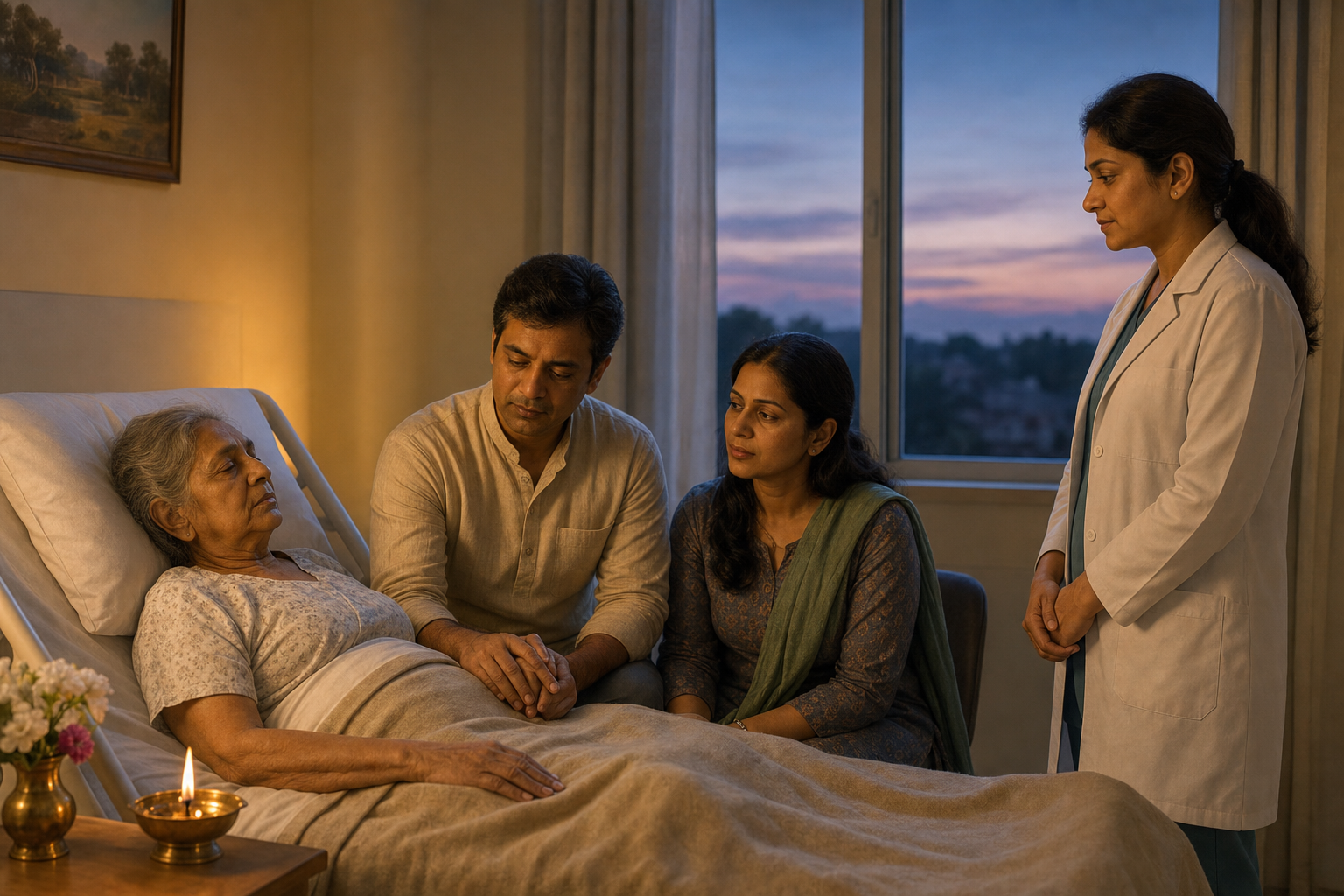
If you are sitting beside someone on life support and have been asked to speak for them, the decision can feel morally impossible. Medical uncertainty, family fear, spiritual duty, and your wish for more time may all be present in the same room.
Your task is not to decide whether the person’s life is worth fighting for. It is to determine whether the treatment still serves that person. Sometimes love supports another attempt at recovery. Sometimes love changes from holding on to permitting comfort and release. The distinction depends on the person’s wishes, the medical trajectory, the burdens of treatment, and what recovery can realistically mean.
Key takeaways
- If you are the surrogate decision-maker, represent the patient’s values rather than your own tolerance for loss.
- Ask what each treatment is expected to accomplish now, not merely whether it can keep the body alive longer.
- A vital sign or laboratory result is only one part of prognosis. Ask about the overall trajectory, neurological responsiveness, organ support, and likely functional outcome.
- Dharmic non-attachment is not indifference, abandonment, or a command to stop treatment. It is the discipline of seeing clearly before acting compassionately.
- Comfort-focused care remains active care. It addresses physical distress as well as emotional, social, and spiritual suffering.
- Grief, doubt, and yearning after a decision do not prove that the decision was wrong.
Start with the goal of treatment, not the machinery

Life support is a set of medical treatments, not a moral verdict. A ventilator or another form of organ support may create time for a reversible condition to improve. The same intervention may later become burdensome when recovery is no longer medically attainable. The machine has not changed; its relationship to the patient’s goal has.
That is why the most useful question is not simply whether treatment can continue. Ask what continuing it is reasonably expected to achieve. If the answer is recovery to a condition the person would accept, continued treatment may be proportionate. If the answer is only further physiological support without a realistic path to the person’s goals, the ethical balance may shift toward comfort.
Four ethical lenses can help you examine that balance:
- Autonomy: What did the person say, write, or consistently demonstrate about serious illness, dependence, awareness, and acceptable quality of life?
- Beneficence: What genuine good is the treatment now providing for this particular person?
- Nonmaleficence: What pain, agitation, invasive intervention, loss of dignity, or prolonged suffering might continued treatment impose?
- Proportionality: Are the likely benefits large enough to justify those burdens?
No single lens should be used as a slogan. Autonomy is more than asking what you would want. Avoiding harm does not mean refusing every uncomfortable treatment, because temporary burdens may be justified by a realistic prospect of recovery. Proportionality requires both sides of the ledger: the harms of stopping too soon and the harms of continuing when treatment no longer reaches its intended goal.
Many clinical and ethical frameworks regard withholding a life-sustaining treatment and later withdrawing that treatment as ethically equivalent when it no longer meets the patient’s goals or imposes disproportionate burdens. Local law, consent rules, and hospital procedures can differ. Ask the treating physician who has decision-making authority, and let the clinical team carry out any change. Never alter life-support equipment or medication yourself.
When mechanical ventilation is withdrawn because recovery is no longer attainable, the process may be called compassionate extubation. The goal changes from reversing disease to relieving distress. It should be planned and carried out by the medical team with palliative measures in place. Ending an ineffective intervention does not mean ending care.
Turn prognosis into questions you can actually decide
Families often cling to isolated numbers because numbers feel solid. A better blood pressure reading or laboratory value may matter, but it cannot answer the whole question. Clinicians judge trajectory through several kinds of information, including neurological responsiveness, sedation and agitation, organ-support requirements, the underlying illness, and whether the person’s function is improving.
Ask for a family meeting with the attending physician and, when available, nursing, palliative-care, social-work, and spiritual-care representatives. Bring the person who can listen and take notes when you cannot. These questions make the meeting more useful:
- What problem is each treatment addressing? Ask which interventions treat the underlying condition and which temporarily replace a failing body function.
- What is reversible? Request a plain-language explanation of what can still improve and what the team believes will not.
- What are the best, worst, and most likely outcomes? Ask about awareness, communication, breathing, dependence, and the level of care likely to be required, not survival alone.
- What evidence would show meaningful improvement? Ask the team to identify observable clinical markers rather than relying on phrases such as wait and see.
- If uncertainty remains, would a defined treatment trial be appropriate? Agree in advance on the goal, the clinical signs that would count as success, and when the team will reassess. A trial without an agreed endpoint can quietly become indefinite treatment.
- What burdens is the patient experiencing? Include pain, breathlessness, agitation, invasive procedures, isolation, and loss of meaningful responsiveness.
- What would comfort-focused care involve? Ask how pain, breathlessness, agitation, and other distress would be managed, who could remain at the bedside, and how the family’s spiritual needs could be accommodated.
Represent the person instead of taking a family vote
The central surrogate question is not what the family prefers. It is what the patient would choose if able to understand the present facts. Start with any clear prior statement. Then consider the person’s enduring values: independence, mental awareness, willingness to endure burdens for a chance of recovery, religious commitments, and attitudes toward prolonged dependence.
Do not turn one casual comment from years ago into a complete answer. Look for consistency across what the person said and how they lived. If their wishes remain unknown, ask which course best protects their welfare while avoiding disproportionate harm.
Family conflict often grows because relatives are answering different questions. One person is asking whether a miracle is possible. Another is asking whether recovery is medically likely. Someone else is asking whether stopping treatment would make them disloyal. Put those questions on the table separately. If disagreement continues, request help from palliative care or the hospital’s ethics process rather than allowing the loudest relative to settle it.
Keep a decision record for the days when guilt returns
Write down the patient’s known wishes, the medical team’s explanation, the expected benefits and burdens, the alternatives discussed, and the reason for the final decision. This is not an attempt to make grief bureaucratic. It preserves what you knew at the time. Later, when your mind asks whether one more intervention might have changed everything, you will have something more reliable than memory shaped by longing.
If the goal changes to comfort, ask for a bedside plan. Find out whom the hospital can accommodate, which prayers or recitations are possible, whether a trusted spiritual adviser can attend, and whom to call if distress appears. Palliative care attends to total pain: physical symptoms, emotional fear, social rupture, and spiritual concern. Each dimension deserves explicit attention.
Dharmic non-attachment does not mean abandoning care

Dharmic traditions do not share one theology of death, and their teachings should not be collapsed into interchangeable vocabulary. Yet they offer related disciplines for acting when love cannot control the outcome.
- Hindu traditions: Vairagya is discerning non-attachment, not emotional coldness. Alongside the Bhagavad Gita’s emphasis on duty and clarity amid unavoidable loss, it asks you to perform the responsibility in front of you without making control of the result the measure of love.
- Buddhist traditions: Anicca, or impermanence, directs attention to change as it is occurring. Acceptance does not remove sorrow. It can prevent the wish for a different reality from disguising itself as a medical argument.
- Jain traditions: Aparigraha challenges possessive grasping. Joined with concern for non-harm, it asks you to examine whether continued intervention benefits the person or mainly postpones your confrontation with separation.
- Sikh tradition: Hukam invites alignment with the unfolding order, while chardi kala and seva keep acceptance from becoming passivity. You can acknowledge what cannot be controlled and still serve courageously through presence, advocacy, and practical care.
None of these teachings produces an automatic answer about life support. Non-attachment cannot substitute for a neurological assessment. Hukam should not be used to silence reasonable medical questions. Ahimsa does not require either stopping every burdensome treatment or extending biological life at any cost. A responsible decision considers intention, prognosis, the person’s wishes, likely benefit, avoidable harm, and the manner in which care is given.
If you seek religious counsel, choose a priest, monk, nun, granthi, teacher, or community elder who understands the patient’s actual lineage and is willing to hear the clinical facts. A spiritual adviser can help interpret duty, ritual, and conscience. The medical team must still explain prognosis and manage treatment, and the legally authorised decision-maker must still follow the applicable consent process.
Pause before fear becomes a moral instruction
Clinging is not only an idea. It can appear as a braced jaw, a tight chest, shallow breathing, or an urgent need to demand action before you understand the options. Those sensations show that your nervous system is activated; they do not tell you which decision is ethically right.
- Feel the chair or floor supporting your body.
- Name the strongest sensation without trying to argue it away.
- Soften muscular bracing where you can and allow the exhale to lengthen without forcing your breath.
- Ask whether you are representing the patient’s values or trying to escape your own fear of loss.
- Return to the medical facts and identify the question that remains unanswered.
This pause is not a decision technique by itself. It creates enough space to distinguish love from panic. If the person can still hear you, simple words may be more useful than an elaborate speech: you are here, they are loved, their efforts are recognised, and the family will continue to care for one another. Permission to rest can be offered without claiming certainty about when death will occur.
Grief after the decision is not a verdict on the decision

After an end-of-life decision, ordinary life can look offensive in its normality. Traffic moves, people work, and meals are served while your world has been divided into before and after. Grief may first occupy nearly every moment and later become a quieter ache. Neither pattern means that love has weakened.
The dual process model of bereavement describes movement between loss-oriented experience and restoration-oriented life. At one moment you may yearn, remember, or cry. At another you may answer messages, handle practical tasks, or laugh. Moving toward daily life is not betrayal, and returning to sorrow is not failure.
Continuing bonds offer another useful frame. You do not have to erase the relationship in order to accept the death. Prayer, remembrance, charitable service, family stories, a written account of the person’s values, and rituals from your own tradition can give love a form that does not depend on physical possession.
When guilt begins to retry the decision, return to the conditions under which it was made:
- What did the clinicians believe was medically attainable at that time?
- Which wishes or values of the person guided you?
- What benefits and burdens were considered?
- Did care continue through symptom relief, dignity, spiritual attention, and presence?
- Are you judging the decision using information that was unavailable then?
- Is the thought that you caused the death actually expressing the wish that you could have prevented every loss?
This review cannot guarantee emotional certainty. It can stop grief from rewriting compassionate discernment as abandonment. Missing the person and believing that comfort-focused care was appropriate can both be true.
Work with grief in tolerable portions. Notice where it appears in the body, stay with the sensation only as long as you can remain grounded, and then orient toward a supportive person, familiar prayer, ordinary task, or stable feature of the room. Reflective writing can help you separate the medical decision, the death itself, and the relationship you still carry. They are connected, but they are not the same event.
Spiritual practice can accompany professional care, but it should not replace it. Seek prompt help from a qualified mental-health clinician, bereavement professional, palliative-care social worker, or physician if grief is preventing basic self-care, driving dangerous substance use, or making daily functioning feel unmanageable. If you may harm yourself or cannot remain safe, contact local emergency services immediately and stay with another person while help is arranged.
Before the next family meeting, write down the patient’s clearest value, the present goal of treatment, and the question the clinical team has not yet answered. Take those words into the room. Choose the course that best represents the person, reduces avoidable harm, and keeps care active even if cure is no longer possible. That is love disciplined by truth rather than measured by control.
References
