
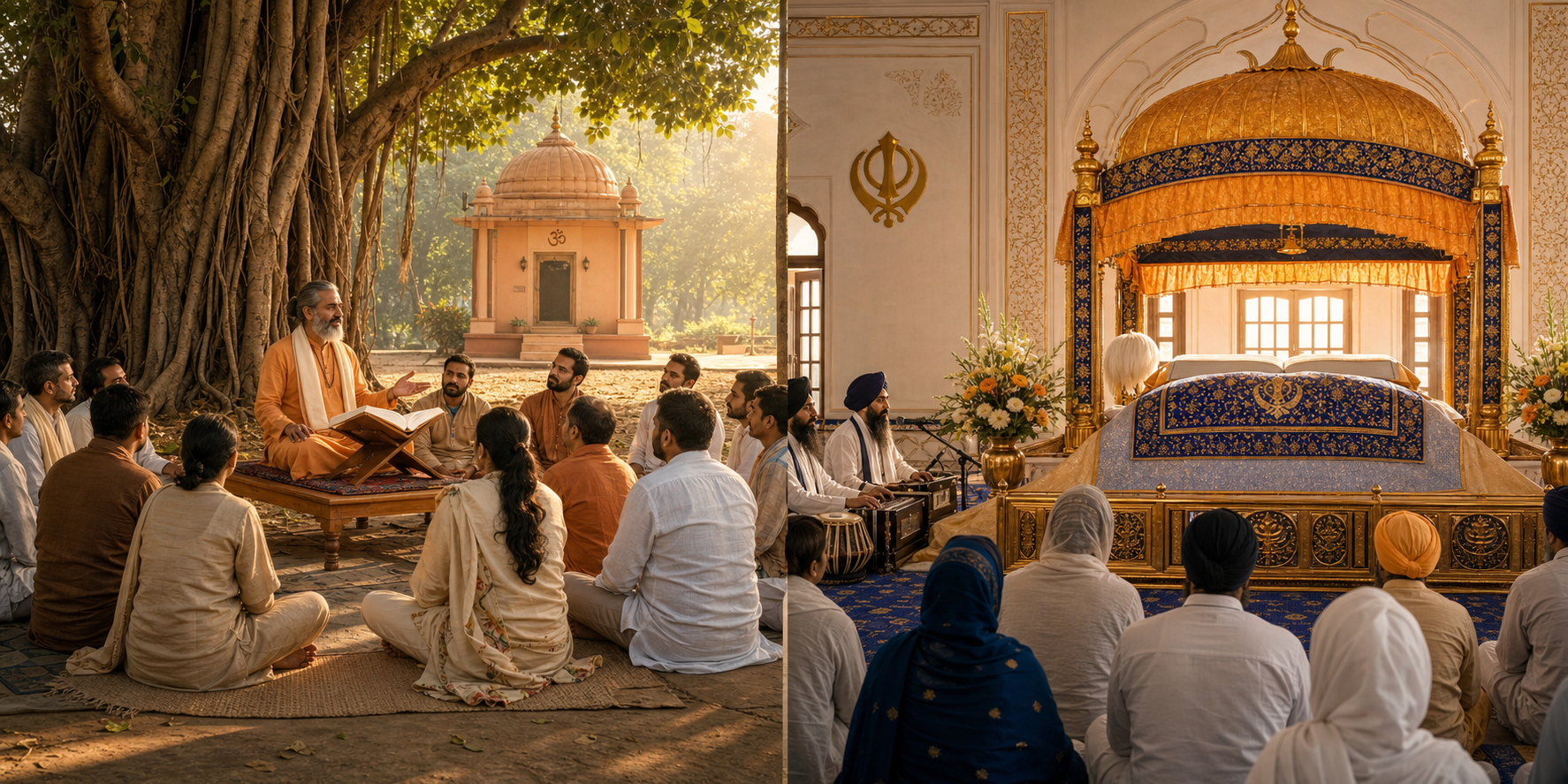
If you are explaining Hinduism and Sikhism to your family, preparing an interfaith event, or entering a gurdwara after years of Hindu satsang, one word can create most of the confusion: Guru. It sounds familiar enough to invite an easy equivalence, yet it carries a different structure of authority in each tradition.
The useful answer is not that Hindus follow human gurus while Sikhs follow a book. That formula diminishes the Hindu understanding of guru-tattva and the Sikh understanding of Guru Granth Sahib. The more accurate view is that both traditions treat sacred knowledge as transformative, disciplined, and inseparable from service, but they do not locate Guruship in the same way.
The same word names two different structures of authority
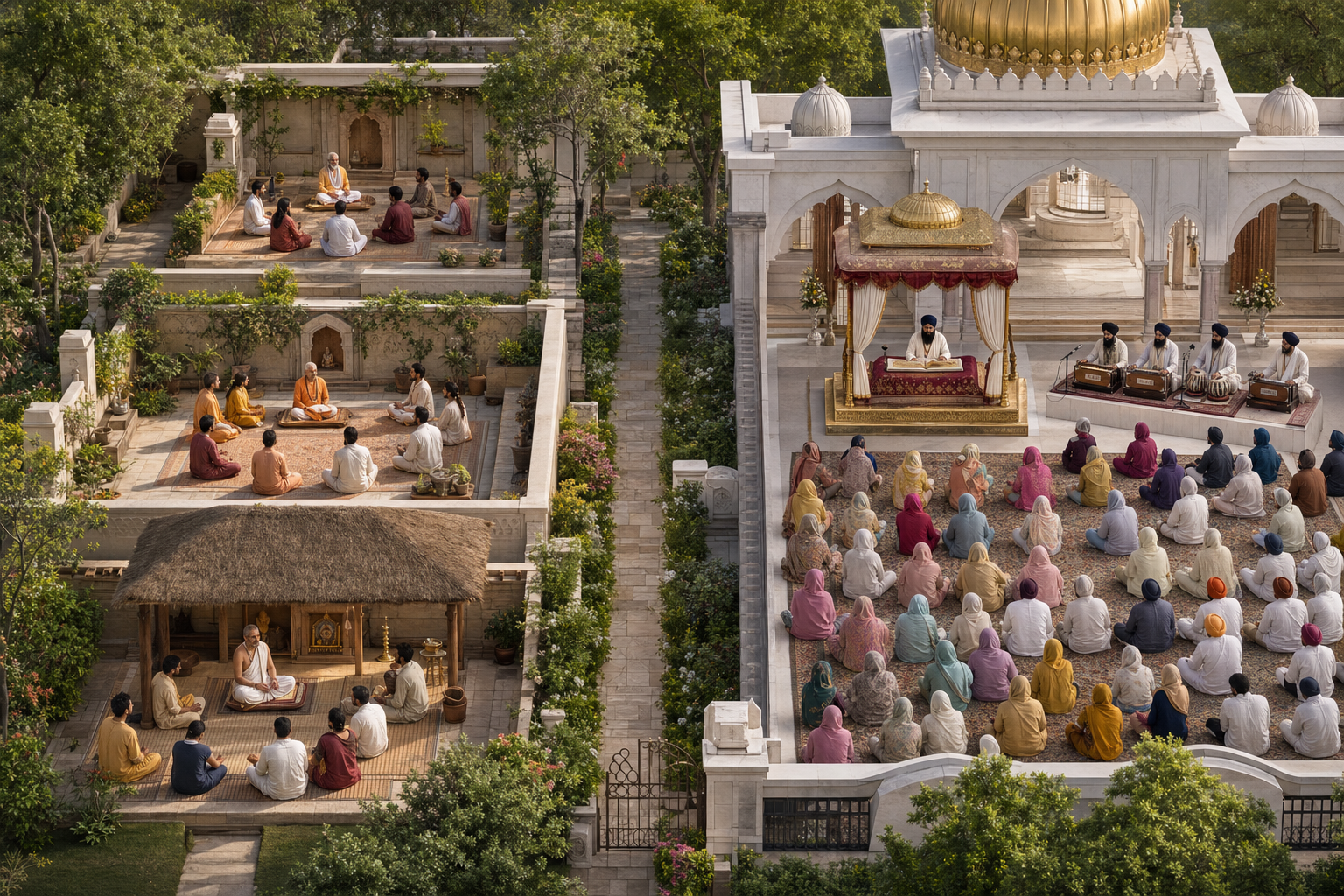
In many Hindu sampradayas, the Guru stands within a relationship among teacher, disciple, lineage, sacred knowledge, and sadhana. The Guru does more than provide information. The teacher explains a path, corrects misunderstanding, gives practices appropriate to the lineage, and helps the shishya turn knowledge into conduct. The forms vary because Hindu traditions include paths centred on bhakti, jnana, karma, yoga, and combinations of these.
This diversity makes it important to ask what a Hindu speaker means by Guru. The word may refer to a living lineage-holder, an initiating teacher, an acharya, an exemplary sage such as Veda Vyasa, or the deeper principle of guidance called guru-tattva. Contemporary observances may also honour parents, academic teachers, artistic mentors, and community guides. Those uses express gratitude, but they do not automatically give every mentor the same ritual or theological status.
The Hindu ideal is therefore personal without being reducible to personality. Guru-tattva joins discernment, disciplined conduct, and liberating knowledge. Reverence for a teacher is meant to sharpen viveka, not abolish it. A personality cult that demands admiration while neglecting truth, study, dharma, and inner refinement contradicts that ideal, however impressive its outward language may be.
Sikh tradition gives Guru a more specifically defined historical and scriptural form. The line of the Sikh Gurus culminates with Guru Gobind Singh Ji. At Nanded in 1708, before the end of his earthly life, Guru Gobind Singh Ji affirmed Guru Granth Sahib as the eternal Guru of the Sikhs. The succession does not continue through an open-ended series of present-day human gurus.
This does not mean that Sikhs have no teachers, interpreters, musicians, office-holders, or elders. It means that none of them becomes a personal successor who displaces the Guruship of Guru Granth Sahib. Sikh spiritual authority is encountered through the Guru’s Shabad, received through recitation, kirtan, reflection, disciplined living, and the collective life of the sangat. If you are looking for the closest Sikh equivalent of a contemporary Hindu lineage-guru, you are beginning with the wrong institutional expectation.
Use four questions to compare the traditions accurately
A useful comparison begins with functions, not labels. Ask where authority rests, how teaching is received, what ritual makes that authority visible, and which calendar observance carries the tradition’s memory. This keeps genuine similarities visible without forcing either tradition into the other’s mould.
| Question | Many Hindu traditions | Sikh tradition | What you should notice |
|---|---|---|---|
| Where does Guruship reside? | Guru-tattva may be embodied through a living teacher and lineage, with sages such as Veda Vyasa serving as archetypal teachers. | The historical Gurus culminate in the eternal Guruship of Guru Granth Sahib. | Do not turn a shared title into an identical office. |
| How is teaching received? | Through instruction, dialogue, initiation where applicable, scriptural study, and sustained sadhana under a lineage or teacher. | Through Shabad, recitation, kirtan, Nitnem, Hukamnama, reflection, and life within the sangat. | Both require practice; neither treats knowledge as information alone. |
| How is reverence expressed? | Forms may include Guru Puja, Vyasa Puja, offerings, dakshina, study, fasting, and service. | Guru Granth Sahib is ceremonially enthroned; daily maryada includes Prakash and Sukhasan, with seva and langar shaping community life. | The visible form of honour reveals where each tradition locates authority. |
| Which observance is central? | Guru Purnima or Vyasa Purnima is a major occasion for honouring teachers, renewing study, and serving others. | Gurpurabs are the central calendrical commemorations. Guru Purnima is not a universal Sikh counterpart to them. | A shared civilizational season does not create a shared liturgical calendar. |
The table describes broad structures, not every Hindu sampradaya or every local Sikh custom. When you encounter a specific community, ask how it names its own practice. That small act of attention is more respectful than applying a polished generalization that the community itself would not recognize.
Ritual practice shows what Guru means
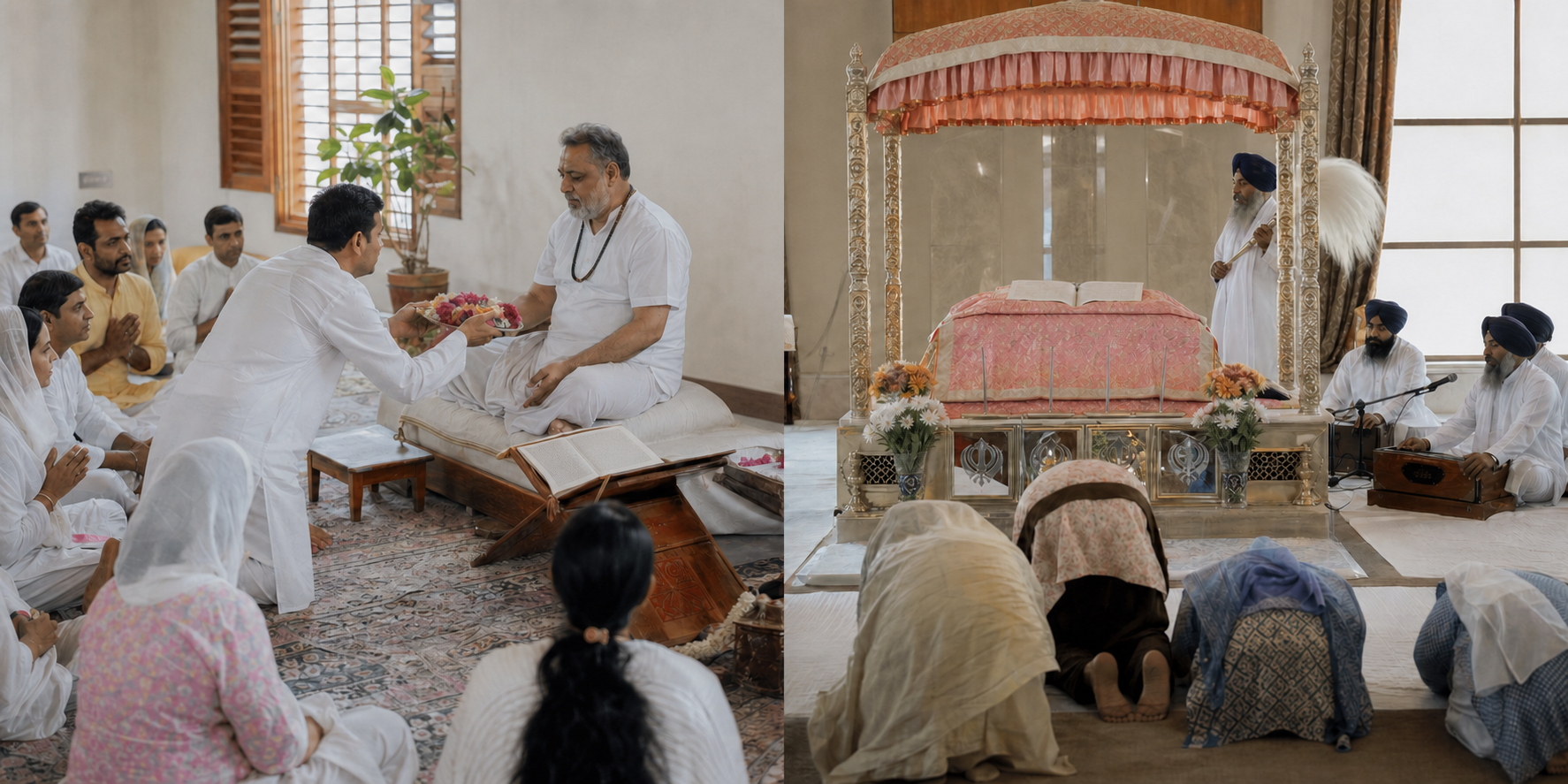
The clearest way to understand these traditions is to watch what each community actually does around sacred authority. Ritual is not decorative evidence added after theology. It trains the body, memory, and community to recognize where guidance resides.
Guru Purnima renews a Hindu relationship of learning
Ashadha Purnima is widely observed as Guru Purnima or Veda Vyasa Purnima. In 2026 it falls on 29 July, although exact tithi spans and ceremonial timings depend on the local panchanga. Veda Vyasa is honoured for the vast work traditionally associated with preserving, organizing, and transmitting sacred knowledge, including the classification of the Vedas and the composition of the Mahabharata.
A household or institutional Vyasa Puja may move through sankalpa, acamana, avahana, and panchopachara or shodashopachara offerings. Flowers, a lamp, incense, fruit, and sattvic food make gratitude visible. Recitations may be taken from the Bhagavad Gita, Upanishads, or Guru Gita. Dakshina, annadana, book donations, and support for learning extend the observance beyond the altar.
If you participate, do not let the offering become the entire act. The practical centre is a renewed obligation to learn. Choose a text, language, art, or discipline; identify the teacher or institution responsible for guiding it; and decide what regular practice begins after the full moon. Guru Purnima joins puja to svadhyaya, dakshina, and seva, so gratitude that produces no deeper study or service remains incomplete.
If you are visiting an unfamiliar Hindu gathering, ask three concrete questions before assuming the format: Which sampradaya or lineage is hosting it? Is the focus Veda Vyasa, a lineage of acharyas, or a living teacher? Is the expected participation ritual offering, scriptural study, seva, or some combination? Hindu plurality makes those questions necessary rather than impolite.
Sikh maryada makes scriptural Guruship visible
In a gurdwara, the ceremonial opening of Guru Granth Sahib is called Prakash, while Sukhasan marks its ceremonial repose. Nitnem, kirtan, and the Hukamnama order the community’s attention around the Guru’s Shabad. These practices make clear why calling Guru Granth Sahib merely a Sikh holy book misses the relationship being enacted. A reference book is consulted when convenient; the Guru addresses, forms, and guides the community.
Langar and seva then carry that instruction into social practice. People sit and eat together without status distinctions, while volunteers perform the work needed to sustain the gathering. The test of hearing the Guru is not confined to correct recitation. It includes truthful conduct, humility, service, and the equal dignity made tangible in the gurdwara.
If you visit, wear clean, modest clothing, cover your head, and follow the local maryada. Direct your attention toward Guru Granth Sahib rather than asking who the current human Guru is. Join langar without seeking a privileged place, and treat service as part of the religious life of the space rather than as hospitality operating beside it.
Local practice should not be carelessly universalized. Takht Sri Hazur Sahib at Nanded, one of Sikhism’s five Takhts and the site associated with Guru Gobind Singh Ji’s final earthly days, preserves shastar connected with the Khalsa tradition and gives the Dasam Granth a respected liturgical place. Its distinctive maryada conserves an early Khalsa inheritance. Those features tell you something important about Hazur Sahib, but they are not a licence to assume that every gurdwara follows every site-specific custom in the same form.
A Takht should also not be mistaken for another Guru. The Takhts are seats of temporal-spiritual authority, memory, deliberation, and Panthic cohesion. They serve institutional functions within Sikh life while Guru Granth Sahib remains the eternal Guru. Keeping those two kinds of authority distinct prevents a common category error.
Speak of kinship without erasing the boundary
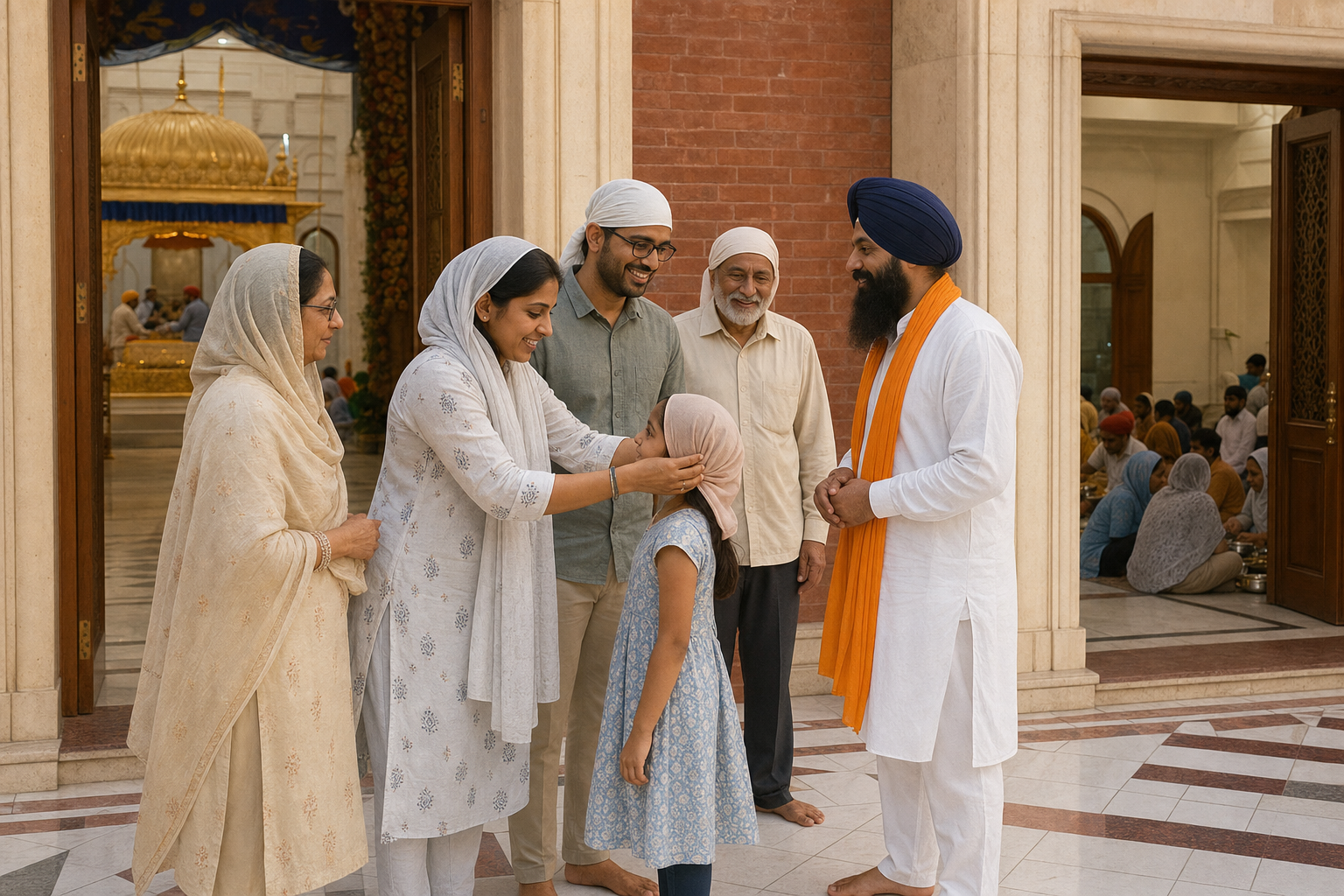
Hindu and Sikh traditions can be discussed as members of a shared Bharatiya civilizational world without declaring them doctrinally interchangeable. The strongest common ground is ethical and pedagogical: truth must be lived, knowledge requires discipline, remembrance must shape conduct, and spiritual formation should issue in service. Hindu annadana and the Sikh institution of langar are not the same rite, but both prevent religious learning from becoming a private possession detached from the needs of others.
The differences are equally substantive. Hindu traditions allow multiple sampradayas, teachers, lineages, and theological accounts of the Guru principle. Sikh tradition remembers a defined historical succession whose Guruship rests eternally with Guru Granth Sahib. Respectful unity begins when you can state both sentences without treating either as an inconvenience.
- Do not say that every Dharmic religion has the same Guru system. Say that Hindu and Sikh traditions share a conviction that sacred knowledge must transform conduct, while structuring Guruship differently.
- Do not describe Hindu devotion to a Guru as automatic surrender of judgement. The classical ideal binds reverence to viveka, svadhyaya, achara, and responsibility. The Guru should form discernment rather than demand its disappearance.
- Do not call Guru Granth Sahib only the Sikh equivalent of a Hindu scripture. Name its eternal Guruship and explain that Prakash, Sukhasan, kirtan, and Hukamnama enact that status.
- Do not present Guru Purnima as a Sikh festival parallel to Hindu Vyasa Puja. Gurpurabs remain the central Sikh calendar markers. Some Sikh communities may use the Ashadha full moon for reflection on gurmat, truthful living, seva, and remembrance of Shabad, but that does not make the observances identical.
- Do not use shared origins or values to silence distinct self-understanding. Civilizational kinship is credible when it can accommodate doctrinal boundaries, different institutions, and different ritual vocabularies.
For a classroom, family discussion, or public programme, one sentence is usually sufficient: Hindu guru traditions commonly transmit knowledge through diverse teachers and lineages, while Sikh Guruship culminates in Guru Granth Sahib; both insist that true learning become disciplined and ethical life. That wording identifies the kinship and the distinction without turning either community into a footnote to the other.
Key takeaways for your next encounter
- Ask where spiritual authority resides before assuming that the word Guru means the same office in both traditions.
- In Hindu settings, identify the sampradaya, lineage, teacher, text, and form of sadhana involved.
- In Sikh settings, recognize Guru Granth Sahib as the eternal Guru and understand Shabad, kirtan, Hukamnama, and maryada in that light.
- Treat Guru Purnima and Sikh Gurpurabs as distinct observances, even when discussing their shared emphasis on remembrance, discipline, and service.
- Read ritual as theology in action: Vyasa Puja renews a teacher-student commitment, while Prakash and Sukhasan manifest scriptural Guruship.
- Use shared Dharmic values to build understanding, not to erase the names and boundaries through which each tradition understands itself.
The next time you hear Guru, pause before translating it into a familiar category. Ask who or what holds authority, how the teaching reaches the practitioner, and which practice makes that relationship visible. At a Hindu gathering, learn the lineage before describing it. At a gurdwara, follow the maryada and listen for the Shabad. That is a small discipline, but it is the difference between merely noticing resemblance and understanding a tradition on its own terms.
References
- DharmaRenaissance Blog – Ashadha Purnima (Guru Purnima) 2026: Date, Rituals, Vyasa Puja Guide & Dharmic Unity
- SikhNet – Takht Sri Hazur Sahib, Nanded: Final Abode of Guru Gobind Singh and the Living Heart of Khalsa
