
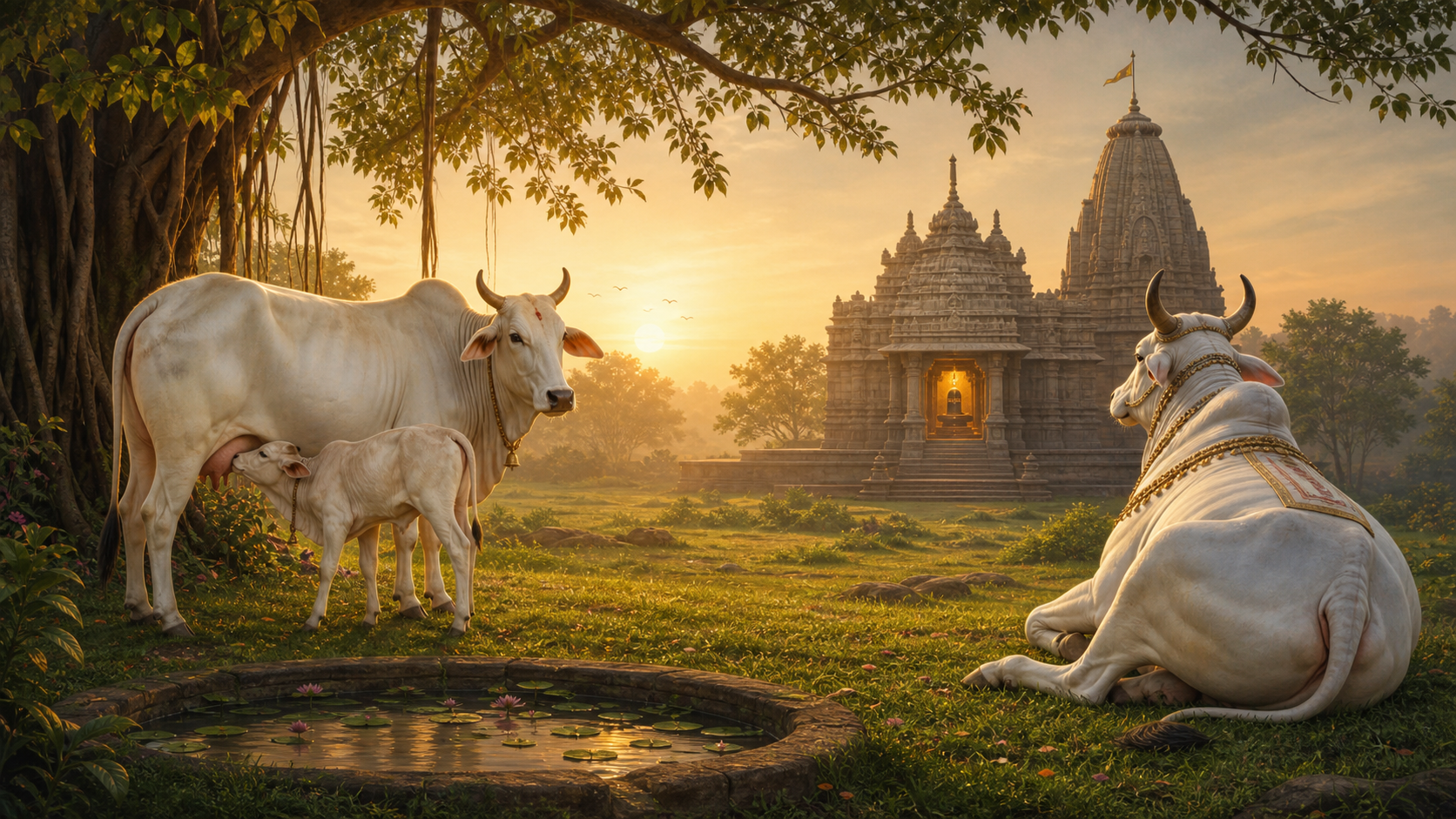
You may have stood before Nandi in a Shiva temple, seen cows surrounding Krishna, and wondered what reverence for these animals is actually asking of you. Calling it either “animal worship” or a celebration of agricultural life misses the point. The images are also instructions: one teaches you how to protect what nourishes life; the other teaches you how to govern power without destroying it.
The most useful way to read the cow and bull is therefore not to ask, “What does this animal stand for?” as though each had one fixed definition. Ask two harder questions: What capacity is being made sacred, and what duty follows from receiving that capacity? The cow places abundance under care. The bull places strength under discipline. Together they show how prosperity, moral order, and inner transformation depend on one another.
Begin with the relationship, not just the animal
The first distinction prevents a common misunderstanding. Nandi has a direct iconographic relationship with Shiva as vāhana, attendant, gatekeeper, and exemplary devotee. The cow’s relationship with Vishnu is not a matching vāhana arrangement; Vishnu’s vāhana is Garuḍa. Cow symbolism enters the Vaishnava field most vividly through Krishna, especially through the names Govinda and Gopāla and the pastoral world they evoke.
This asymmetry matters. If you force cow and bull into a tidy pair of divine vehicles, you lose much of their meaning. Krishna tends cows, shelters a vulnerable community, and makes preservation intimate. Nandi faces Shiva in composed attention, showing how vital force becomes capable of approaching the sacred. One relationship is expressed through guardianship and nourishment; the other through alignment and disciplined presence.
The Sanskrit vocabulary opens further layers. Go ordinarily means cow or cattle, but its symbolic range can include speech, light, rays, knowledge, and the faculties through which we encounter the world. Vṛṣa and vṛṣabha name the bull and carry associations of vigor, fertility, strength, and dharma; vṛṣa can itself denote righteousness. These meanings should not be substituted mechanically every time a word appears. They form a field of associations that poets, theologians, ritual traditions, and temple builders use according to context.
When you encounter either animal in a story, sculpture, or ritual setting, use three questions:
- What is the animal doing? Grazing, yielding, protecting, carrying, waiting, listening, or confronting each points toward a different lesson.
- How does the divine figure relate to it? Krishna tends the herd; Shiva receives Nandi’s unwavering gaze. The relationship carries more meaning than an isolated animal emblem.
- What obligation follows? A sacred symbol is incomplete if it produces admiration but no change in conduct. Look for a demand to protect, share, restrain, persevere, or pay attention.
This method avoids three reductions at once. The animals are not merely objects of irrational devotion, not merely fertility emblems, and not interchangeable signs of “nature.” They belong to a moral vocabulary in which living power becomes auspicious when it is joined to responsibility.
The cow makes nourishment answerable to dharma
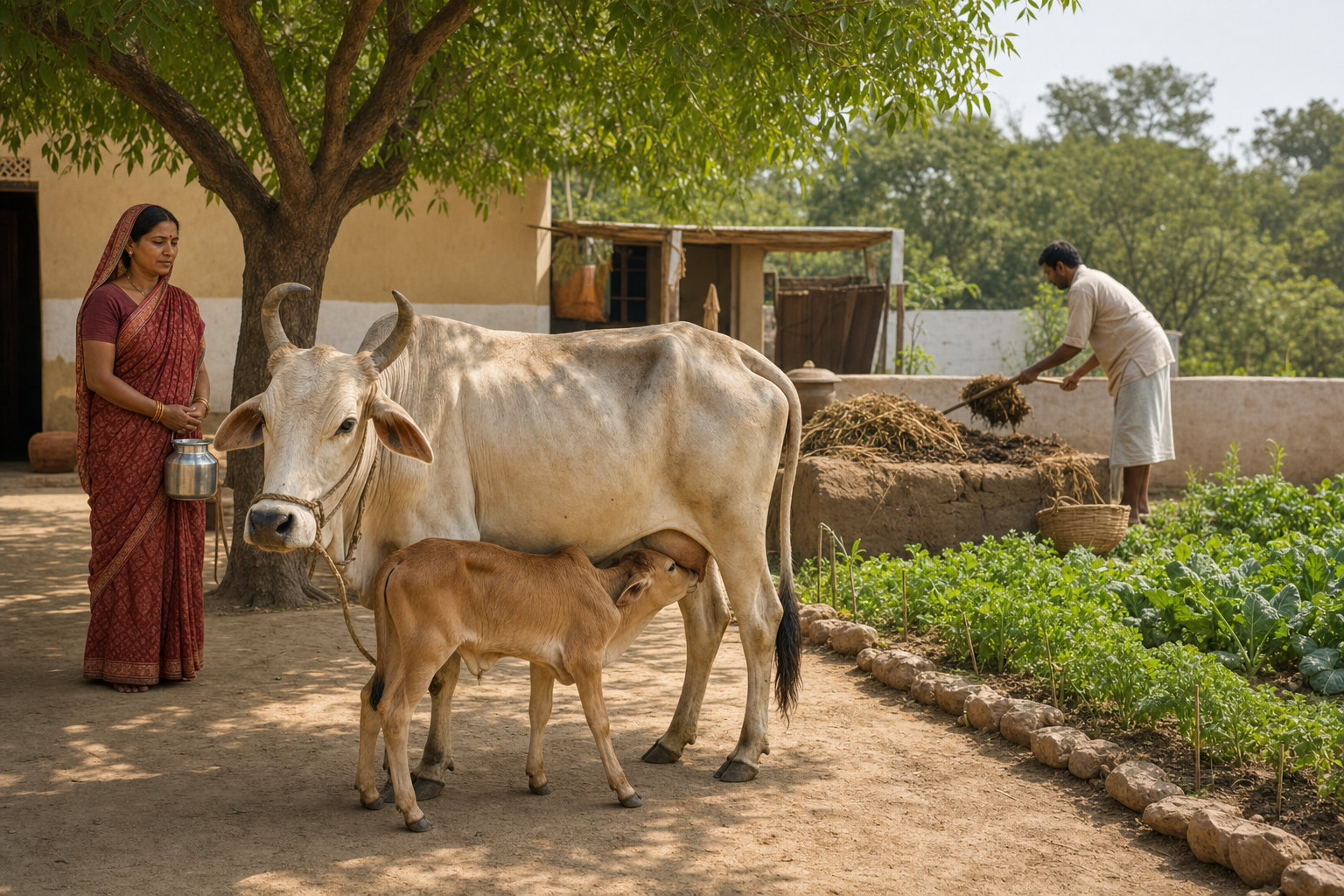
A cow gives without appearing predatory. That visible pattern of nourishment makes it a fitting image for wealth that sustains life rather than wealth gained through conquest. Krishna’s care for cows therefore does more than decorate an idyllic childhood. Govinda and Gopāla reveal preservation as a daily relationship with dependent beings. Protection is not performed once; it consists of feeding, sheltering, watching, and returning day after day.
This is Vishnu’s preservative principle brought down to the scale of village life. Vishnu is associated with stability, clarity, and the maintenance of cosmic and moral order. Krishna’s pastoral form shows what that order looks like from the ground: vulnerable life is guarded, resources circulate through a community, and prosperity is legitimate only when compassion governs its use.
Surabhi, also known as Kamadhenu, emerges during the Samudra Manthana as a giver of abundance. Milk and ghee connect that abundance with yajña, where receiving and returning belong to the same cycle. The symbol is not a promise that desire should be endlessly satisfied. It places provision inside ritual obligation. A boon becomes auspicious when it sustains a larger order rather than enlarging appetite without limit.
The Mahābhārata and related traditions likewise praise go-dāna, the gift of a cow. Its social logic is easier to see when you stop treating the gift as a magical transaction. A productive living resource moves into another household or sacred institution, carrying the possibility of food, ritual provision, continuity, and livelihood. Giving redistributes the means of sustenance while binding wealth to duty.
The association between cow and Pṛthvī, the Earth, enlarges the same principle. Earth can be imagined as a patient mother whose bounty sustains many beings. Images of “milking” the Earth are easily distorted if they are detached from dharma. They do not make extraction limitless. They imply dependence: the beneficiary must preserve the conditions from which the benefit comes. The cow–Earth correspondence turns consumption into a relationship of reciprocity.
That gives you a concrete test for any modern appeal to cow protection. Do not judge it by the intensity of its rhetoric. Ask what happens to the actual animal:
- Is food, shelter, space, and competent care available throughout the animal’s life?
- Does responsibility continue when the animal is no longer economically productive?
- Are the people doing the daily work of care treated with dignity?
- Does the practice reduce harm, or merely move suffering out of sight?
- Are benefits taken while the costs of care are left to someone else?
A system that praises the cow while abandoning an aging animal has preserved an emblem and neglected its dharma. Go-rakṣā becomes spiritually serious only when protection survives the point at which profit ends.
Pañcagavya provides another example of a circular ritual imagination. Cow-derived substances are gathered and reused in disciplines of purification, and they also appear in some Ayurvedic traditions. The symbolic lesson concerns circulation and the refusal to regard useful gifts as disposable. It should not be turned into an automatic medical conclusion. Sacred use is not, by itself, evidence that every product, preparation, ingestion, or application is safe or effective. A medical claim still has to be assessed as a medical claim.
The inward interpretation of go makes the lesson personal. If cows can suggest speech, light, knowledge, or the senses, then Gopāla can be contemplated as the guardian of your faculties. Try this for one ordinary day: notice what you repeatedly allow into your attention, what kind of speech you produce, and whether those inputs leave the mind clearer or more agitated. Tending the inner herd means protecting attention before asking it to yield insight.
Nandi shows what happens when strength learns to listen
The bull presents a different problem. Strength, fertility, momentum, and generative force can build a world, but they can also injure, dominate, or dissipate themselves. Sanatana Dharma does not solve that problem by pretending vigor is impure. It asks how vigor can be made fit for worship.
Shiva as Paśupati is the lord of beings. In an inward reading, the “animal” also includes impulses that move before reflection: anger, appetite, fear, sexual energy, ambition, and the need to assert oneself. Shiva does not merely destroy these forces. He receives, contains, and transforms them. The title Vṛṣabhadhvaja, “he whose banner bears the bull,” announces command over potency rather than fear of it.
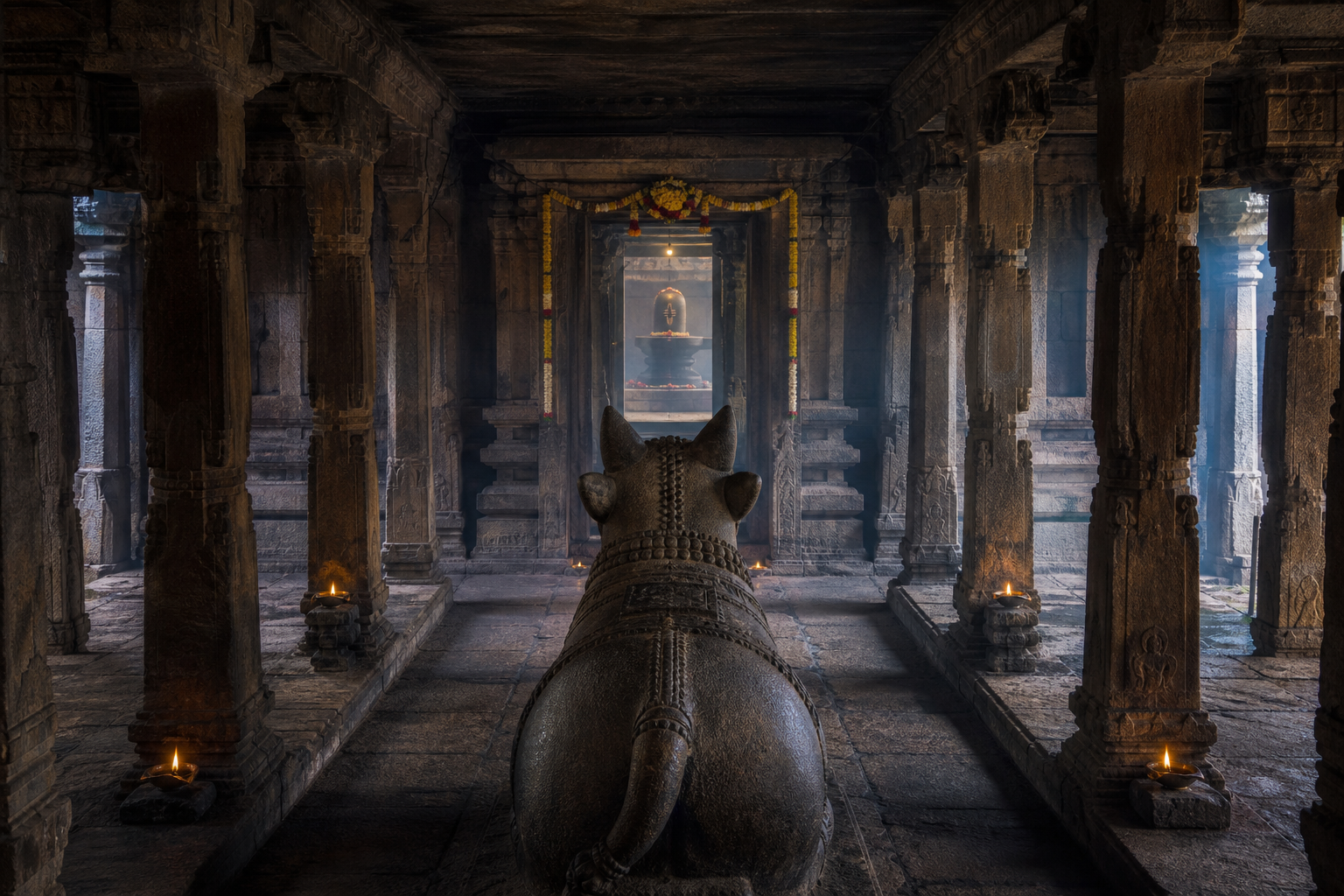
Nandi makes that transformation visible. The bull is powerful, yet seated. His ears are receptive, his body is composed, and his attention remains fixed on the liṅga. The temple alignment between Nandi and the sanctum creates a corridor of attention: strength no longer rushes wherever impulse sends it. It has acquired a direction.
This is why Nandi should not be mistaken for a celebration of brute masculinity. Aggression is power that has failed to listen. Nandi’s force has become steadiness, service, and readiness. His stillness is not weakness; it is the visible evidence that energy is no longer wasting itself.
Yogic language describes the same movement through prāṇa and retas, vital and generative energies, brought under vrata, brahmacarya, and dhyāna. A vow supplies a boundary. Brahmacarya contains energy instead of scattering it. Meditation gives it a sustained object. Ojas names the refined vitality associated with that disciplined transformation. These terms describe an inner discipline, not a reason to despise the body or suppress every desire.
The guṇa framework sharpens the distinction. Vishnu’s preservative field is closely associated with sattva: lucidity, balance, and care. Shiva should not simply be equated with tamas, as though he represented inert darkness. Shaiva thought can present him as guṇātīta, beyond the guṇas, capable of receiving and transforming the volatile mixture of rajas and tamas without being bound by it. The bull’s energy is therefore not declared evil. It is brought into conscious relationship with a transcendent center.
You can turn Nandi’s placement into a short contemplative practice whenever local temple custom and the flow of worship permit:
- Pause without blocking other devotees and notice Nandi’s seated body before looking toward the sanctum.
- Follow the line of attention from Nandi to the liṅga. Let your breathing and posture become quieter.
- Name one strong force currently moving through you. Be precise: irritation, desire, anxiety, ambition, or restlessness is more useful than calling it simply “energy.”
- Give that force one dharmic boundary. Decide what you will not do under its influence and what constructive action it will serve instead.
- Carry the vow beyond the temple. Nandi’s teaching is completed by repeated conduct, not by a moment of calm before the sanctum.
If you are angry, for example, the aim is not to become incapable of force. Refuse harmful speech, then use the energy to address the actual wrong clearly. If ambition is consuming your attention, do not pretend you have no ambition; bind it to truthful means and a responsibility larger than self-display. That is the practical difference between suppression and consecration.
Earth and Dharma reveal why the two symbols belong together
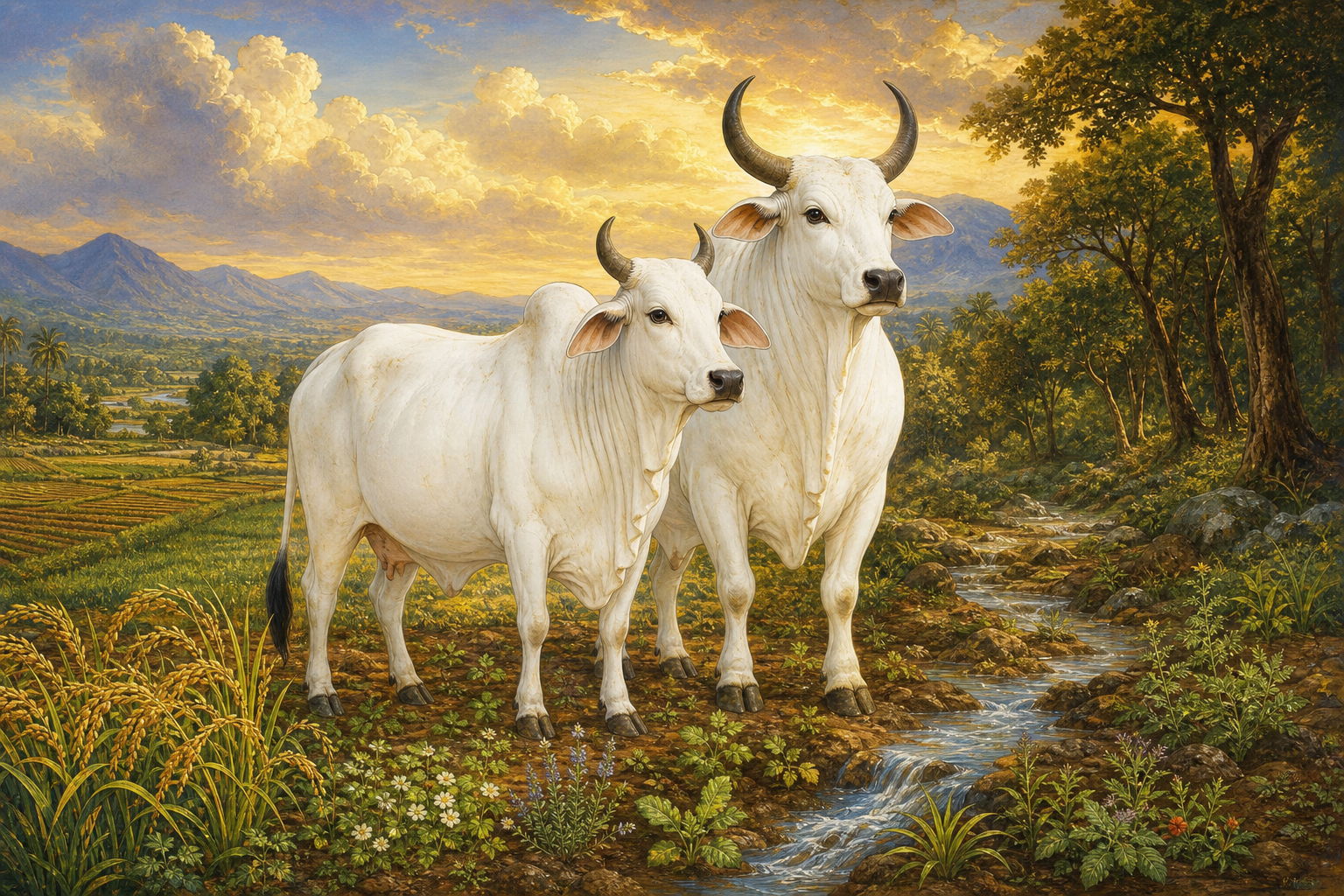
The Śrīmad-Bhāgavatam brings cow and bull into one moral scene by representing Earth as a cow and Dharma as a bull. As historical time declines through the yugas, the bull’s supports are weakened. The image makes a civilizational claim: material bounty cannot remain healthy when the moral structure supporting it is steadily damaged.
The reverse is also true. Moral language becomes sterile when it ignores the material conditions of life. A society cannot praise restraint while exhausting the land, neglecting dependent beings, or making honest livelihood impossible. Earth needs Dharma because abundance without limits becomes plunder. Dharma needs Earth because principles have to sustain embodied beings rather than hover above their needs.
| Question | Cow | Bull |
|---|---|---|
| Symbolic center | Nourishment protected by duty | Power directed by discipline |
| Primary divine field | Krishna and Vishnu’s work of preservation | Shiva and Paśupati’s work of transformation |
| Human virtue | Compassion, reciprocity, and responsible provision | Restraint, steadfastness, and focused action |
| Failure when distorted | Exploitation disguised as prosperity, or sentiment without care | Aggression, domination, or vitality squandered through impulse |
| Daily question | What depends on my protection? | What force in me needs a worthy direction? |
This pairing also explains why the imagery has an agrarian depth without being reducible to economics. The cow sustained households and ritual life, while the bull supplied labor for cultivation and transport before industrialization. Human communities received real benefits from these animals. Reverence converted that dependence into a language of obligation. The economic relationship was not supposed to erase the animal’s dignity.
Temple architecture teaches the same lesson through space. Nandi’s position makes the Shaiva approach to the sanctum a lesson in concentrated power. Vaishnava settings use Garuḍa, the bali-pīṭha, the dhvaja-stambha, and Krishna’s pastoral imagery to place protection, offering, and divine sovereignty within the devotee’s path. You are not merely walking past decoration. The approach to the deity is arranged as a curriculum.
The wider dharmic world develops related images without making identical theological claims. Zen Buddhism’s ten ox-herding pictures trace the encounter with, training of, and eventual transformation of the untamed mind. Jain tradition remembers Ṛṣabhanātha, whose name bears the sense of “Bull-Lord,” as the first Tīrthaṅkara and places radical ahiṃsā and restraint at the heart of spiritual ascent. Sikh tradition is iconographically distinct, yet kirat karo, agrarian dignity, honest labor, and reverence for creation resonate with the demand that material life be sustained ethically. These are family resemblances across dharmic traditions, not proof that their doctrines are interchangeable.
The same care is needed when sacred imagery enters public debate. A symbol cannot be used as a moral trump card that exempts conduct from scrutiny. If an appeal to cow protection produces cruelty toward people, neglect of animals, or indifference to those carrying the burden of care, it contradicts the ahiṃsā and reciprocity invoked in the cow’s name. If an appeal to strength rewards intimidation, it contradicts Nandi’s lesson of force under command. Dharma is tested in consequences as well as slogans.
Key takeaways for reading the symbols in practice
- The cow’s Vaishnava significance appears especially through Krishna as Govinda and Gopāla; it is not a second vāhana relationship parallel to Nandi and Shiva.
- Cow symbolism joins nourishment to obligation. Receiving sustenance creates duties toward the being, community, and Earth that provide it.
- Nandi represents neither passivity nor uncontrolled aggression. His posture shows strength becoming receptive, steady, and single-pointed.
- The cow as Earth and the bull as Dharma show that prosperity needs moral limits, while moral order must protect the conditions of embodied life.
- Sacred symbolism does not prove a medical claim or excuse harmful political conduct. A claim must still be judged in its proper field, and conduct must still answer to ahiṃsā.
- Use two questions whenever you meet these images: “What must be protected?” and “What power must be directed?”
Before the day ends, choose one concrete answer to each question. Improve the care of one being, resource, or relationship on which you depend. Then place one strong impulse under a clear vow that prevents harm and gives the energy useful work. The cow and bull cease to be distant symbols at precisely that point: nourishment becomes gratitude in action, and strength becomes service.
References
