

You may enter the Kathmandu Valley expecting a collection of important temples and leave wondering whether you missed the pattern connecting them. Ganesh, Kali, Pashupati, Guhyeshwari, the Mother goddesses, Bhairavas, and Buddhist deities can look like separate objects of devotion until you learn to read the valley as a mandala.
The practical question is not simply which deity represents consciousness and which represents power. It is how clear awareness becomes effective action without turning into domination, and how spiritual power remains guided by discernment. Nepal Mandala answers by placing theology in shrines, routes, images, festivals, and daily conduct.
Key takeaways
- Nepal Mandala is both a sacred region and a way of seeing. Its temple networks turn the Kathmandu Valley into an outward map of an inward spiritual process.
- Consciousness and power are inseparable. Cit is luminous awareness; Shakti is awareness acting as manifestation, concealment, revelation, and transformation.
- Two pairings make this principle concrete. Pashupatinath and Guhyeshwari express the relation between the witnessing centre and the generative matrix. Siddhi Ganesh and Siddhikali express the relation between discerning order and transformative force.
- Siddhi means accomplished capacity, not spiritual display. Its reliable signs are greater steadiness, discernment, courage, self-mastery, and ability to serve.
- A respectful visitor can contemplate the public sacred geography without imitating initiatory Tantra. Advanced mantra, yantra, nyasa, mudra, homa, and kundalini disciplines properly belong under qualified lineage guidance.
Read the valley as field, threshold, and centre

Nepal Mandala historically names the cultural and sacred region centred on the Kathmandu Valley. Calling it a mandala does not require you to imagine one centrally planned monument. It directs your attention to relationships: which shrines guard a boundary, which powers govern a threshold, which places draw you towards a centre, and how movement between them changes the pilgrim.
The field is the valley itself. Sacred places are not isolated points on a sightseeing map; they participate in networks of protection, transmission, memory, and worship. The landscape teaches by repetition. You meet a guardian in one neighbourhood, a Mother in another, a fierce protector elsewhere, and a centre of stillness beside a seat of generative power. The pattern becomes intelligible through movement.
The thresholds are marked by circuits of Bhairavas, the ring of Ashta Matrikas, and the Chaturvinayaka. A threshold is more than an entrance. It is the point at which an intention either becomes ordered or remains confused. Ganapati presides over precisely this transition: before knowledge becomes work, before aspiration becomes a vow, and before a pilgrim crosses from ordinary attention into sacred attention.
The centre is not merely a dot on a diagram. It is the condition in which awareness and its power cease pulling in different directions. The close relation between Pashupatinath and Guhyeshwari makes that teaching spatially visible: stillness is not barren, and creative power is not blind.
Notice shared grammar without erasing distinct traditions
Nepal Mandala has long been shaped by interaction among Shaiva, Shakta, and Vajrayana lineages. Buddhist sadhanas preserved in the Nishpannayogavali and Sadhanamala include forms of Ganapati, while Hindu Tantric traditions honour yoginis and Matrikas that also appear in Buddhist ritual worlds. Guhyeshwari is revered by Hindus and Buddhists, making her an especially clear sign of this intertwined sacred culture.
That does not mean the traditions are interchangeable. Shared deities, ritual technologies, or sacred places do not erase differences in refuge, initiation, vows, metaphysics, or lineage authority. You will understand Nepal Mandala more accurately if you look for a shared ritual vocabulary while allowing each community to speak its own theological language. Dharmic unity does not require uniformity.
Two sacred pairings reveal the Tantric principle
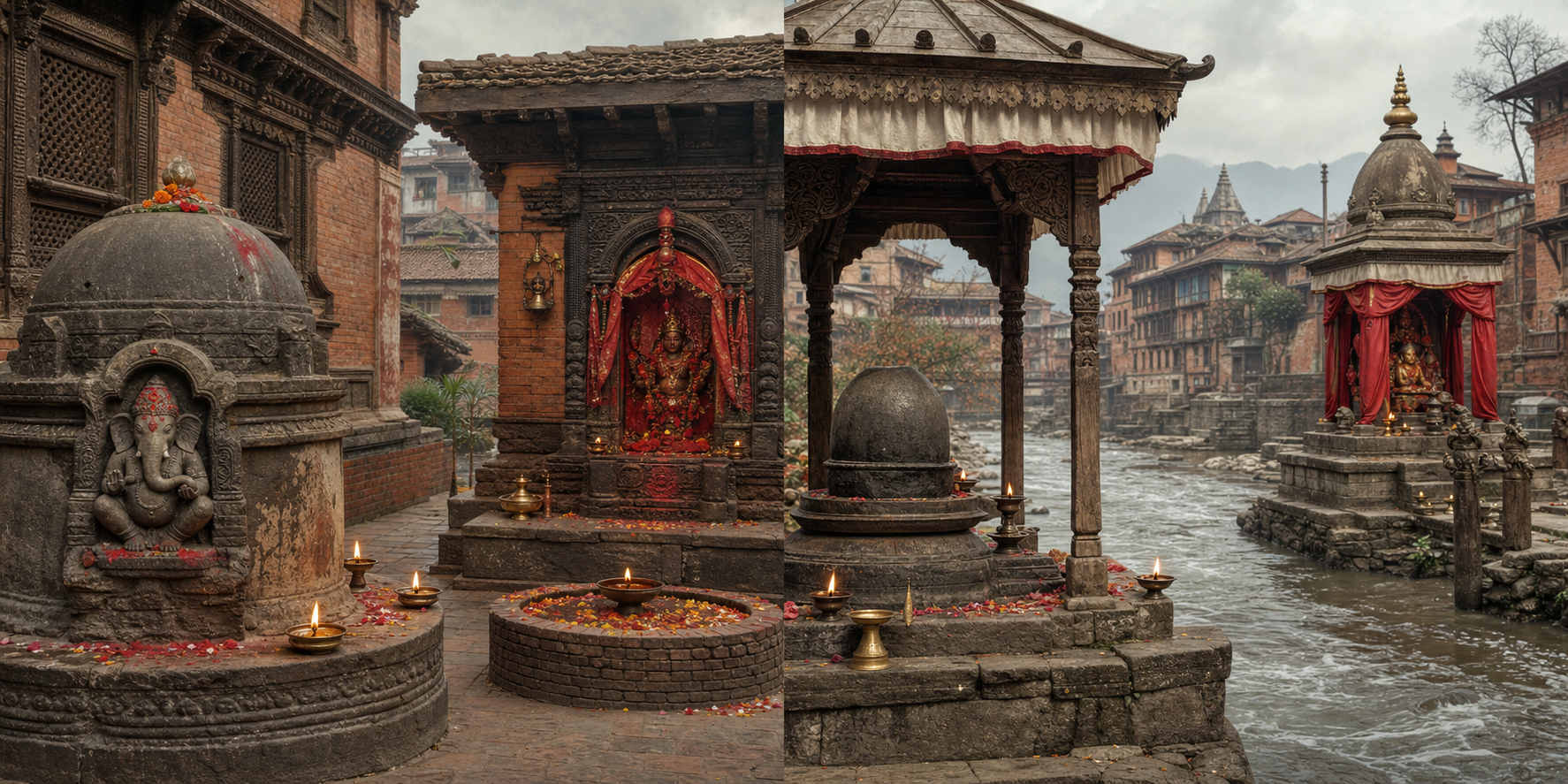
Pashupatinath and Guhyeshwari: witness and generative ground
In Tantric metaphysics, cit is self-luminous consciousness. Shakti is not an external substance added to it. She is consciousness’s inherent capacity to know, create, conceal, disclose, sustain, and transform. We can distinguish awareness and power for the sake of understanding, but we cannot finally divide them without misunderstanding both.
Pashupatinath and nearby Guhyeshwari embody this polarity within the valley. Pashupati can be contemplated as the quiet, witnessing centre. Guhyeshwari, whose name identifies her as the Lady of Secrets, is honoured as the hidden matrix from which manifestation arises. Her frequent worship in aniconic yoni form directs attention towards generative ground rather than a figure meant merely to be looked at.
If you visit both places, resist the urge to collect two impressions and move on. Carry one question from one shrine to the other. At Pashupatinath ask, “What remains aware before I react?” At Guhyeshwari ask, “What is this awareness capable of bringing forth?” The questions are contemplative prompts, not substitutes for temple liturgy. Their purpose is to help you notice the relation between clarity and capacity.
This also corrects a common mistake. Consciousness is not passivity, and Shakti is not mere emotional intensity. Awareness that never enters conduct is incomplete. Energy that refuses discernment becomes disorder. Their union means that seeing clearly and acting effectively belong to one spiritual life.
Siddhi Ganesh and Siddhikali: orientation and transformation
Siddhi is accomplished capacity: intention, discipline, and grace ripening into something that can actually be done. Ganapati is invoked at beginnings because he governs the passage from possibility to ordered action. The name Siddhi Ganesh emphasizes his relation to accomplishment and to buddhi, the discernment without which success can become self-defeating.
Siddhikali supplies the transforming force. Kali cuts through what has become constricting, false, or exhausted. Her fierceness is not a licence for aggression. It is the intensity required to end bondage rather than decorate it. Siddhikali is especially cherished in Madhyapur Thimi, where communal rites place the goddess within the renewal of collective life.
The pairing gives you a useful diagnosis whenever an undertaking is stalled. First ask whether the obstruction is a failure of understanding: an unclear aim, divided priorities, poor timing, or an unexamined consequence. That calls for the Ganapati dimension of ordering intelligence. Then ask whether you already know what is right but are refusing the necessary change. That calls for the Kali dimension of decisive transformation. Many real obstacles contain both.
Classical Tantra names the ashta-siddhis as anima, mahima, laghima, garima, prapti, prakamya, ishitva, and vashitva. They symbolize mastery over limitation. They should not become a collector’s list of paranormal trophies. The more useful question is whether your capacity is becoming disciplined, truthful, and beneficial.
Let the iconography tell you what kind of work is required
Ganapati’s attributes form a compact lesson. The broken tusk signifies surrender of something lesser for something greater. The modaka points towards the sweetness of realization. The goad redirects movement; the noose gathers wandering impulses. When you see these objects, ask what must be sacrificed, what deserves to be pursued, where you need correction, and what in your life needs containment.
Kali’s kartrika cuts ignorance, while the skull-cup receives what has been severed so its residue is not allowed to rule unseen. Her gestures of boon-giving and fearlessness show that fierce form and compassionate purpose are not opposites. Her darkness can be understood as the limitless night of awareness, not as moral evil.
These are aids to attention, not permission to invent private rituals around sacred implements. Read the image first. Notice the action it depicts. Then translate that action into an ethical question about your own conduct.
Turn a visit into a disciplined pilgrimage of attention
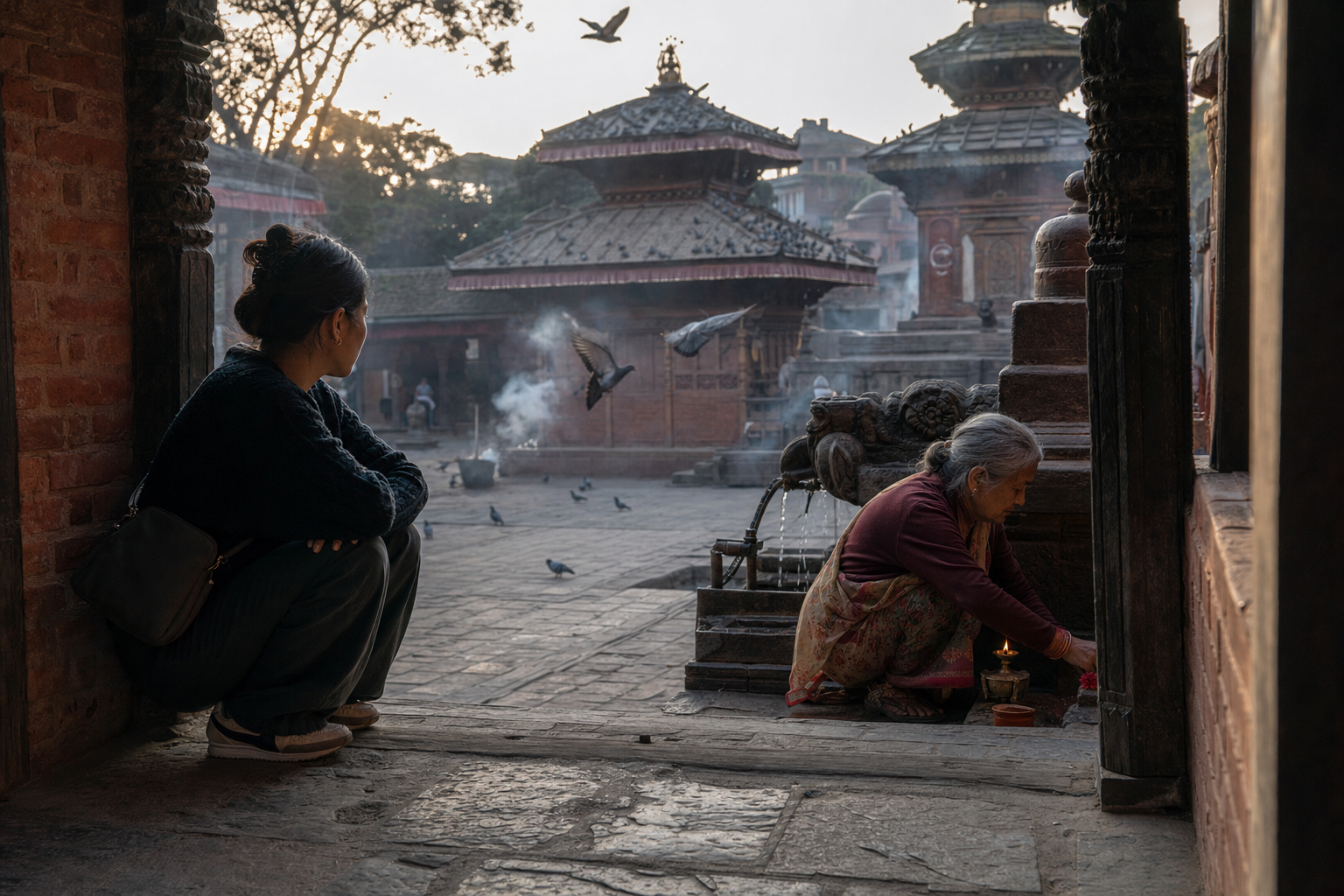
You do not need to pretend to be an initiate to learn from the valley. A useful visit begins with a clear distinction: public darshan and contemplative reflection are open forms of encounter, while lineage rites have their own permissions and disciplines. Honour whatever access rules, ritual boundaries, and community instructions you meet at each shrine.
The sequence below is a framework for study and reflection, not a claim that every devotee follows one mandatory itinerary. Do not rush it merely to complete a list.
- Begin with witnessing. At Pashupatinath, let your first act be attention rather than petition. Identify the undertaking, fear, or conflict you have brought with you. Separate what is actually known from what you are assuming.
- Approach the hidden source of capacity. At Guhyeshwari, consider what must be generated, nourished, or allowed to emerge. Ask whether the power you seek would serve dharma or merely strengthen an existing attachment.
- Study the thresholds. The Chaturvinayaka comprise Ashok Binayak near Kathmandu’s old royal heart, Jal Binayak at Chobar, Karya Binayak at Bungamati, and Surya Binayak at Bhaktapur. At each, return to the same practical examination: What is the obstruction? What part of it is internal? What part requires a concrete external response? What would a well-ordered beginning look like?
- See power in communal form. At Siddhikali in Madhyapur Thimi, look beyond an individual request for success. The goddess also animates collective renewal. Consider what your intended accomplishment contributes to family, community, or the maintenance of a sacred inheritance.
The four Vinayakas mark boundaries, guide auspicious movement, and help ritually secure the mandala. Do not assign each one an elaborate private meaning without a traditional basis. The repeated questions above are simply a way to let the circuit expose different layers of the same obstacle as you change place and perspective.
Spring festivities along the Bhaktapur-Thimi corridor make another dimension visible. Palanquin processions, drumming, Ganesh deities, and the exchange of sindur show Shakti entering shared life rather than remaining an abstract metaphysical idea. Siddhikali’s communal celebrations dramatize renewal through collective participation. If you encounter them, follow local direction and do not reduce a living jatra to colourful material for spectatorship.
After each visit, write down what became clearer, which obstruction you recognized, what action now follows, and who will be affected by it. This keeps pilgrimage from dissolving into mood. A sacred impression becomes useful when it changes the quality of your next decision.
Carry the mandala home without imitating initiation

The outer geography has done its work when you can recognize its pattern at an ordinary threshold: before a difficult conversation, a new responsibility, a promise, or a necessary ending. You can honour the cit-Shakti principle through a simple discipline that does not claim initiatory authority.
- Establish the threshold. Pause before beginning. Recall Ganapati as the intelligence that orders movement and removes obstruction.
- Name the intention precisely. Replace “I want success” with the actual task, the people affected, and the condition that would make the result dharmic rather than merely advantageous.
- See before acting. Separate fact from fear, habit, fantasy, and self-justification. This is the work of consciousness.
- Choose the necessary movement. Identify the truthful action that turns understanding into reality. This is the work of Shakti.
- Apply the ethical seal. Test the action against truthfulness, non-harm, self-restraint, and steadiness. If it fails that test, greater intensity will not turn it into siddhi.
A quiet invocation of GAM, the bija associated with Ganapati, can accompany the beginning of an undertaking. Kali is associated with KRIM or KREEM. But knowing the spelling of a bija is not the same as receiving a mantra practice. Repetition, visualization, breath coordination, nyasa, and ritual application can depend on lineage-specific instruction. Do not assemble an advanced sadhana from isolated public fragments.
The same distinction applies to yantra and ritual. Tantric unity can be expressed as mantra in sound, yantra in geometry, and embodied rite through puja, homa, nyasa, and mudra. Understanding those categories helps you recognize the tradition’s precision. It does not by itself confer authorization or competence to perform every method.
Use the yogic map as a discipline, not a performance
In the yogic correspondence, Ganapati is associated with muladhara, the foundational support where energy is gathered and stabilized. Kali can be contemplated as awakened kundalini moving through and purifying the stations of awareness. Their fulfilment at sahasrara symbolizes a condition in which the person’s capacities no longer work against one another.
This map should make you more grounded, not more fascinated with dramatic sensations or claims of attainment. Its practical test is integration. Are you steadier under pressure? Can you distinguish a real obstacle from wounded pride? Can you act firmly without cruelty? Can you remain responsible when power becomes available?
Judge siddhi by what your power does to other people
Steadiness, truthfulness, non-harm, and self-mastery are conditions of genuine accomplishment. In household and monastic life, the principle becomes visible through such ordinary duties as sharing prasada, caring for elders, and sustaining temples. These acts prevent Shakti from being reduced to domination or personal charisma.
A practice that increases contempt, coercion, carelessness, or the desire to appear exceptional has failed this test, however esoteric its language may sound. Power deserves the name Shakti when it can protect, repair, include, and set things in right relation. Siddhi deserves its name when discernment has become dependable conduct.
Choose the threshold already in front of you. Name the obstruction honestly, bring clear awareness to it, and perform the next truthful, non-harming action. That is where Nepal Mandala stops being only a sacred landscape you admire and begins becoming a sacred order you can embody.
References
