
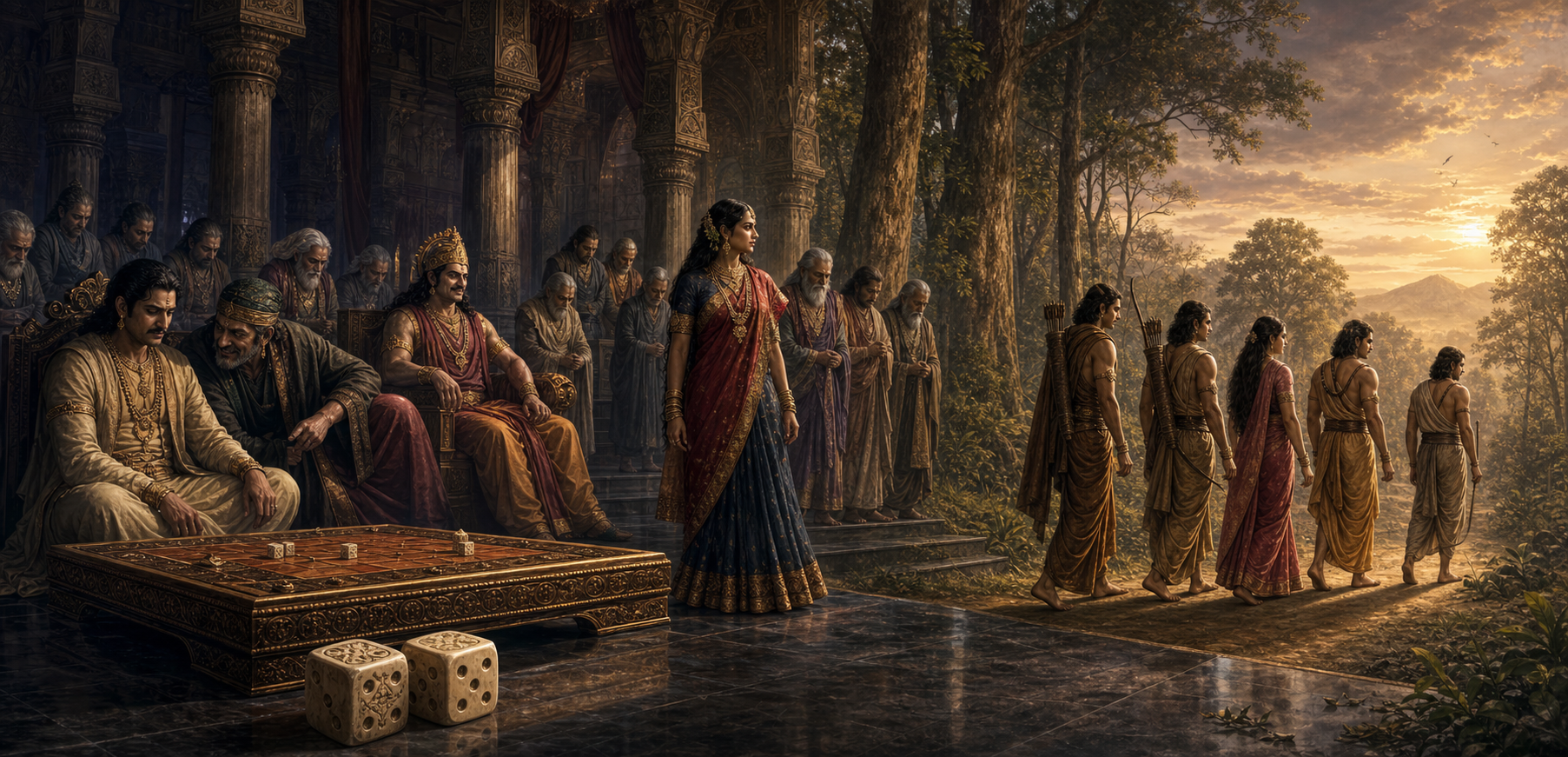
If you are trying to understand what the Mahabharata asks you to do when rules are used to serve injustice, follow the Pandavas from the dice hall into exile. The sequence shows that a formally accepted contest can still be corrupt, that suffering does not prove guilt, and that dharma after failure begins with honest self-examination rather than instant retaliation.
This is not a simple contest between flawless heroes and obvious villains. Duryodhana and Shakuni construct the trap, but Yudhishthira enters it. Vidura warns the court, but power refuses to listen. The assembly possesses rank and learning, yet fails to protect Draupadi. Exile then asks whether the Pandavas can turn loss into discipline without pretending that the original injustice was acceptable.
The moral disaster begins before the first throw
The dice game is often remembered through its shocking losses, but its first moral lesson appears earlier. Duryodhana extends the invitation to Yudhishthira while Shakuni directs a calculated trap. The outward form is hospitality and play. The inward purpose is dispossession.
That distinction matters whenever someone says that an outcome must be fair because all parties agreed to the procedure. Consent to enter a process does not cleanse deception, hidden coordination, unequal information, or a predetermined objective. A rule can be valid in itself and still become an instrument of adharma in the hands of people acting in bad faith.
Yudhishthira’s participation nevertheless matters. Calling the game a trap should not erase his agency. His attachment to royal convention, his willingness to keep playing, and his failure to stop as the stakes become morally intolerable all belong in the judgement. The Mahabharata does not require us to distribute blame equally. It requires us to see different kinds of responsibility clearly: the responsibility for designing the wrong, the responsibility for enabling it, and the responsibility for failing to resist it.
Vidura recognizes the danger and tries to halt the game. His failure to persuade the court does not make his counsel mistaken. It exposes a recurring weakness in institutions: wisdom may be present but politically inconvenient. A court has not fulfilled its duty merely because someone was permitted to object. The real test is whether those holding power can still act on an unwelcome warning.
Before you enter any consequential contest, negotiation, or commitment, ask four questions:
- Who designed the conditions, and what outcome do they privately want?
- Can every participant withdraw when the stakes change, or will honour and social pressure be used to keep them involved?
- Who has already warned that the process is unsafe, unfair, or manipulated?
- Who has the authority to stop the process, and what prevents that person from acting?
If those questions reveal a trap, do not let etiquette become your excuse for proceeding. Dharma does not require cooperation with a dishonest design simply because refusing would feel embarrassing.
A lawful appearance cannot purify an adharmic purpose
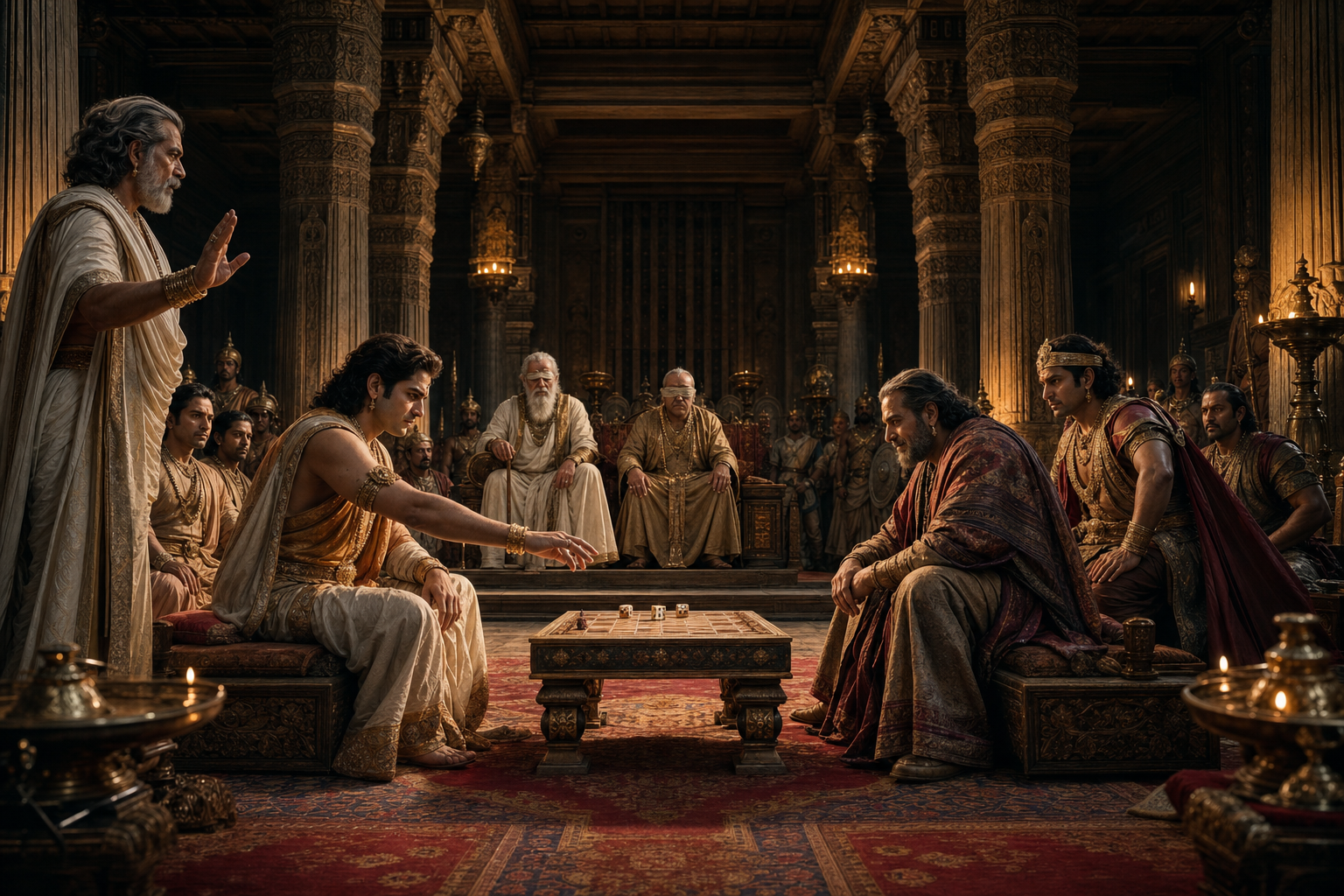
The game steadily turns persons, relationships, and royal duties into stakes. That is the deeper corruption. Dice are only the mechanism. The underlying error is the belief that possession and authority allow a ruler to gamble away everything entrusted to him.
Draupadi’s challenge brings this error into the open. She asks whether Yudhishthira, after losing himself, retained the standing to stake her. Her question is not a technical distraction from the story. It forces the assembly to decide whether a procedural sequence can override the dignity of a person. The court’s inability to give a morally adequate answer shows how legal cleverness becomes dangerous when everyone is afraid to name the underlying wrong.
This is why the dice hall should not be read as a warning against gambling alone. It is also a warning against moral outsourcing. Duryodhana can point to the wager. Shakuni can point to the throws. The assembly can point to Yudhishthira’s participation. Each procedural fact becomes a way to avoid the immediate duty to protect someone being wronged.
You can detect the same evasion whenever a discussion becomes obsessed with whether a harmful act was technically permitted while ignoring what the act does to a human being. At that point, change the question. Do not ask only, Was the rule followed? Ask:
- What duty was this rule meant to protect?
- Is the rule now being used against that duty?
- Has a person been reduced to property, leverage, or a symbol in someone else’s contest?
- Would we still defend the procedure if we occupied the most vulnerable position within it?
The Mahabharata’s answer is not that rules are irrelevant. A kingdom without rules collapses into appetite. The sharper lesson is that rules require moral interpretation. Dharma includes attention to intention, circumstance, responsibility, and consequence. Procedure serves justice; it cannot replace justice.
Exile is a consequence, not a verdict of moral guilt

The Pandavas leave the court for a long forest exile followed by a required thirteenth year in concealment. It would be a serious misreading to treat their suffering as proof that they deserved defeat. Adharma can produce real consequences. The fact that the injured person must live with those consequences does not convert the wrong into justice.
This distinction is useful when you face a setback created partly by another person’s manipulation and partly by your own error. You do not have to choose between two false stories: that you were wholly powerless, or that everything that happened was your fault. You can name the injustice precisely while also examining the decision that made you vulnerable to it.
That is the moral work of exile. Distance from the dice hall removes the noise of status, argument, and public humiliation. It creates room for harder questions:
- Which warning did we hear but refuse to honour?
- Which habit, attachment, or idea of prestige overruled our judgement?
- What did we wrongly assume we had the right to risk on behalf of others?
- Which capacity must be strengthened before authority can safely be held again?
- What must remain non-negotiable even when recovering what was lost?
Exile becomes morally fruitful only when it produces this clarity. Hardship does not automatically purify anyone. Pain can deepen resentment as easily as wisdom. The decisive question is what the sufferer does with the interval between loss and renewed power.
Nor does acceptance of exile mean approval of the dice game. The Pandavas can honour the condition imposed on them without declaring the trap righteous. This is an important Dharmic distinction: accepting present reality is not the same as calling every cause of that reality just. Sometimes self-command means refusing a premature reaction while preparing to meet the unresolved wrong with greater strength and clearer judgement.
The incognito year turns royal identity into service
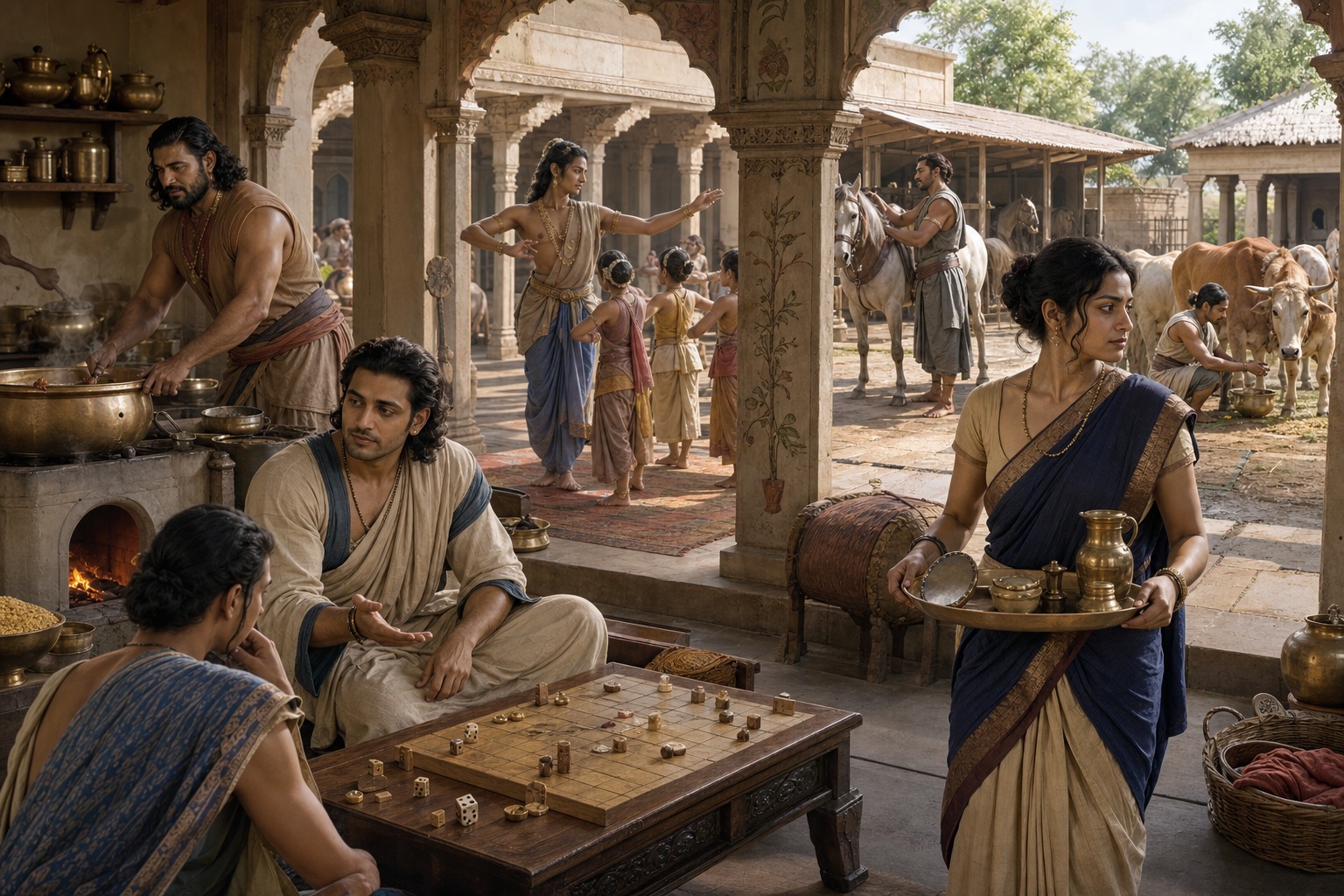
The final phase of exile intensifies the discipline. The Pandavas must live without publicly relying on the identities that once defined them. Their roles in King Virata’s realm are practical forms of service, not displays of royal status. Concealment therefore becomes more than a plot device. It tests whether their abilities remain useful when recognition disappears.
Sahadeva offers a particularly clear example. The youngest Pandava assumes the identity of Tantipala and tends King Virata’s cattle. A prince who once belonged near the centre of political power now accepts responsibility for living wealth that requires patient observation and daily care.
The work is not morally smaller because it lacks prestige. Cattle cannot be protected by a title. They require competence, steadiness, and attention. Sahadeva’s disguise therefore reveals something that the dice hall obscured: knowledge is not an ornament of rank. Its value lies in responsible application.
This movement from court to cattle also corrects the illusion that dharma belongs only to grand decisions. The catastrophe began amid royal ceremony, public rules, and arguments about honour. Reconstruction occurs through ordinary duties performed without applause. The epic directs your attention from reputation to reliability.
You can apply that test without imitating the Pandavas’ circumstances:
- Separate your function from your title. Write down the people, responsibilities, or goods that your role exists to protect.
- Choose one necessary task that brings little recognition and perform it to the same standard as visible work.
- Notice which abilities survive when you cannot rely on status, institutional authority, or public approval.
- Treat temporary obscurity as a test of discipline, not as permission to neglect your duty.
This is not a command to remain invisible when justice requires speech. Vidura’s example has already shown the duty to warn. The lesson of incognito service is narrower: when circumstances remove your public identity, dharma can still be practised through the quality of your care, restraint, and competence.
Key takeaways from the journey
- A process can follow familiar rules and still be corrupt when its conditions were designed to deceive or dispossess.
- Responsibility is not all-or-nothing. You can condemn a trap while examining the choice that allowed it to work.
- A warning has no institutional value unless someone with authority is willing to act on it.
- Human dignity sets a limit on what power, ownership, or formal consent can legitimately place at stake.
- Suffering is not proof of guilt, and accepting a consequence does not require calling its cause just.
- Exile becomes moral preparation when it produces self-knowledge, disciplined capability, and clearer limits.
- Incognito service tests whether your dharma depends on recognition or remains dependable without it.
The next time honour, convention, or pressure urges you into a compromised process, pause before the first throw. Listen for the Vidura who is being ignored. Identify what is not yours to gamble. If loss has already occurred, use the interval ahead as the Pandavas eventually do: protect dignity, recover discipline, and become fit to hold responsibility without repeating the failure that made exile necessary.
References
- Hindu Blog – Vidura Attempts to Halt the Dice Game in the Mahabharata: A Modern-Day Perspective
- Hindu Blog – Sahadeva During the Incognito Exile Period in Mahabharata – Symbolism
