

If you understand the philosophy while reading but lose it as soon as ordinary life resumes, or if kirtan moves you without giving your life a clear direction, you do not have to choose between study and devotion. The missing element is a disciplined exchange between them.
Gaudiya bhakti closes that gap by joining hearing, chanting and remembrance. Scripture tells you whom you are approaching, what your relationship is, and what devotion asks of you. Sacred sound carries that understanding out of the intellect and into attention, speech, conduct and service.
Give every session a relationship, a practice and a goal
A useful Gaudiya reading does more than collect inspiring statements. It follows the framework of sambandha, abhidheya and prayojana: the relationship you need to understand, the practice appropriate to that relationship, and the goal toward which the practice leads.
- Sambandha: What is the relationship among Krishna, the individual self and the world? Gaudiya theology approaches this relationship through acintya-bheda-abheda, inconceivable unity and difference. You are neither Krishna nor independent of Krishna.
- Abhidheya: What should you do in light of that relationship? The practical answer is bhakti expressed through hearing, chanting, remembering, worship and service.
- Prayojana: What is the intended result? It is not merely relief, religious status or even liberation considered in isolation. The goal is prema, awakened love expressed through willing service.
This three-part lens prevents two common errors. The first is metaphysics without practice: you can explain a doctrine but it does not govern your reactions. The second is practice without orientation: you complete a ritual but cannot say what relationship it is meant to awaken.
After reading a passage, therefore, ask three direct questions: What does this clarify about reality? What response does it ask from me? What kind of love is that response meant to cultivate? If you cannot answer, stay with the passage instead of rushing to the next one. A smaller amount of scripture understood in this way is more useful than a large amount stored as disconnected information.
Read until the verse gives you something to remember

Srimad Bhagavatam is not a collection of interchangeable quotations. Its twelve cantos and 335 chapters develop a theological and narrative movement toward pure devotion to Krishna. The Krishna narratives of the Tenth Canto form a theological and aesthetic summit, but they should not be detached from the text’s larger account of reality, discipline, purification and surrender.
Begin with context. Identify who is speaking, who is listening, what prompted the exchange and what problem the passage addresses. A statement given to a king facing death, a sage answering a philosophical question and a devotee speaking in prayer do not perform the same function. Context protects you from turning every sentence into a universal instruction.
Then slow down at the important Sanskrit terms. A word-for-word gloss helps, but it is not the end of interpretation. Where your edition supplies anvaya, follow the syntactic relationship among the words. Notice which meaning fits the argument and devotional setting rather than selecting whichever English equivalent feels most familiar.
Traditional Gaudiya reading also depends on parampara. Commentaries associated with Sridhara Svami, Jiva Gosvami and Visvanatha Cakravarti Thakura, along with the translations and purports of A. C. Bhaktivedanta Swami Prabhupada, place an individual verse within a sustained interpretive lineage. This does not remove the need to think. It gives your thinking a coherent theological setting and makes it answerable to more than personal preference.
Use a simple sequence whenever you study:
- Locate the conversation. Write down the speaker, listener and immediate question.
- Mark the decisive term. Choose the Sanskrit word or phrase on which the passage’s meaning turns.
- Trace the main claim. State the passage’s philosophical movement in your own words without copying the commentary.
- Apply the three-part lens. Identify sambandha, abhidheya and prayojana.
- Carry one remembrance. Select a name, quality, teaching or instruction that can return to mind during chanting and ordinary activity.
After a class or concentrated reading, allow five to ten minutes of quiet reflection. Then write a brief synthesis in your own words. The test is not whether your notes are extensive. It is whether you can explain what the passage changes about the way you see, choose or serve.
Let chanting test whether reading has reached the heart
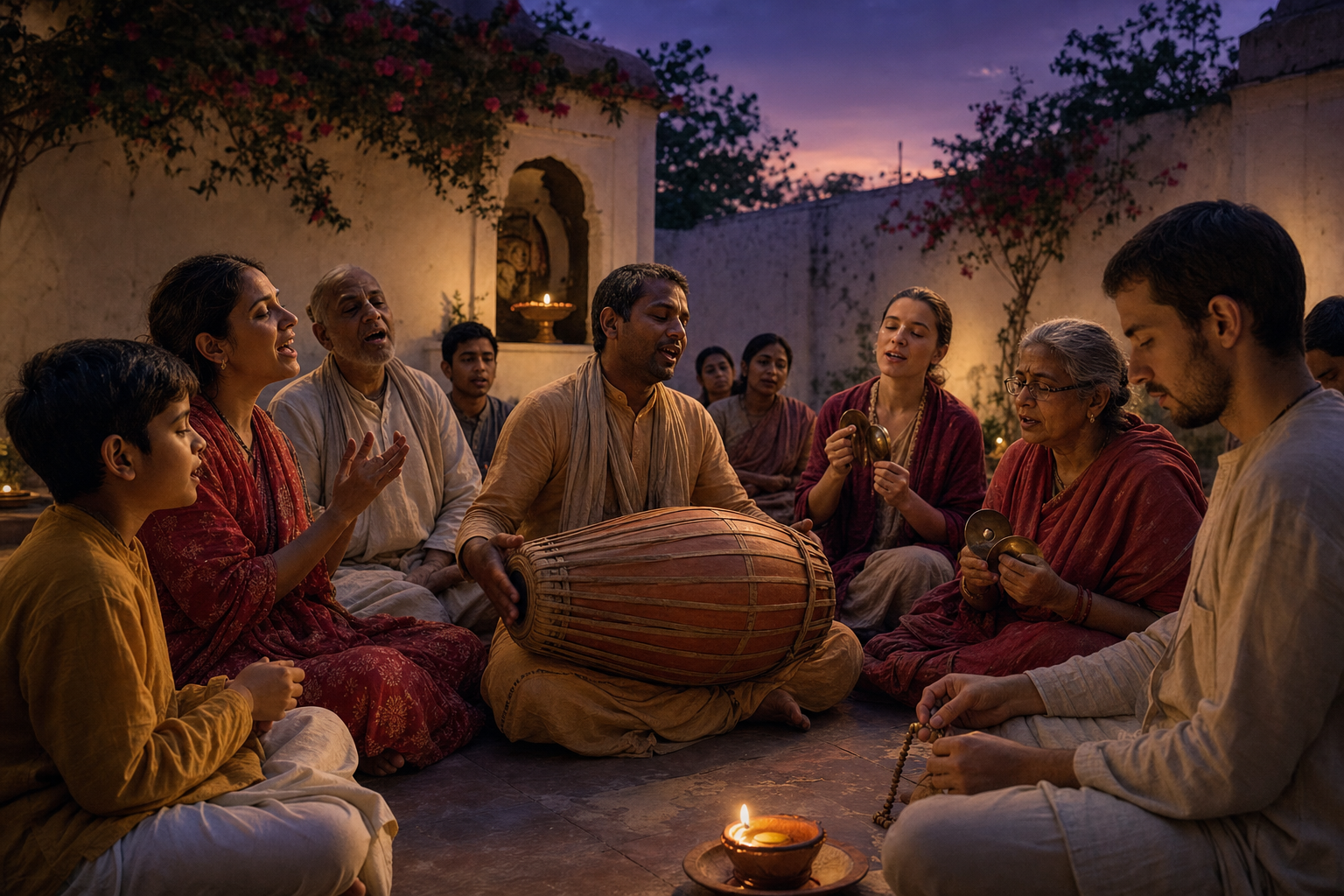
The central Gaudiya practice of sacred sound is the maha-mantra: Hare Krishna, Hare Krishna, Krishna Krishna, Hare Hare / Hare Rama, Hare Rama, Rama Rama, Hare Hare. Its repetition is not meant to erase meaning. The divine names give attention a personal object and turn remembrance into direct invocation.
Scriptural study prepares you to chant with understanding. Chanting then tests that understanding. Can you remain present to the name when novelty is gone? Can you continue when emotion is quiet? Can the humility praised in your reading survive interruption, disagreement and fatigue? These are more revealing questions than whether a particular session felt elevated.
Japa and kirtan train attention in complementary settings. A measured daily japa practice gives you a regular encounter with distraction, intention and return. Congregational kirtan places the same sacred names within shared hearing and response. Neither should become background audio. In both, hearing is the immediate discipline.
During japa, pronounce the mantra clearly enough to hear what you are saying. When the mind leaves, do not turn the lapse into a second distraction through self-reproach. Return to the next name. The practical unit of recovery is not tomorrow’s session; it is the mantra now in front of you.
During kirtan, receive the call before giving the response. The leader establishes pitch, textual clarity and pace, while the assembly strengthens the devotional mood through attentive repetition. Harmonium, mrdanga, kartals, melody and rhythm support this exchange, but musical structure remains in service to remembrance.
- Listen to the complete lead phrase instead of anticipating it.
- Repeat the words clearly, even when the melody becomes energetic.
- Follow the established beat rather than competing with it.
- Let your voice support the congregation, not display itself above it.
- When attention drifts, use the next response as an immediate point of return.
- Leave with a service intention so the sound continues as conduct.
A rising tempo, strong percussion or an emotional chorus can help gather the assembly. None of these by itself proves spiritual depth. The relevant question is what the sound is doing to your orientation: whether it increases remembrance of Krishna, receptivity to instruction, regard for other devotees and willingness to serve.
Measure growth by steadiness, conduct and service

Gaudiya teaching describes a movement from anartha-nivritti through nistha, ruci, asakti, bhava and prema: impediments are gradually cleared, steadiness develops, genuine taste appears, attachment deepens, spiritual emotion awakens and love matures. This map is useful when it produces patience and honest self-observation. It becomes harmful when treated as a status ladder.
Do not diagnose your stage from one powerful kirtan or one dry period. Emotional intensity changes with music, company, fatigue and circumstance. Look instead for a durable pattern. Does practice resume after enthusiasm falls? Is scriptural correction easier to receive? Is service becoming less dependent on recognition? Are your habits giving remembrance more room?
Ethical change belongs inside this assessment. Truthfulness, compassion, self-restraint, nonviolence, mindful speech, simplicity and upright livelihood are not decorative virtues added after devotion. They prepare the mind for attentive practice and reveal whether sacred hearing is reaching daily life. If chanting increases while contempt, dishonesty or careless harm also increases, something in the practice needs correction.
The nine processes of bhakti widen the field beyond a single preferred activity: sravanam, kirtanam, smaranam, pada-sevanam, arcanam, vandanam, dasyam, sakhyam and atma-nivedanam. Hearing and chanting should nourish remembrance; remembrance should become worship, prayer, service, friendship and surrender. If your practice remains confined to the time when a book is open or music is playing, deliberately connect it to one of these other expressions.
Association also matters. Weekly satsang gives you questions you would not generate alone, examples you cannot supply for yourself and accountability that private intention often lacks. Choose company that combines textual seriousness with humility and service. Charisma without scriptural grounding can misdirect devotion; technical learning without devotional character can make it sterile.
Respect for other dharmic paths need not weaken this Gaudiya centre. Sikh naam-simran and seva, Buddhist communal recitation and compassion, and Jain stavan, ahimsa and aparigraha show how sacred sound and ethical discipline resonate across distinct traditions. The practices are not interchangeable, because their theological settings and revealed vocabularies differ. You can honour the shared discipline of remembrance without pretending that every path makes the same claim.
Key takeaways: build one practice instead of two
- Before reading: make a brief sankalpa. Name the quality of attention or service you want the session to strengthen.
- While reading: identify the speaker, listener, decisive Sanskrit term and central claim before looking for personal application.
- After reading: use sambandha, abhidheya and prayojana to state the relationship, practice and goal revealed by the passage.
- During japa: hear the mantra you are presently chanting. Treat every noticed distraction as an invitation to return, not as a verdict on your fitness for bhakti.
- During kirtan: receive the lead, respond clearly and let rhythm and melody support collective remembrance.
- After sacred sound: translate remembrance into a specific act of truthfulness, restraint, kindness or seva.
- Each week: bring your reading and practice into satsang. Ask about what remains unclear and listen for correction without defensiveness.
Begin at your next reading, not with an ambitious overhaul. Find the passage’s relationship, practice and goal. Carry one remembrance into the maha-mantra. Then let the quality of your next choice show whether you actually heard it. Repeated steadily, that movement from scripture to sound to service is the working shape of Gaudiya bhakti.
References
- Dandavats – Srimad Bhagavatam Decoded: Profound Insights from His Grace Radheshyam Prabhu’s ISKCON Class
- Dandavats – HH Niranjan Swami in Boston: The Transformative Power of Kirtan, Sound, and Gaudiya Bhakti
