
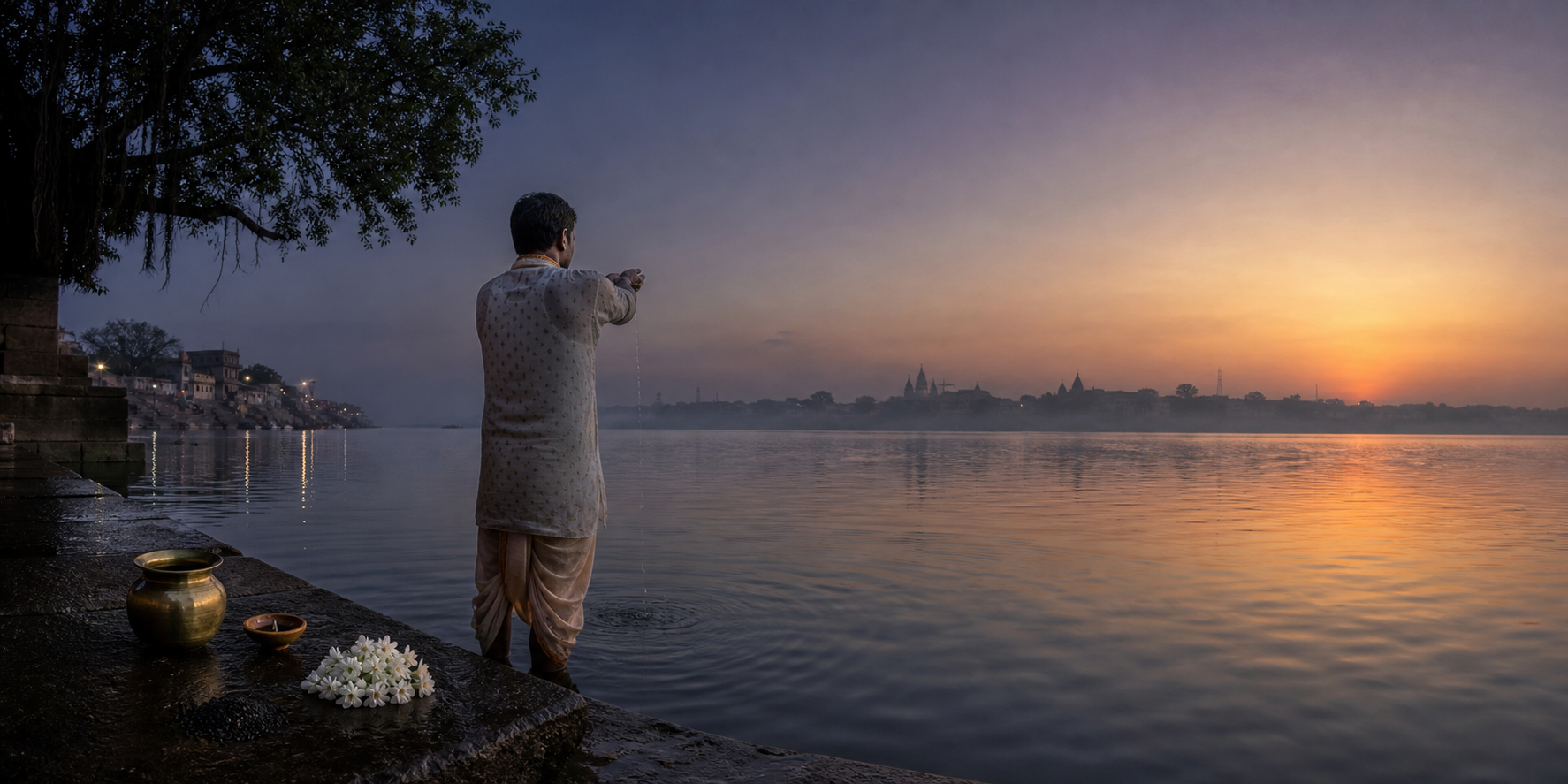
If you need to place tarpan, vrata, charity or a new beginning on June 15, do not treat the whole Monday as one ritual period. The decisive change comes in the morning: Amavasya ends at 8:45 AM IST, and Shukla Paksha Pratipada then continues until 6:17 AM on June 16.
Your practical rule is simple. Keep Amavasya-oriented observances before 8:45 AM. Put a fresh undertaking after that boundary, then check your city’s Rahu Kaal or preferred Choghadiya before fixing the exact time.
June 15 Panchang at a glance
June 15, 2026 is a Monday, so the portion of the morning during which Amavasya remains in force is Somvati Amavasya. The name does not apply merely because the civil date is Monday; it arises from the actual overlap of Amavasya tithi with Somvar.
| Panchang phase | Time in IST | Best use of the period |
|---|---|---|
| Somvati Amavasya | Monday morning until 8:45 AM on June 15 | Pitri-karya, tarpan where customary, japa, vrata, dana and quiet reflection |
| Shukla Paksha Pratipada | 8:45 AM on June 15 until 6:17 AM on June 16 | Sankalpa, study, planning, collaborative work and other gentle beginnings, subject to local muhurta checks |
Key takeaways
- Complete any observance that specifically requires Amavasya before 8:45 AM IST.
- Do not assume that all of Monday remains Somvati Amavasya; Pratipada governs the rest of the day after the tithi changes.
- For a new undertaking, satisfy two conditions: begin after 8:45 AM and avoid the locally calculated inauspicious periods used by your tradition.
- Do not copy a Nakshatra, Moon Rashi, Rahu Kaal or Choghadiya time from another city. Confirm those details for your location and intended hour.
Why 8:45 AM, rather than midnight, controls the day
A tithi is not a conventional date running from one midnight to the next. It changes whenever the angular separation of the Moon and Sun advances through the next 12-degree interval. Around Amavasya, the lunar cycle passes through conjunction and the waxing fortnight begins. That astronomical transition can occur at any hour of the civil day.
This is why June 15 carries two distinct Panchang phases. The morning begins under Amavasya, but Shukla Paksha Pratipada takes over at 8:45 AM. If your sankalpa or rite requires the tithi prevailing at the moment of performance, the clock time matters more than the date printed at the top of a calendar page.
The distinction prevents two common mistakes. The first is postponing an Amavasya observance until Monday evening, when Amavasya has already ended. The second is beginning a growth-oriented activity early in the morning merely because it is scheduled for June 15, without noticing that the inward-facing tithi remains active.
How to use the Somvati Amavasya morning
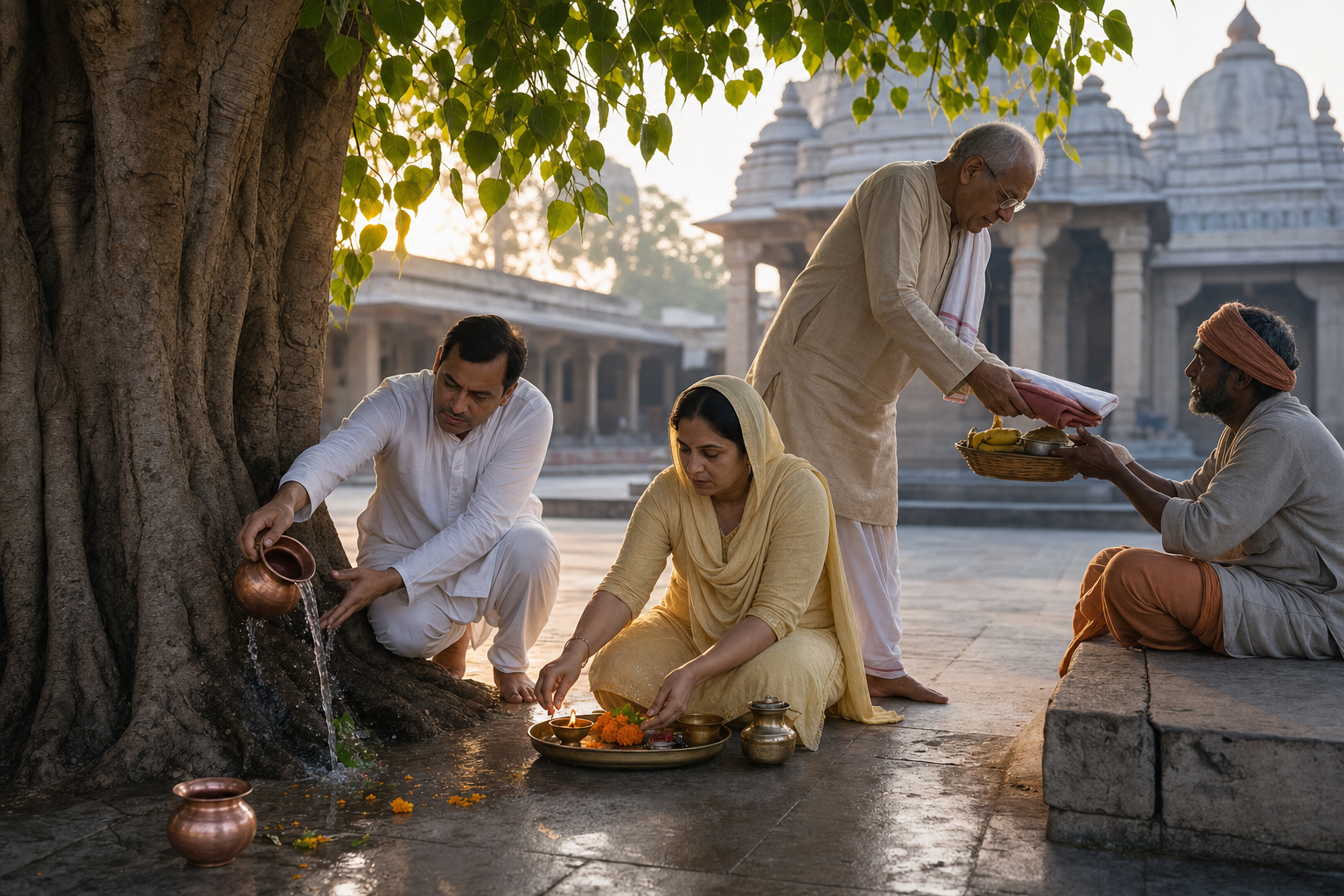
The morning is best approached as a contained period for remembrance and completion. You do not need to assemble every regional custom into one ceremony. Follow the form received through your family, temple or sampradaya, and use the 8:45 AM boundary to keep that practice within Amavasya.
- Settle your morning routine early enough that the observance does not have to be rushed against the tithi boundary.
- If your lineage performs tarpan or another form of pitri-karya on Amavasya, complete it before 8:45 AM.
- Use japa, quiet recitation or contemplative silence when a formal ancestral rite is not part of your household practice.
- Make dana concrete. Food or essential items are appropriate forms of giving; arrange the recipient or place of donation beforehand rather than leaving the intention vague.
- If you observe a vrata, keep it according to your established family or sectarian discipline instead of creating new rules for this date.
Peepal worship, pradakshina and lighting a dipa are meaningful customs in some communities. A bath at a sacred or nearby water body is important in others. These are lineage-shaped expressions of reverence, not universal requirements. The shared centre is gratitude toward forebears, restraint in one’s own conduct and service to others.
A mixed Dharmic gathering should preserve those distinctions. Hindu households may centre pitri-karya; Buddhist communities may relate lunar observance to Uposatha and ethical recollection; Jain practice may emphasize vrata or pratikraman. The modern Sikh Nanakshahi calendar is solar-fixed, although lunar markers remain visible in the broader Punjabi cultural setting. Shared remembrance and seva can unite a gathering without presenting different disciplines as interchangeable.
How to place a new beginning after Amavasya
Once Pratipada begins at 8:45 AM, the day’s emphasis can turn from completion toward cultivation. Suitable beginnings include opening a course of study, drafting a project outline, initiating collaborative work, establishing a household routine for the waxing fortnight or consecrating an object used in the workplace.
Pratipada alone does not make every later minute equally suitable. Treat it as the first filter, then apply the local time rules followed by your household or region.
Rahu Kaal: Monday Rahu Kaal commonly occupies an early-morning block. It is often approximated as 7:30-9:00 AM when sunrise is close to 6:00 AM, but this is not a nationwide fixed time. The interval must be calculated from local sunrise. Because that illustrative block extends beyond the 8:45 AM tithi change, beginning at exactly 8:45 AM could still place you inside Rahu Kaal in some locations. Wait for the city-specific interval to end before launching something important.
Yamaganda and Gulika Kaal: These periods are also avoided for important beginnings in many regional systems, although their weight varies by tradition. If your family normally observes them, include them in the same city-level check rather than relying only on Rahu Kaal.
Abhijit Muhurta: When a necessary undertaking cannot be moved freely, Abhijit Muhurta can provide a broadly favourable midday option in traditions that use it. It is centred on the exact midpoint between local sunrise and sunset and is commonly described as extending approximately 24 minutes on either side of that midpoint. Use locally calculated bounds; ordinary clock noon is not always the same as local solar midday.
Choghadiya: Gujarati, Rajasthani and other Western Indian practices may refine the choice through daytime Choghadiya. Its periods are roughly 96 minutes long and are anchored to local sunrise, so their clock times move with the place and season. After 8:45 AM, look for a locally calculated Shubh, Labh or Amrit period. Do not lift a favourable block from a calendar prepared for another city.
The result is a two-gate decision: first enter Shukla Paksha Pratipada after 8:45 AM; then select an acceptable local window. This is more reliable than declaring either the entire morning or the entire afternoon auspicious.
Check Nakshatra, Rashi and the lunar month locally
A complete Panchang normally gives more than the tithi. Nakshatra describes the Moon’s lunar mansion, while Chandra Rashi identifies the sign occupied by the Moon. On Amavasya the Moon is conjunct the Sun, so the Moon-sign reading is especially closely connected to the Sun’s sidereal position.
No responsible Nakshatra or Rashi choice can be made from the date alone when your actual concern is a particular ceremony, journey or launch time. Before fixing the appointment, open a reliable regional Panchang and check the entry for your city and intended moment. Record the following details together:
- Your city or the actual place where the undertaking will occur.
- The 8:45 AM IST transition from Amavasya to Pratipada.
- The Nakshatra prevailing at the intended time and any nearby transition.
- The Moon Rashi at that time.
- The locally calculated Rahu Kaal and, where observed, Yamaganda and Gulika Kaal.
- Abhijit Muhurta or favourable Choghadiya if either system is part of your practice.
You may also see different lunar-month labels around this date. Amanta and Purnimanta calendars name and close lunar months differently, and some almanacs may place the occasion in relation to Adhik Jyeshta Maas 2026. That difference does not overturn the functional timing: Amavasya remains until 8:45 AM, followed by Pratipada.
Put the plan in your calendar before June 15. Reserve the early morning for the ancestral or contemplative discipline you actually observe, mark 8:45 AM as the tithi boundary, and schedule any beginning only after both Pratipada and a suitable local window are in force. If a temple or family priest will guide the rite, give them your city and proposed time rather than asking whether the date is simply “good.”
References
