
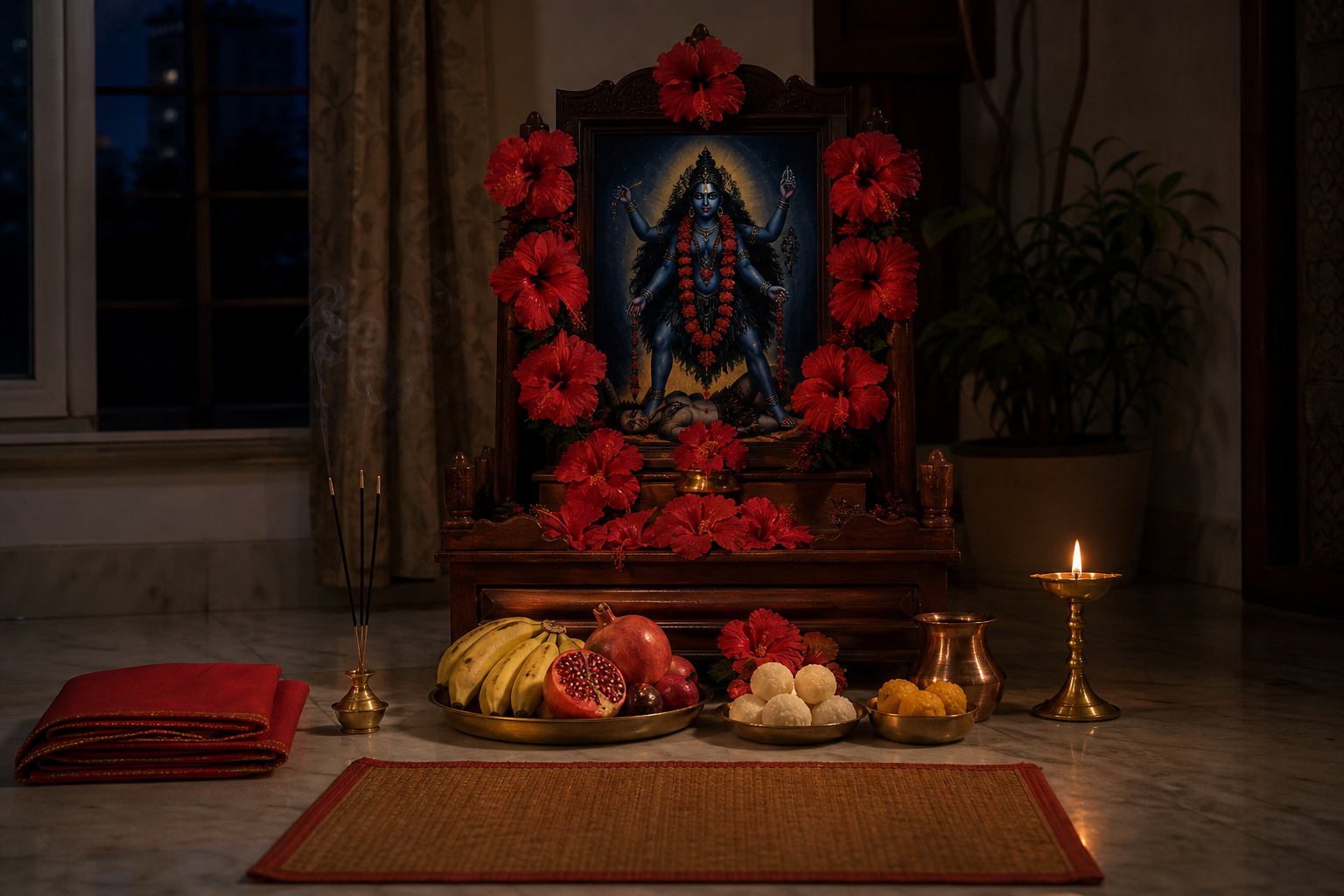
If you want to worship Ma Kali at home, the difficult part is rarely finding flowers or lighting a lamp. It is knowing which Kali observance you are keeping, which timing applies where you live, and how much of a traditional ritual belongs safely in a household setting.
You do not need to reproduce a temple ceremony or attempt an unfamiliar Tantric liturgy. A disciplined domestic puja can be complete in spirit with a clean altar, a clear sankalpa, a few accepted offerings, attentive mantra or meditation, arati, and the sharing of prasad.
Key takeaways for your household puja
- Identify the observance before choosing the date. Dipanwita Kali Puja falls on Kartik Amavasya and coincides with Diwali, while Ratanti Kalika Puja is observed on Magha Krishna Paksha Chaturdashi.
- Use a panchang calculated for your location. Nishita Kaal is based on the local night and should not be treated as a universal 12:00 a.m. appointment.
- Keep the ritual proportionate to your knowledge. A simple Panchopachara puja is preferable to an elaborate procedure you do not understand.
- Prepare the food and altar before the principal worship window. Reserve Nishita Kaal for dhyana, offerings, japa, pushpanjali, and arati rather than household logistics.
- Choose non-violent, sattvic offerings. Flowers, lamps, fruits, sweets, and a simple cooked bhog are sufficient. A pumpkin or ash gourd is a symbolic bali substitute only where that custom is already understood.
- Leave specialized rites to trained practitioners. Formal nyasa, complex homa, secret mantras, and advanced Tantric kriyas require living guidance from a qualified guru or priest.
First decide which Kali observance you are keeping
The phrase Kali Puja usually refers to Dipanwita Kali Puja, also called Shyama Puja, in Bengal and several neighboring regions. It is the festive worship held on Kartik Amavasya, on the same lunar night as Diwali. Ratanti Kalika Puja is a different observance, with a quieter and more inward character. It belongs to Magha Krishna Paksha Chaturdashi.
| Observance | Lunar date | Devotional character | Household timing |
|---|---|---|---|
| Dipanwita Kali Puja or Shyama Puja | Kartik Amavasya, coinciding with Diwali | Festive, lamp-filled, and often shared with the wider community | Preparations after sunset, with the principal worship centered on Nishita Kaal |
| Ratanti Kalika Puja | Magha Krishna Paksha Chaturdashi | Restrained, meditative, and especially focused on japa and inward purification | Nishita Kaal is preferred; Pradosh Kaal may be used when that accords with local or family tradition |
Do not select the date from the festival name alone. Check three things in a regional panchang: the applicable tithi, its beginning and ending times, and the locally calculated Nishita Kaal. The relevant window varies by place because Hindu midnight is located from the local span between sunset and the following sunrise. A schedule copied from another city, or from the previous year, may therefore put your main worship outside the intended interval.
You also do not have to begin every part of the puja at midnight. Cleaning, cooking, arranging the altar, and laying out offerings can be finished much earlier. Begin the domestic observance after sunset and place its contemplative center – dhyana, mantra-japa, pushpanjali, and arati – within or near the Nishita window shown by your panchang.
Keep neighboring observances distinct
In the Bengali Dipanwita sequence, Bhoot Chaturdashi is kept on the preceding day. Families traditionally light fourteen lamps, or choddo prodip, in remembrance of ancestral presences and for spiritual safeguarding. That practice prepares the household for Amavasya, but it is not the principal Kali Puja itself.
Kali Chaudas or Naraka Chaturdashi in Kartika should not be confused with Ratanti either. If different regional customs meet in your family, retain the distinctions instead of forcing them into one improvised ceremony. Your inherited family paddhati, where one exists, should determine how the observances are coordinated.
Build a usable altar, not an overloaded one
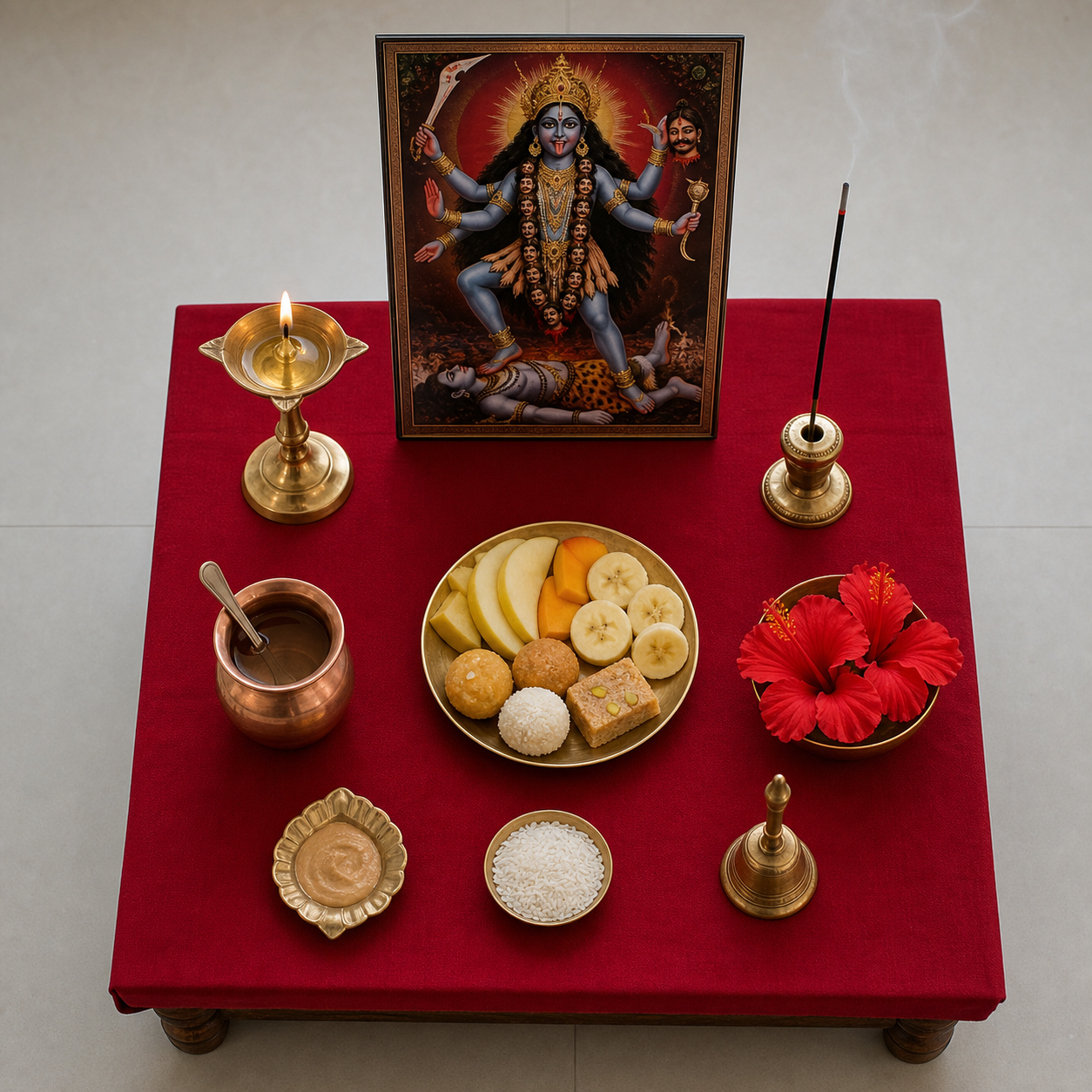
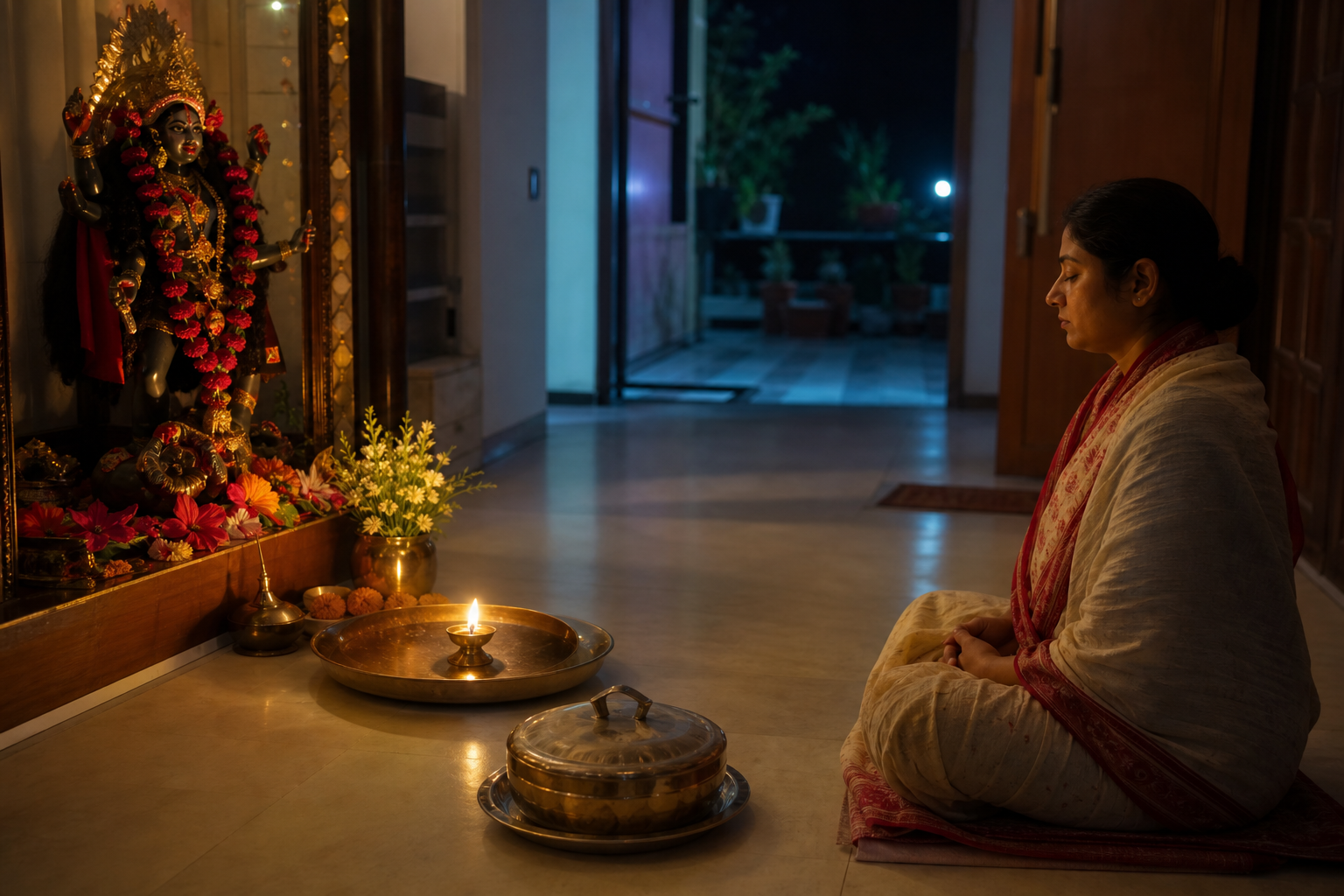
A household altar needs enough structure to support attention. It does not need to imitate a public pandal. Choose a stable, clean place where lamps cannot be knocked over and where people can sit without crossing in front of the offerings.
Gather the essential items first
- A murti or picture of Ma Kali that your family recognizes. Dakshina Kali is especially associated with Dipanwita worship, while a gentler Shyama depiction is also used in domestic devotion.
- A clean altar cloth. Red cloth is customary in many households but need not become an obstacle if your family uses something else.
- One or more secure oil or ghee lamps, with sufficient fuel for the period in which they will be attended.
- Fresh water and small clean vessels for the symbolic acts of welcome and offering.
- Kumkum or another gandha used in your household tradition.
- Red hibiscus, when available, or other fresh red flowers. Hibiscus has a particularly close place in Kali worship.
- Incense or a mild natural fragrance, provided that the room can be ventilated.
- Fruit, sweets, or a simple cooked naivedya.
- A mala if you plan to count mantra repetitions. Rudraksha or sphatik malas are used in Kali japa, but counting is not compulsory.
A kalasha with leaves and coconut may be established where that belongs to your family procedure. It is an optional ritual support, not a test of whether your devotion is valid. The same principle applies to decorative alpona: it can beautifully mark the sacred area, but it should be completed before worship rather than becoming a late-night source of haste.
Choose one coherent naivedya
Your offering can be as modest as fruit and a homemade sweet. Bengali Dipanwita households may prepare khichuri, labra, luchi, sandesh, or narkel naru. A quieter Ratanti offering may consist of khichuri, payesh, fruit, or simple sweets. There is no advantage in preparing so many dishes that the family reaches the altar tired, distracted, or late.
Keep the domestic offering sattvic and non-violent. In communities that preserve a symbolic form of an older bali structure, pumpkin or ash gourd may be used as a substitute. Do not add this simply because you have seen it elsewhere. Use it only when your family or guiding priest understands the custom; otherwise flowers, fruit, and cooked bhog are fully appropriate.
Fasting is similarly a discipline, not a universal admission requirement. Ratanti practitioners may keep phalahara, take sattvic food, or fast partially until the night worship is complete. If fasting is unsuitable for your health or responsibilities, eat simply and keep restraint in speech and conduct instead. Do not turn an optional vrata into a physical risk.
Follow a complete but manageable household vidhi
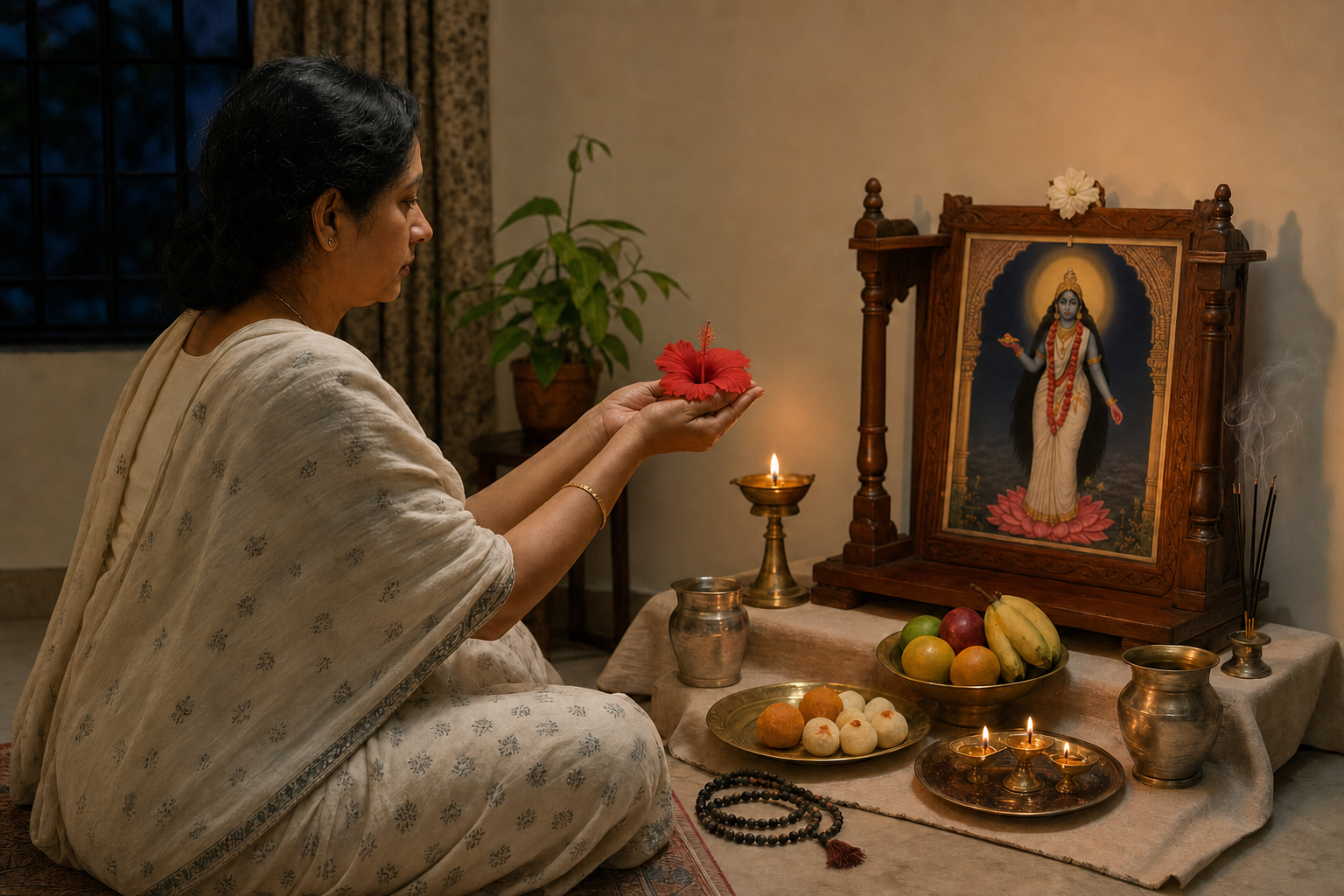
If your family has an established paddhati or instructions from a trusted priest, follow those. If it does not, the sequence below stays within widely accepted domestic upacharas. Read it through before beginning so that the night does not become a search for the next step.
- Purify the place and settle yourself. Clean the worship area, wash, wear clean clothes, and place phones and unrelated distractions away from the altar. Sit quietly for a few breaths before lighting anything.
- Light the lamp safely. Place the diya on a heat-resistant, level surface, away from cloth, flowers, doorways, children, and pets. Light incense only if the room has adequate ventilation.
- Establish the altar. Set the image or murti securely. If your tradition uses a kalasha or a brief Ganesha invocation before the principal puja, perform it now. Do not add Navagraha or other preliminary rites merely to make the ceremony appear elaborate.
- Make the sankalpa. State the place, observance, deity, and your intention. Plain language is sufficient: on this sacred tithi, in this home, you worship Ma Kali for clarity, courage, protection, and the welfare of all. For Ratanti, a concise traditional formulation is asmin Magha-mase Krishna-paksha Chaturdashi tithau Ratanti Kalikayah pujam karisye.
- Perform dhyana and avahana. Contemplate Kali as the Mother who removes ignorance and grants fearlessness. Invite her presence with humility. The purpose is to collect the mind, not to produce a dramatic experience.
- Offer the upacharas you understand. A concise Panchopachara may consist of gandha, flowers, incense, lamp, and naivedya. A family familiar with Shodashopachara may include asana, padya, arghya, achamaniya, symbolic bathing, cloth, ornament, tambula, pradakshina, and a formal conclusion. For a framed picture or a murti not intended for abhisheka, offer bathing water symbolically rather than pouring liquid over it.
- Offer flowers attentively. Present hibiscus or another red flower one at a time. Let each flower correspond to something consciously surrendered – fear, vanity, resentment, heedlessness, or another obstacle you are prepared to stop feeding.
- Choose one mantra practice. A widely used invocation is Om Krim Kalikayai Namah, with Krim also written as Kreem. If counting supports concentration, 108 repetitions form a manageable household practice. Ratanti worship may also use Om Kalikayai Vidmahe Smashanavasinyai Dhimahi Tanno Kali Prachodayat. Choose one recitation and keep it steady; speed and numerical ambition defeat the purpose.
- Use stotra or silence where appropriate. Mahakali Ashtakam or a Kali stavanam learned in your tradition may follow the japa. Karpuradi-stotra should be used where it is already familiar. You may also sit silently between recitations and let the mind rest before the deity.
- Offer pushpanjali and arati. Gather the family for the final flower offering. Perform arati with careful, unhurried movements. If Nishita Kaal is your principal window, this is the portion to place within it rather than delaying it with additional decoration or cooking.
- Offer and share prasad. Present the prepared food, allow a period of quiet reverence, and then distribute it. Sharing prasad, receiving the blessings of elders, and including children turns the worship from a private performance into household dharma.
- Conclude respectfully. Thank Ma Kali, ask forgiveness for mistakes, and perform the form of visarjana or ritual closing known in your family. With a permanent household image, you are concluding this session of worship, not discarding the image.
The practical rule is simple: finish the material work early and protect the principal interval for attention. If midnight worship is impossible during Ratanti, Pradosh Kaal can serve as an alternative where local tradition accepts it. For Dipanwita, do not invent a universal replacement time; consult your regional panchang, family practice, or a trusted local priest.
Keep Kali worship ethical, safe, and inwardly demanding
Do not borrow advanced Tantra without guidance
A public temple may conduct homa, specialized Tantric kriyas, or extended rites under trained archakas and sadhakas. Those ceremonies are not templates to reproduce from fragments found online. Formal nyasa, restricted mantras, and advanced ritual procedures depend on transmission, preparation, and correction by a qualified guru.
This boundary does not make household worship spiritually inferior. Ethical offerings, mantra-japa, meditation, and devotion already express the heart of Kali upasana. When you do less with full attention, you are practicing discipline. When you add procedures you cannot interpret, you are collecting ritual gestures.
Read the fierce image as a demand for inner honesty
Kali’s iconography can be unsettling when it is detached from its metaphysical language. Her sword signifies the cutting of ignorance. The severed head points to the destruction of egoic delusion. Her garland and girdle confront the identities and actions to which human beings cling. Her position upon Shiva joins dynamic Shakti to absolute stillness. Most importantly for a householder, her other hands offer abhaya, or fearlessness, and varada, the granting of grace.
The image is therefore not a celebration of violence. It asks whether you are willing to let truth cut through fear, attachment, and self-deception. Before pushpanjali, identify one fear you will meet without evasion and one ego-driven habit you will stop defending. That makes the symbolism operational rather than ornamental.
Let safety and ecological restraint become part of the offering
Late-night worship creates ordinary household risks that piety does not cancel. Keep passageways clear, ventilate incense, tie back loose cloth near flames, and never leave a diya unattended. If the family becomes tired after the puja, extinguish every flame safely before sleeping.
Choose clay and natural colors when bringing home an idol, reduce disposable decoration, and keep the soundscape considerate of elders, children, animals, and neighbors. Sacred light does not require needless waste or disturbance. Care for the living environment is not an accessory to worship; it is one way reverence becomes visible.
Give the night a consequence the next morning
Kali Puja should alter at least one choice after the lamps are cleared. Ratanti discipline particularly emphasizes truthfulness, restraint in speech, mindful consumption, and seva; families may express it through annadanam or a quiet act of care. Dipanwita’s shared sweets and neighborhood bonds carry the same movement from altar to community.
Before you close the altar, choose one action for the following day: feed someone, repair a strained relationship without surrendering truth, restrain a recurring harmful response, help a neighbor, or reduce avoidable waste. Keep the promise small enough to complete. The household puja ends ritually with arati and prasad, but its test begins when you act with greater courage and compassion.
References
- DharmaRenaissance Blog – Unveiling Dipanwita Kali Puja: Diwali Night’s Fierce Grace, History, and Home Rituals
- DharmaRenaissance Blog – Ratanti Kalika Puja in Magha: Sacred Night of Shakti, Timings, Vidhi, Meaning
