
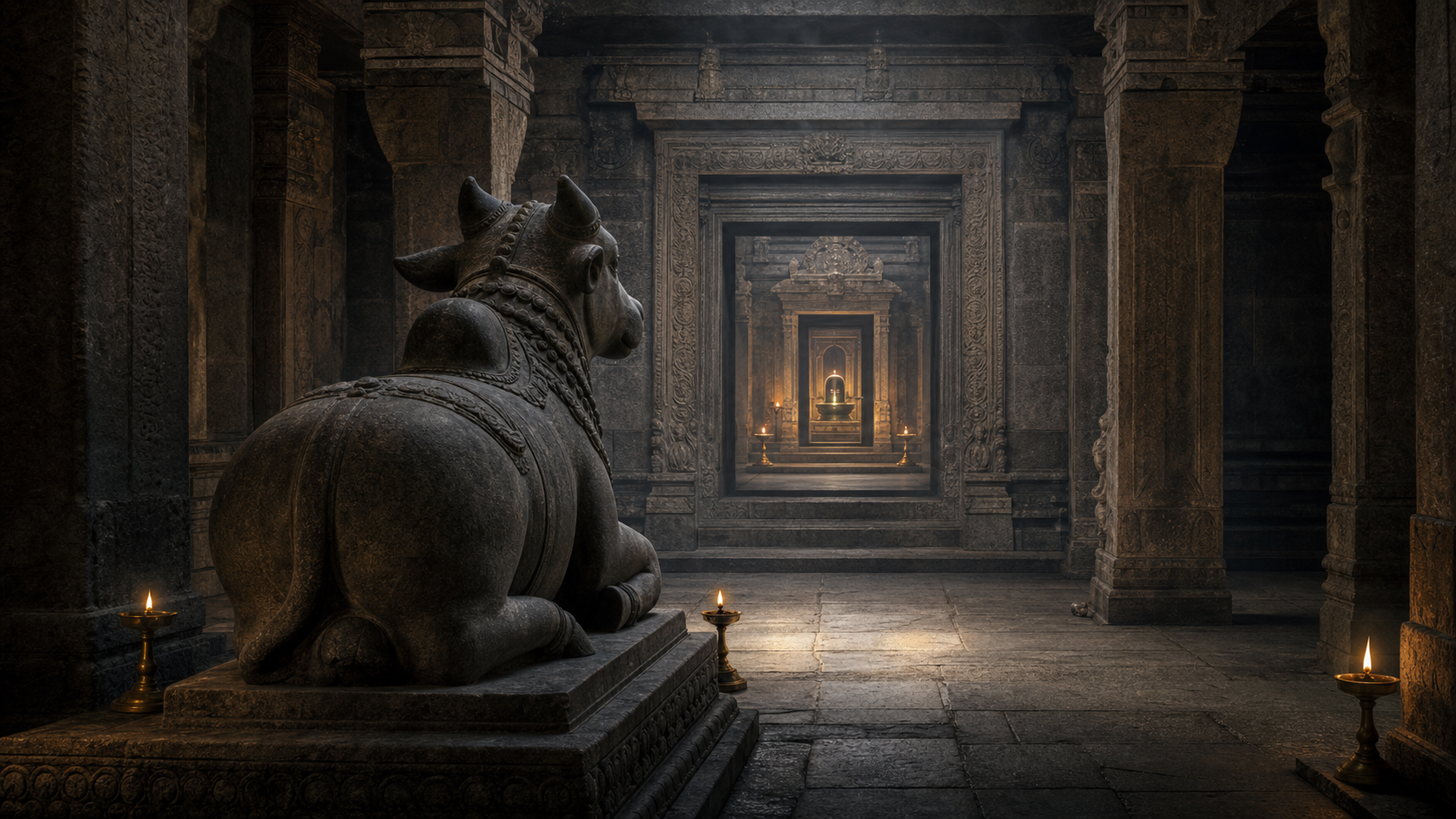
You enter a Shiva temple and Nandi is already there: seated, silent, and looking exactly where you came to look. If you have wondered whether he is simply the animal Shiva rides, the temple itself gives a larger answer. Nandi occupies the approach to the sanctum because he shows you how to approach Shiva.
Read three things first: his strength, his stillness, and the direction of his gaze. Together, they form a practical map. Bring your power under dharma, turn your attention toward the divine, and let restless movement settle before seeking darshan.
Nandi is not just the animal Shiva rides
Calling Nandi Shiva’s vahana is correct, but incomplete. In sacred iconography, a vehicle is not merely transportation. It reveals the kind of power associated with a deity and what happens when that power is brought into divine order. Nandi is capable of enormous force, yet the form placed before Shiva is neither charging nor wandering. His strength has become available without remaining impulsive.
Shaiva tradition gives Nandi several connected roles. Each one teaches you something different about spiritual approach:
- As vahana, Nandi represents strength carrying a purpose greater than itself.
- As guardian, he marks the threshold between ordinary movement and the concentrated space of the sanctum.
- As leader of Shiva’s ganas, he shows that devotion can include responsibility, order, and service.
- As Nandikeshvara, the teacher, he represents knowledge conveyed through disciplined attention. Dance tradition also remembers Nandikeshvara as the seer associated with the Abhinaya Darpana, linking Shiva’s cosmic movement with Nandi’s composed stillness.
These roles belong together. Nandi guards because he is devoted, leads because his strength is governed, and teaches because his attention does not scatter. He is not an obstacle placed between you and Shiva. He is the first instruction on the way to Shiva.
Why the contrast with the horse matters
The canonical contrast between the bull and the horse clarifies Nandi’s purpose. Rig Veda 1.163 praises the horse’s swiftness and solar vitality. The Ashvamedha connects it with royal sovereignty, while the horses of Surya, the swift Ashvins, and the future appearance of Kalki give it a strong association with motion, outward action, and the restoration or administration of worldly order.
That does not make the horse inferior. It makes the horse suited to a different symbolic function. The horse readily expresses rajas: speed, projection, expansion, and command. Shiva, as Adiyogi and lord of the inward-turning path, requires a symbol of power that can become quiet without becoming weak. Nandi supplies precisely that form.
This distinction gives you a reliable rule for reading Hindu iconography: do not isolate the animal from its deity, posture, location, and sacred narrative. The same animal can carry different meanings in another setting. Rishabhanatha, the first Jain Tirthankara, bears the bull as his emblem, but that does not make him another version of Nandi. The shared bull motif can reveal an Indic respect for steadiness and ethical order without erasing the distinct theology of either tradition.
Dharma appears as disciplined strength
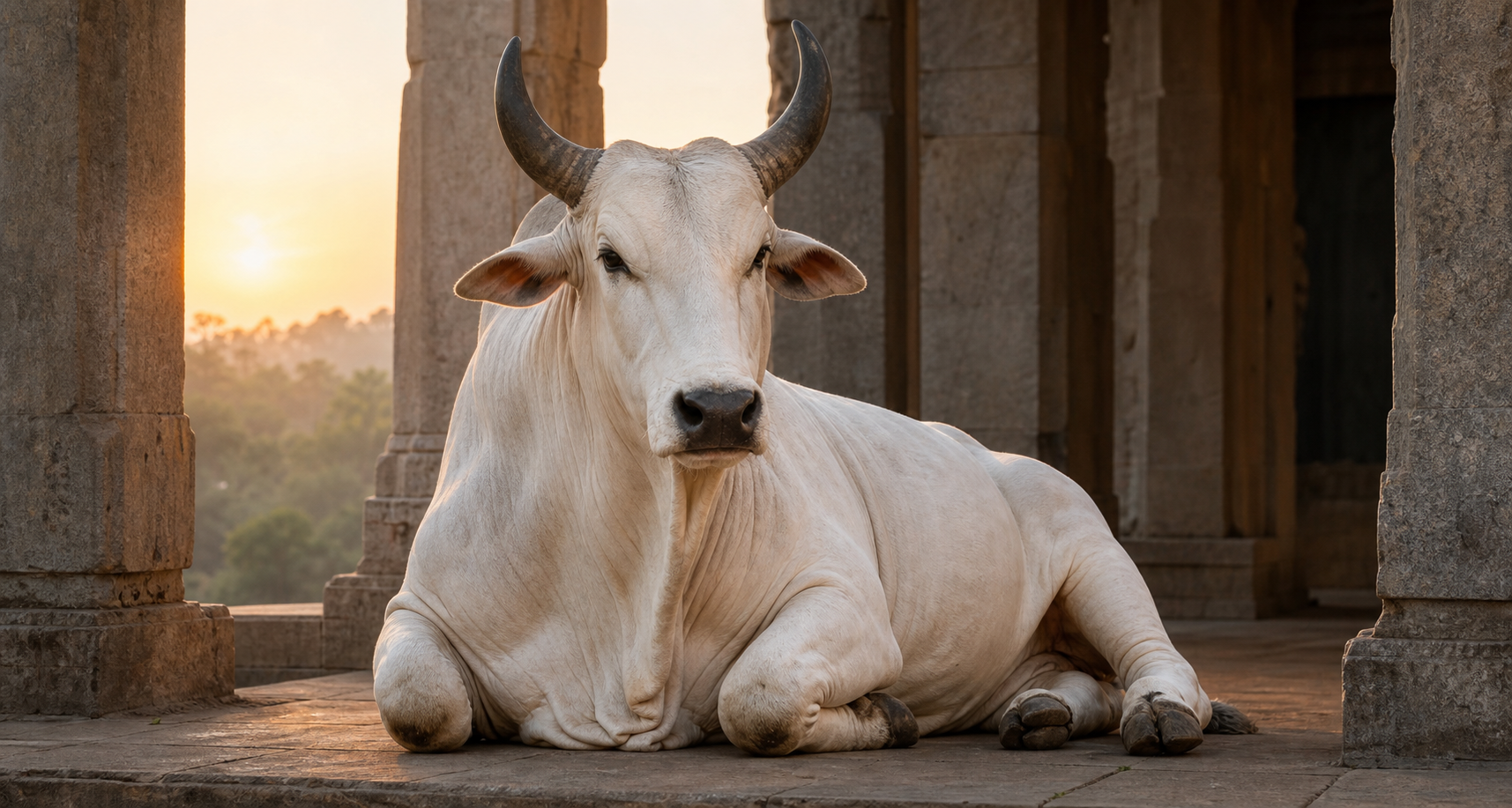
Nandi and Vrishabha disclose two sides of the symbol. The name Nandi is commonly connected with ananda, bliss: not momentary excitement, but the settled fullness associated with Shiva’s presence. Vrishabha means bull, while vrisha also carries the sense of righteousness. Nandi can therefore be read as both blissful devotion and dharma made visible.
The image of dharma as a bull appears across the Mahabharata and later Puranic imagination. In the familiar yuga pattern, the bull stands securely on four legs in Satya Yuga, loses support through Treta and Dvapara, and remains on one leg in Kali Yuga. The point is not animal anatomy. It is a moral diagnosis: as collective conditions deteriorate, sustaining righteous order becomes progressively harder.
Nandi remains facing Shiva within that world of decline. His posture answers a practical question: what do you do when the age around you does not support dharma? You stabilize what is within your responsibility. Keep the promise you have made. Restrain strength that would otherwise become aggression. Complete a duty without demanding recognition. Refuse to let urgency decide what is right.
The bull’s agrarian meaning makes this lesson more concrete. A horse can dramatize rapid movement and conquest; the bull evokes the patient strength by which households, fields, and villages endure. Nandi therefore represents more than impressive power. He represents power that can bear weight, remain dependable, and serve life over time.
That is why the seated form matters. A charging bull would show force in release. Nandi shows force voluntarily held. His stillness is not imposed helplessness but mastery. When you look at him, ask not merely whether you possess strength, but whether your strength can remain obedient to dharma when action, anger, praise, or fear pulls it elsewhere.
The much-discussed Indus Valley image often called the Pashupati seal should be handled with the same discipline. Its horned yogic figure, surrounding animals, and resonance with later ideas of Pashupati make comparison understandable, but the identification of that figure as a proto-Shiva remains academically unsettled. Treat the resemblance as a possible civilizational echo, not as conclusive proof of an unbroken iconographic identity. Reverence does not require overstating the evidence.
The temple axis turns symbolism into practice
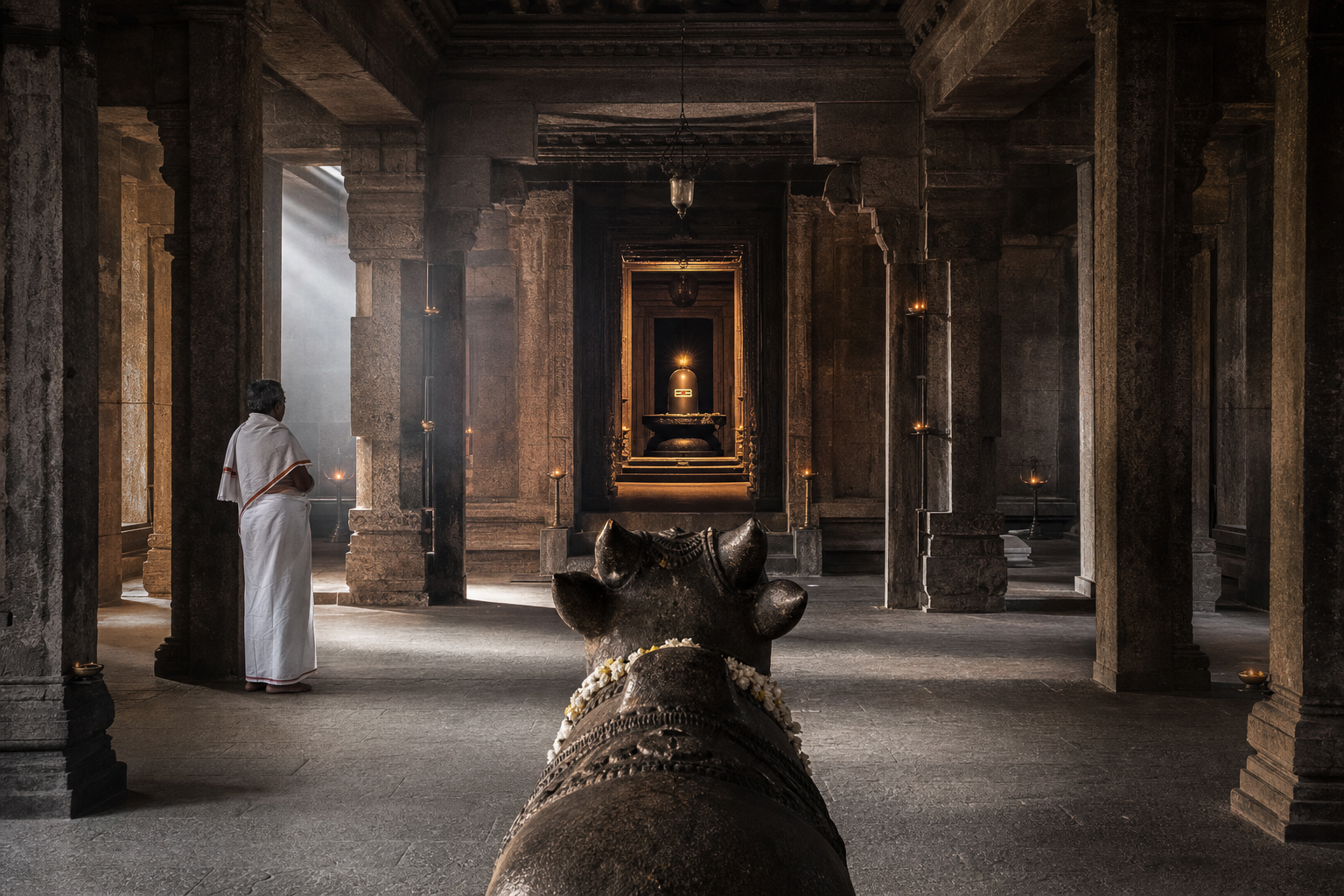
Nandi’s placement is as important as his identity. Shaiva Agamas such as the Kamikagama and Suprabhedagama prescribe a Nandi Mandapa aligned with the garbhagriha. Nandi is often positioned slightly lower than the sanctum, facing the Shiva-linga without deviation. The arrangement creates a line of attention: devotee, Nandi, and Shiva.
In many living temple traditions, the devotee receives darshan through the visual frame made by Nandi’s horns. This is not merely an attractive sight line. The axial relationship between Nandi and the linga turns architecture into instruction. Your body slows near Nandi, your gaze narrows toward the sanctum, and scattered attention begins to gather around one object.
Three disciplines are being taught without a lecture. Bhakti appears in Nandi’s unwavering orientation toward Shiva. Dharma appears in the steadiness with which he holds his place. Ekagrata, or one-pointed attention, appears in the uninterrupted direction of his gaze. The temple does not ask you merely to understand those ideas. Its layout invites you to enact them.
A five-step way to read Nandi during darshan
You do not need to invent a new ritual to receive this instruction. Follow the temple’s local customs, avoid blocking another devotee’s view, and use the existing arrangement as a brief contemplative guide:
- Pause before passing Nandi. Notice that the approach to the sanctum changes from walking to waiting. Let that threshold register.
- Observe the posture. Nandi possesses strength, but he is seated. Ask where your own energy is moving faster than discernment.
- Follow the direction of his gaze. Let your eyes move from Nandi toward the linga. The important feature is not Nandi in isolation, but Nandi in relationship with Shiva.
- Allow one natural breath to settle. Do not force a conspicuous pranayama exercise in a crowded temple. Simply notice whether a quieter breath also makes your attention less scattered.
- Carry one dharmic resolve away. Choose something concrete enough to do: govern harsh speech, fulfil a neglected obligation, or direct your effort toward service rather than display.
This is a way of reading the temple, not a claim that every Shaiva temple follows an identical darshan protocol. Regional customs and physical layouts vary. Local practice should lead; Nandi’s broader instruction does not depend on turning one custom into a universal command.
Stillness is a yogic achievement, not passivity
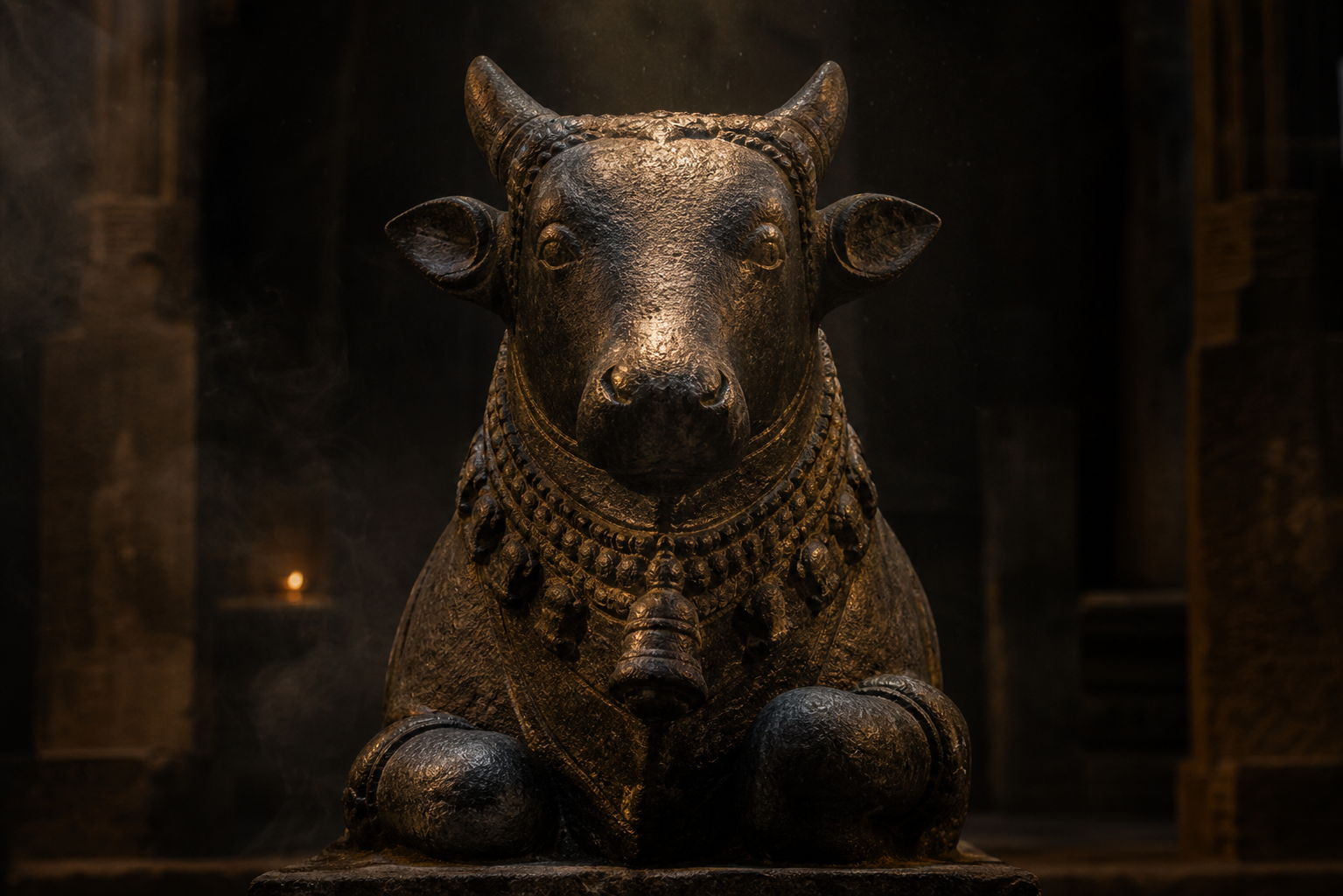
Nandi becomes especially clear when read through the three gunas. Tamas tends toward weight and inertia. Rajas tends toward motion, projection, and agitation. Sattva tends toward clarity, balance, and lucidity. A living bull can display heavy stillness or tremendous force. Before Shiva, those capacities are neither denied nor allowed to rule. They are reoriented toward attentive clarity.
This is the subtle point: spiritual discipline does not have to destroy energy in order to transcend restlessness. Nandi retains his mass and strength. What changes is their government. His power is placed in the service of awareness, just as yogic practice seeks to steady prana and manas rather than remain driven by every surge of vitality or thought.
Shiva as Adiyogi represents mastery of life-energy and mind. Nandi mirrors the condition required to approach that mastery. Breath becomes less erratic, the senses stop pursuing every stimulus, and attention remains available to what matters. In this reading, Nandi is not merely calm by temperament. He represents the achievement of making calm strong.
This corrects three common misreadings. Stillness is not laziness when it holds disciplined capacity. Renunciation is not incapacity when it releases the need for outward conquest. Devotion is not emotion alone when it requires the repeated alignment of conduct, energy, and attention.
The relationship between Nandi and Nataraja deepens the same insight. Shiva’s dance displays cosmic motion, transformation, and time. Nandi’s rhythmic stillness shows the ground from which movement can arise without becoming chaos. Shaiva symbolism does not force you to choose between action and contemplation. It asks whether action is held by consciousness and whether contemplation remains capable of right action.
Three questions to carry outside the temple
Before a difficult action, use Nandi’s form as a compact test:
- Is this strength under dharma? Being able to act does not by itself make the action right.
- Is my attention facing the real purpose? If anger, status, or haste has taken over, your gaze has metaphorically left the sanctum.
- Does this moment require movement or restraint? Sometimes dharma demands forceful action. Sometimes the greater strength is remaining seated until the impulse becomes clear.
This test keeps Nandi’s symbolism from becoming decorative. It gives you a way to distinguish controlled power from suppressed power, concentration from rigidity, and patient service from passivity.
Key takeaways
- Nandi is simultaneously Shiva’s vahana, guardian, leader of the ganas, devotee, and teacher; reducing him to transportation misses the structure of the symbol.
- The name Nandi evokes bliss, while Vrishabha connects the bull with righteousness and the wider image of dharma standing against decline.
- His seated posture represents available strength under discipline, not weakness or inactivity.
- The Nandi Mandapa and sanctum axis train bhakti, dharma, and one-pointed attention through the devotee’s own movement and gaze.
- The yogic reading is transformational: tamasic weight and rajasic force are redirected toward sattvic clarity rather than simply rejected.
- Comparisons with horses, Jain bull imagery, or the Pashupati seal should preserve context and uncertainty instead of flattening distinct traditions into one claim.
When you next enter a Shiva temple, do not hurry past Nandi as though the meaningful experience begins only at the sanctum. Pause long enough to see whether your own attention is facing where his attention faces. Let the temple’s custom guide your conduct, and let Nandi’s posture question the way you use your strength.
Then choose one capacity you already possess and place it under dharma before using it. That small act of alignment is where Nandi stops being an image you have decoded and becomes a discipline you can practise.
References
