

Your hand moves to the next bead, the mantra continues, and somewhere inside, another conversation takes over. You rehearse tomorrow’s work, answer an old accusation, compose a message, judge your concentration, or start explaining your spiritual life to yourself. By the time you notice, several repetitions have passed without your full attention.
You don’t have to defeat the mind before you can practise japa well. You need a reliable way to recognise inner speech without suppressing it, decide whether it deserves attention, and return to the mantra before the thought becomes a private drama.
Let the mantra lead the inner conversation
Japa needs a clear hierarchy. The mantra is the practice; every plan, memory, feeling, image, and judgement is an event arising within the practice. Inner dialogue becomes a problem when the dialogue takes the leading place and the mantra becomes background sound.
Use a direct test. At the end of a repetition, could you say that you actually heard or inwardly perceived the mantra? You don’t need to reconstruct every syllable or interrogate yourself. Simply notice whether you were present to the sacred sound or occupied by another line of thought.
Attention has probably shifted when:
- Your hand and voice continue automatically while the mind develops complete sentences about something else.
- You speed up mainly to finish your count rather than to perceive the mantra.
- You start measuring how distracted you are and grading the quality of the session.
- You conduct an imaginary argument with someone who isn’t present.
- You keep polishing an insight because it feels too important to postpone.
None of these requires anger at the mind. Anger merely adds another voice. Your practical task is to withdraw permission from the competing conversation and give the next mantra your attention.
This changes the standard by which you judge a sitting. Success doesn’t require a blank mental field. It consists in repeatedly choosing what will lead. A distracted repetition can therefore be followed immediately by an attentive one; you don’t need to wait until the whole mind feels peaceful.
Use the same return whenever the mind wanders

A simple return keeps you from negotiating with every thought. Use the sequence below whenever you realise that an inner conversation has displaced the mantra.
- Notice the function of the thought. Name it briefly as planning, replaying, judging, worrying, imagining, or praying. Name the kind of activity, not its whole story. The label should close the discussion rather than begin an analysis.
- Offer it or park it. In devotional japa, you may place the concern before the Lord in a brief, sincere phrase. If your lineage frames the practice differently, acknowledge that the matter can wait until the sitting is over. An urgent practical duty can be marked on paper without being solved in the middle of japa.
- Attend to the next complete mantra. Return at a clean boundary and listen at the pace permitted by your discipline. Don’t wait to feel devotional, calm, or worthy. Attention begins with the next repetition available to you.
The bead in your hand can help because it gives the body a definite present place. It isn’t evidence of how many times you failed; it is the current opportunity to attend. That is what makes the image of the bead bag as a setting for spiritual conversation so useful: your hand can call you back from the conversation invented by the mind to the practice you actually sat down to perform.
Don’t rewind a large part of the session merely to punish yourself for wandering. If your guru, vow, or sampradaya gives a precise rule about counting, incomplete repetitions, pronunciation, beads, or the bead bag, follow that rule. The method here governs attention; it doesn’t replace the discipline you have received.
Give different kinds of inner speech different answers

Not every thought has the same cause. The return to the mantra remains the same, but what you do after japa should depend on the kind of thought that appeared.
- Plans and remembered tasks: Don’t organise the day inside the mantra. Mark a genuinely necessary task with a few words, then return. Review the note after japa and act on it. When you consistently honour the note later, you no longer need to keep rehearsing the task to prevent forgetting it.
- Replayed conversations: Notice whether you are preparing for a real responsibility or trying to win an imaginary hearing. Either way, japa isn’t the place to draft the perfect reply. Set the matter aside. If a response, apology, or boundary is actually needed, decide on it after the sitting when you can see the situation more soberly.
- Emotion and personal prayer: Grief, gratitude, fear, and longing may naturally turn toward prayer. The useful distinction is between direct address and self-absorbed narration. A brief offering that returns you to the mantra can belong to devotion; a long internal explanation that makes you stop hearing the mantra has replaced the practice.
- Self-judgement: Thoughts such as “my japa is terrible” or “a serious practitioner wouldn’t think this” are distractions wearing religious clothing. Don’t answer them with a defence of your character. Label the judgement and attend to the mantra. The return itself is the appropriate response.
- Insight and inspiration: A promising idea can capture attention more effectively than an unpleasant thought because you want to preserve it. Record a short cue if necessary, but don’t develop it. If the insight is worthwhile, you can examine it after japa without sacrificing the present repetition.
- An unresolved duty: A neglected promise, dishonest action, or avoidable conflict may recur because it requires conduct outside meditation. Don’t use more inner commentary as a substitute for correction. Return during japa, then take the necessary ethical action afterwards.
This distinction also prevents a common mistake: treating every emotionally charged thought as spiritual guidance. Intensity alone doesn’t establish truth. Let japa steady your attention, and examine decisions after the session with the teachings, obligations, and counsel appropriate to your tradition.
Remove the negotiations that begin before japa
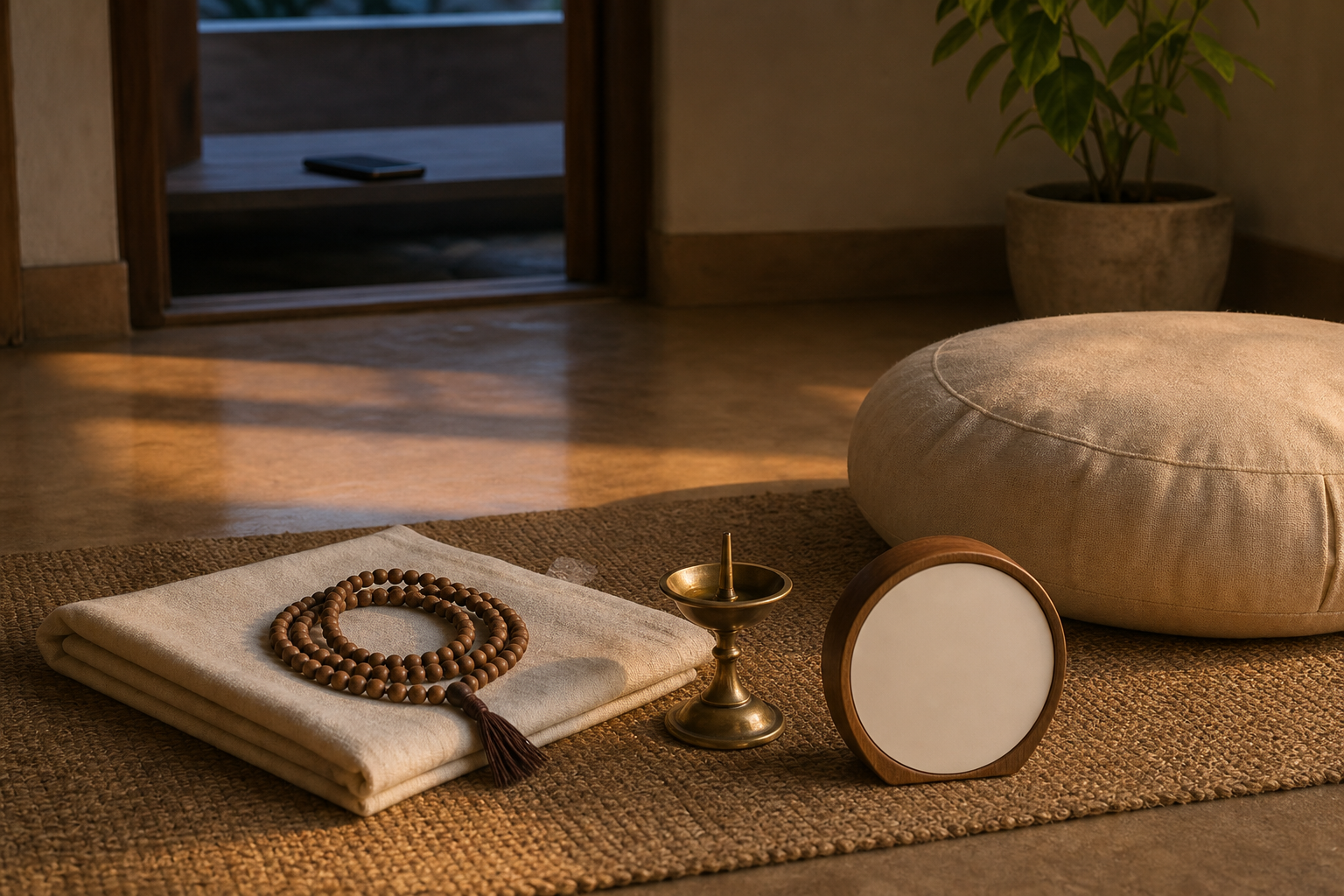
Some inner dialogue is invited by decisions left open. If you sit down without deciding how you will practise, the mind spends the session negotiating pace, count, comfort, messages, and stopping time. Settle what you can beforehand.
- Decide the commitment before beginning. Use the count, duration, or vow established by your practice. Don’t renegotiate it merely because concentration has become difficult.
- Remove visible prompts. Put aside the phone, open messages, unfinished reading, and anything else likely to start a chain of thought. A device used only as a timer should not also display incoming demands.
- Make a parking note. Before touching the beads, write down the tasks already pressing for attention. This is not a planning session. The note simply assures you that remembering them during every repetition is unnecessary.
- State the purpose plainly. Remind yourself whom or what the mantra addresses in your tradition and what attentive repetition requires. A clear intention is more useful than demanding a particular mood.
- Choose an attentive pace. Recite in the manner you have been taught and at a pace at which the mantra can actually be perceived. Unless your discipline specifies speed, finishing faster is not a reliable measure of better japa.
- Make only permitted adjustments. If dullness or agitation grows, adjust posture, voice, or setting in ways consistent with your tradition. The purpose is to restore attention, not to keep changing the practice until it becomes entertaining.
After the session, look at what repeatedly pulled you away. A recurring task may need scheduling. A recurring conflict may need a conversation. A recurring digital cue may need to be removed before the next sitting. This review should produce a practical adjustment, not a verdict on your spiritual worth.
Most importantly, keep the promises you make to the mind. If you repeatedly say, “I will deal with this after japa,” and never do, the concern will return with greater force. Completing the task, having the conversation, or consciously deciding that no action is needed protects the next period of sadhana.
Key takeaways
- The presence of inner speech doesn’t decide the value of your japa; the decisive act is whether you follow it or return to the mantra.
- When attention wanders, identify the thought’s function, offer or park it, and attend to the next complete mantra.
- Brief personal prayer can support devotional remembrance, but extended self-narration can displace the sacred sound.
- Planning, moral duties, and useful insights should normally be handled after japa, when you can give them deliberate attention.
- Use the bead in your hand as a present anchor, not as a record of failure.
- Instructions received from your guru or sampradaya take precedence over general advice about counting, pronunciation, and the handling of beads.
At your next sitting, don’t demand a silent mind. Make a smaller and more workable commitment: whenever another conversation takes over, recognise it, put it outside the current repetition, and return. If an unfinished duty keeps coming back, address it when the session ends. Japa is strengthened bead by bead through that honest return.
References
