
You may be wondering whether Durban’s mass Hanuman Chalisa recitation was simply an unusually large devotional programme or a model that Hindu communities elsewhere should study. Its lasting importance lies in the combination: a familiar spiritual practice, participation across inherited community lines, confident Hindu self-identification and carefully organised seva.
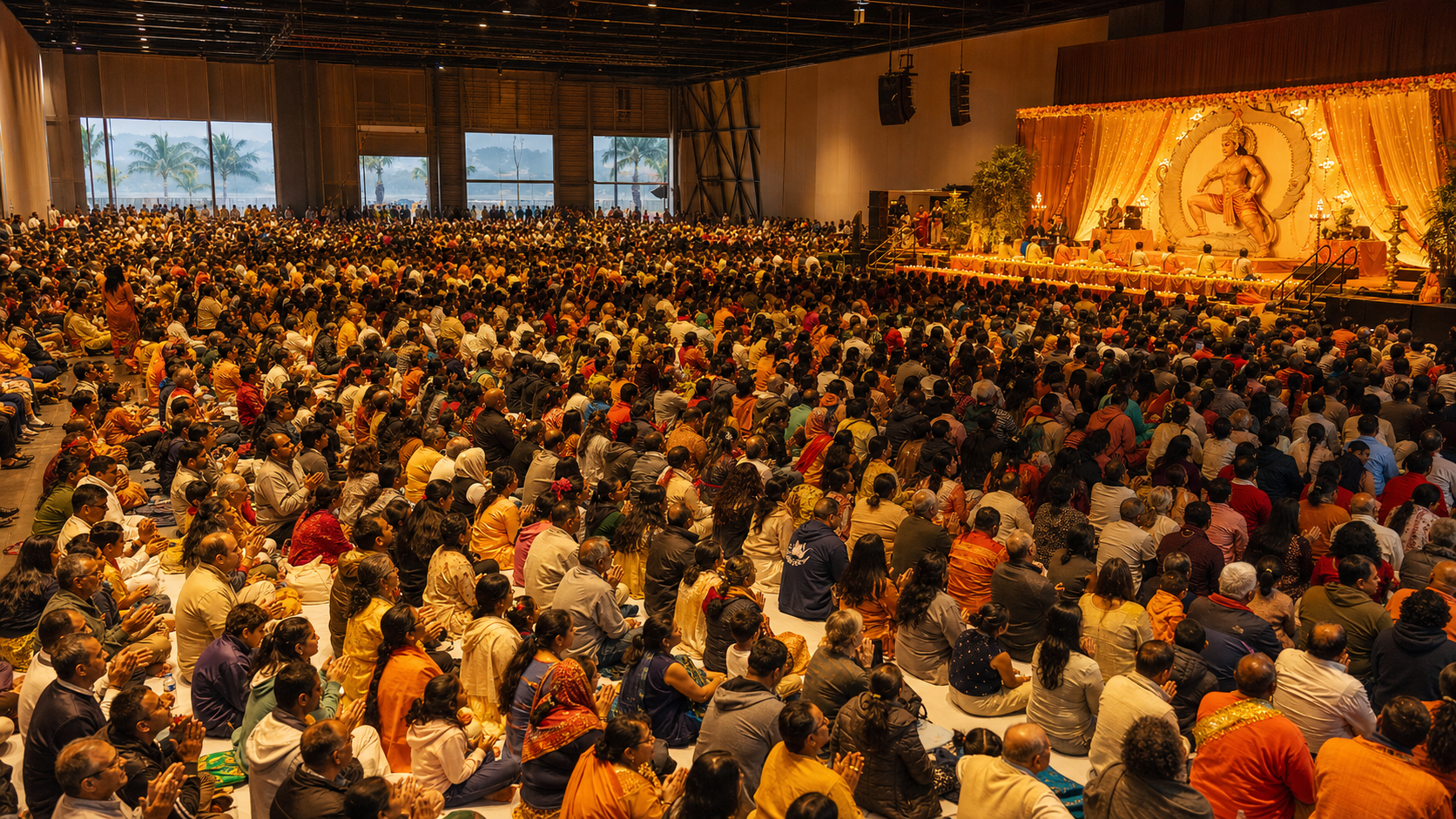
On 5 July 2026, Chinmaya Mission South Africa assembled more than 17,000 people in Durban for 27 collective recitations of the Hanuman Chalisa. The programme was called Man to HANUMAN. Organisers reported more than 400,000 recitations in total. Those attendance and chant figures are organiser-reported, but even read with that qualification, the gathering offers serious lessons for Hindus trying to turn cultural inheritance into living community.
Why the gathering was more than a large bhajan
A large audience can remain passive. A large congregation cannot. The crucial choice in Durban was to organise the day around repeated participation rather than a performance watched from a distance.
Bhajan singer Anup Jalota led the chanting with singer-actor Anuja Sahai, presenting the Hanuman Chalisa in different ragas. Yet the centre of the event remained the assembled devotees. During the final two rounds, the congregation stood with Swami Abhedananda Sarasvati while thousands of saffron flags were raised. The emotional force came from people doing the same sadhana together, not merely watching recognised performers do it for them.
The Hanuman Chalisa is especially suited to this kind of gathering because it is recognisable, repeatable and participatory. A devotee does not have to belong to the host institution to enter its rhythm. The text provides a common centre while Hanuman provides a widely understood model of bhakti expressed through courage, discipline and service.
This distinction matters when you assess the event’s significance. The achievement was not simply putting thousands of Hindus in one venue. It was enabling them to act as a congregation through a shared spiritual discipline. Numbers create visibility; common practice creates belonging.
A shared practice crossed inherited community lines
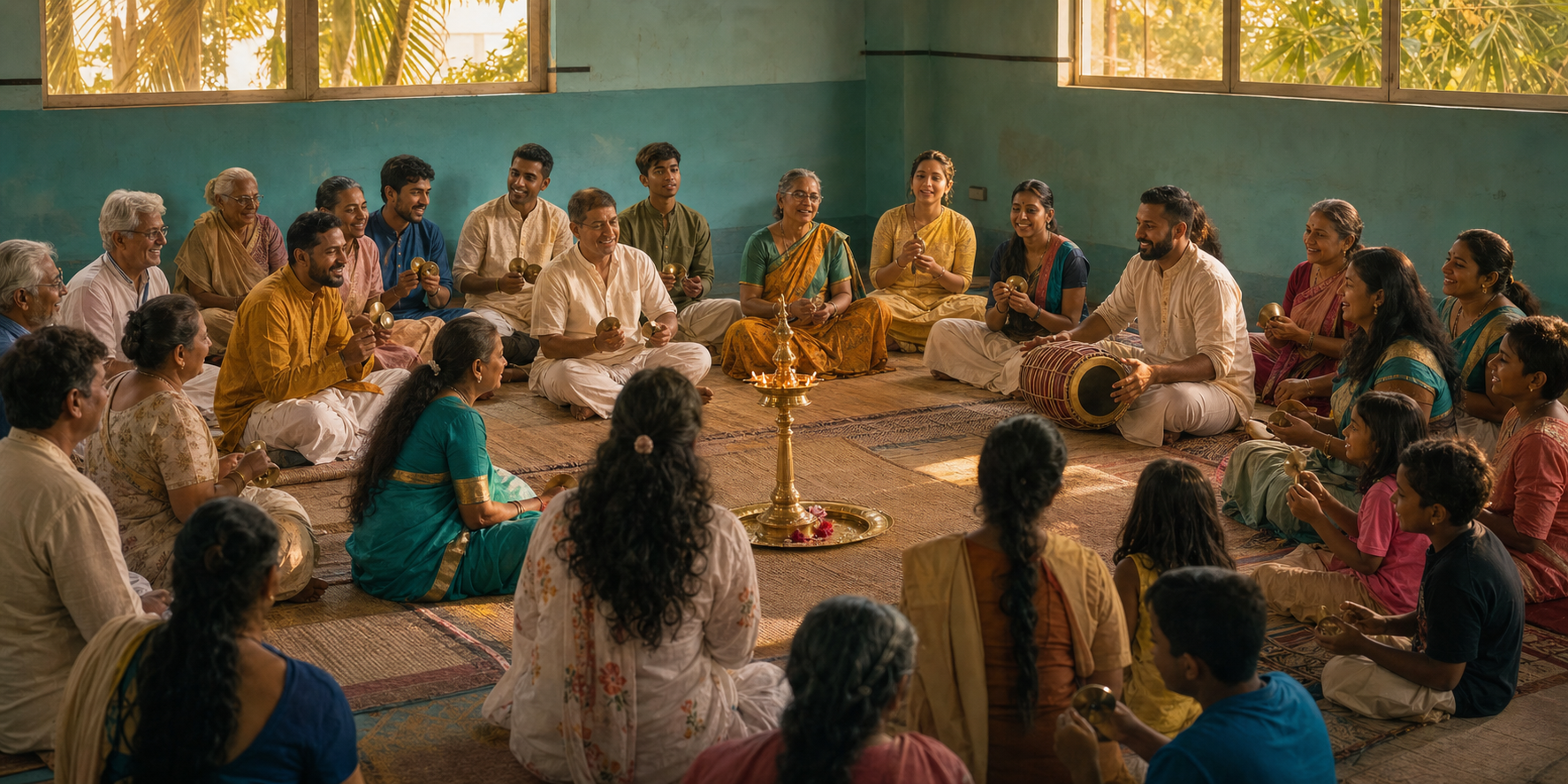
Swami Abhedananda’s stated aim was to bring South African Hindus together across differences of language and Indian state of origin. That is a practical diaspora challenge. Families may preserve distinct languages, temple affiliations, regional customs and ritual forms even while sharing a broader Hindu identity.
Unity does not require those distinctions to disappear. A durable Hindu coalition gives people two things at once: room to preserve their particular traditions and an accessible practice through which they can stand together. The Chalisa served as that common layer in Durban. It did not require every attendee to adopt the same regional culture or surrender an existing sampradaya.
If you are helping organise a gathering, this gives you a useful test. Ask whether the central practice can be entered sincerely by people outside the host organisation. If participation depends on knowing one institution’s internal culture, the programme may attract its existing circle without building a wider community. A familiar text, a clearly announced format and enough guidance for less-practised attendees lower that barrier without diluting the worship.
The public message reinforced the common layer. Flags carried an image of Hanuman and the words “I Am A Proud Hindu.” That sentence did not ask attendees to deny their regional or sectarian identities. It gave them a wider identity in which those inheritances could meet.
The hidden centre of the event was seva
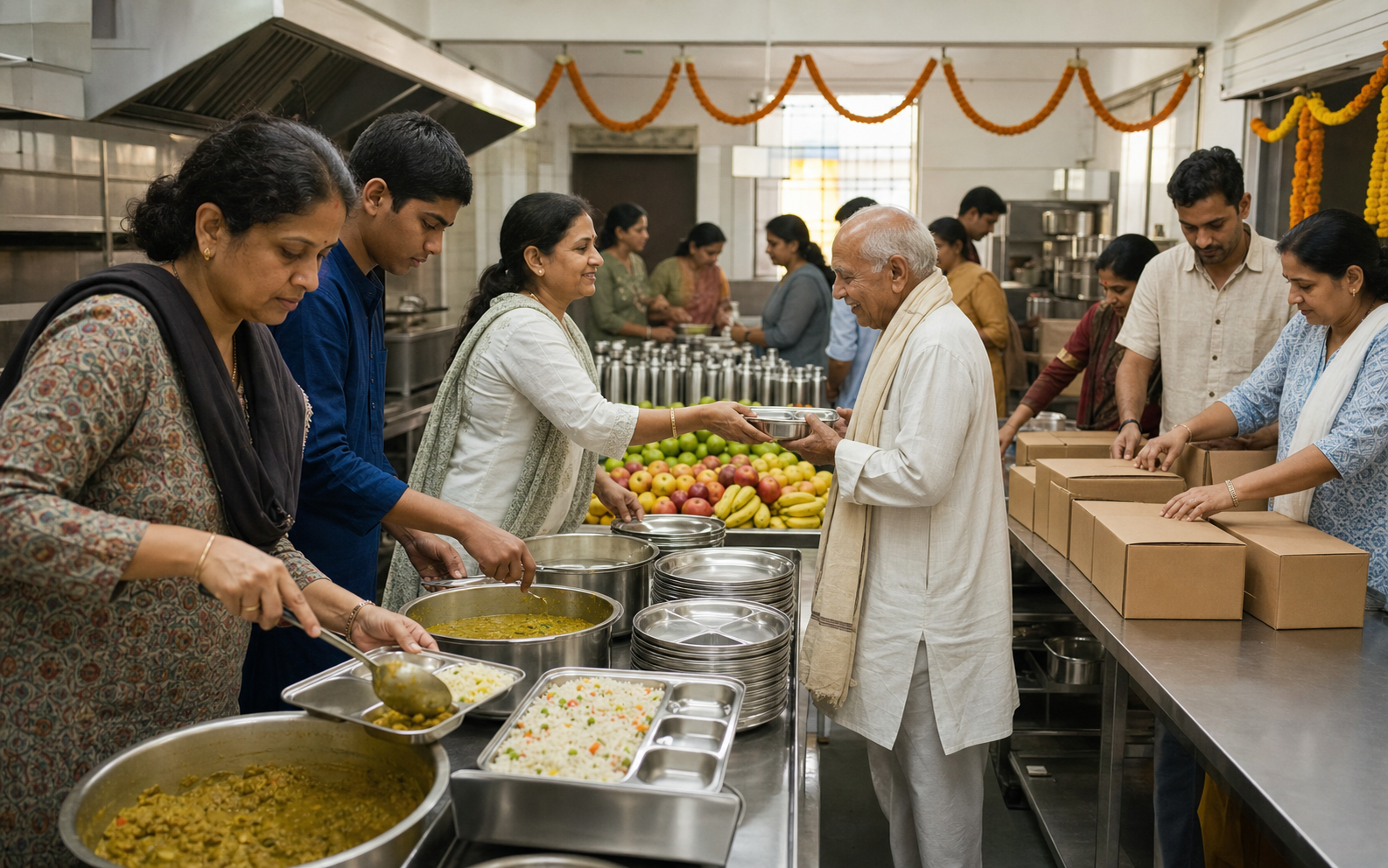
The stage and flags made the visible moment. Transport, food, parking and volunteer labour made the moment possible. This is the part community organisers should study most closely.
More than 5,000 attendees travelled in 85 buses from five South African provinces. That means participation was designed beyond the immediate city. A national invitation without a transport plan would have remained an aspiration; buses converted it into access.
The original attendance target was 10,000, while the reported turnout exceeded 17,000. Volunteers prepared for the larger demand by cooking and packing nearly 20,000 full meals between 11 p.m. and 11 a.m. before the programme. Other volunteers spent the preceding week preparing 27,000 rohts, a sweet used in local Hindu ritual, for offering and distribution as prasad.
Those numbers reveal an important organising principle: hospitality cannot be calculated as an afterthought once the spiritual programme is fixed. If people travel from other provinces, navigate a large venue and join an extended collective practice, transport, accessible parking, food and crowd movement are part of the religious welcome. Seva is not the backstage department of a dharmic event. It is one of the forms through which the event expresses its dharma.
The take-home materials also mattered. Each attendee reportedly received spiritual books, a Hanuman altar image, a copy of the Hanuman Chalisa and sindoor prasad. These were not merely souvenirs. They gave a household the means to continue something of the day’s practice after the crowd dispersed.
When you plan a community programme, write down the participant’s entire journey: learning about it, reserving transport, arriving, finding a seat, participating, eating, receiving prasad and returning home. If your planning document begins and ends with the stage schedule, you have designed a production rather than a congregation.
Hindu pride works best when it is publicly responsible
The gathering made Hindu identity unmistakably visible. Organisers distributed 10,000 saffron flags, and the repeated declaration on them was affirmative: “I Am A Proud Hindu.” It stated who the participants were without defining that identity through hostility towards someone else.
That distinction is worth protecting. Public Hindu confidence becomes credible when symbols, worship and speech are matched by disciplined conduct. Good crowd management, accessible arrangements, meals for attendees and courteous civic engagement make pride legible as responsibility rather than mere display.
KwaZulu-Natal Premier Thami Ntuli attended as guest of honour, raised a saffron flag, followed the Hanuman Chalisa and recognised the Mission’s contribution to South African society. One dignitary’s participation should not be mistaken for proof of universal public agreement. It does show that an explicitly Hindu gathering can maintain its religious character while engaging civic leadership openly.
For organisers, the right balance has three parts. The worship should remain recognisably Hindu. Civic guests should be welcomed without being allowed to turn the gathering into their platform. The event’s public conduct should demonstrate that Hindu visibility and contribution to the wider society reinforce each other. If any one of those parts is missing, either the identity becomes timid, the ritual becomes instrumentalised or the public claim loses credibility.
How to build a smaller gathering that can endure
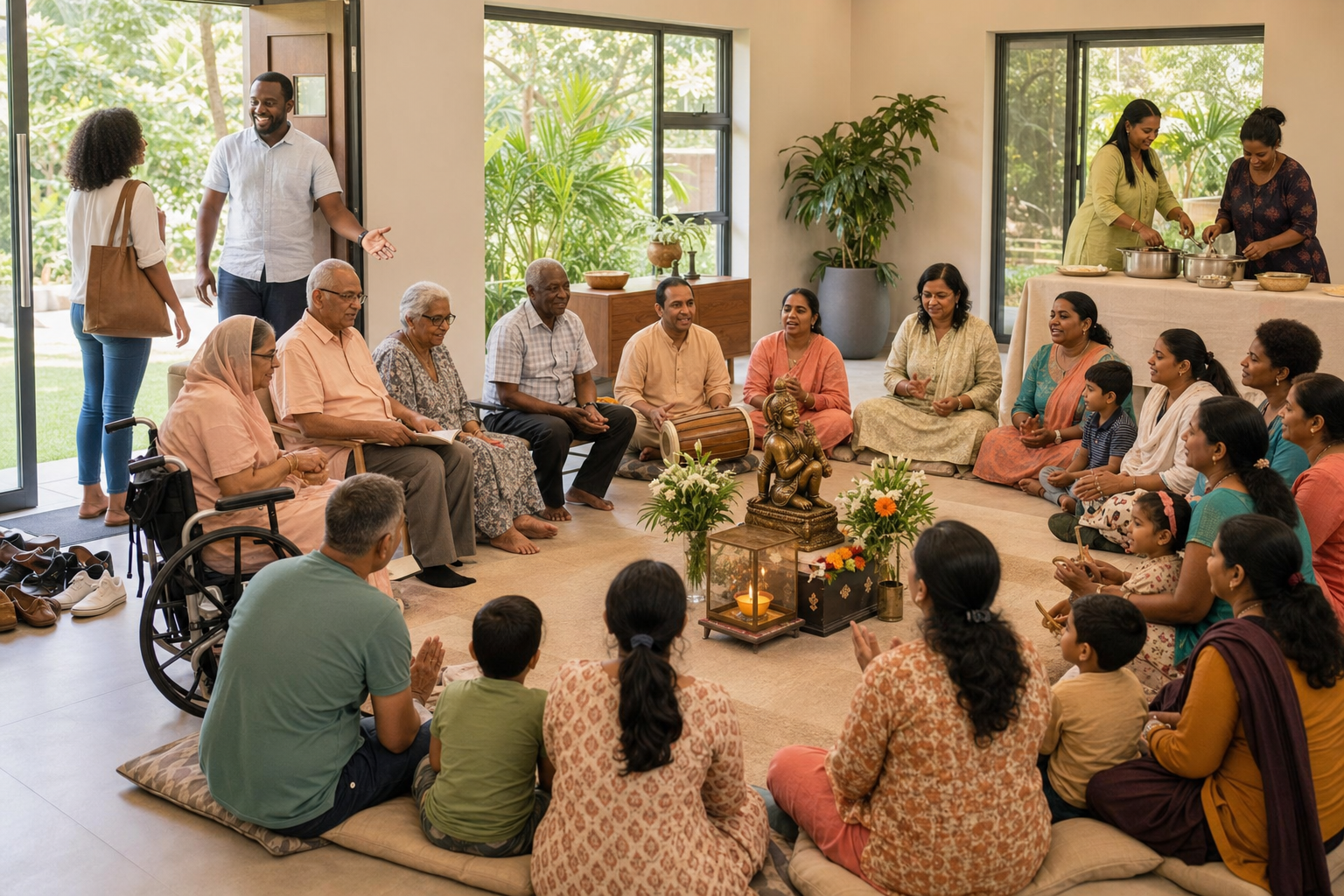
You do not need 17,000 people or 27 rounds to apply Durban’s strongest lessons. Copying the scale would miss the point. What can be adapted is the architecture that connected sadhana, identity, access, seva and continuity.
Key takeaways for Hindu community organisers
- Define the spiritual action precisely. Name the text, the number of recitations, who will lead them and how attendees will follow. A clear participatory centre prevents the programme from becoming a sequence of unrelated performances.
- Build the coalition before advertising the crowd. Invite temples, linguistic associations and regional communities to participate as partners. Make the shared worship the meeting point, not membership in the host organisation.
- Separate the attendance estimate from the safe venue limit. Track registrations and transport bookings, but never allow enthusiasm to override the venue’s legal capacity, emergency arrangements or crowd-control requirements.
- Treat travel and accessibility as participation issues. Map where people are coming from, appoint coordinators for each bus or departure point, publish arrival instructions and confirm accessible parking before the event date.
- Give food, prasad and devotional materials named owners and quantities. The reported Durban turnout substantially exceeded its original target, so establish a realistic service buffer and a safe contingency plan rather than assuming registrations are the final headcount.
- Design the return home as carefully as the arrival. A Chalisa text, altar image or book can help turn one collective experience into household practice. Pair the materials with a clearly announced next satsang or local recitation opportunity.
- Report results with precision. Distinguish registrations, transport bookings, counted entries and organiser estimates. Large figures can attract attention, but transparent figures build the trust needed for the next gathering.
Your next step can be one planning meeting built around a single question: what would allow a Hindu from another linguistic, regional or institutional background to arrive, participate fully and return home able to continue the practice? Answer that concretely through worship, transport, access, food, prasad and follow-through. That is how a memorable gathering becomes durable Hindu institution-building.
References
