

You may have arranged a shrine with care and still found that it feels like a decorated shelf. Or you may have entered a temple, seen its gates and circumambulatory paths, and wondered why the route matters when the deity is the apparent destination. In both cases, the missing idea is not another object. It is the disciplined crossing from ordinary space into a bounded field of presence.
Krānta gives you a precise way to understand that crossing. It connects the placement of a boundary, the direction of movement, the geometry of a maṇḍala, and the establishment of a sacred center. Once you can see that structure, you can read a temple or yantra more intelligently and shape a modest domestic precinct without pretending to reproduce a formal Tantric consecration.
Krānta begins with a step, not an object
The Sanskrit krānta belongs to the verbal family of √kram, meaning to step, stride, or cross. Its participial range includes what has been crossed, stepped upon, or occupied. In a Tantric spatial reading, that movement becomes a way of describing ground that has been entered, delimited, ordered, and made fit for sacred presence. The decisive change is therefore relational: a perimeter is established, a threshold is crossed, and movement becomes accountable to a center. This semantic movement from stepping to sacred occupation is the key to the concept.
Krānta should not be forced into one rigid definition wherever it appears. Usage varies by period and lineage. It is better treated as a strong interpretive key for a family of Tantric operations than as the name of one universally identical ritual step. That distinction keeps you from mistaking a useful spatial principle for a liturgical formula that every sampradāya must perform in the same way.
Several related terms help sharpen the meaning:
- Krānta emphasizes crossing, stepping upon, or occupation.
- Ākrānta adds the sense of being pervaded or thoroughly occupied.
- Saṃkrānti names an ingress or transition, especially a calendrical crossing such as Makara Saṃkrānti.
- Parikrama and pradakṣiṇā describe ordered movement around a center.
- Vikrama preserves the force of a powerful or heroic stride.
These are not interchangeable words. Together, however, they show why stepping carries more than mechanical meaning in dharmic practice. A threshold separates conditions. A circuit confirms the centrality of what is enclosed. A measured stride places the body inside an order that the mind is being asked to accept.
Nor should occupied be read as a political claim of exclusion. In this setting, occupation means the stabilization of sacred presence and the reordering of conduct around it. The divine is not imprisoned by a line on the ground. The line disciplines human attention. It tells you where casual behavior ends, where a different mode of speech and movement begins, and what must be protected from distraction.
How an ordinary surface becomes a kṣetra
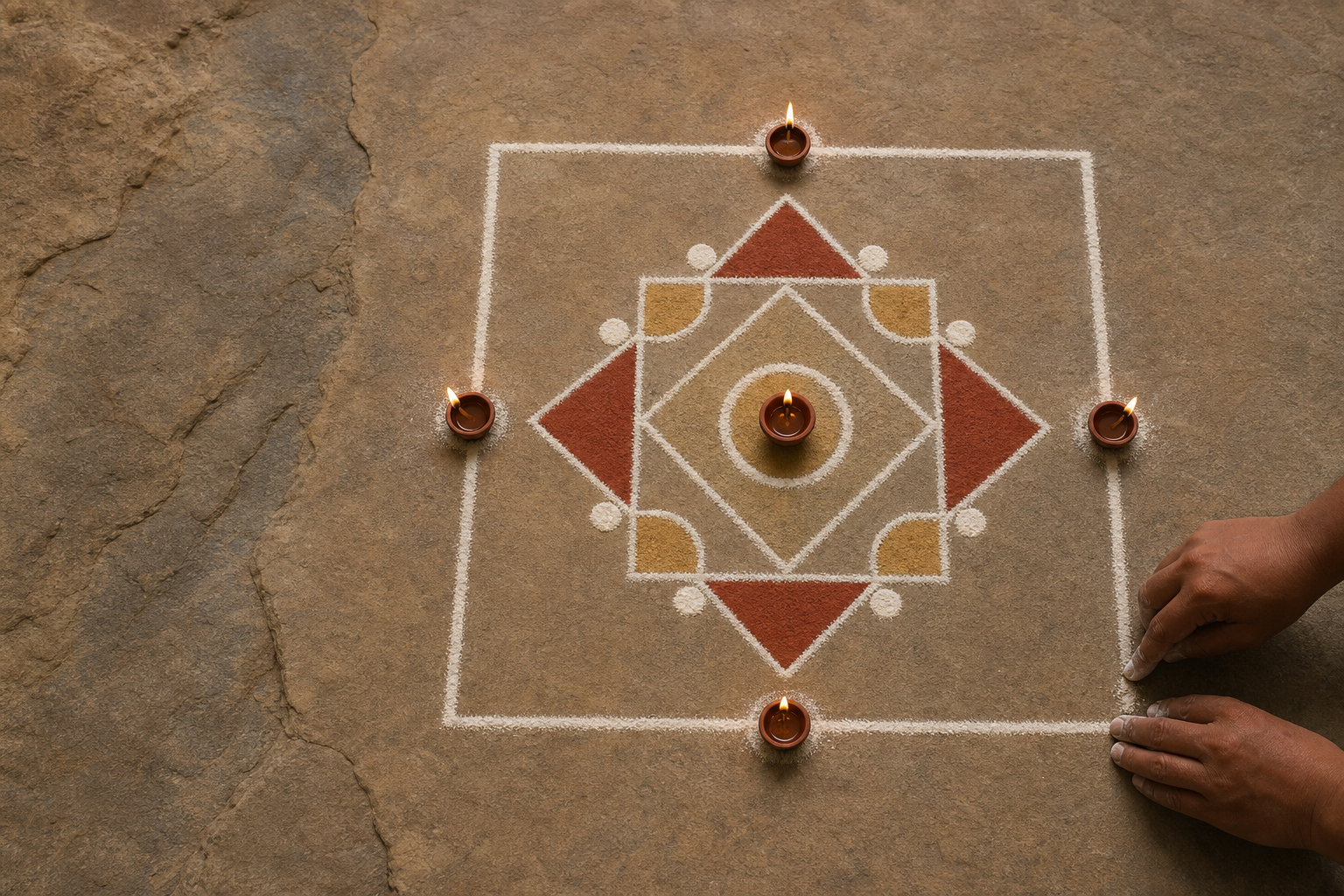
Tantric ordering works by stages. The exact mantras, measurements, and ritual sequence depend on the lineage and occasion, so the following is a conceptual map rather than a do-it-yourself consecration manual. Its value is that it lets you see what each class of action accomplishes.
- Prepare the ground. Bhū-śuddhi addresses the site as ground worthy of purification, not as an inert surface waiting to be decorated. Physical readiness and ritual readiness belong to the same movement of care.
- Measure and orient it. The field is aligned, proportioned, and given a legible form. A caturasra or square may establish stability; a trikona or triangle may establish a different ritual geometry. Cardinal direction, proportional measure, and the division of the surface into padas prevent arbitrary placement.
- Establish the enclosure. Dik-bandha seals the directions, a rakṣā-cakra provides a protective circuit, and the bhūpura gives the maṇḍala an outer limit. The boundary makes entry deliberate.
- Relate body and field. Nyāsa places sacred syllables or powers upon the body and the maṇḍala. Mudrās act as kinetic seals. Mantra names, invokes, delimits, and fills the field.
- Stabilize presence. Prāṇa-pratiṣṭhā marks a decisive transition from arranged form to ritually inhabited form. What follows must be approached with the discipline due to presence, not handled as movable décor.
- Move through the ordered field. Āvaraṇa-pūjā, pradakṣiṇā, and other lineage-specific procedures activate the relationship among perimeter, intermediate powers, practitioner, and center.
This progression explains why sacred geometry alone is insufficient. A correctly drawn figure can display the architecture of a maṇḍala, but Tantric ritual also requires acts that purify, bound, invoke, place, seal, and sustain. In the ritual ordering of measured and protected ground, geometry supplies the form while mantra, mudrā, nyāsa, and disciplined movement establish the field as lived sacred space.
The Vāstu Puruṣa Maṇḍala makes the architectural logic especially clear. Its grid maps differentiated relations onto the ground. Dikpālas anchor direction, padas articulate position, and pramāṇa governs proportion. The result is not empty symmetry. It is a hierarchized kṣetra in which the center, edges, directions, and permitted routes do different work.
You can test any proposed sacred layout with four questions. Where does the precinct begin? What marks the act of entering? What draws movement toward or around the center? What conduct changes once the boundary has been crossed? If none of these can be answered, the arrangement may be devotional in intention, but its spatial order remains weak.
A maṇḍala is a route for attention
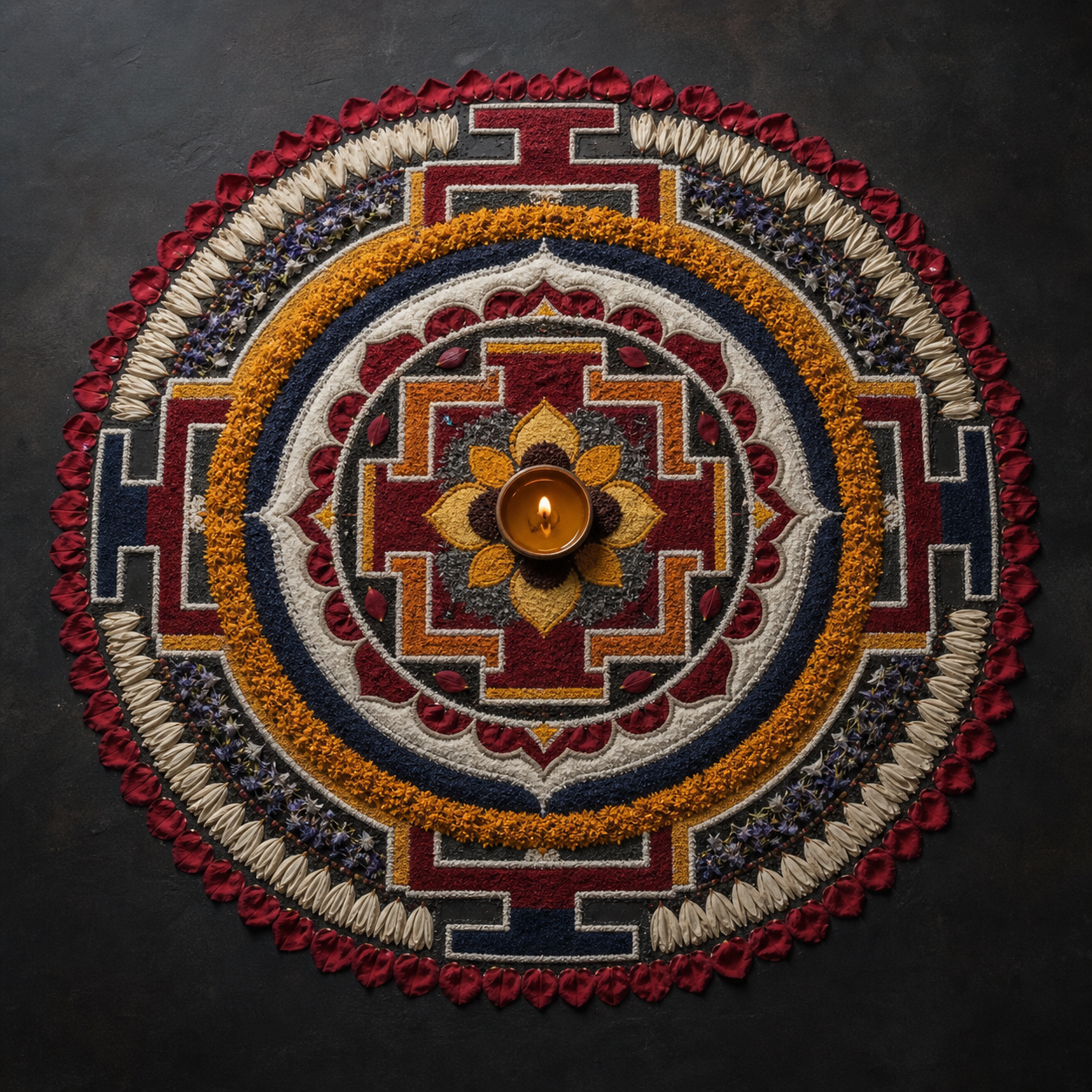
A maṇḍala is often treated as an image to decode. Tantric worship asks more of it. It is an inhabited cosmogram whose enclosures regulate approach. You do not simply look at the center; you become capable of approaching it by passing through an ordered series of relations.
The Śrīcakra is the clearest example. Its navāvaraṇa consists of nine enclosures traversed from the outer bhūpura toward the bindu. Each enclosure refines the mode of presence and attention. The worshipper’s progressive inward passage corresponds to the stabilization of the deity at the center. Mantra, mudrā, and nyāsa coordinate that spatial journey with the practitioner’s own body and awareness. This movement through nine enclosures toward the bindu is why the Śrīcakra cannot be reduced to an attractive geometric motif.
The component forms also carry spatial functions. The caturasra gives steadiness and definition. Eight-petalled and sixteen-petalled lotuses unfold successive relational fields. The ardhacandra introduces another kind of transition, while the bhūpura distinguishes the ordered interior from what lies beyond it. Measurements in aṅgula and hasta, cardinal alignment, and the use of shadow lines express the same insistence: sacred order is made visible and testable rather than left as a vague feeling.
When you encounter a yantra, begin with structure before chasing symbolism. Identify the outer limit. Find the gates or openings. Trace the successive enclosures. Notice whether the geometry asks attention to expand, contract, rotate, or converge. Locate the bindu only after you have understood the path that makes the bindu a center. This prevents the common mistake of jumping mentally to the innermost point while ignoring the disciplines of approach.
A printed or digitally displayed yantra may accurately preserve a geometric form, but geometry by itself does not perform consecration. Do not describe every copy as ritually installed, and do not improvise seed syllables, nyāsa, or prāṇa-pratiṣṭhā from an abbreviated diagram. If your practice requires those operations, follow the instructions of the relevant lineage, teacher, priest, or ritual manual. Precision here is part of reverence.
Temples and pilgrimage routes make the grammar walkable
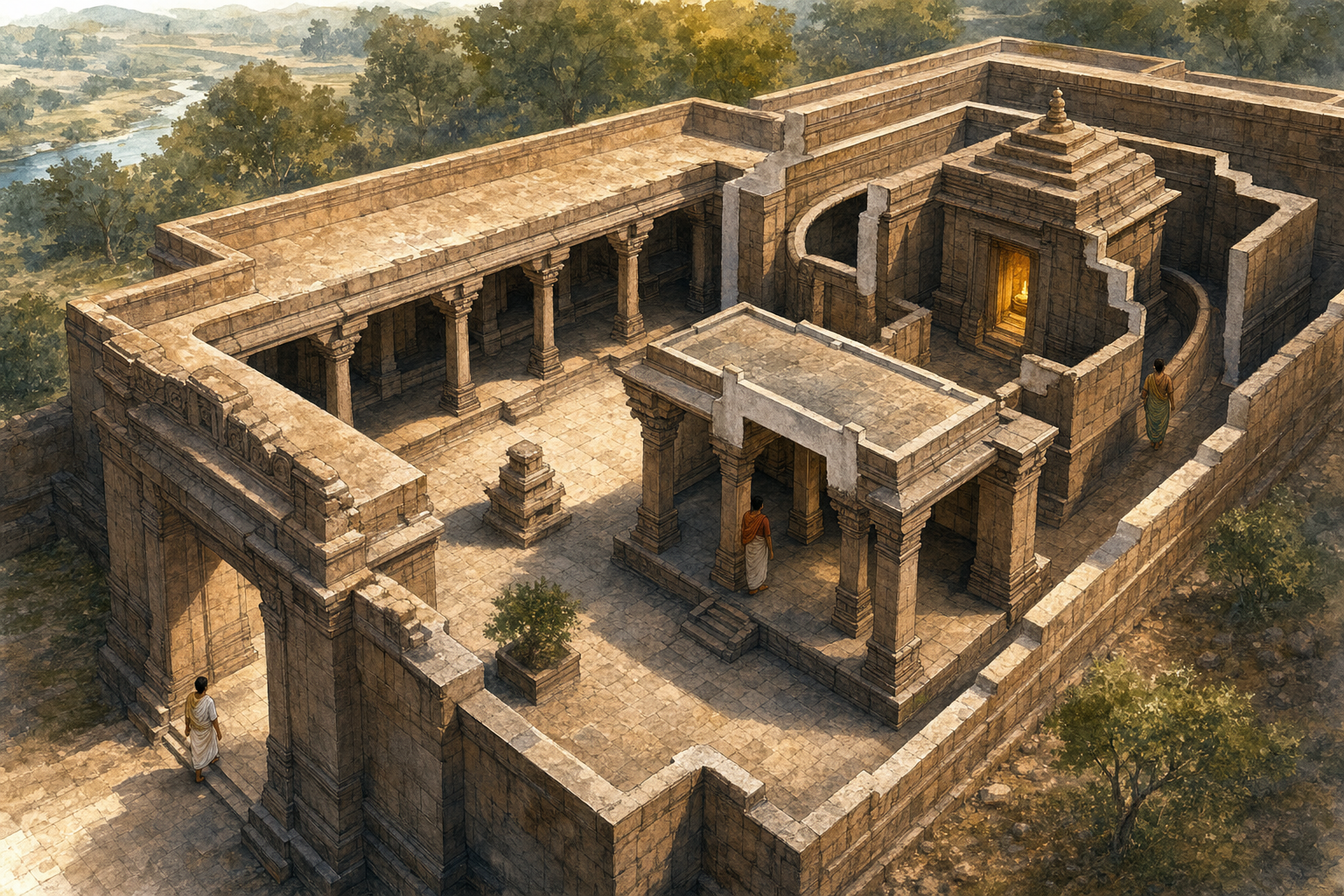
A Hindu temple gives architectural volume to the same ordering. The garbhagṛha concentrates presence. The maṇḍapa provides a place of assembly and approach. The pradakṣiṇā-patha turns reverence into directed bodily movement. Toranas, walls, and successive thresholds distinguish degrees of access. The building is therefore not a box containing a sacred object. It is a sequence of crossings that leads from dispersion toward concentration.
You can make a temple visit more attentive without inventing any new rite:
- Recognize the first meaningful boundary. It may be a gateway, an enclosure, a place for removing footwear, or a threshold into the maṇḍapa. Finish casual conversation and put away distractions before crossing it.
- Observe the local direction of movement. Follow signs, temple custom, and instructions from those responsible for the precinct. Do not impose a circumambulatory route where one is not permitted.
- Let each threshold change your conduct. Lowering the voice, slowing the body, and bringing the hands and gaze under control are practical ways of acknowledging that entry matters.
- Read the center through the route. Notice how halls, guardians, subsidiary shrines, and enclosures prepare the approach to the garbhagṛha instead of treating them as obstacles between you and darśana.
- Cross according to the custom you have received. Some household and temple traditions prescribe entering with the right foot. Honor that rule where it belongs, but do not turn one community’s convention into a universal command.
The same logic expands beyond a single structure. Pīṭhas, kṣetras, and tīrthas bind landscape to mythic memory, lineage, guardianship, and prescribed routes. Entering a temple town, bathing at a tīrtha, joining a ratha-yātrā, or circumambulating a hill turns geography into a field of collective practice. Gates, ghats, roads, and procession paths teach a community how to move together around what it holds sacred.
Temporal crossings complete the picture. Saṃkrānti marks an ingress in time, just as a threshold marks an ingress in space. Makara Saṃkrānti, with its baths, offerings, and calendrical significance, shows how communities can cross a measured temporal boundary through disciplined acts. The maṇḍala orders where you stand; the festival calendar orders when and how you cross.
Comparable spatial disciplines appear elsewhere in the dharmic family, but resemblance should not be confused with identity. Vajrayāna Buddhist empowerment employs carefully partitioned maṇḍalas. Jain temple enclosures and circumambulatory paths coordinate movement with restraint and purity. Sikh gurdwaras order reverent movement around the Guru Granth Sahib and through sarovar precincts under maryādā. These traditions should not all be labelled Tantric, nor should krānta be claimed as their universal technical term. What they share is the recognition that boundaries and bodily conduct can train humility, attention, and communal order.
Bring the principle home without imitating consecration
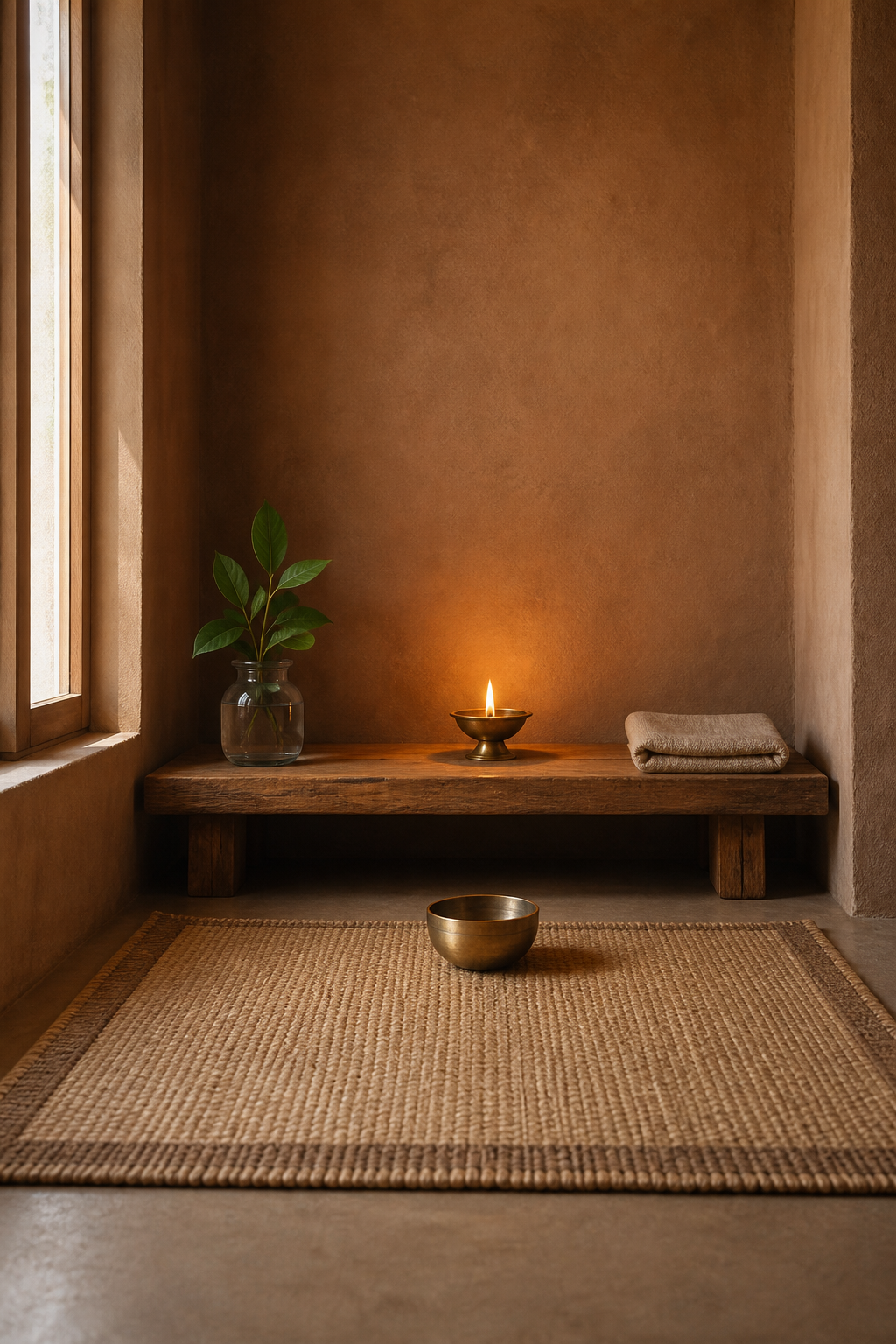
A domestic shrine does not need the scale of a temple to embody ordered space. It does need more than devotional objects placed wherever a shelf happens to be free. The practical aim is to establish a small precinct whose boundary, center, and rules of approach remain consistent.
- Choose a stable site. Use a fixed surface that can remain clean and is not continually repurposed for keys, bills, food containers, or household storage.
- Prepare the ground you actually have. Clean the surface and its immediate surroundings. If your sampradāya gives you a form of bhū-śuddhi, use that received practice rather than assembling a generic ritual from unrelated traditions.
- Make the precinct legible. A dedicated platform, cloth, tray, or clearly maintained shelf can mark the limit. The point is not decoration; someone approaching should be able to tell where casual handling stops.
- Establish a center and orientation. Place the principal mūrti, image, or properly received yantra according to the practice you follow. Let lamps and accompanying forms support that center. Do not choose directions or placements merely because a diagram looks balanced.
- Adopt one crossing discipline. Pause before beginning worship, quiet your speech, wash as your custom requires, and enter the practice in the same deliberate manner each time. Use the right foot only where that convention belongs to your tradition.
- Repeat an ordered movement. Approach, offer, recite, sit, or circumambulate in a stable sequence suited to the space and your practice. Repetition turns the shrine from an occasional display into a reliable container for attention.
- Guard the boundary after worship. Keep the precinct free of casual clutter and handle its contents consistently. Sacred occupation creates responsibility for the condition of the space between rituals, not only during them.
A pañcāyatana altar offers a compact example when it belongs to your received practice: five deities are arranged as a small maṇḍala rather than accumulated as unrelated images. Its value lies in ordered relationship. If you have not received its layout, do not reconstruct it casually from the idea of five alone.
The ecological implication is equally practical. Bhū-śuddhi treats earth as worthy of reverence, and the protected boundary discourages casual profanation. A sacred corner kept immaculate while the surrounding ground is neglected would contradict that logic. Care should move outward from the precinct: cleanliness, restraint, and responsibility are the ethical trace of sacred presence.
Key takeaways
- Krānta links stepping and crossing with the ritual occupation and ordering of ground.
- A sacred field needs a legible boundary, a meaningful threshold, an oriented center, and disciplined movement.
- Geometry displays the order, but mantra, mudrā, nyāsa, and consecratory acts establish a ritually inhabited field.
- The Śrīcakra’s nine enclosures teach approach as a progressive refinement, not an immediate leap to the bindu.
- At home, begin with a stable precinct and consistent conduct; leave formal installation rites to the lineage that transmits them.
Begin with one threshold you already cross. Make its boundary clear, remove what does not belong, and decide what changes in your speech, pace, and attention when you enter. That small discipline is the first honest step from arranging sacred things to inhabiting sacred space.
References
