

You may chant the maha-mantra, honour an acharya, and belong to a temple without knowing whether your connection to the Gaudiya lineage is becoming spiritually alive. The decisive question is not whether you can reproduce a succession of names. It is whether what you have received is reshaping your attention, conduct, service, and relationships.
This gives you a practical way to understand guru-bhakti. It is neither admiration from a distance nor loyalty to a religious personality. It is the disciplined reception of bhakti through humility, thoughtful inquiry, practice, and seva – followed by the responsibility to embody and transmit what you have received.
Key takeaways
- A Gaudiya lineage is alive when siddhanta, sadhana, devotional character, and service pass together from one generation to the next.
- Guru-bhakti needs three mutually correcting elements: humility, sincere inquiry, and seva. Removing any one of them distorts the relationship.
- The Caitanya tree allows distinct teachers and communities to remain rooted in one devotional purpose without pretending that every branch has the same history or emphasis.
- You can assess living transmission by examining what is taught, what is practised, what character it forms, and whether disciples are equipped to serve rather than merely to belong.
- Daily nama, regular hearing, remembrance of Vaishnava exemplars, concrete seva, and honest reflection turn inherited identity into lived devotion.
The Caitanya tree changes how you see lineage
A list presents lineage as a sequence. A tree presents it as an organism. Roots provide nourishment, the trunk gives continuity, branches carry life in different directions, and fruit reveals whether the whole organism is healthy. This is why the tree associated with Sri Caitanya Mahaprabhu is more useful than a pedigree alone.
Sri Caitanya stands at the inexhaustible centre of the Gaudiya devotional world. Nityananda, Advaita, and Gadadhara are remembered as great trunks through which divine love is distributed, invoked, and nourished. Srivasa and the wider community of associates make congregational sankirtana visible as a shared way of life. The structure is theological as well as historical: one source of prema expresses itself through complementary persons, gifts, and forms of service.
This matters when you encounter differences among Gaudiya communities. Variation is not automatically deviation. One branch may emphasise public kirtana, another scriptural exposition, another contemplative cultivation, sacred art, publishing, temple worship, or household formation. Ask whether the variation still draws nourishment from the same roots and serves the same devotional end. A branch is not independent merely because it has developed a recognisable shape.
The same test applies to your own practice. If your devotion becomes intensely private but never develops compassion, service, or the ability to join others in kirtana, one part of the tree has been separated from the rest. If your community is highly active but gives little space to hearing, remembrance, and interior refinement, outward growth may be outrunning nourishment. Healthy transmission holds inward absorption and outward distribution together.
The Six Gosvamis of Vrindavana show another dimension of this balance. Rupa, Sanatana, Raghunatha Dasa, Raghunatha Bhatta, Jiva, and Gopala Bhatta did not merely repeat a received enthusiasm. They gave it theological grammar, disciplined practices, literature, sacred geography, and institutional form. Srinivasa Acharya, Narottama Dasa Thakura, and Syamananda Prabhu then carried those gifts through literature, kirtana, teaching, and guru-disciple communities. Reception became clarification; clarification became distribution.
Use that pattern when someone bases spiritual authority mainly on ancestry, title, institutional position, eloquence, or popularity. Those things may have a legitimate place, but none of them alone demonstrates transmission. Look for continuity of teaching, disciplined practice, recognisable devotional character, and the capacity to nourish devotion in others. The fruit completes the genealogy.
Guru-bhakti works through humility, inquiry, and seva
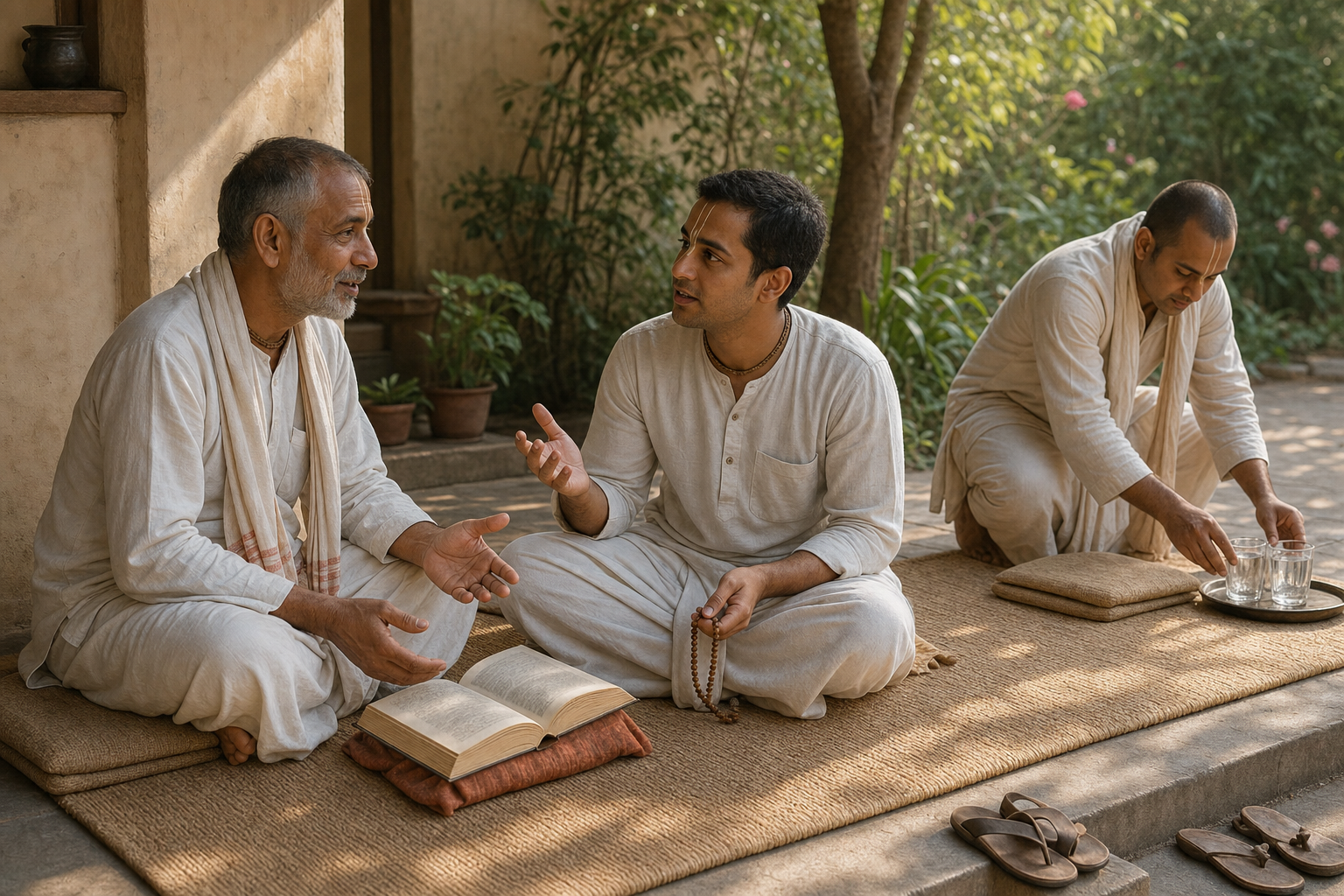
Bhagavad-gita 4.34 places three movements together: pranipata, pariprasna, and seva – humble approach, sincere inquiry, and service. The combination protects the guru-disciple relationship from three common distortions.
- Humility without inquiry can become passivity. You may repeat a conclusion without understanding its scriptural basis, proper application, or limits.
- Inquiry without humility can become intellectual consumption. You collect teachings while resisting the discipline that would allow them to change you.
- Service without either can become factional labour. You stay busy for a person or organisation without becoming more attentive to Krishna, more truthful, or more compassionate.
Mature guru-bhakti keeps all three active. You approach with the willingness to be corrected. You ask precise questions because understanding matters. You serve so that knowledge descends from abstraction into habit and character. The bond between guru and disciple is sustained through this union of humility, inquiry, and service, not through sentiment alone.
This also clarifies what surrender does not mean. It does not require you to abandon discernment, conceal confusion, or treat every preference of every senior person as eternal siddhanta. A genuine question asked in a service mood is part of the scriptural model. Before accepting a major instruction, make sure you understand what is being asked, how it serves bhakti, and whether it is a universal principle or a contextual application.
When correction is necessary, test your response before defending yourself. Can you restate the instruction fairly? Can you identify the attachment it exposes? Can you ask for an example of correct application? Can you act on the part you already understand? These questions turn discomfort into discipleship without demanding blind agreement.
Guru-bhakti should finally increase Krishna-bhakti. The guru is honoured as the bearer of divine teaching and grace, not as a rival centre of possession. A disciple who constantly advertises loyalty but neglects nama, sastra, ethical restraint, or service has confused the sign of devotion with its substance. Conversely, someone who receives an instruction, practises it steadily, serves without theatricality, and gives credit to guru and Vaishnavas may display a deeper bond with far fewer declarations.
Four tests reveal whether transmission is living
No checklist can certify another person’s spiritual realization. You can, however, examine whether a teacher and community provide the conditions in which recognisable Gaudiya bhakti can be received and practised. If you are considering deeper commitment, initiation, mentorship, or responsibility in a community, observe these four areas over time.
- Test the teaching. Can the teacher connect practical instructions to Krishna, Sri Caitanya, the acharyas, and established Gaudiya siddhanta? Are foundational practices explained clearly, or is authority sustained mainly through private claims and personal charisma? Notice whether difficult questions receive reasoned answers and whether contextual advice is distinguished from timeless principle.
- Test the practice. Does the community organise life around nama, kirtana, hearing, remembrance, worship, and seva? The practical architecture of japa, kirtana, sastra study, and hands-on service matters because each discipline corrects a different weakness. Japa gathers attention, kirtana joins devotion to community, study refines judgement, and seva exposes self-centred habits.
- Test the fruit. Look beyond polished public events. Do long-term practitioners become more truthful, dependable, hospitable, and willing to share credit? Is scholarship joined to humility? Does emotional expression lead to service, or does it become a way to claim status? Gaudiya devotion honours refined spiritual emotion, but rasa language without disciplined conduct is not evidence of maturity.
- Test the transmission. Are disciples being equipped to hear, think, practise, teach appropriately, care for others, and assume responsibility? A living guru does more than gather followers. A living community forms servants who can carry devotion into homes, temples, classrooms, art, scholarship, food distribution, publishing, and public kirtana without making themselves the new centre.
Several warning signs become easier to notice through these tests. Be cautious when lineage names function mainly as prestige; when questioning is treated as disloyalty; when service consistently protects a leader’s image rather than the community’s spiritual welfare; when intense devotional language excuses poor conduct; or when members are taught whom to oppose more carefully than how to chant, study, and serve.
Also notice whether the community can honour contribution outside a narrow stereotype. Gaudiya transmission has moved through renunciants and householders, scholars and musicians, temple servants and publishers. Devotional art can become disciplined sadhana when iconography, narrative, materials, and atmosphere are placed in service to remembrance. Oral history can preserve the practical wisdom that formal chronicles miss. Women who teach, mentor, create, organise, and preserve sacred memory are not peripheral to transmission; their service helps a tradition become inhabitable across generations. The work of turning sacred geography and theology into immersive devotional education shows how fidelity can take forms beyond the lecture hall.
This broader vision does not dilute the lineage. It asks a stricter question: does each form of cultural expression actually train perception toward Krishna and deepen hearing, remembrance, character, and seva? Novelty is not the criterion, but neither is familiarity. Service is judged by what it faithfully carries.
Turn spiritual inheritance into a rule of life
You do not need a large public role to participate in living transmission. Begin with a small rule of life that joins the parts of bhakti most easily separated by modern schedules. Make it sustainable enough to keep and concrete enough to examine.
- Receive the Name before receiving the day’s noise. Give your primary japa commitment a protected place rather than fitting it around messages, feeds, and unfinished tasks. If your present commitment is inconsistent, establish a repeatable baseline with guidance from a trusted teacher instead of making a dramatic promise you will abandon.
- Hear one teaching in context. Read a manageable passage from Bhagavad-gita, Srimad-Bhagavatam, Caitanya-caritamrta, or an established Gaudiya acharya. Record the instruction in one sentence and name the habit it should affect. This keeps study from becoming the accumulation of quotations.
- Remember a Vaishnava as an exemplar. Recall an associate of Sri Caitanya or an acharya in your lineage and identify one concrete virtue: Nityananda’s accessibility, Advaita’s prayerful urgency, Gadadhara’s nourishing steadiness, the Gosvamis’ disciplined scholarship, or an acharya’s missionary courage. Then choose one situation in which you will practise that virtue.
- Complete one accountable seva. Choose a task another person can actually rely on you to finish. Quiet reliability trains guru-bhakti more effectively than volunteering for visible work and leaving ordinary duties to others.
- Join collective devotion regularly. Private japa cannot replace the relational discipline of kirtana and sadhu-sanga. Notice how you behave before and after the singing: whom you welcome, whether you help, how you speak, and whether the shared holy name reduces or inflames social rivalry.
- Review the fruit honestly. Ask whether your practice is making you more attentive, truthful, teachable, and useful. If knowledge is increasing while resentment, vanity, or unreliability remains untouched, take one specific pattern to a trustworthy guru, mentor, or mature Vaishnava for guidance.
Families and communities can adapt the same rule collectively. Read a short passage together, sing, remember one Vaishnava and one virtue, then decide on a shared act of service. Preserve the memories of senior practitioners by asking focused questions: Which instruction sustained your practice? Which mistake took longest to recognise? What did your guru teach through conduct rather than words? Record such testimony accurately and with permission. Living memory becomes part of the bridge between generations.
Do not wait to feel spiritually accomplished before transmitting what you have genuinely received. Teach only to the level of your understanding, distinguish realization from repetition, and remain answerable to guru, sastra, and sadhu. You can invite someone to kirtana, explain why you chant, cook in service, preserve a devotional song, support a child learning sacred history, or make a neglected community duty dependable. The lineage lives wherever faithful reception becomes faithful giving.
Choose one element of this rule today and place it where tomorrow’s distractions cannot easily remove it. Guru-bhakti becomes visible through the next instruction you understand, the next practice you keep, and the next person whose devotion your seva helps to nourish.


References
- Dandavats – Sri Caitanya Mahaprabhu’s Living Tree of Love: Nityananda, Advaita, Gadadhara and the Gaudiya Legacy
- Dandavats – A Bond of Love Part 3: HG Jagattarini dasi on Guru-Bhakti, Devotional Art, and Vaishnavi Leadership
