
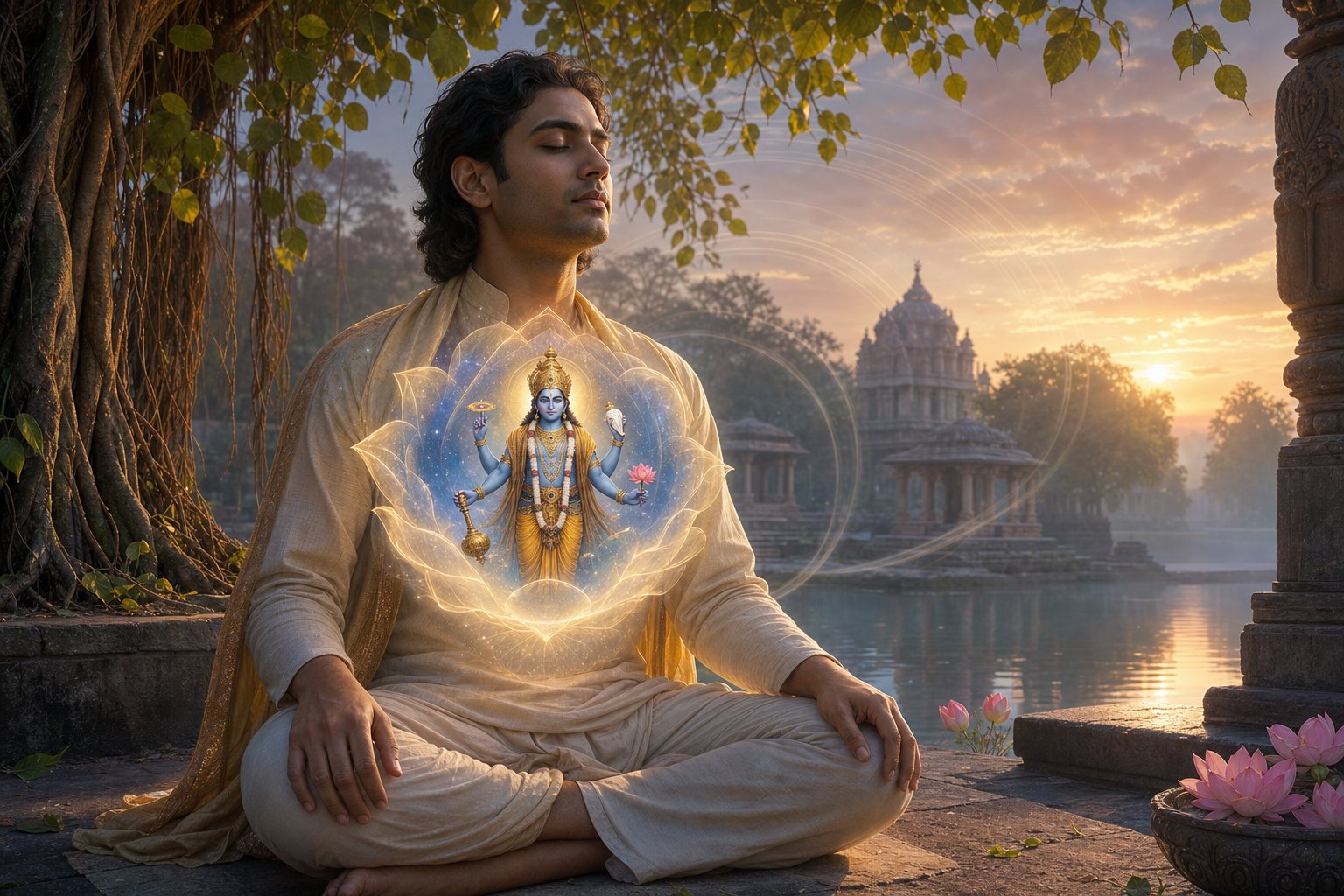
You may understand the beauty of the heart-lotus and still be unsure what to do when you sit down. Should you visualize a flower, concentrate on the physical heart, regulate the breath, repeat a mantra, or simply wait for a devotional feeling?
The practice becomes much clearer when each element has one job. The heart gives attention a center. The breath removes unnecessary agitation. The mantra turns attention toward Nārāyaṇa. Silence allows the method to yield to presence. You do not need forceful breathing, breath retention, elaborate chakra imagery, or an unusual experience.
Place attention in the contemplative heart, not the organ
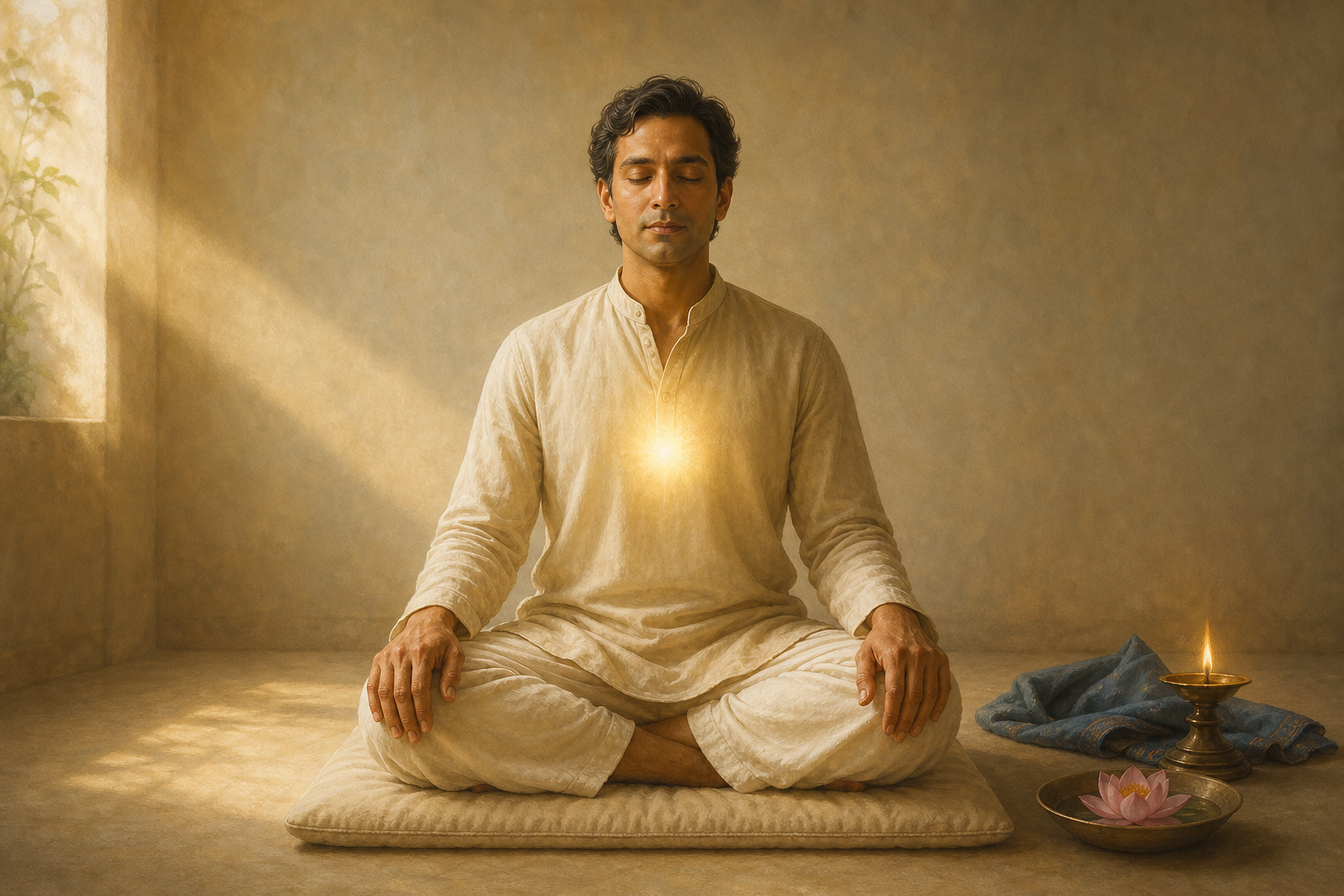
The Nārāyaṇa Sūktam, preserved in the Mahānārāyaṇa Upaniṣad within the Taittirīya Āraṇyaka, moves from the all-pervading Supreme to the indwelling presence in the heart. Its direction is inward, but its vision is not small: the Nārāyaṇa encountered within is the same reality that pervades everything.
This is why hṛdaya, the contemplative heart, should not be reduced to the biological heart. The bodily region around the sternum can serve as an accessible doorway for attention, but you are not trying to enter, stimulate, or control a physical organ. Hṛdaya is the converging center of embodied feeling, attention, life, devotion, and intuitive discernment.
The language of hṛdaya-guhā, the cave of the heart, emphasizes inward depth. Dahara ākāśa, the subtle space within the heart, expresses the apparent paradox even more sharply: limitless reality is known through an intimate center. The space is called small because it is approached within you, not because Brahman has been compressed into a tiny location.
Later yogic language offers a useful crosswalk by associating the heart region with anāhata, balanced vital movement, devotion, and compassionate discernment. That correspondence does not make every later chakra diagram part of the Nārāyaṇa Sūktam. Petal counts, colors, inner sounds, and subtle-body sequences vary among lineages. If your sampradāya gives you a specific method, follow it. Otherwise, a simple sense of inward openness is sufficient.
The lotus is therefore meditative architecture rather than an anatomical claim. Its unfolding represents the clarification of attention. Its unstained quality represents awareness that need not be corrupted by every passing mental state. Its center points toward quiet presence. You may use that imagery lightly, but you do not have to manufacture a detailed inner picture.
Key takeaways before you begin
- Choose a stable, dignified seat, but keep the spine, chest, jaw, and shoulders free from strain.
- Use the sternum area as an attentional doorway; do not concentrate on the heartbeat or try to manipulate the physical heart.
- Begin with smooth nasal breathing in an easy 4–4 rhythm and no breath-holding. Move to 6–6 only when it remains completely comfortable.
- Repeat oṁ namo nārāyaṇāya mentally. Let the mantra accompany the breath without squeezing its syllables into a rigid pattern.
- Treat lotus imagery as optional. Attention to Nārāyaṇa matters more than the vividness of a visualization.
- Warmth, spaciousness, tenderness, or no special sensation at all can occur. None of these is a score of spiritual attainment.
A complete 12–20-minute heart-lotus practice
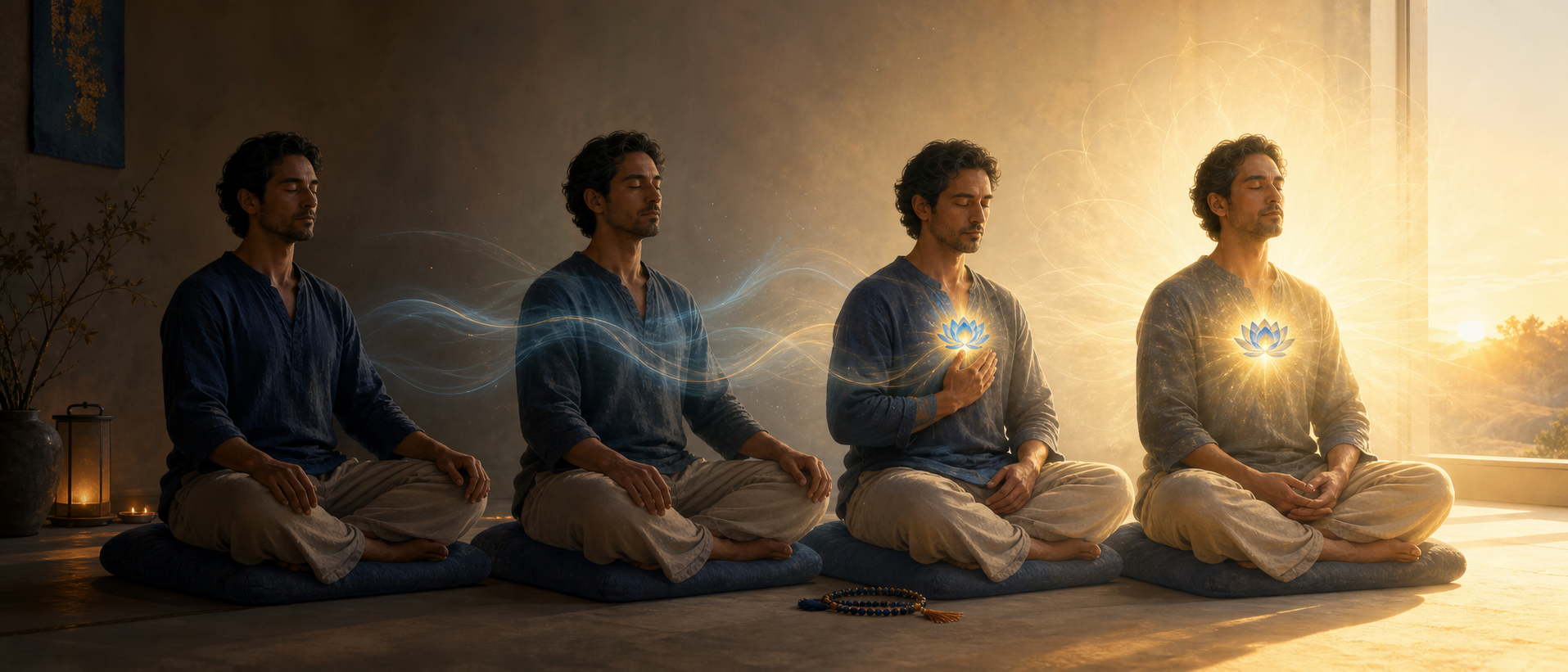
Set aside 12–20 minutes and use the same basic sequence consistently. Do not keep changing techniques because one sitting feels quiet and another feels restless. Abhyāsa works through repeated return, not through the production of identical experiences.
- Establish the seat. Sit on a cushion or chair in a position you can maintain without bracing. Let the spine rise naturally. Keep the chest open but unforced, the chin neutral, and the hands at rest. Close the eyes if that feels steady; otherwise, keep a soft downward gaze.
- Recollect the orientation. Before managing the breath, form one clear intention: Nārāyaṇa is not a distant object you must summon. The indwelling presence is already here, and the practice makes your attention available to it. Keep this recollection simple. A theological speech inside the mind only replaces one kind of distraction with another.
- Settle the breath. Breathe through the nose and allow the exhalation to finish without being pushed. If counting helps, inhale for four comfortable counts and exhale for four. Do not hold the breath between phases. Once 4–4 is consistently smooth, 6–6 may be used, but longer is not automatically deeper. If counting creates air hunger, tightness, or preoccupation, abandon the count and breathe naturally.
- Rest attention at the heart center. Let awareness settle in the region around the center of the chest. Do not search for a tiny point, stare mentally into the body, or monitor every heartbeat. Receive the whole area as a quiet field. On each exhalation, allow the shoulders and the tissue around the sternum to soften.
- Introduce the mantra. Repeat oṁ namo nārāyaṇāya silently. Oṁ opens attention toward the Supreme; namo carries the movement of reverence and surrender; nārāyaṇāya directs that offering to Nārāyaṇa. Allow an unhurried recitation to flow with the complete breath rather than forcing one exact syllabic division between inhale and exhale. If coordinating mantra and counting becomes busy, drop the numbers and retain an easy, even breath.
- Allow the lotus to remain simple. If imagery arises naturally, sense the heart-lotus opening from within or recognize a quiet luminosity at its center. Do not choose intensity over stability. A faint image, a felt sense of openness, or no visual image at all is enough. The lotus serves attention; attention does not serve the picture.
- Release the supports periodically. When the breath is quiet and the mantra feels settled, let the mantra fall silent for a while. Rest in uncontrived awareness at the heart. Do not immediately ask whether Nārāyaṇa is present. That question turns presence into an object under inspection. If thoughts carry you away, return to the breath and mantra without irritation.
- Close without breaking the thread. Let the breath return to its natural rhythm. Notice the body as a whole, open the eyes, and remain seated long enough to avoid a rushed transition. Carry one mental repetition of oṁ namo nārāyaṇāya into the next ordinary action. The aim is not to preserve a fragile mood but to let remembrance accompany movement.
The sequence has a deliberate logic. Posture reduces avoidable disturbance. Breath steadies the somatic field. Mantra joins sound, meaning, and devotion. Heart-centered awareness interiorizes the worship. Silence prevents the supports from becoming ends in themselves.
Read what happens without turning it into a scorecard
Heart-centered practice can make subtle feeling more noticeable. Warmth around the sternum, spaciousness, softness, devotion, grief, or a bittersweet release may arise. These responses need neither suppression nor spiritual promotion. Let them move without grasping, then return to Nārāyaṇa.
When nothing seems to happen
Do not intensify the breathing or construct a brighter lotus. The absence of a striking sensation is not the absence of practice. Notice the more basic task: can you remain present for one breath, one mantra, and one return after distraction? That capacity is steadiness developing in its least theatrical form.
If the chest area feels vague, use the contact of the breath at the nostrils as your primary anchor while retaining a gentle awareness of the heart region in the background. Once attention settles, let the emphasis return to the heart. This is more useful than repeatedly probing the body for a special center.
When emotion becomes strong
First, stop trying to deepen the state. Let the breath return to its natural rhythm. Feel the seat beneath you, relax the hands, and open the eyes if necessary. Continue the mantra only if it feels stabilizing. You do not need to interpret tears, tenderness, or old memories while they are occurring.
If meditation repeatedly produces overwhelming fear, traumatic material, dissociation, or difficulty functioning afterward, do not push through it alone. Pause the practice and seek support from an appropriately qualified mental-health professional. Spiritual aspiration does not make destabilization a test you are required to endure.
When a physical symptom appears
Chest pain, faintness, pronounced dizziness, or difficulty breathing is not evidence that a subtle knot is opening. Stop the exercise and seek appropriate medical evaluation. Do not use a contemplative interpretation to dismiss a potentially important physical symptom. During ordinary practice, breath should remain comfortable enough that you do not have to recover from it.
Several common mistakes have the same root: striving for confirmation. Expanding the chest aggressively, holding the breath without instruction, forcing energy upward, demanding a vivid lotus, or chasing emotional sweetness all shift the practice from surrender to acquisition. Correct them by returning to the smallest complete action: an easy breath, one mantra, and relaxed attention at the heart.
Let Bhakti, Yoga, and Vedānta perform different jobs
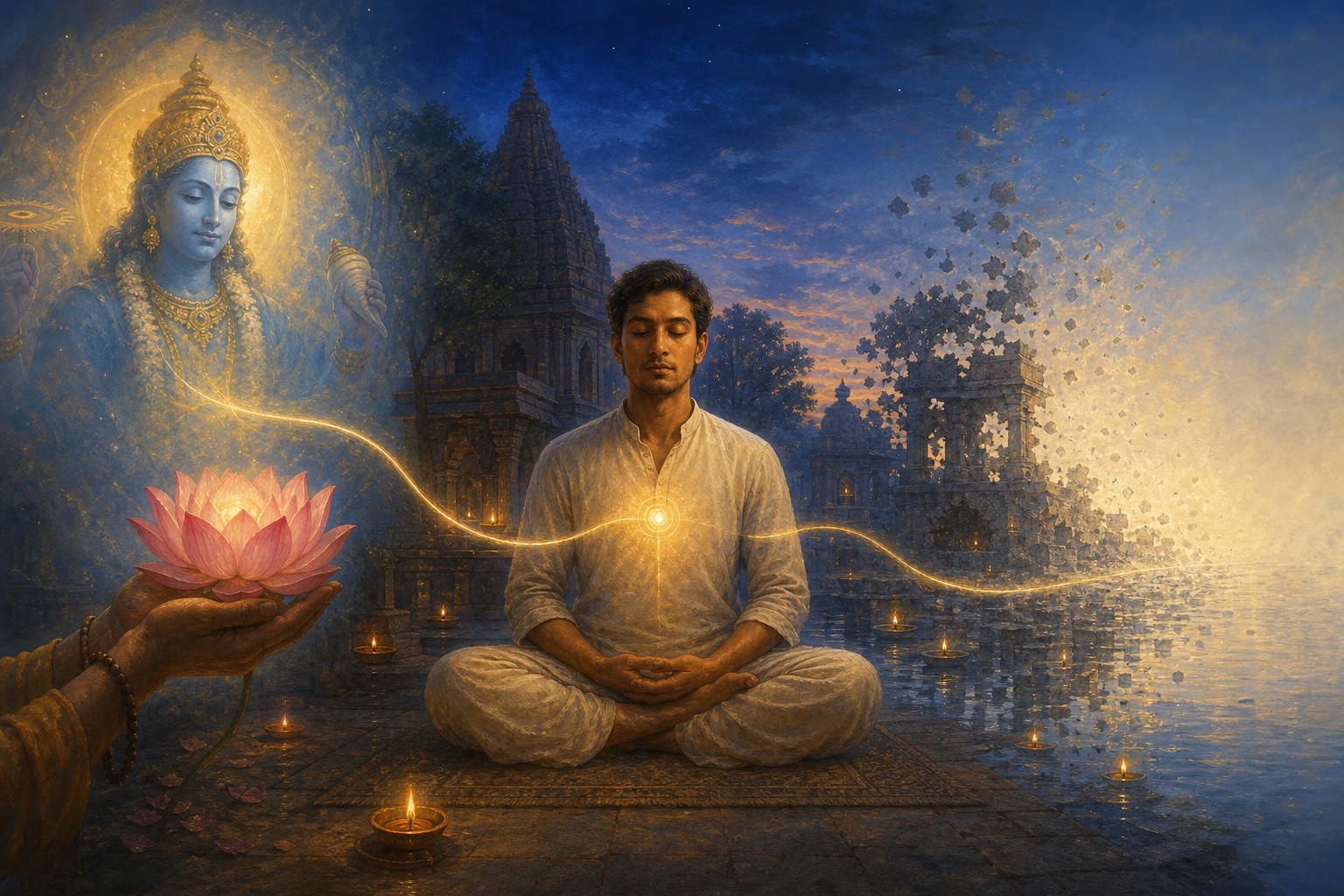
Nārāyaṇa heart-lotus contemplation is strong because its elements are complementary rather than interchangeable. Bhakti gives the practice direction and intimacy: you turn toward the indwelling Lord with reverence. Yoga gives it repeatable form through posture, breath, attention, and mantra. Vedānta prevents a crucial misunderstanding: the Divine is not a small object sealed inside your body, but the all-pervading ground known through the inward center.
You can diagnose imbalance in the practice by noticing which element has dropped out. If repetition becomes dry and mechanical, foreground the meaning of namo and the act of offering. If devotion becomes emotionally vivid but unstable, simplify the imagery and let posture and breath provide containment. If contemplation becomes abstract speculation, return to the felt heart region and the sound of the mantra.
This integration also explains why the Nārāyaṇa Sūktam belongs naturally in both ritual and solitary practice. During abhiṣeka, homa, or daily recitation, worship reveals Nārāyaṇa through consecrated action and sound. Sitting quietly afterward turns the same recognition inward. External worship and internal contemplation need not compete; each prevents the other from becoming incomplete.
The most reliable test comes after you rise. The heart-lotus has not unfolded merely because you felt warmth during meditation. Look instead for less reflexive speech, greater composure in relationship, more room before anger becomes action, and a steadier remembrance that the same indwelling reality is not confined to you. Compassionate discernment is not an ornamental result of heart practice. It is how inward recognition begins to shape conduct.
Begin with 12 minutes, an easy 4–4 breath, no retention, and mental repetition of oṁ namo nārāyaṇāya. Keep that form stable across your next several sittings. When the mantra naturally gives way to silence, do not rush to fill it. Let the heart-lotus be known by the quality of attention it gathers and the quality of life that follows.
References
