
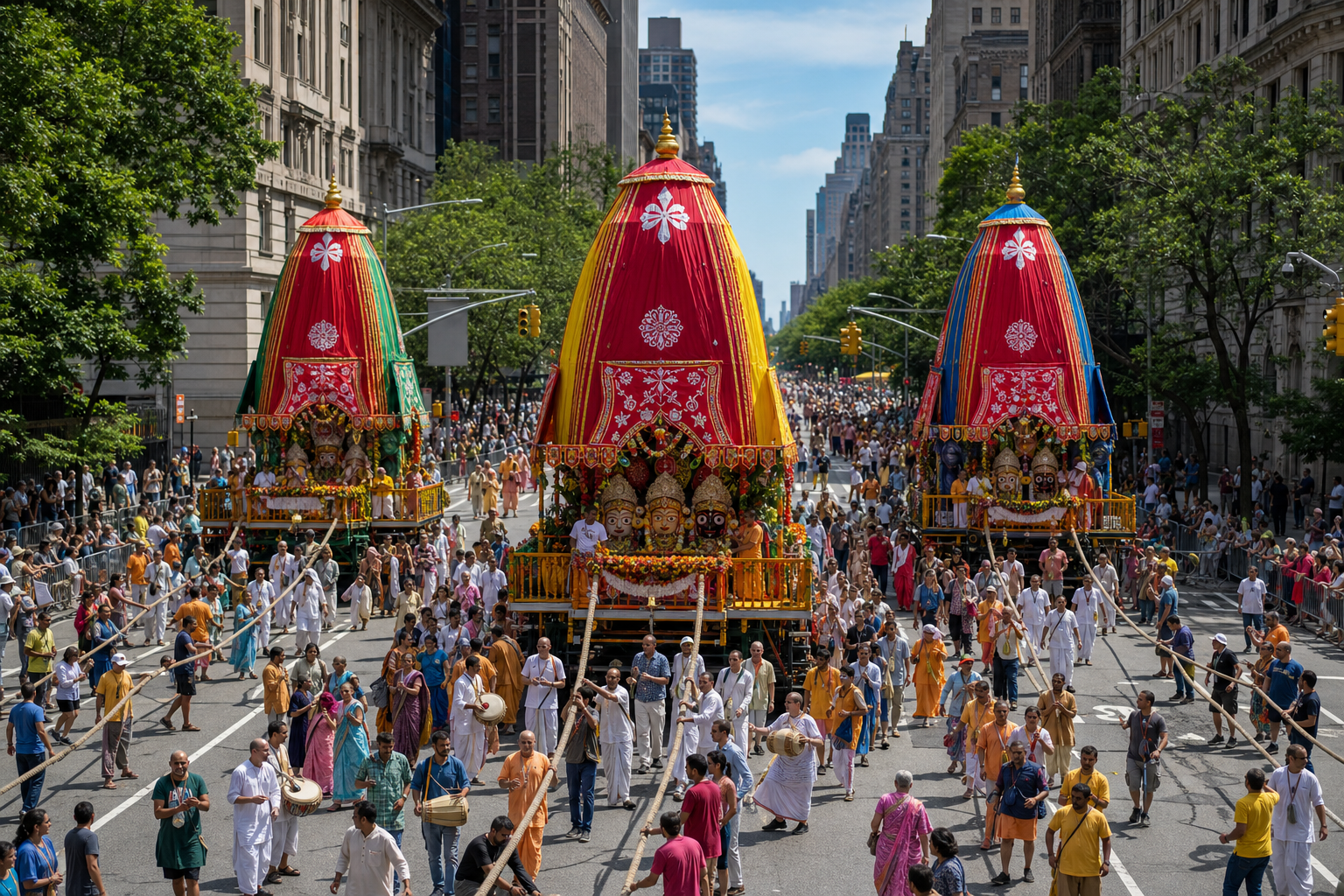
If you are considering New York City’s ISKCON Ratha Yatra but do not know what happens beyond the music and monumental chariots, you do not need specialist knowledge to participate meaningfully. You do need to know what you are seeing, where public devotion meets crowd management, and how to choose a form of participation suited to you.
The most useful preparation is not memorizing every ritual term. It is understanding why the deities enter the street, how the procession unfolds, and when to follow the volunteers rather than the movement of the crowd.
What the street procession makes possible
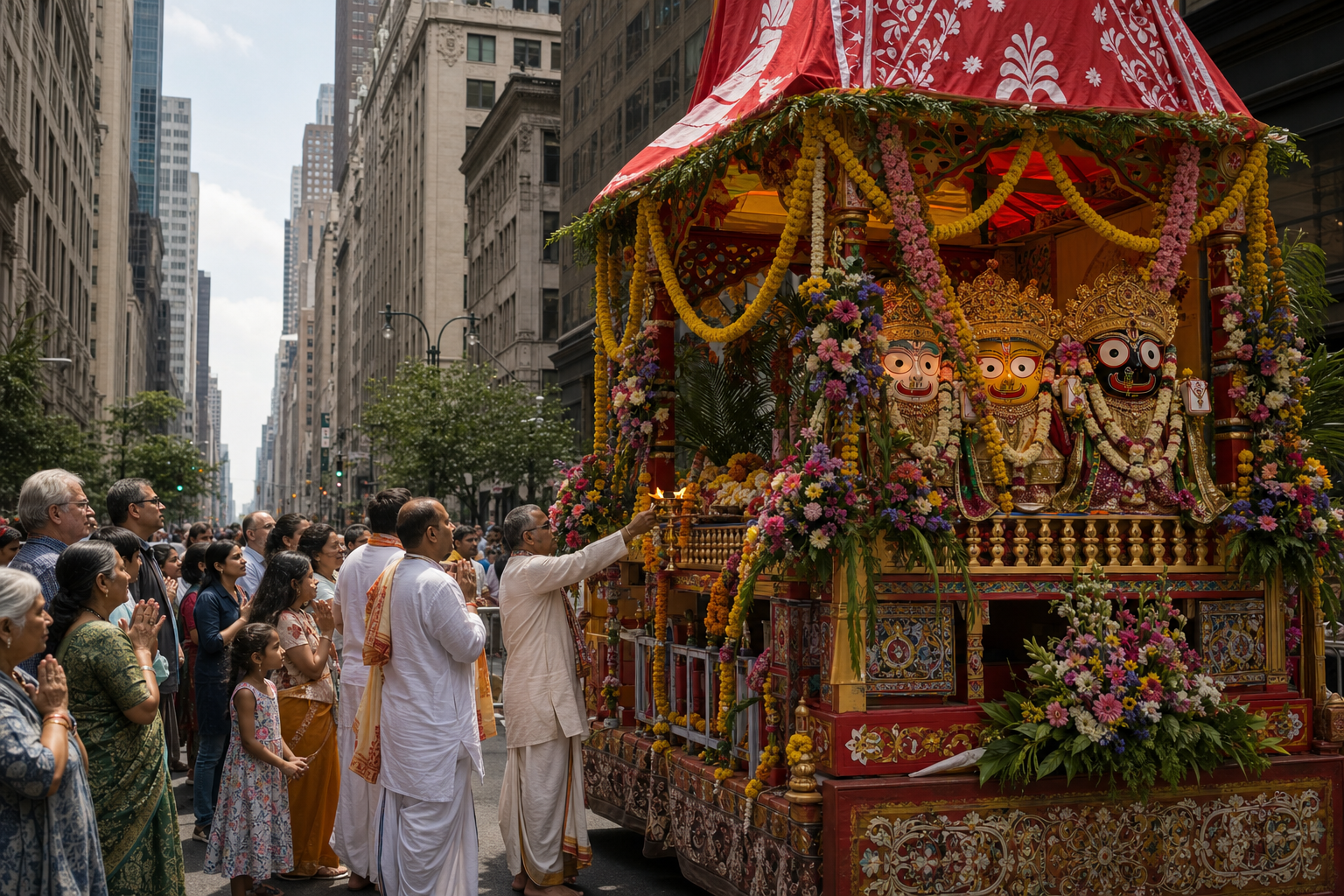
Ratha Yatra is rooted in the Jagannath tradition of Odisha. Lord Jagannath, Balabhadra and Subhadra leave the temple setting and appear before the wider community in a public procession. The decisive movement is therefore not simply from one location to another. It is from the relative enclosure of the sanctum to darshan made accessible in public space.
That changes how you should approach the day. You are not standing outside a private ceremony and waiting for permission to become interested. The outward journey is itself an invitation. You may chant, pull a rope when directed, receive prasadam, watch quietly or simply offer respectful attention as the deities pass. Proximity is not the only measure of participation, and touching the rope is not a requirement for receiving darshan.
The three deities must also be understood as a triad rather than as interchangeable figures on decorated vehicles. In Puri, their chariots are traditionally called Nandighosha for Jagannath, Taladhwaja for Balabhadra and Darpadalana for Subhadra. Each has its own form, canopy and traditional wheel count. New York preserves the essential threefold symbolism even though its chariots must be built and operated for a very different streetscape.
This is an important distinction for anyone tempted to judge authenticity by outward duplication. A New York chariot may use modular timber-and-steel construction, detachable parts and modern braking systems. Those adaptations answer transport rules, street gradients and public-safety needs; they do not erase the identities of Jagannath, Balabhadra and Subhadra. Ritual continuity lies in whom the chariots carry, why the deities travel and how the community serves them.
The metropolitan setting is itself part of ISKCON’s history. The first known public Ratha Yatra outside India was organized in San Francisco in 1967, after which the Hare Krishna movement brought the festival to major cities around the world. The New York celebration during ISKCON’s 60th year, 1966–2026, therefore belongs to a long effort to carry a distinctly Bharatiya devotional tradition into public life without confining it to the diaspora.
Read the procession as a sequence, not a spectacle
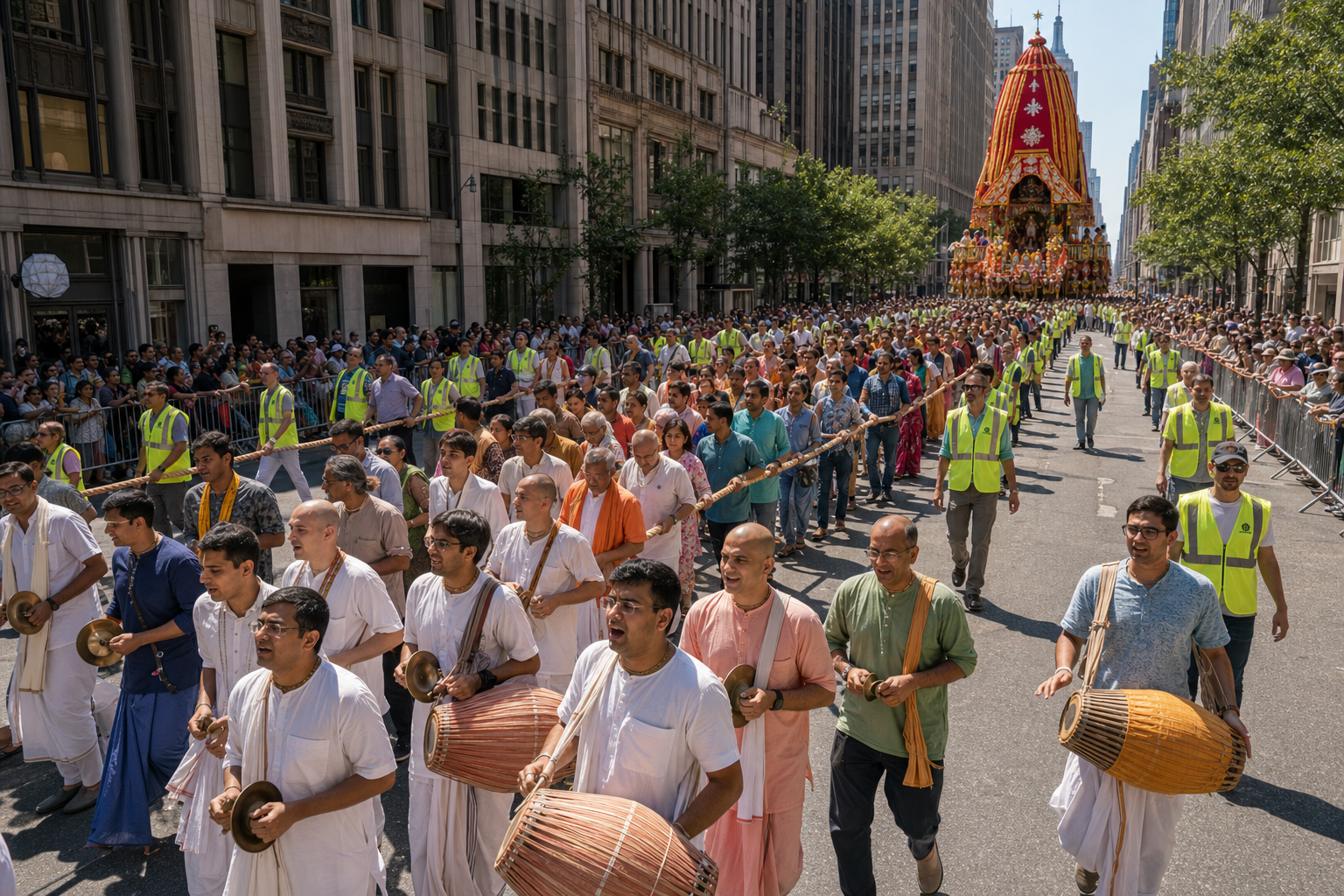
A first-time visitor can easily experience the parade as one continuous burst of color, chanting and movement. Look for four ritual movements instead. They explain the inner logic of the day.
- Alankara: The ornamentation of the deities is not background decoration. Notice how fabric, flowers, color and placement prepare the deities to be received in public. Give this stage time rather than treating it as a delay before the procession.
- Chhera pahanra: Ceremonial sweeping expresses humility and service. Its force comes from the reversal it enacts: status recedes before seva. The work associated with the road of the Lord is treated as an honor.
- Kirtan: Congregational chanting gives the moving assembly its devotional center. You can join the response after hearing the refrain; musical training and fluency are unnecessary. If you prefer not to sing, listen deliberately instead of treating the sound as parade entertainment.
- Pulling the chariots: The shared rope turns spectatorship into coordinated service. Enter only where a marshal invites participants, match the established pace and release space when instructed. The significance lies in moving together, not in reaching the rope first.
These stages also protect the festival from being reduced to cultural display. The chariot is visually commanding, but bhakti supplies its meaning. Ornamentation becomes an offering, sweeping becomes humility, sound becomes remembrance, and collective effort becomes seva.
You may also encounter a contemplative reading of the chariot as a movement of consciousness: away from external division and toward inward harmony. That interpretation is best used as a discipline for your own attention. Ask what you are carrying into the crowd, whether you can move without pushing, and whether your participation makes room for someone more vulnerable beside you.
Ratha Yatra can resonate with other Dharmic communities without being flattened into a generic interfaith ritual. Its theology and ceremonial form are specifically grounded in Jagannath bhakti. Its public hospitality, seva and accessibility nevertheless create recognizable points of contact with Sikh langar and with the ethical importance of ahimsa in Jain, Buddhist and Hindu traditions. Shared values make respectful encounter possible; they do not make the traditions identical.
Choose your form of participation before the crowd tightens
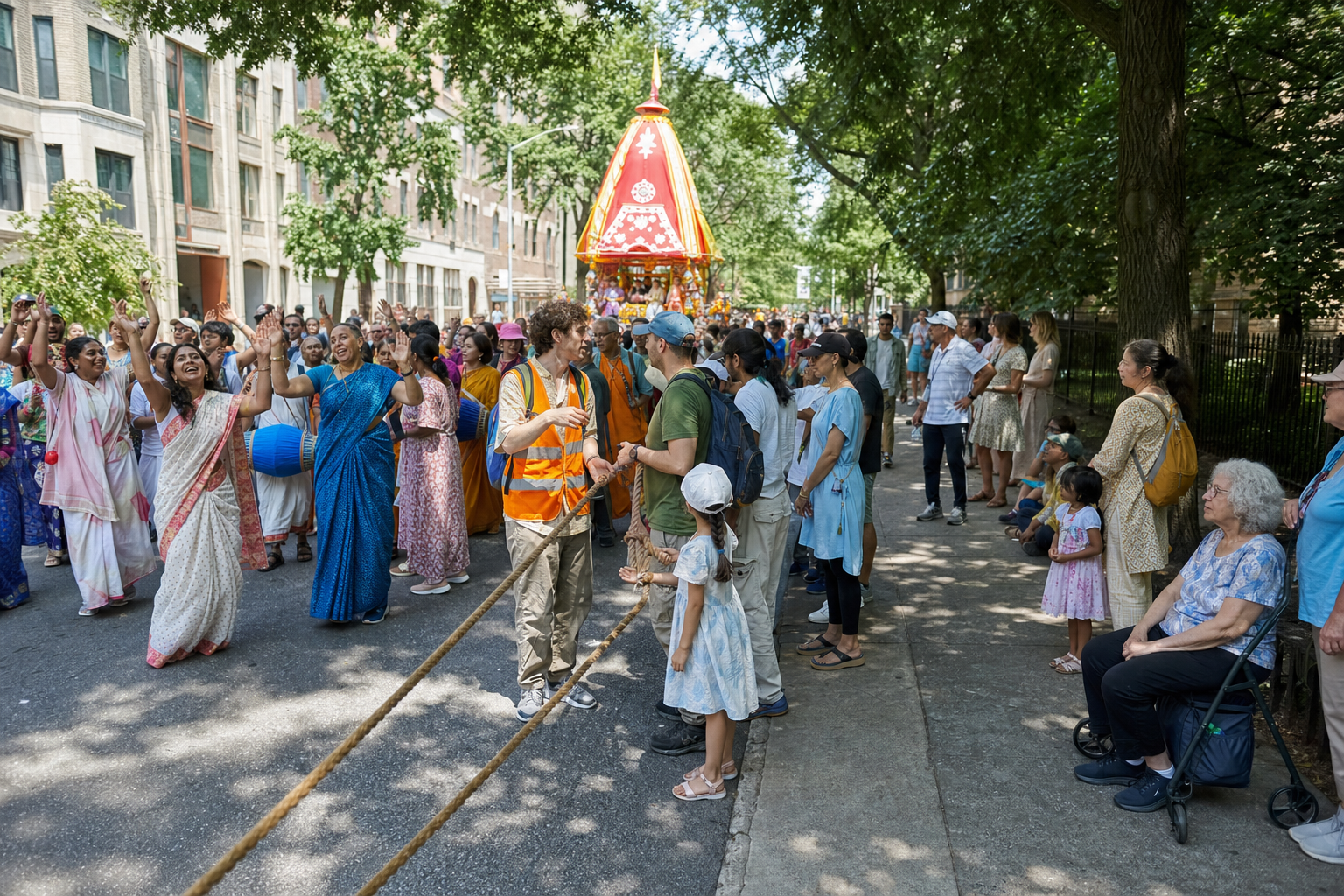
You will have a better day if you decide in advance whether your priority is close participation, quieter darshan, family accessibility or the cultural program at the destination. Trying to do all of these from the densest part of the rope line usually creates unnecessary strain.
- For active participation: Position yourself where marshals are organizing the rope rather than entering from the side. Follow the guide crew’s signals and accept that access may pause while the chariot is maneuvered.
- For quiet darshan: Choose a clear viewing position outside the rope-side buffer. You can bow, chant softly or watch without entering the moving group.
- For elders or visitors with disabilities: Ask a volunteer early about sightlines, rest points and seating near the performance area. Accessibility provisions can include these features, but their locations matter more than their mere availability.
- For children: Keep the family together outside operating zones and explain before arrival that the ropes, wheels and guide corridors are working parts of a moving procession, not objects to approach without direction.
- For lower sensory intensity: Sound systems are designed to carry kirtan through an outdoor urban setting. Seek a designated quiet area or ask a volunteer where the sound is less concentrated rather than waiting until it becomes uncomfortable.
The procession is only one part of the experience. Destination programming can include kirtan, Odissi or Bharatanatyam, folk and classical presentations, and exhibits explaining the Jagannath tradition, ISKCON’s work and India’s cultural heritage. If you want context rather than only a view of the chariots, leave enough attention and energy for this portion of the day.
Prasadam deserves the same deliberateness. The food is sattvic and vegetarian, but its religious meaning does not rest merely on its ingredients. It has been prepared and offered within a devotional practice, then distributed without distinction of background. Receive what you will eat, avoid wasting it and make room for the next person. This simple conduct keeps hospitality from turning into a congested food queue.
Do not rely on a previous year’s routine for operational details. Confirm the current route, access points, start arrangements, accessibility provisions and destination program from the current ISKCON NYC event information before traveling. A major city procession depends on permits, traffic controls and emergency access, so details that look incidental can change how you should enter or leave the event.
Treat the rope line as both sacred and operational space
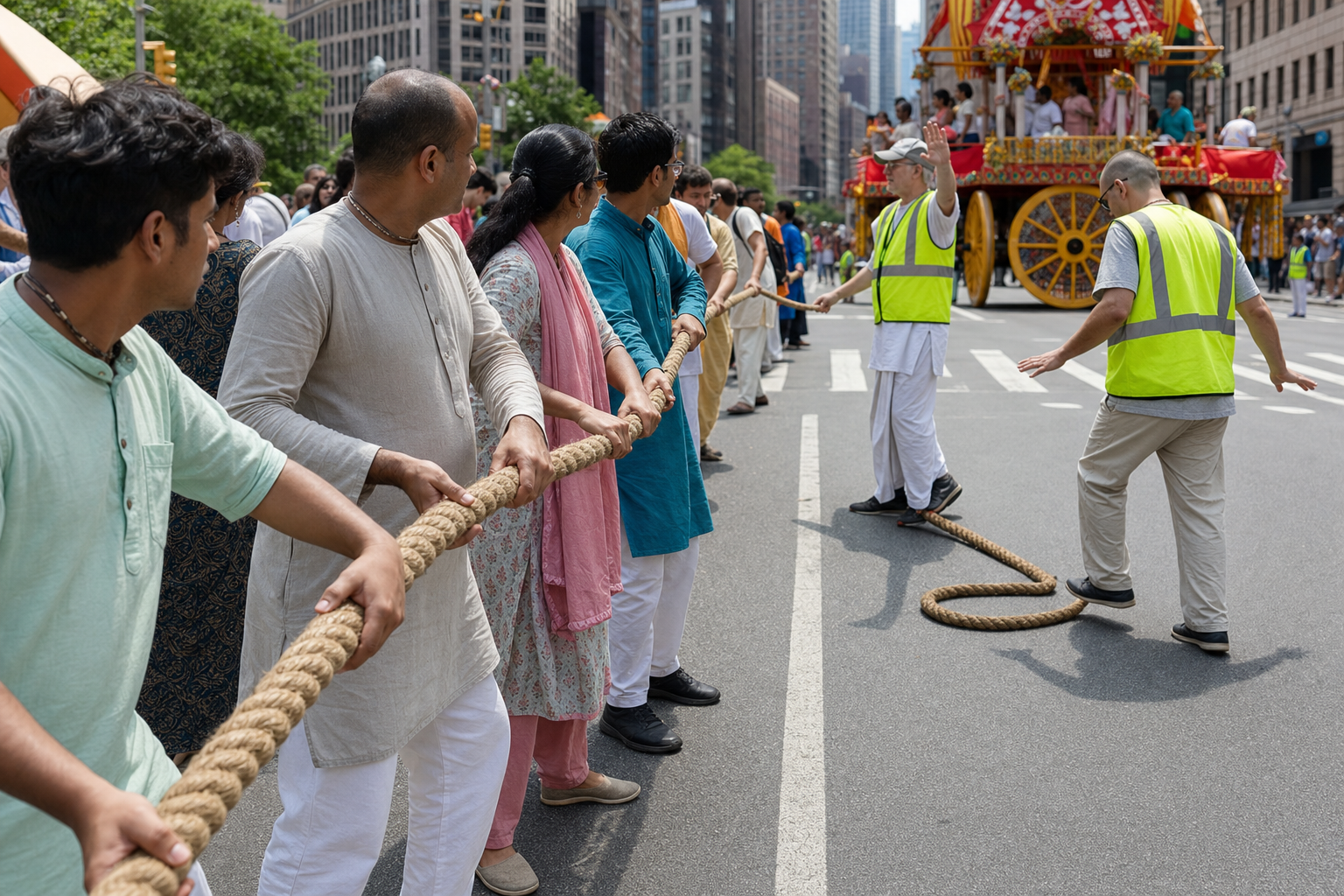
The strongest etiquette at Ratha Yatra is practical reverence. A chariot’s decorated superstructure can make its wheels, braking system and steering needs easy to overlook. New York’s operation may involve industrial-grade ropes, guide crews, redundant braking measures and wheel chocks. Marshals, buffer zones and temporary pauses are therefore part of the safe conduct of the yatra, not interruptions to devotion.
- Never cross a rope-side buffer, guide corridor or space directly around a chariot merely because another attendee has done so.
- Use the marshal’s instruction, not the chariot’s apparent stillness, as your signal that it is safe to approach or join.
- Keep situational awareness during kirtan. Immersion in chanting should deepen considerate conduct, not make you unaware of wheels, ropes or people changing direction.
- Give elders, children and persons with disabilities room before looking for your own preferred viewing angle.
- Seek consent before taking close-up photographs of participants. A public procession does not turn every individual act of prayer into unrestricted portrait material.
- Maintain respectful distance from the deities and the teams serving immediately around them. A crowded moment is not an invitation to press closer.
Urban discipline is not separate from dharma here. Traffic coordination preserves emergency access. Controlled cable routing and generator placement protect participants. Chariot crews maintain the physical conditions in which collective worship can proceed. When you follow their directions promptly, you are helping sustain the ritual rather than merely complying with event management.
The same principle applies to waste and transport. Reusable chariot parts and canopies, cloth banners, compostable serving items, separated waste streams, water-refill arrangements and lower-emission equipment can reduce the burden of a large festival. Use the labeled disposal stream in front of you, carry only what you need, and follow shared-transit guidance where practical. Cleanliness after the procession is one visible measure of whether celebration remained aligned with seva.
Key takeaways for your day
- Come for darshan, not only for the scale of the chariots: Jagannath, Balabhadra and Subhadra are the center of the procession.
- Look for the sequence of alankara, ceremonial sweeping, kirtan and coordinated rope pulling; each turns a public parade into devotional practice.
- Choose active rope participation, quieter viewing or destination programming according to your needs. None requires you to force your way closer.
- Follow marshals around ropes and chariots. Their directions respond to machinery, gradients, crowd flow and emergency access that may not be visible to you.
- Receive prasadam as sacred hospitality, take only what you will eat and leave the serving area clear for others.
- Recognize shared Dharmic values without erasing the festival’s specific roots in the Jagannath and bhakti traditions.
Before you set out, confirm the current operational details and choose one intention for the day: attentive darshan, wholehearted kirtan, disciplined seva or patient learning. Then let that intention govern how you move through the crowd. New York supplies the streets, but participants determine whether those streets become only a parade route or a path of devotion.
References
