
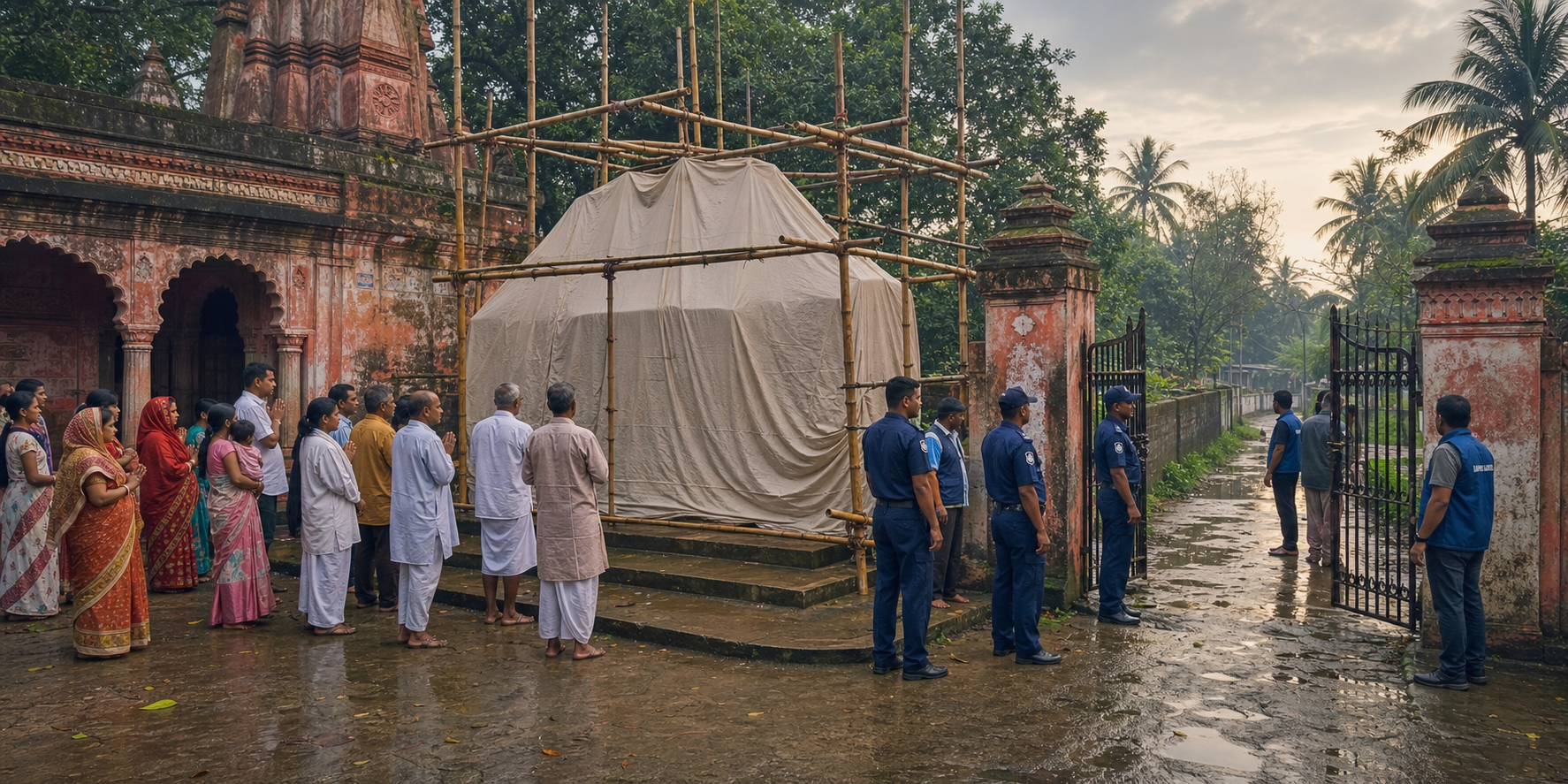
If you are responsible for a temple, worried about relatives in Bangladesh, or trying to help from abroad, the central question is practical: can Hindu worship continue without asking local devotees to gamble with their safety?
On 14 June 2026, construction of a Bhagwan Ram murti in Bangladesh was reported to have stopped after threats and a campaign against the project. Pausing may have prevented an immediate confrontation. It cannot be allowed to become the final outcome. The proper response is a protected, time-bound return to lawful worship, backed by evidence, police action, and community safeguards.
A safety pause must not become a permanent veto
A temple committee facing a credible threat has two duties that can pull in different directions. It must protect devotees from foreseeable harm, and it must resist the gradual normalization of intimidation. The first duty can justify a temporary pause. The second requires a written path to resumption.
This distinction matters because coercion often succeeds without an attack. If threatening a procession, murti installation, or festival repeatedly causes the religious activity to disappear, extremists learn that menace is enough. Families learn the opposite lesson: public expressions of Hindu identity carry costs that the State may not prevent. That is the chilling effect minority communities feel long after a particular confrontation has ended.
Bangladesh’s constitutional framework contains a tension, but not an excuse for official inaction. Article 41 protects freedom of religion subject to law, public order, and morality. Secularism remains a fundamental principle of the State, while Article 2A recognizes Islam as the state religion. Whatever political disagreement surrounds that arrangement, its operational meaning should be straightforward: a lawful Hindu observance does not lose protection because private actors threaten disorder.
Article 18 of the International Covenant on Civil and Political Rights reinforces that obligation. Religious freedom requires more than the State refraining from directly banning worship. Public authorities must also protect people from coercion by non-state actors. When intimidation is credible, telling the threatened community simply to remain quiet shifts the burden from the lawbreaker to the victim.
Official statistics place Hindus at roughly eight per cent of Bangladesh’s population. Minority status does not reduce a citizen’s rights; it increases the practical importance of equal protection. A community with less demographic and political weight is less able to absorb repeated closures, property damage, legal costs, and fear-driven migration.
You can judge an official response by four concrete questions:
- Was the Hindu activity itself lawful, or has any actual legal violation been identified?
- Did authorities assess the people making the threats, their intent, their reach, and their ability to mobilize violence?
- Were restrictions aimed at likely disruptors, or only at the devotees being threatened?
- Did the pause come with protective measures and a reviewable date for resumption, or was the community left in indefinite limbo?
If officials cannot answer those questions, the problem is not merely weak event management. It is a failure to turn formal religious freedom into an enforceable right.
When a threat arrives, build an evidence-and-protection file

If danger appears immediate, move people away from the exposed area, contact local police, and do not confront or attempt to identify suspected attackers yourself. A murti, structure, or delivery can be replaced; a life cannot. Once people are safe, the committee should create a disciplined record that supports both immediate protection and later accountability.
- Appoint one temple liaison. Police, administrators, lawyers, vendors, and volunteers should receive consistent information from a named person rather than several conflicting accounts.
- Preserve the original threat. Keep screenshots, account names, links, dates, times, surrounding messages, audio, video, and original files where available. Do not edit a file merely to make it easier to share.
- Separate fact from interpretation. Record the exact words or conduct, where they appeared, who directly witnessed them, and what was happening at the site. Label second-hand information as second-hand.
- Create a chronological incident log. Add every threat, suspicious visit, police contact, platform report, public rumor, delivery interruption, and protective step. Keep copies somewhere other than the temple premises.
- Notify police and the district administration in writing. Ask for acknowledgment, a complaint or reference number where applicable, a threat assessment, and a named official liaison. Oral assurances are useful in an emergency but difficult to verify later.
- Request interim safeguards tied to the actual risk. These may include visible patrols, protected access for workers and materials, separation of hostile groups from the site, and rapid police response if mobilization begins.
- Obtain local legal help. Bangladesh’s Penal Code, preventive-policing powers, rules concerning places of worship, and cyber-crime provisions may all be relevant, but the correct procedure and legal provision depend on the conduct and evidence. A qualified local lawyer or recognized legal-aid organization should decide how a formal complaint is framed.
Do not turn the evidence file into a publicity feed. Reposting a threat repeatedly may expand its audience, expose witnesses, reveal security arrangements, or accelerate the rumor it was meant to rebut. Share complete evidence with police, counsel, and trusted platform channels. Publish only what local organizers judge safe and necessary.
Authorities should then identify which conduct may amount to criminal intimidation, unlawful assembly, damage or threatened damage to a place of worship, or online instigation. The community’s task is to report accurately and preserve evidence. Determining criminal liability, making arrests, controlling hostile crowds, and enforcing court conditions are responsibilities of the State.
Set measurable conditions for a safe restart
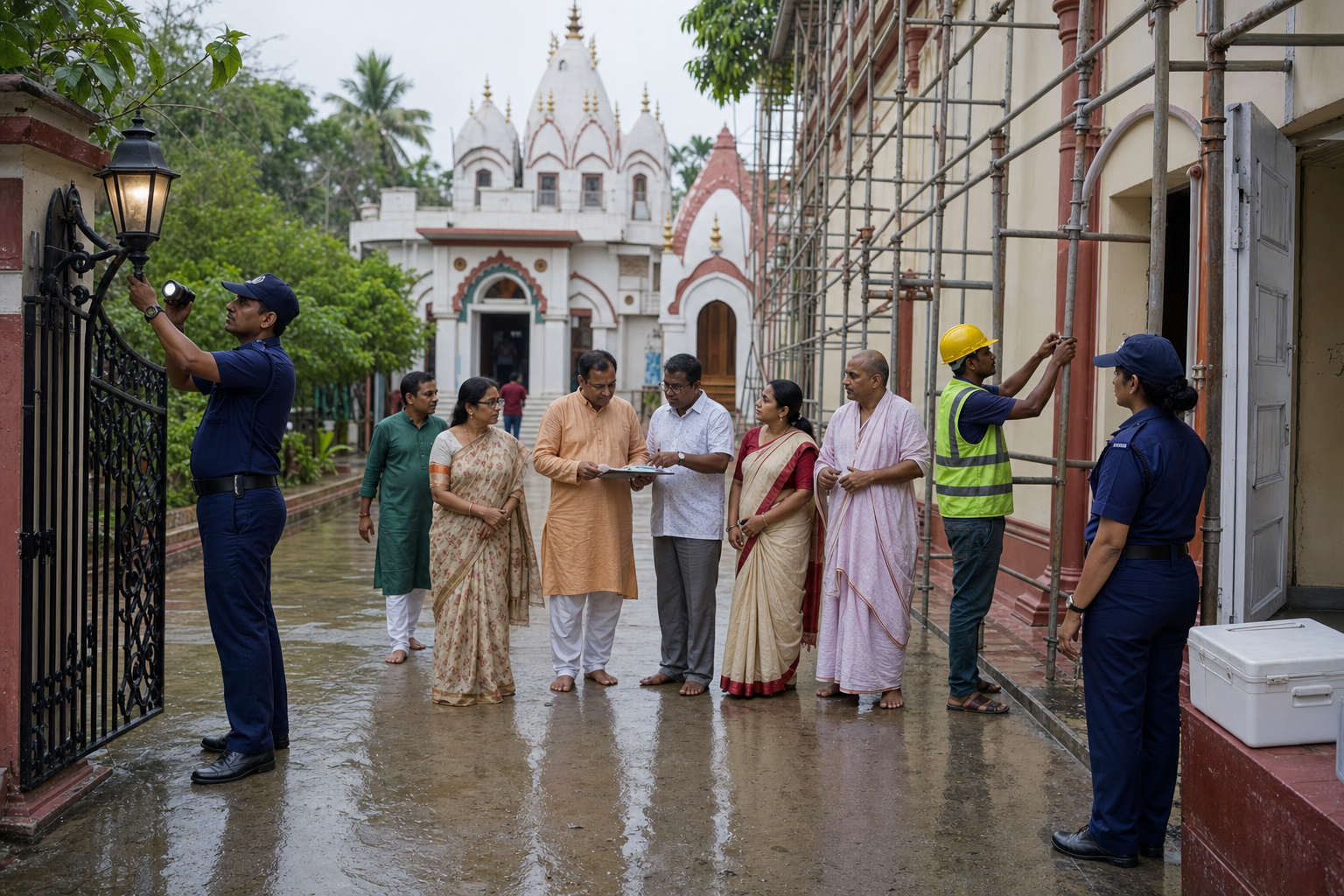
Neither a vague promise of protection nor a demand to proceed at any cost is an adequate plan. Organizers and authorities need a written restart framework with named owners, observable safeguards, and a review point. No single camera, patrol, or interfaith statement proves that a site is safe; the layers must work together.
| Condition | What should be in place | Primary owner |
|---|---|---|
| Threat assessment | A current assessment of the threat’s intent, organizers, reach, likely timing, and capacity for harm | Police and district administration |
| Law-enforcement response | A named liaison, patrol or deployment plan, escalation channel, and targeted measures against identified disruptors where legally justified | Police and courts |
| Site protection | Clear entrances and exits, adequate lighting, visible boundaries, controlled access, and CCTV with secure retention | Temple committee with police advice |
| Event operations | Ingress and egress routes, crowd management, first-aid readiness, vetted marshals, protected deliveries, and reliable communications | Temple committee and police |
| Public information | One verified account of what is happening, what safeguards exist, and how false or inflammatory claims will be corrected | Named official and community spokespeople |
| Accountability | Preserved evidence, documented complaints, lawful action against instigators, and a process for restitution if damage occurs | Police, prosecutors, courts, and insurers |
Where evidence supports intervention, authorities can consider targeted arrests, lawful prohibitory measures against would-be disruptors, bail conditions preventing proximity to the site, and court-supervised monitoring. These tools should focus on credible threats and unlawful conduct, not suppress ordinary disagreement or impose a blanket burden on peaceful worshippers.
What to check before work or worship resumes
- Police and temple liaisons have exchanged working contact details and tested the communication chain.
- Workers, vendors, priests, and volunteer marshals know where to report a concern without starting a public confrontation.
- Emergency access and exit routes remain clear, even when attendance or public attention increases.
- Volunteer marshals understand that their role is to guide, observe, and report. They should not pursue, detain, or confront suspected agitators.
- First-aid supplies and designated helpers are ready, with particular attention to children, older devotees, and anyone who may have difficulty leaving quickly.
- Screening measures are lawful, proportionate, and based on conduct rather than religious or communal profiling.
- CCTV footage and incident records are stored securely, with access limited to people who need it.
- Materials, contractors, and deliveries are documented so loss, damage, insurance claims, or restitution requests can be substantiated.
After the event or construction milestone, hold a short debrief with police, organizers, marshals, and first-aid personnel. Record what failed as carefully as what worked. A weak radio connection, blocked gate, missing camera angle, or delayed police response is a correctable vulnerability if it is documented before the next gathering.
Stop rumor from becoming organized intimidation
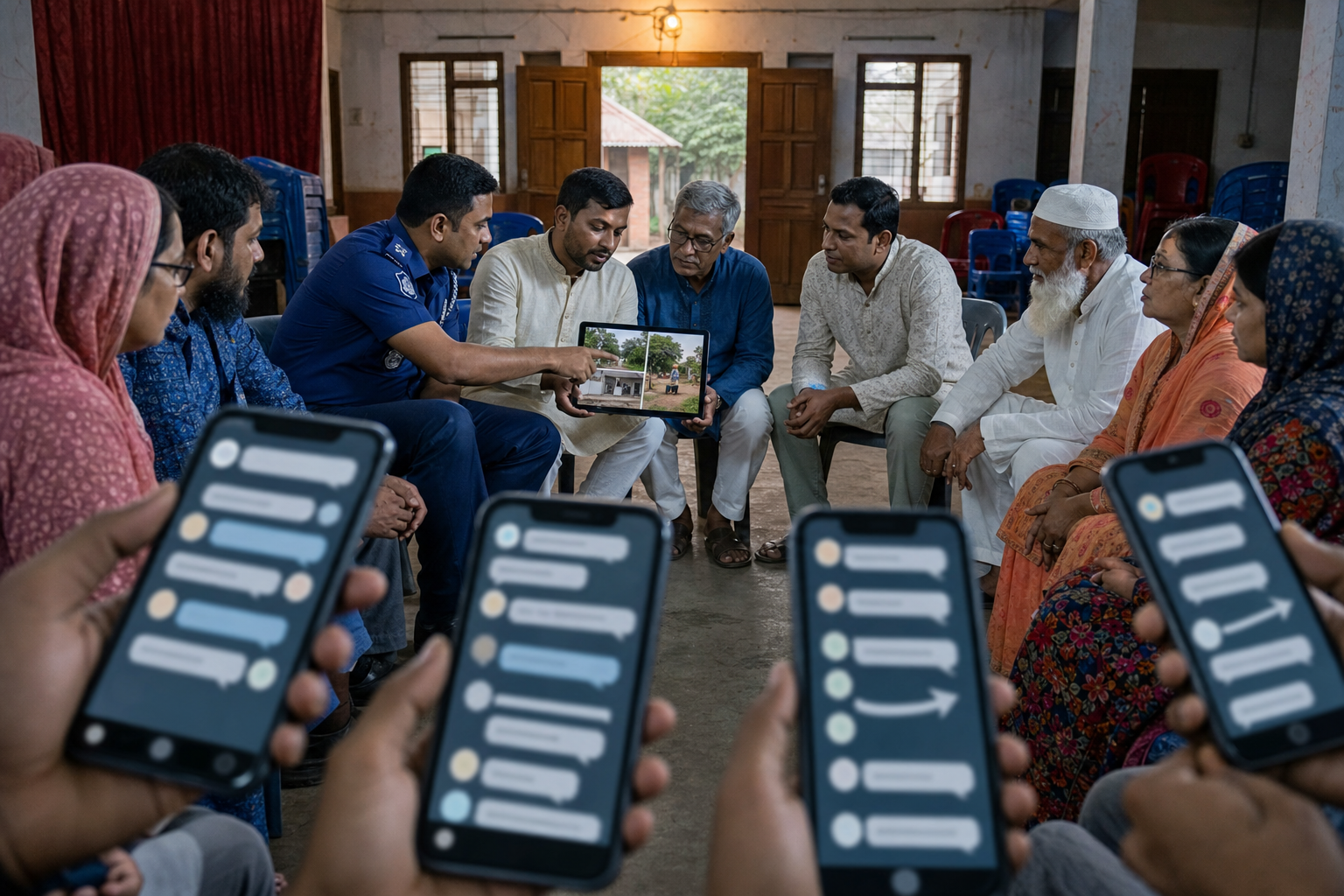
Religious flashpoints rarely begin with a complete and verified account. Rumor cascades, organized extremist mobilization, and local property or political disputes reframed as religious grievances can reinforce one another. A false claim supplies outrage, a small network converts outrage into movement, and an unrelated local dispute supplies people with an immediate target.
A temple committee does not need to decide whether every hostile statement is legally punishable. It does need to distinguish an unpleasant opinion from a credible mobilization signal. The Rabat Plan of Action provides a useful structure for authorities assessing possible incitement: context, the speaker’s status, intent, content and form, extent of dissemination, and likelihood of harm. Use those same headings when assembling an escalation file, while leaving the legal conclusion to competent authorities.
- Capture the claim before engaging with it. Preserve its wording, origin, audience, and any call for action.
- Verify privately. Ask the temple liaison, district administration, or another directly responsible body whether the underlying allegation is true.
- Assess movement, not merely emotion. Note whether the claim is being repeated rapidly, whether influential accounts are amplifying it, and whether it includes a place, time, target, or instruction.
- Route it to the right channel. Credible threats go to police and counsel; inflammatory platform content goes through the platform’s reporting process; ordinary errors may need a concise correction.
- Correct without multiplying the provocation. State the verified fact, provide the responsible contact, and avoid reproducing slurs, graphic material, witness identities, or operational security details.
Make interfaith solidarity operational
A joint photograph after violence is not a prevention system. A district-level interfaith rapid-response cell can be one if it has named contacts, agreed triggers, and direct access to administrators. Temple trustees, mosque mutawallis, Hindu, Buddhist, Jain, Sikh, and Muslim leaders, women’s groups, youth representatives, and local officials should meet before a sensitive installation or festival, not only after trouble begins.
Its minimum working arrangement should include a contact list, a method for verifying urgent claims, a process for issuing a joint correction, a police escalation channel, and an agreed rejection of threats against lawful worship. When respected Muslim leaders publicly defend a Hindu community’s right to worship, they deny extremists the claim that intimidation represents an entire religious population. Cross-Dharmic solidarity makes the same point from another direction: minority rights are a shared civic interest, not a concession granted to one group.
Help from abroad without increasing local exposure
If you are in the diaspora, let the people carrying the risk define what help is safe. Useful support can include local legal aid, trauma counseling, lighting and CCTV upgrades, secure record storage, insurance for material assets, cultural programming, and verified emergency assistance. Route funds through recognized local bodies with clear accounting.
Do not publish a threatened person’s name, phone number, travel plan, witness statement, or exact security weakness without informed consent. Do not convert an unverified local allegation into a global campaign simply because it fits a familiar pattern. Speed may bring attention, but an error can damage a complaint, feed hostile propaganda, and leave local Hindus facing the consequences after international attention moves elsewhere.
Key takeaways
- A temporary pause can protect life, but it must lead to a documented, time-bound plan for resuming lawful Hindu worship.
- The State should restrain credible intimidators and protect the threatened community; public-order concerns should not become a reward for coercion.
- Preserve original threats, maintain a chronological incident log, submit written complaints, and obtain local legal guidance before making legal claims publicly.
- Restart only with layered protection: police coordination, controlled access, clear exits, trained marshals, first aid, secure CCTV, and a communications plan.
- Counter dangerous rumors through verification, targeted escalation, and trusted interfaith contacts rather than uncontrolled reposting.
- Diaspora assistance should strengthen locally requested protection and accountability without exposing witnesses or dictating risks from a distance.
If you are supporting a threatened temple now, ask for one concrete deliverable: a written protection-and-restart plan naming the police liaison, current risks, interim safeguards, unresolved conditions, and next review date. That document will not remove danger by itself. It will show whether every responsible institution is moving toward the only acceptable result – Hindu worship restored under the rule of law, without fear becoming an unofficial veto.
References
